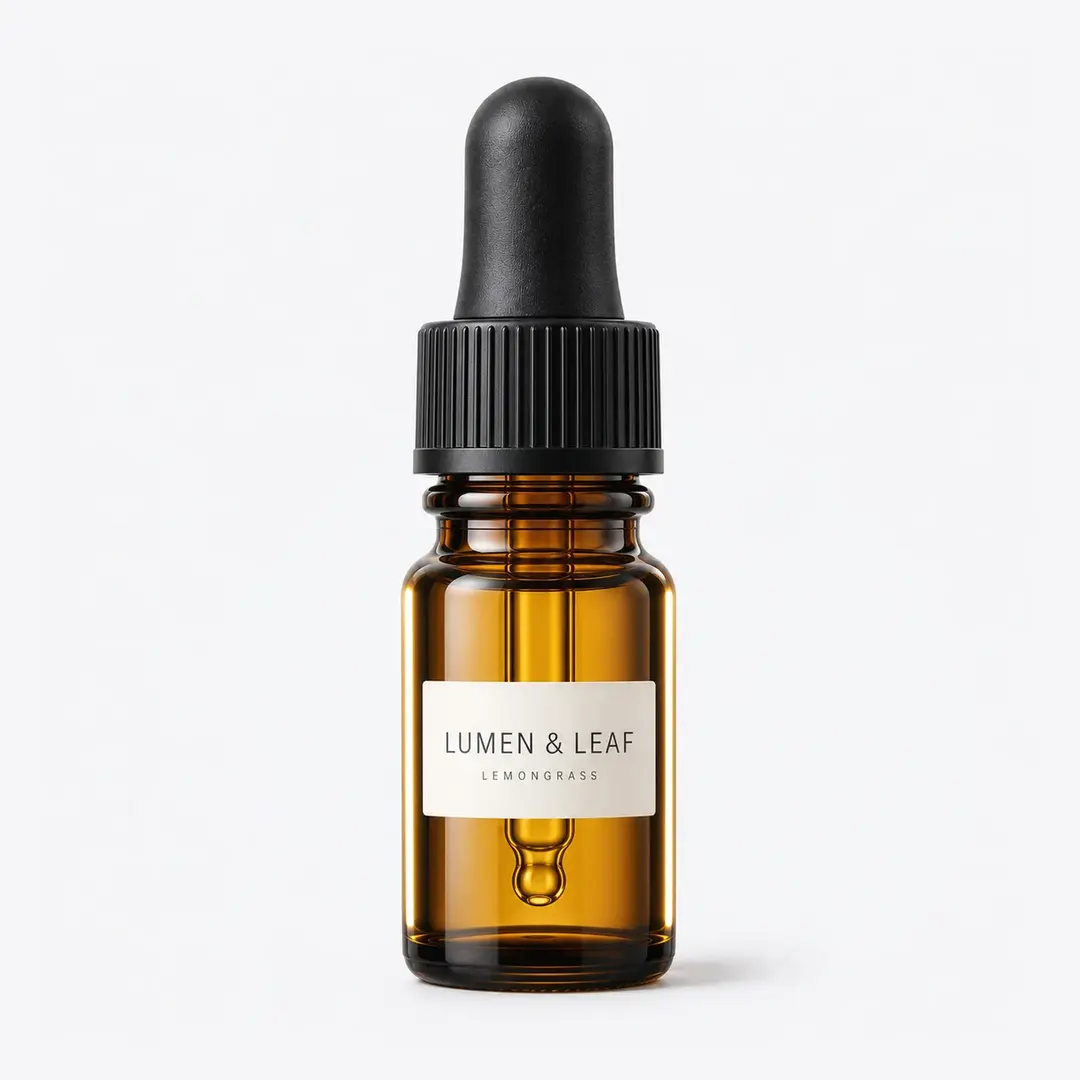
Essential Oil Glass Bottle Series 5560 is a small amber vial, photographed close-up with its screw-thread neck and fitment ring clearly defined, in the size class that dominates travel and on-the-go aromatherapy. If your brand sells roll-ons for airport kiosks, mini blends for hotel amenities, sample vials for subscription boxes, or any SKU a customer might drop into a carry-on bag, this page is for you. Travel formats succeed or fail on details that full-size bottles never face: cabin-baggage liquid rules, altitude pressure changes, jostling in handbags, and leakage that ruins a customer’s luggage and your reviews in one event. Here is how to specify this series for that reality.

Sizing for Carry-On and Travel Retail Rules
The commercial logic of travel sizes starts with regulation. Cabin baggage rules in most markets limit individual liquid containers to 100 ml, and the small vial class shown here sits far inside that limit, which is precisely why 5 ml and 10 ml formats dominate airport and travel retail shelves. But compliance is not only about the number on the label: border officers and security screeners read the container’s nominal capacity, so a bottle whose brimful volume is close to a threshold deserves a capacity declaration that matches the drawing, not a marketing rounding. We confirm nominal and brimful capacities on the technical drawing at quotation so your label claims are defensible in every market you ship to.
Why Leak-Proof Closures Matter More in Travel Formats
A full-size bottle lives upright on a shelf; a travel vial lives sideways at the bottom of a handbag, upside down in a gym kit, and at cabin altitude where pressure differentials push liquid against the seal. Every weakness in a closure that a shelf-bound bottle forgives, travel punishes. For this series we recommend lined screw caps with liners matched to your formula’s solvent load, or orifice reducers whose press-fit onto the molded neck ring adds a second sealing barrier inside the cap line. Dropper assemblies can travel well too, but their bulbs add a failure mode under sustained heat, so for pure travel SKUs a reducer-plus-cap system is the lower-risk specification. As always, validate with an inverted storage test before the production run.
Altitude, Pressure Changes, and Headspace
Cabin pressure at cruising altitude is equivalent to roughly 2,400 meters of elevation, and the pressure cycle on ascent and descent stresses every sealed container in the cabin. Glass itself is indifferent to this, but the air headspace inside the vial is not: it expands, and it will find the weakest path out, which is usually the cap liner. Two practical mitigations cost nothing at specification time. Keep headspace to the standard fill level on the drawing rather than under-filling, since less trapped air means less expansion force. And choose liners with good compression recovery so the seal re-seats after the pressure cycle rather than taking a permanent set. Your filler can confirm fill level tolerances against our drawing.
Sample Programs, Subscription Boxes, and Amenity Kits
The same size class that satisfies cabin rules also powers three fast-growing channels. Discovery sets convert browsers into buyers at high margin per milliliter; subscription boxes need a vial that survives parcel networks without bubble-wrapping each unit; and hotel amenity programs want a format that looks intentional on a bathroom tray. Amber glass serves all three because it reads as authentic apothecary packaging while protecting the oil from the light exposure that travel inevitably brings, whether in a clear cosmetic pouch or on a sunlit windowsill. The Series 5560 vial’s heavy base keeps it upright on amenity trays, a small detail that hotel buyers notice.
Glass Versus Plastic for Travel SKUs
Buyers sometimes assume plastic is the default for travel because of breakage risk. In practice, small glass vials in this size class are remarkably robust: wall thickness relative to span is high, and in partitioned cartons they survive parcel networks routinely. What glass adds is inertness against aggressive oils, a premium feel that justifies travel-retail pricing, and no risk of the formula picking up a plastic taste in a hot car. For neat essential oils and concentrated blends, glass remains the professional choice at any size.
Labeling and Claims on Tiny Travel Bottles
Small vials leave little room for text, yet travel SKUs often carry the most regulated claims: capacity declarations, ingredient lists, and usage warnings all compete for a few square centimeters. Plan a two-panel label or a wrap with a peel-back leaflet early, and keep the nominal capacity prominent and consistent with the drawing. Brands selling the same oil in multiple sizes should keep the declared capacity format identical across the range, which simplifies both compliance review and customs paperwork when cartons cross borders.
Quality Control and Standards
Production lots of Series 5560 are verified against international glass container methods: thermal shock resistance per ASTM C149, internal pressure strength per ISO 7458, and vertical load resistance per ISO 8113. Annealing is checked under polarized light, neck finishes are gauged to drawing tolerances so closures seal consistently, and amber tint is matched to master color plates. Packaging documentation supports Regulation (EC) No 1223/2009 for cosmetic products sold in the EU, and lot test reports are available on request.
Ordering Travel Formats From the Factory
Small vials carry higher unit-count minimums than larger bottles because they mold and pack densely; our glass bottle MOQ explained guide shows how MOQ scales across a size range so you can plan sample, travel, and full-size orders together. Export orders ship in partitioned cartons, palletized and shrink-wrapped as shown above, with closures packed separately on request. If you are new to sourcing from China, our guide to importing glass bottles from China walks through sampling, lead times, and freight planning step by step. To specify Series 5560 for a travel or sample program, send your target capacity, closure preference, and annual volume through the contact page and we will return drawings and a quotation.
Frequently Asked Questions
Is this vial size allowed in carry-on luggage?
Yes. The small vial class of Series 5560 sits far inside the 100 ml per-container cabin baggage limit used in most markets, which is why 5 ml and 10 ml formats dominate travel retail. Make sure your label’s nominal capacity matches the technical drawing, since screeners read the declared capacity, and we confirm both nominal and brimful volumes at quotation.
How do I stop travel vials from leaking in customers’ bags?
Specify a lined screw cap with a liner matched to your formula, or an orifice reducer whose press-fit onto the molded neck ring adds a second sealing barrier. Reducer-plus-cap systems avoid the bulb failure mode that droppers can suffer under heat. Always validate with an inverted storage test before the production run.
Does cabin altitude affect sealed essential oil vials?
The pressure cycle at cruising altitude expands the air headspace and pushes against the cap seal. Two free mitigations help: fill to the standard level on the drawing rather than under-filling, and choose liners with good compression recovery so the seal re-seats after the cycle. Glass itself is unaffected.
Glass or plastic for travel sizes, which is better?
Small glass vials are more robust than their reputation: high wall-to-span thickness and partitioned cartons carry them through parcel networks routinely. Glass adds chemical inertness against aggressive oils, a premium feel that supports travel-retail pricing, and no plastic taste pickup in hot conditions. For neat essential oils it remains the professional choice.
Can this series serve sample and subscription programs too?
Yes, the same size class powers discovery sets, subscription boxes, and hotel amenity kits. Amber glass reads as authentic apothecary packaging while protecting oils from light exposure in clear pouches, and the heavy base keeps vials upright on amenity trays. We can quote sample, travel, and full-size formats together.
What quality testing and MOQ apply?
Lots are tested per ASTM C149 (thermal shock), ISO 7458 (internal pressure), and ISO 8113 (vertical load), with annealing checks, neck gauging to drawing, and tint matching to master plates; documentation supports EU Regulation (EC) No 1223/2009. Small vials carry higher unit-count MOQs because they mold and pack densely; our MOQ guide on the site explains the structure.


