Glass tea bottles cluster in a few capacity bands: 250 to 350 ml for a single serve, 500 ml for a longer or shared drink, 200 to 330 ml for cold brew and sparkling tea, and 500 ml to 1 litre for concentrates that are diluted before serving. Which band suits your product is decided less by flavour than by how the tea is sterilized, because hot fill, aseptic filling, cold fill and carbonation each ask something different of the glass and the closure. Settle the route and the serving occasion first, and colour, neck finish and cap follow from them.
Capacity bands by tea type and sterilization route
The table is organised by product and process, not by millilitres, since the process rules capacities in or out before anything else does. Treat each band as an opening position. The final figure moves with your fill point, the label and the neck finish your filler accepts, and we confirm any recommendation against a drawing and a physical sample before an order goes ahead.
| Product and route | Capacity band | Glass colour | Closure | Typical channel | Effect on the specification |
|---|---|---|---|---|---|
| Clear ready-to-drink tea, hot fill | 250 to 350 ml single serve; 500 ml as the longer drink | Usually clear; amber or green for bright shelves or a long shelf life | Crown on the small sizes; aluminium roll-on or screw cap at 500 ml | Convenience, impulse, vending | Must tolerate thermal shock; cap has to cope with vacuum after cooling |
| Clear tea, ultra-high-temperature treated, aseptic fill | 250 to 500 ml, mostly at the lower end | Clear works; a tint still shields the liquor | Aluminium roll-on or lined screw cap held to close dimensions | Convenience retail, long ambient supply chains | Dimensional consistency for sterile filling and capping; no thermal shock load |
| Cold brew, cold fill, chilled distribution | 200 to 330 ml; small because it is sipped slowly | Amber or dark green; protection outranks clarity | Liner-sealed screw cap picked for repeated sealing when cold | Specialty shops, cafes, premium online packs | Low-temperature sealing; labels that stay on under condensation |
| Sparkling tea, carbonated | 250 to 330 ml, small to limit pressure per unit area | Any; a wide mouth increases seal demand whatever the colour | Pressure-rated crown or crown-style cap built for the internal pressure | Convenience, hospitality, variety packs | Pressure rating, heavier shoulder, validated capping specification |
| Milk tea or tea latte, retort or ultra-high-temperature | 250 to 350 ml single serve; bigger formats for foodservice | Opaque or strongly tinted; tea with dairy is the most light-sensitive mix | Roll-on for retail single serve; wide-mouth screw or lug for foodservice | Convenience, foodservice, catering | Inner wall that cleans easily; cap tolerant of heavier residue |
| Concentrated tea base, pasteurized | 500 ml to 1 litre, set by a measured dilution ratio | Amber or dark; dilution concentrates the effect of light on colour | Screw cap with induction seal or tamper-evident band | Foodservice, catering, online refill packs | Neck that pours cleanly, seal that survives decanting, label space for dilution instructions |
How each route loads the glass and the closure
The route sets how much heat a filled bottle must survive, whether the contents remain under pressure once capped, and whether the product spends its life chilled. Those answers determine whether clear glass is acceptable, whether walls need to be thicker and which cap can be trusted. Shape only becomes a free choice afterwards.
Hot fill
The tea is kept at pasteurising temperature and filled warm, and the heat of the liquid, helped by a hold or an inversion step, sanitises the container and the headspace. The glass is shocked once when it is filled and again when it is cooled. As the headspace contracts a vacuum develops, so the closure has to be one that tolerates it.
Ultra-high-temperature processing with aseptic filling
Here the product is sterilised before it reaches the bottle and goes cold into a container that has already been sterilised. Heat is hardly an issue for the glass. What the process needs instead is bottles that are dimensionally alike across a whole run, because a sterile filling head and its capping geometry leak or misalign when the finish varies. Hot fill and aseptic lines can run similar shapes, but the specifications behind those shapes differ.
Cold fill into a chilled chain
Cold filling swaps the thermal problem for a shelf-life and cold-chain problem. The specification therefore tightens around closure sealing, not around heavier glass.
Carbonation
Carbonation is not a sterilization route, which is why it gets forgotten. A sparkling tea is a pressure question first, and its internal pressure can sit an order of magnitude above what any still tea produces. Glass copes well with pressure; the neck finish and the cap carry the strain. Capacity also starts to interact with headspace and fill height, something a still product never has to consider.
Serving occasion, light and seal pressure
Leave the route aside and tea sizing still has three separate parts. Trying to settle all of them with one capacity figure is the usual mistake.
Serving occasion is what creates bands instead of an endless scale of volumes. A bottle finished in one go from a convenience shelf does a different job from one shared over two or three glasses, and both differ from a concentrate that a foodservice operator dilutes. The occasion defines the band, and the brand's place within it tends to come from price architecture and shelf presence.
Channel sharpens that choice. Convenience and impulse retail prefer roughly 250 to 350 ml because the drink is bought and finished quickly. Foodservice and catering count in servings, not bottles, so they move towards large formats and concentrates. Online sales are governed by parcel economics: several small bottles in a pack often travel better than one big one, and the weight of the glass enters the shipping calculation.
Light matters more for tea than buyers used to clear soft drinks expect, and it is covered in the next section.
Seal pressure varies widely between still, hot-filled, cold-filled and carbonated tea, and it scales with the diameter of the opening as well as with the pressure. A wide mouth spreads the load along a longer seal circumference yet leaves a larger unsupported panel. For that reason capacity and neck finish are normally decided together, not one after the other.
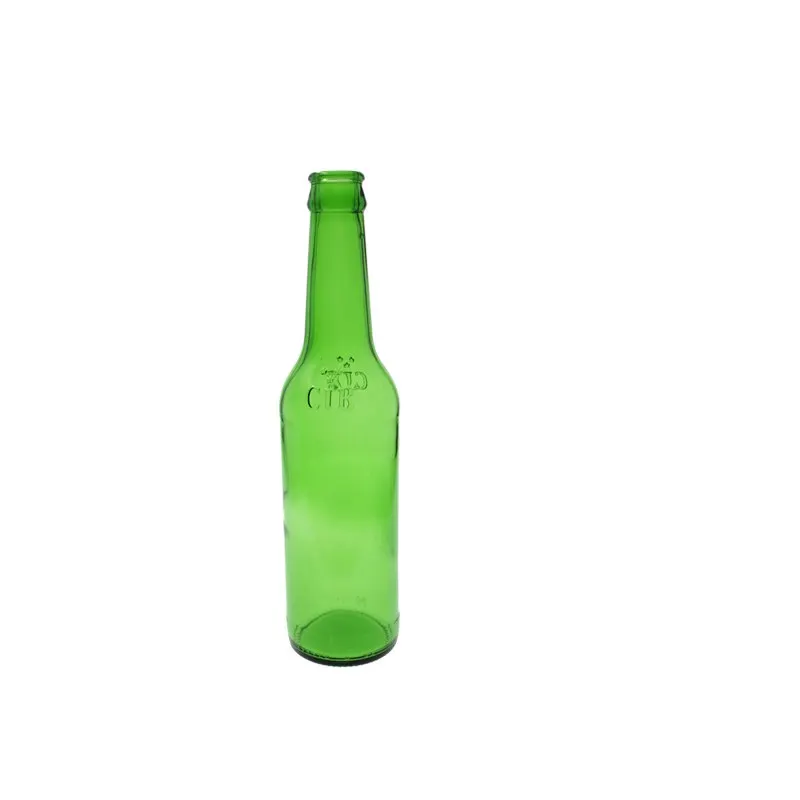
Clear, tinted or coated glass
On a serious tea project colour is chosen ahead of shape, for three reasons.
- Colour shift. The compounds behind the amber and green tones of brewed tea oxidise in light, and ultraviolet does it faster than visible light. A shop window and a fluorescent shelf of equal brightness are therefore not the same exposure.
- Haze and sediment. Polyphenols in tea bind to one another and to proteins as time passes. If light alters the liquor, a product already inclined to cloud looks worse behind clear glass.
- Perception. Nothing chemical is involved here. A clear bottle shows the true colour, so shoppers take any drift in shade as lost freshness even when the taste is unchanged.
Clear glass shows off a bright, freshly brewed liquor and exposes one that may change tone before it sells. Amber and green cut out much of the harmful spectrum and conceal slight sediment, but the display is gone. A clear bottle with a spray coating or a sleeve is the compromise: light is blocked where the decoration sits, and the uncovered shoulder and base still reveal the tea without tinting the glass. Shelf life, shelf lighting and how far the brand depends on visible colour decide between them, and the decision belongs in the specification, before a mould is cut.
Sediment is a formulation matter before it is a packaging one, yet the bottle affects how noticeable it is. A smooth inner wall and well-controlled annealing leave particles fewer places to hold on. Tinting or decoration softens the look of any deposit, and a little extra headspace keeps the fill line clear of the shoulder, where optical distortion is at its worst.
What to decide before requesting a size recommendation
None of the points below needs a finished design. Each needs a decision, and a supplier can only suggest a sensible size once they are known.
- Tea type and solids. Clear brewed tea, cold brew, milk tea, fruit-infused or sparkling, and whether pulp or dairy is present. Solids alter the usable fill height and how sediment behaves.
- Route and fill temperature. Hot fill, ultra-high-temperature with aseptic filling, cold fill with chilled distribution, or tunnel pasteurization after filling. No other answer shapes the bottle as much.
- Capacity and fill point. Nominal capacity is measured to a defined brim-full point, and the volume available under the closure is less. Give the amount the customer should actually drink as well as the nominal figure of the mould.
- Carbonation. Still or sparkling and, if sparkling, the pressure range at the highest temperature your supply chain can reach.
- Colour and light exposure. Clear, amber, green, or a coated or sleeved finish, together with how long the bottle is likely to wait on shelf.
- Closure and filler interface. Crown, aluminium roll-on, or a plastic or aluminium screw cap; the neck finish your line already runs; the capping equipment you have. Cap and finish diameter form one interface and cannot be altered separately later on.
- Channel. Impulse retail, foodservice or online with parcel delivery. This also affects how strong the outer pack must be.
- Volumes and destination market. Annual and per-order quantities do not alter the size. They decide whether a stock shape will do or a private mould is justified.
Where something is undecided, give a range and say what you assumed. A handful of candidate capacities with the route still open is far more workable than nothing, since it narrows down which moulds deserve a quotation. It is common for the route to be fixed after sizing talks have started, and we point out which of our recommendations would shift if it changed.
If a filling line exists, tell us its neck finish and any capping limit so the proposal fits equipment you can actually run. At concept stage, the channel and intended shelf life are enough for us to show the bands the category uses. Commercial terms depend on the shape, the quantity and the destination, so they are confirmed per enquiry once the specification is settled.
Related questions that are answered on other pages
Tea sizing is often mixed up with a few adjacent topics.
- Existing iced tea formats. If your product is already a packaged iced tea and you want to know which shapes and formats the category has settled on, see the guide to iced tea bottle formats.
- Tea within a wider drinks range. When juices, waters or functional drinks share the range, the comparison across categories is on the page about beverage bottle sizes.
- Coffee. Coffee uses the same glass family, closures and much of the channel logic, but cold brew and ready-to-drink coffee are frequently packed under nitrogen or carbonation, which makes pressure a primary requirement. Its oils and solids also change sediment behaviour and shelf appearance. Size a tea line and a coffee line separately; a shared shape is something to optimise afterwards.
- Supply volume. Whether a plant can deliver a chosen 330 ml bottle in the yearly quantity and seasonal pattern you plan is a question of plant capability: furnace output, forming machine hours, decoration and assembly throughput, and what remains available after other customers and colour-change losses. A correct size can still be undeliverable at the volume needed.
- Packing and bulk supply. Bottles per pallet, container loading by format and the structure of bulk programmes are explained under glass containers in bulk.
- The glass itself. If the material has not been chosen, start from the glass bottle collections, which gather the considerations shared by tea, juice and dairy formats.
Frequently asked questions about tea bottle sizes
Which glass tea bottle sizes are used most?
Single-serve ready-to-drink tea is sold mainly at about 250 ml, 300 ml and 500 ml. The two smaller sizes lead in convenience and impulse retail. The 500 ml bottle is for a longer drink or for sharing, and it is common wherever price per litre is watched.
Does the kind of tea alter the size I should pick?
It shifts the workable range more than the nominal number. Clear brewed tea can be filled near the shoulder and looks good in clear glass. Milk tea usually gets a wider mouth and more opaque glass. Sparkling tea stays in a small bottle to limit pressure on the seal, and a concentrate is sized by its dilution ratio instead of a drinking occasion. The band moves because the constraint is different, not because the flavour is.
Which closure belongs on a tea bottle?
Route and pressure decide, not capacity. A small, still, hot-filled tea in the classic shape often carries a crown. A larger still bottle, or one meant to be resealed, generally takes an aluminium roll-on or a lined screw cap. Carbonated or nitrogen-charged tea requires a pressure-rated closure with a validated capping specification, because the seal is what keeps the gas in.
What should an enquiry include?
Six items let us reply with a size recommendation and a drawing reference instead of more questions: tea type and formulation, sterilization route, target capacity with its fill-point assumption, closure preference and filler interface, channel and expected time on shelf, and volumes with destination. We return a capacity band, the colour options that suit the route and shelf exposure, and the closure families compatible with both.