For ready-to-drink iced tea, start the bottle specification from the filling process: most tea in glass is hot-filled at 85 to 92°C, so the bottle needs proven thermal shock resistance, enough weight for the capacity and a finish matched to the co-packer's capper. The usual sizes are 250 ml, 330 ml and 500 ml, and for most 330 ml bottles a weight of 230 to 260 grams balances thermal stability against freight. Closure, glass colour and pallet plan follow from those first choices.
What to tell us about the filling process
Three figures shape the bottle more than anything else: fill temperature, pasteurization method and target shelf life, whether that is 6 or 18 months. With those, plus the co-packer's tunnel length and belt speed, the glass weight and finish can be specified around the product instead of the product being adapted to a stock container.
Hot-fill
On a typical line the tea is pasteurized, filled at 85 to 92°C and capped straight away. The bottle is then tilted or inverted so the hot liquid sterilizes the cap liner, and it passes through a cooling tunnel where spray water brings it below 35°C over 20 to 30 minutes.
That swing stresses the glass. The industry standard for hot-fill containers is resistance to a temperature differential of at least 35°C; the mould series we put forward for tea are tested to a 42°C differential. Performance comes from even wall thickness, careful annealing in the lehr and a shape without sharp transitions at shoulder and heel. A thin spot at the neck ring is enough to crack a bottle in the filling hall, however good the sketch looked.
The test itself is simple to ask for: bottles are immersed in a hot water bath and moved to cold water, and the margin is recorded. If your process fills above 92°C or cools unusually fast, say so at the inquiry stage so the weight can be set and the margin confirmed with extra testing.
Vacuum after cooling
As the tea cools in the sealed bottle it contracts, and headspace pressure falls to a partial vacuum of roughly 0.3 to 0.5 bar. This is useful, because it holds the cap's safety button down as a tamper indicator. It also loads the shoulder inward, so a new mould should come with a vacuum-resistance calculation and a check on cooled, filled samples for panel deflection. A bottle that passes will not implode or panel at the end of the tunnel.
Cold-fill, aseptic and HPP
Premium cold-brew and refrigerated teas are increasingly filled aseptically or treated by high-pressure processing. With no thermal shock, lighter bottles become possible. The demand shifts to the seal, which has to be hermetic without heat helping the liner flow, so we look for tighter finish tolerances and settle with the filler whether a plastisol-lined crown or a lug cap with a safety button suits their equipment.
Capacities, weights and dimensions
| Capacity | Typical weight | Height | Body diameter | Finish options | Common closure |
|---|---|---|---|---|---|
| 250 ml | 170-200 g | 195 mm | 60 mm | 28 mm crown, 38 mm twist | Crown cap or ROPP |
| 330 ml | 230-260 g | 225 mm | 66 mm | 26 mm crown, 38 mm twist | Crown cap or ROPP |
| 500 ml | 320-380 g | 265 mm | 74 mm | 38 mm twist, 48 mm lug | Twist-off lug or ROPP |
| 750 ml | 480-550 g | 300 mm | 84 mm | 48 mm lug | Twist-off lug |
Each of the three main sizes belongs to a different occasion. The 250 ml bottle is a single serve for cafes, airlines and grab-and-go coolers. The 330 ml is the global volume leader and the default for supermarket multi-packs and foodservice. The 500 ml serves the value and sharing segment, and is common in convenience stores and in Asian markets where a larger single bottle is normal.
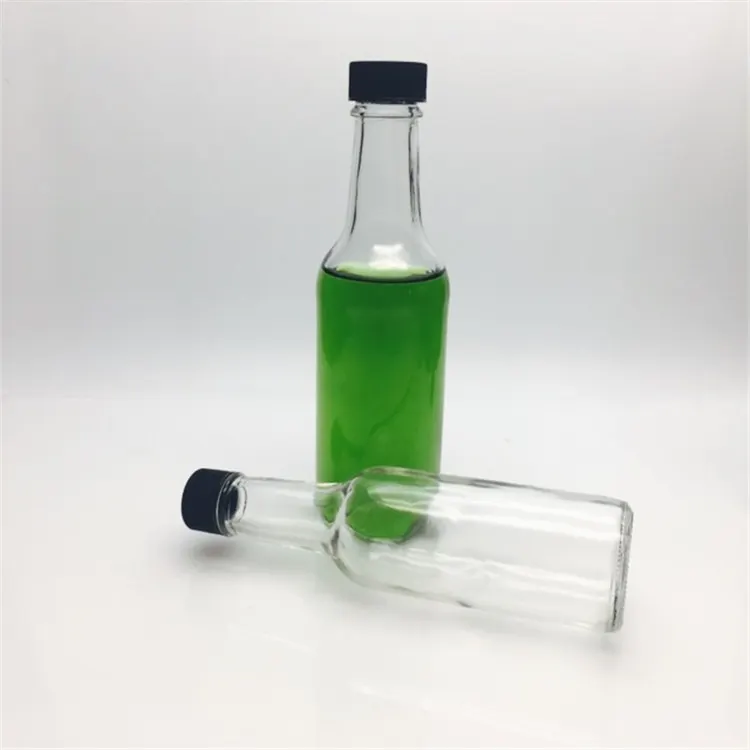
Channel should guide the choice. Vending machines and convenience coolers have slots standardized long ago around cans and small bottles, which favours 250 ml and 330 ml. Supermarket buyers increasingly ask for 500 ml because the larger face has more shelf presence and supports multi-serve positioning. Brands that sell through several channels often launch two sizes together, which is simpler than adding a second later.
Weight and cooling
A 250 ml bottle at 170 grams and a 500 ml bottle at 320 grams behave differently in the same tunnel. Heavier glass spreads heat more evenly but cools more slowly, and that affects tunnel design and the filler's energy use. This is why the weight is worked back from the co-packer's line data.
Headspace and label panel
A 330 ml bottle with a brimful capacity of 345 ml leaves just enough headspace for expansion during hot-filling. A 500 ml bottle needs proportionally more, or it will panel as the tea contracts. Ask for a fill-point drawing so the co-packer can set the filler nozzles without trial and error.
Check the label panel on the same drawing. A strongly curved body can leave only 60 mm of usable label height. A generous, slightly recessed panel takes paper and BOPP labels on standard labelling equipment.
Closures and neck finishes
| Closure | Sizes | Strength | What to check |
|---|---|---|---|
| Crown cap | 26 mm and 28 mm | Runs very fast on standard beer-line cappers; a clear freshness signal on opening | A reinforced neck ring that takes the crimping force of cappers at 400 bottles per minute |
| ROPP aluminium | 28 mm and 38 mm | Reseals, which suits larger bottles and tea sipped over an afternoon | Thread dimensions held to plus or minus 0.2 mm so the capping heads form threads without damaging the liner |
| Wide-mouth twist-off | 38 mm or 48 mm | A juice-like drinking experience; suits pulp or chia seeds | Thicker finish glass and thermal testing, since the larger opening cools unevenly |
Crown caps remain the workhorse of RTD tea. For 500 ml we generally suggest a 38 mm twist-off finish, with either an ROPP cap or a lug cap with a safety button: the wider opening drinks better at that serving size, and consumers expect to reseal it. A crown is still reasonable at 500 ml if the co-packer runs a crown line and the product moves quickly.
A wide-mouth bottle should pass the same 42°C thermal shock test as a narrow neck. Tea and juice often share 38 mm twist-off finishes and capping equipment, so the options for glass juice bottles in bulk are a useful comparison.
All three families come in tamper-evident versions: crown caps with ring pulls, ROPP caps with breakaway bands, and lug caps whose vacuum button pops up when the seal breaks. The button suits hot-filled tea especially well, because the cooling vacuum sets it with no extra component. For the European Union, specify closures that meet local tamper-evidence expectations, and have the chosen cap test-fitted on the bottle before mould sign-off or production.
Flint or amber glass
Tea is photosensitive. Ultraviolet light speeds the breakdown of catechins and can turn a bright green tea brown within weeks under fluorescent retail lighting.
| Colour | Light protection | Suits | Trade-off |
|---|---|---|---|
| Amber | Blocks roughly 90 percent of UV light below 450 nm | Lightly processed green and white teas; products claiming high antioxidant content | Hides the liquid, a loss for hibiscus or butterfly pea flower teas |
| Flint | Needs help from the label | Cold-brew lines where the golden or amber liquid is part of the appeal | Use UV-filtering labels or full-body shrink sleeves, leaving a window |
Dark black teas lose little by going into amber. Antique green and dead-leaf green give a heritage apothecary look, as specialty runs quoted case by case. For photography, amber is consistent under any lighting while flint needs more care, so marketing teams tend to use flint for hero shots and amber for line extensions.
Colour also bears on recycling claims. Glass of any colour is infinitely recyclable, but flint has the highest value in recycling streams because it can be remelted into any colour; amber and green are sorted into separate cullet grades. Furnaces run with cullet ratios between 40 and 60 percent depending on colour, which cuts energy per bottle by roughly 15 percent against virgin-batch melting.
Why tea brands choose glass over PET
Tea polyphenols degrade quickly in contact with oxygen, and PET lets a measurable amount in over a 9 to 12 month shelf life. Glass is a complete barrier, with no oxygen transmission, flavour scalping or migration. In co-packer shelf-life trials, the glass-packed sample almost always holds colour, aroma and pH better than plastic after 180 days, which matters when bottles may spend weeks in a warm warehouse.
The second reason is positioning. Shoppers link glass with natural ingredients and honest labelling, which supports a brand built on "brewed" or "organic". Hotel minibars, airline catering, gourmet grocers and cafe chains default to glass for their drinks programmes.
Top load, packing and export documents
Top-load strength decides whether pallets can be stacked. A standard 330 ml tea bottle should withstand a vertical load of at least 180 kg before deformation, which supports double-stacked pallets in an ocean container. A 40-foot high-cube container holds approximately 60,000 to 75,000 pcs of the 330 ml size, depending on packaging configuration.
- Packing: export cartons with dividers, or bulk on pallets with layer pads. For long inland trucking legs, such as the US Midwest or central Europe, dividers reduce scuffing.
- Pallets: shrink-wrapped, corner-boarded and strapped, with a loading plan and gross weights issued before booking so the forwarder can check container limits.
- Paperwork: commercial invoice, packing list, bill of lading, certificate of origin, and a fumigation certificate for wooden pallets where the destination requires one.
- Food contact: glass meeting FDA and EU 10/2011 requirements, with migration test reports from accredited laboratories on request.
- Customs: HS codes verified against the destination's tariff schedule before the container closes.
Glass is heavy. At 250 grams per 330 ml bottle, a full container carries roughly 18 metric tons of packaging. Taking a bottle from 260 grams to 230 grams saves about 2 tons per container, but only counts if the lighter bottle is re-validated for thermal shock, internal pressure to 6 bar, vertical load, and impact on heel and shoulder. Ask for those test reports.
Buyers consolidating several drinks lines can plan mixed containers, since these bottles share pallet footprints with glass milk bottles and the common juice bottle sizes.
One bottle family for tea, juice and kombucha
A 330 ml bottle with a 38 mm twist finish can hold iced tea now and cold-pressed juice or a functional sparkling water later, from the same moulds. It works when the silhouette is neutral, with a straight or gently tapered body and enough flat panel for any category's label. The co-packer changes nothing, because fill height, capper chuck and labeller settings stay the same.
The gain is speed as much as cost. A second product in the same bottle needs no new moulds, line trials or pallet patterns, only a label design. If your plan includes juice, kombucha, functional water or cold coffee, choose the mould family with the widest future use over a quirkier tea-only shape. The same thinking extends to craft programmes built around a glass growler.
Custom moulds and decoration
Stock moulds cover most projects. For a proprietary shape, resin models are made for physical evaluation after the design is approved, and production moulds are cut once you sign off.
- Embossing and debossing are built into the mould, so the logo is permanent and survives recycling streams that strip paper labels.
- Screen printing puts graphics directly on the glass and needs no new mould; decals do the same for stock bottles.
- Acid etching gives a frosted finish.
- Colour spraying produces gradient effects.
We coordinate third-party inspection where your quality protocol calls for SGS or BV, along with the export documents listed above.
Frequently asked questions
What is the minimum order quantity for iced tea bottles?
It is quoted per project and depends on the mould and the line it runs on, as well as decoration.
Can the bottles be hot-filled at 90°C?
Yes. That sits inside the 85 to 92°C range these bottles are specified for.
How long do production and shipping take?
Timing is confirmed per project, once mould, decoration and line schedule are known.
Can a logo be embossed on the bottle?
Yes, on a custom mould. On stock bottles, screen printing or decals add branding without new tooling.
Which quality documents should come with an order?
We are a sourcing desk, so certification belongs to the plant matched to your project. Ask for its ISO 9001 certificate, food-contact compliance for FDA and EU rules backed by third-party migration reports, and a certificate of analysis per lot covering dimensions, thermal shock performance and visual quality. Pre-shipment inspection by SGS, Bureau Veritas or your own team can be arranged, as can a plant audit for vendor qualification.