One of our guides on wholesale drink bottles; start there for the overview.
Glass juice bottles come in four core sizes: 250ml, 330ml, 500ml and 1 liter. Pick the size by sales channel first, then let the filling process set the glass weight and the closure, because a hot-fill bottle at 85 to 92 degrees Celsius needs heavier, better-annealed glass than a cold-fill bottle of the same capacity. If the process might change later, specify for hot-fill: that bottle runs safely on either line, while a lightweight cold-fill bottle does not.
Which size suits which channel
Each size has a home channel, and a bottle that sells well in one tends to struggle in another. A 250ml bottle belongs in a hotel minibar and loses money in a grocery multipack. A 1L bottle suits foodservice and does not fit a retail shelf plan drawn around 500ml.
| Size | Where it sells | What drives the design | Usual finish |
|---|---|---|---|
| 250ml | Convenience stores, airline catering, hotel minibars, kids' lines | Label area on a tall, narrow body; the shopper decides in about three seconds at the cooler door | 28mm continuous thread or 38mm lug |
| 330ml | Craft-positioned juices and blends, European on-trade | A silhouette shared with beer and kombucha bottles | 28mm continuous thread or 38mm lug |
| 500ml | Grocery and club stores | A cap that reseals cleanly through repeated opening; controlled glass weight | 38mm lug or 38mm continuous thread |
| 1L | Smoothie bars, cold-pressed subscriptions, restaurant kitchens, warehouse clubs | Base stability, label panel height and a wide pour | 38mm or 43mm twist-off |
Two of these need a further note. Buyers of 330ml bottles often ask for a pressure-rated design even when the juice is still; if you do, have internal pressure resistance confirmed per ISO 7458 at 1.2 MPa or better. At 500ml, weight is worth arguing over on the drawing. The difference between a 320 gram and a 360 gram hot-fill bottle adds up to 800 kilograms across 20,000 pieces, and that mass is paid for twice, once as glass and once as freight.
For the largest format, our page on 1 liter glass bottles goes into more depth, and the wholesale juice bottle overview places these sizes in the wider category.
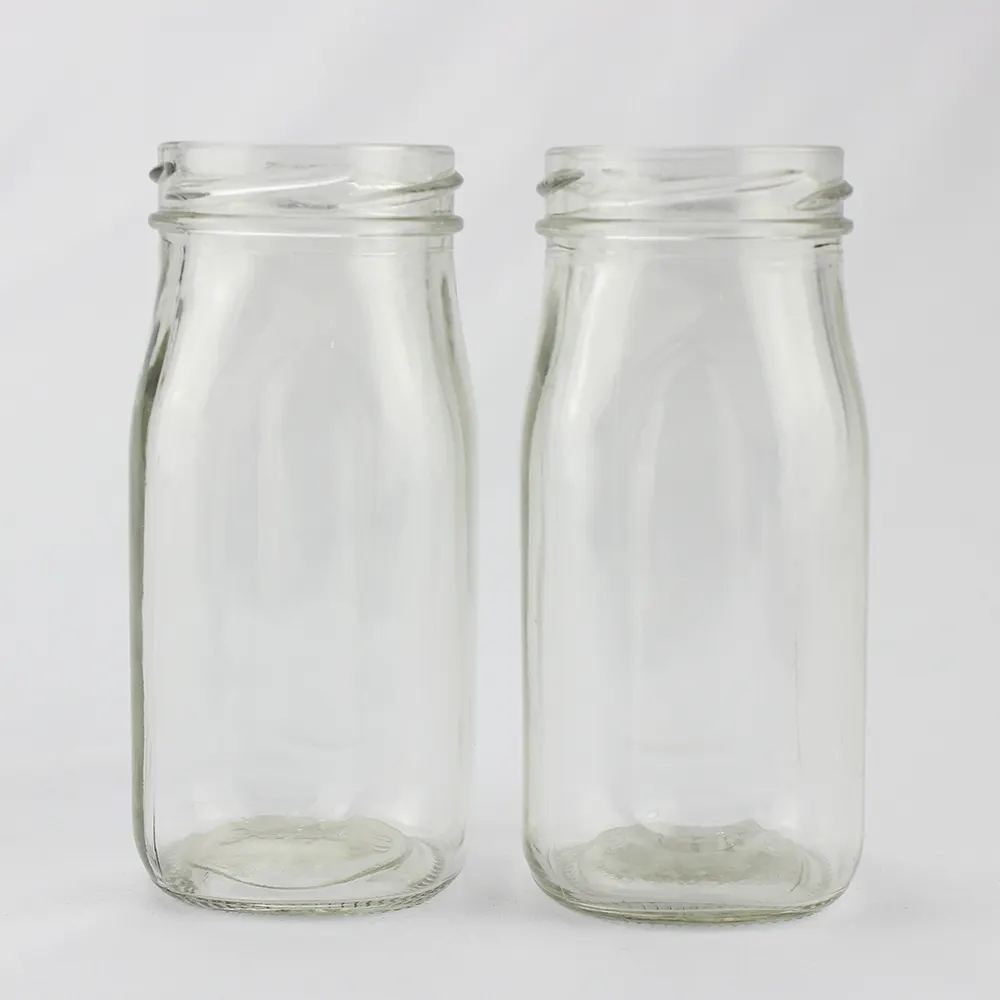
Dimensions, weights and pack counts by size
The figures below are typical for stock flint juice bottles and are meant for planning. The project drawing confirms the real values, along with anything the table omits, such as punt depth, label panel angle and neck bore.
| Parameter | 250ml | 330ml | 500ml | 1L |
|---|---|---|---|---|
| Brimful capacity | ~265ml | ~345ml | ~520ml | ~1040ml |
| Overall height | 185 – 210mm | 195 – 225mm | 215 – 245mm | 270 – 300mm |
| Body diameter | 55 – 62mm | 60 – 66mm | 66 – 74mm | 82 – 90mm |
| Hot-fill glass weight | 190 – 220g | 230 – 260g | 310 – 360g | 520 – 600g |
| Cold-fill glass weight | 170 – 200g | 210 – 240g | 280 – 330g | 470 – 550g |
| Pieces per carton | 24 pcs | 24 pcs | 12 pcs | 6 pcs |
| Pieces per pallet | ~2,880 pcs | ~2,400 pcs | ~1,440 pcs | ~720 pcs |
Read the brimful row before the nominal one. Brimful capacity is the volume to the very top of the neck, and the gap between it and the declared fill is the headspace. Hot-fill juice typically needs 4 to 6 percent of brimful capacity as headspace and cold-fill 3 to 4 percent, which is why a 500ml hot-fill bottle should measure around 520ml brimful on the drawing.
How the filling process changes the bottle
Hot-fill
Juice filled at 85 to 92 degrees Celsius puts more structural demand on the glass than anything else in this category. Two test results decide whether a bottle is fit for it:
- Annealing. Residual stress has to be low, checked per ASTM C148. A badly annealed bottle cracks at the shoulder or heel when hot juice meets cold glass.
- Thermal shock. We ask for qualification per ISO 7459 at a temperature differential of at least 42 degrees Celsius, and 45 degrees or better where the process holds the product hot after filling.
Hot-fill designs also put extra glass into the base and heel. That accounts for the hot-fill weights in the table sitting 10 to 15 percent above the cold-fill ones.
Cold-fill
High-pressure processing (HPP), aseptic filling and preservative systems all avoid the heat, so the bottle can be lighter and the shape and decoration less constrained. The concern shifts to the closure. Cold-fill lines usually call for a 38mm continuous-thread cap with an induction or foam liner in place of a lug twist-off, since it holds its torque more consistently through chilled distribution.
The glass bottle size chart sets size, process and closure side by side if you are still weighing combinations.
Stock, modified-stock or custom mould
Once size and process are fixed, the remaining choice is how much of the bottle is yours alone.
| Route | What changes | Suits | Main risk |
|---|---|---|---|
| Stock mould | Nothing; you buy an existing bottle | A first launch or co-packer trials | Competitors can buy the identical bottle |
| Modified stock | Finish, weight or an embossing plate on a stock body | A growing brand that needs to look different | Changes stop at surface features |
| Full custom mould | The whole shape is proprietary | A national brand with committed volume | Capital is tied up before sell-through is proven |
Sampling takes longest on the custom route because it includes mould trials. Cost and timing for all three are quoted per project and depend on the mould, the decoration, the quantity and the freight terms. When two quotes for the same bottle differ noticeably, check whether the lower one assumes lighter glass, no decoration or ex-works delivery.
Frequently asked questions
Which size should a new juice brand start with?
Start with the size your first channel will list: 250ml for convenience, 500ml for grocery. A single size executed properly is a better launch than four spread thin, because every extra SKU repeats the decoration setup and the closure order.
Can one bottle serve both hot-fill and cold-fill lines?
Only in one direction. A bottle qualified for hot-fill is safe on a cold-fill line, but a lightweight cold-fill bottle will break on a hot-fill line running at 90 degrees.
Which neck finish is standard for juice?
Hot-fill juice is mostly on 38mm lug twist-off. Cold-fill 250ml bottles commonly use 28mm continuous thread, and 1L bottles often take a 43mm twist-off. Whatever the convention, the finish has to match the capping chucks your co-packer runs.
Is glass or PET the cheaper choice at 500ml?
PET costs less per unit. Glass earns its place in other ways: it supports a higher shelf price, it survives HPP, and it avoids the flavour-scalping complaints that acidic juices attract in plastic.
Can caps be sourced together with the bottles?
Yes. We source lug twist-off and continuous-thread closures checked against the bottle finish and document the torque specification for each SKU, so bottle and cap arrive as a tested pair.