For comparison, most wine, spirits and oil programmes start from 750 ml glass bottles.
A 500 ml glass bottle is chosen by category first: craft spirits take a round, square or faceted body with a bar top or GPI 28-400 thread, juice and kombucha take a wide mouth with a twist-off lug, olive oil takes a green Marasca or Dorica with a pourer finish, and carbonated drinks need a pressure-rated long-neck. Fix the fill process, the closure and the filling line before the silhouette, because the neck finish and any pressure rating are built into the mould and cannot be added afterwards.
Where the 500 ml size fits
The size is used in four broad groups. Craft distillers bottle gin, vodka and whiskey in it because a smaller bottle asks less of a first-time buyer than a 750 ml one, and it suits travel retail. Juice and kombucha producers use it as the grab-and-go size: enough to share, small enough to finish while fresh. Olive oil, vinegar and syrup brands treat it as their main retail size, and sauce makers use it for foodservice lines.
Two practical points help across all of them. A 500 ml bottle fits refrigerator doors that a 750 ml silhouette does not, and it falls inside the volume thresholds of many European deposit schemes.
Shape, finish and colour by category
| Category | Usual 500 ml shape | Neck finish | Glass colour | What to prioritise |
|---|---|---|---|---|
| Craft spirits (gin, vodka, whiskey) | Nordic round, square, faceted | Bar top 18.5 mm or GPI 28-400 | Flint, extra flint, frosted | Shelf presence and the opening ritual |
| Juice and kombucha | Wide-mouth round, French square | 38–43 mm twist-off lug | Flint | Filling speed, hot-fill tolerance |
| Olive oil and vinegar | Marasca, Dorica round | 31.5 mm pourer finish | Antique green, dark green | UV protection, controlled pour |
| Syrups and sauces | Round sauce, woozy-tall | 28–38 mm continuous thread | Flint or amber | Handling of viscous product, cap seal |
| Ready-to-drink cocktails | Long-neck beverage | Crown 26 mm or ROPP 28 mm | Flint or amber | Carbonation pressure rating |
Each shape trades something. A faceted square looks strong in photographs but runs slower through a rotary filler than a round bottle. A wide mouth fills quickly and pours less precisely. The sensible route is to start with the filler and the closure, then pick the most distinctive body that equipment will accept.
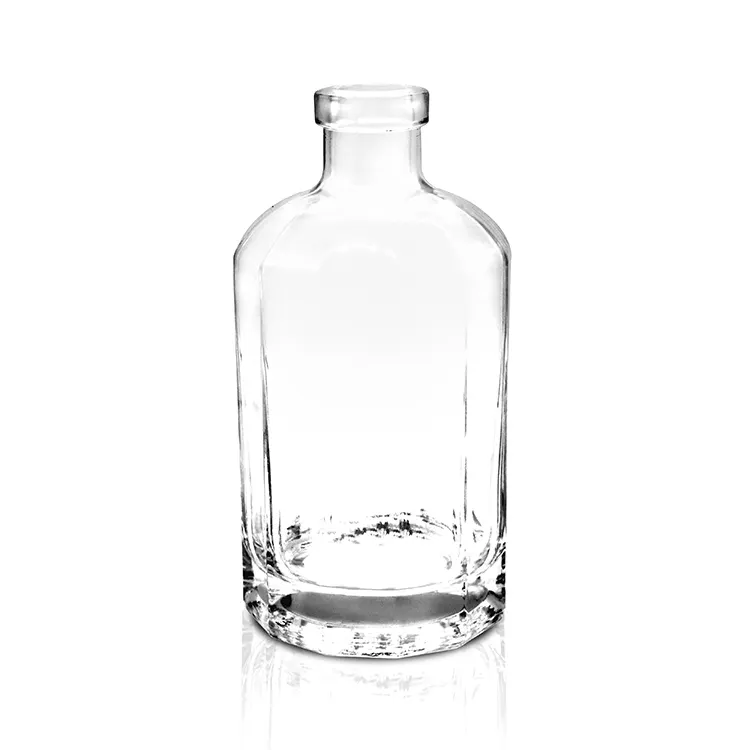
For spirits, the closure choice comes before the bottle. A bar top with a cork stopper is the craft convention; a GPI 28-400 screw finish suits faster lines and a resealable positioning. Switching between them later means new glass.
Dimensions and performance figures to specify
| Parameter | Typical range | What it affects |
|---|---|---|
| Brimful capacity | 510–530 ml for a 500 ml fill | Headspace for thermal expansion and legal fill tolerance |
| Glass weight | 280 g (light beverage) to 620 g (heavy spirits) | Hand-feel, perceived quality, freight |
| Height | 180–290 mm, depending on shape | Shelf and carton fit |
| Body diameter | 62–85 mm | Label panel size and bottles per case |
| Internal pressure rating | Up to 10 bar on carbonated designs | Required for RTD and kombucha |
| Thermal shock | ≥42°C differential per ASTM C149 | Survival in hot fill and pasteurisation |
The test references that belong in a 500 ml specification are ASTM C149 for thermal shock, ISO 7458 for internal pressure resistance, ISO 7459 for thermal endurance and EU Regulation 10/2011 for food-contact compliance. Ask for the lot documentation to cite them.
Carbonated products need separate attention. A pressure-rated bottle distributes its glass more heavily and uses a different finish geometry, so state the carbonation level in the first enquiry and ask for the pressure-rating certificate with the samples.
Checks against your filling line
A bottle can be right on paper and still stop a line. Four points are worth confirming before an order is placed.
- Change parts. Star wheels, guides and grippers on a rotary filler are made for one bottle. A diameter shift of 5 mm can call for a new set, and that set may outweigh the glass in the budget.
- Neck handling. Pucks and neck guides rely on a stable neck ring diameter. Faceted or tapered necks may push the line to body handling.
- Labelling. Square and faceted bodies need an orientation system on a pressure-sensitive labeller. Round bottles are the quickest to label.
- Washing and rinsing. Returnable or heavy bottles need a verified thermal shock margin if the line has a hot caustic wash.
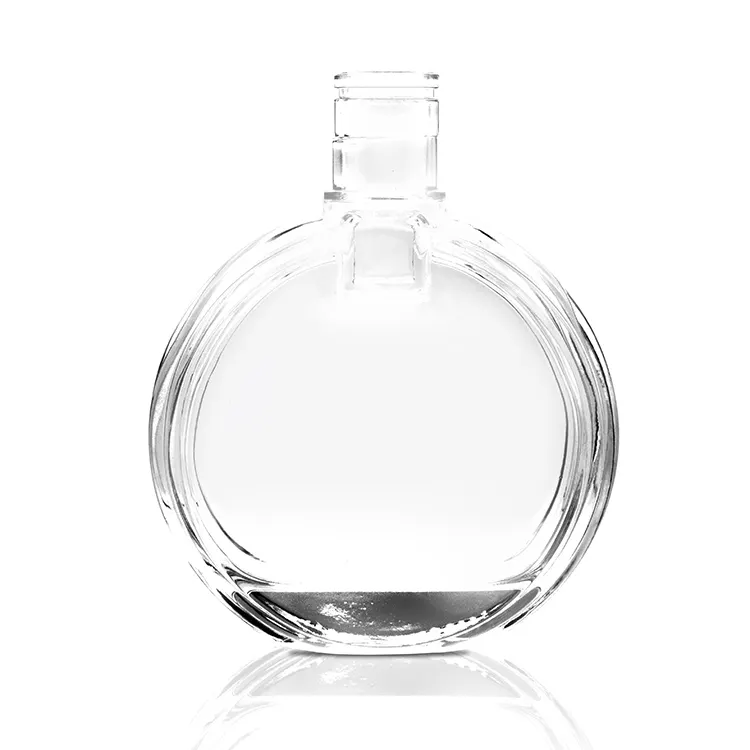
Send us the filler type and the labeller model with the enquiry and we check the drawing against them before a plant is asked to quote.
500 ml beside 375 ml and 700/750 ml
| Factor | 375 ml | 500 ml | 700/750 ml |
|---|---|---|---|
| Role in a spirits range | Tasting, gift sets | Craft flagship, travel retail | Standard retail |
| Barrier to a first purchase | Lowest | Low | Full |
| Bottles per 20GP (approx.) | 34,000–38,000 | 28,000–32,000 | 22,000–26,000 |
| Fit with EU deposit schemes | Yes | Yes, a core size | Varies by country |
Brands that build a family often lead with 500 ml and add a 375 ml gift bottle and a 750 ml retail bottle on either side. Keeping one neck finish across all three means a single closure stock serves the whole range. If the range goes wider than that, the bottle size chart lists the full capacity ladder.
What to put in the brief
- Product category and fill process: cold fill, hot fill, carbonated or pasteurised
- Shape family or reference photos, with a target glass weight
- Neck finish and closure, if already chosen
- Filling line type (rotary or linear, neck or body handling) and labeller model
- Quantity per SKU, annual volume and the dates you are working to
- Destination port, Incoterm, and any deposit-scheme or regulatory marking
Frequently asked questions
Can a 500 ml glass bottle hold a carbonated drink?
Only a pressure-rated design can. Carbonated drinks and kombucha need a bottle engineered for internal pressure of up to about 10 bar, with a crown or ROPP finish suited to it.
Will a 500 ml bottle run on a line set up for another size?
In most cases it will, once the change parts are right. The capper has to match the finish, the star wheels and guides have to match the diameter, and a square body may need orientation at the labeller.
How many 500 ml bottles go into a container?
A 20GP takes roughly 28,000 to 32,000 bottles of a typical shape, depending on diameter and case layout, and a 40HQ about double that. Heavy spirits bottles load slightly fewer, because the container reaches its weight limit before it is full.
Do European deposit schemes accept 500 ml?
Yes. It is a core size in most European deposit-return systems. Some schemes require specific marking, so tell us which markets are involved and the requirement goes into the production documents.