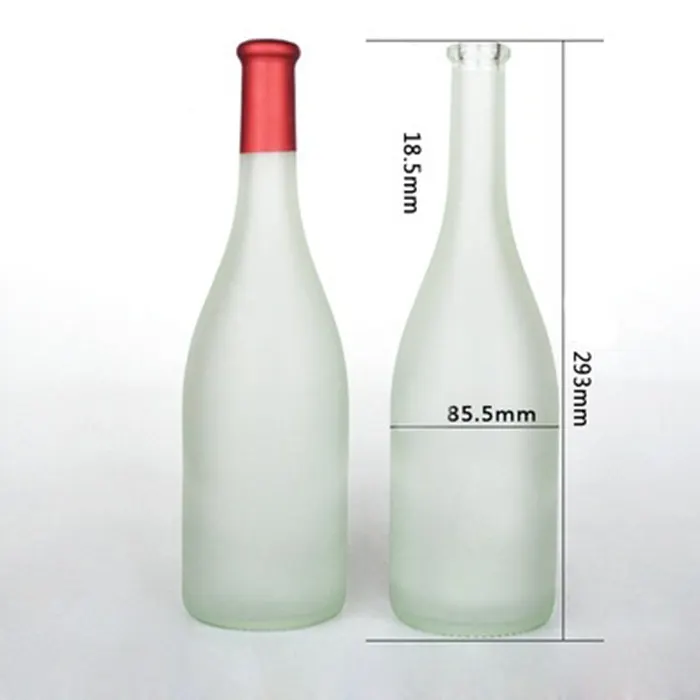
Part of our empty wine bottles range; the stock moulds are pictured at the end of this guide.
A standard 750 ml Burgundy bottle stands 290–300 mm tall, measures 88–92 mm across the body and weighs 450–550 g, with either an 18.5 mm cork finish or a BVS 30×60 screw finish. The two decisions that matter most are glass weight, which sets both glass and freight cost, and whether your bottling line can take the wider body and the sloping shoulder. Colour, punt depth and closure follow from the wine and the market.
Stock dimensions by capacity
These are typical values for stock Burgundy bottles, given for planning. The project drawing confirms the final figures.
| Capacity | Height | Diameter | Weight | Finish |
|---|---|---|---|---|
| 375 ml | ~238 mm | ~76 mm | 350–400 g | Cork 18.5 mm or BVS 30×60 |
| 750 ml | 290–300 mm | 88–92 mm | 450–550 g (custom 400–900 g) | Cork 18.5 mm or BVS 30×60 |
| 1.5 L magnum | ~355 mm | ~110 mm | 850–1,000 g | Cork 18.5 mm |
Four glass colours are usual: antique green, the standard for reds; dead-leaf green; flint for whites and rosés; and amber on request.
Standards to ask for
Bottles should be annealed per ASTM C148. Where the wine will pass through a cold chain or a hot climate, ask for thermal-shock testing per ISO 7459. Capacity tolerance held per ISO 8106 supports fill-point compliance under TTB and EU rules, and an EU 1935/2004 declaration covers food contact.
Choosing a glass weight
| Class | Weight at 750 ml | Where it fits |
|---|---|---|
| Lightweight | 400–450 g | High-volume brands and those leading on sustainability |
| Standard | 450–550 g | Regional estates and retail chains |
| Premium | 600–750 g | Wines positioned higher on the shelf |
| Prestige heavyweight | 800–900 g | Icon wines and the gift market |
The direction of the market is towards lighter glass. Estates that used 600 g bottles a decade ago now use equivalents of 480–520 g, and report no pushback from consumers. The change lowers glass cost, freight emissions and reported carbon in one move, and because wine bottles are weight-sensitive freight, every gram removed also cuts the freight share of the landed bottle.
Lighter does not have to mean weaker. Current forming keeps wall thickness tight enough for lightweight bottles to pass the same impact and vertical-load tests as heavier ones, and the standard class copes with all normal distribution. Our advice is to keep heavyweight builds for the few SKUs that are truly prestige wines.
How the shape differs from Bordeaux
A Bordeaux bottle has straight sides, a high abrupt shoulder and a 76–80 mm diameter. That shoulder was a practical feature for structured reds with heavy sediment, which it holds back during decanting. The Burgundy bottle is wider and carries a long, low-angle shoulder inherited from the blown-glass traditions of Burgundy and the Rhône. It suits Pinot Noir and Chardonnay, whose fine lees seldom need trapping.
Today the choice is largely brand language, but it has three practical consequences for a buyer:
- Case efficiency. Bordeaux bottles pack more tightly into a standard 12-bottle case, so the same shelf or pallet footprint holds more wine.
- Label height. The cylindrical body is the only flat surface for a label. A front label has to stop below the shoulder curve, which typically limits it to 100–110 mm.
- Buyer expectation. The sloping shoulder signals Pinot and Chardonnay heritage, the Bordeaux shape Cabernet and Merlot. A Cabernet in Burgundy glass, or a Pinot in Bordeaux glass, produces a mismatch that focus groups pick up even when they cannot name it.
What the punt does
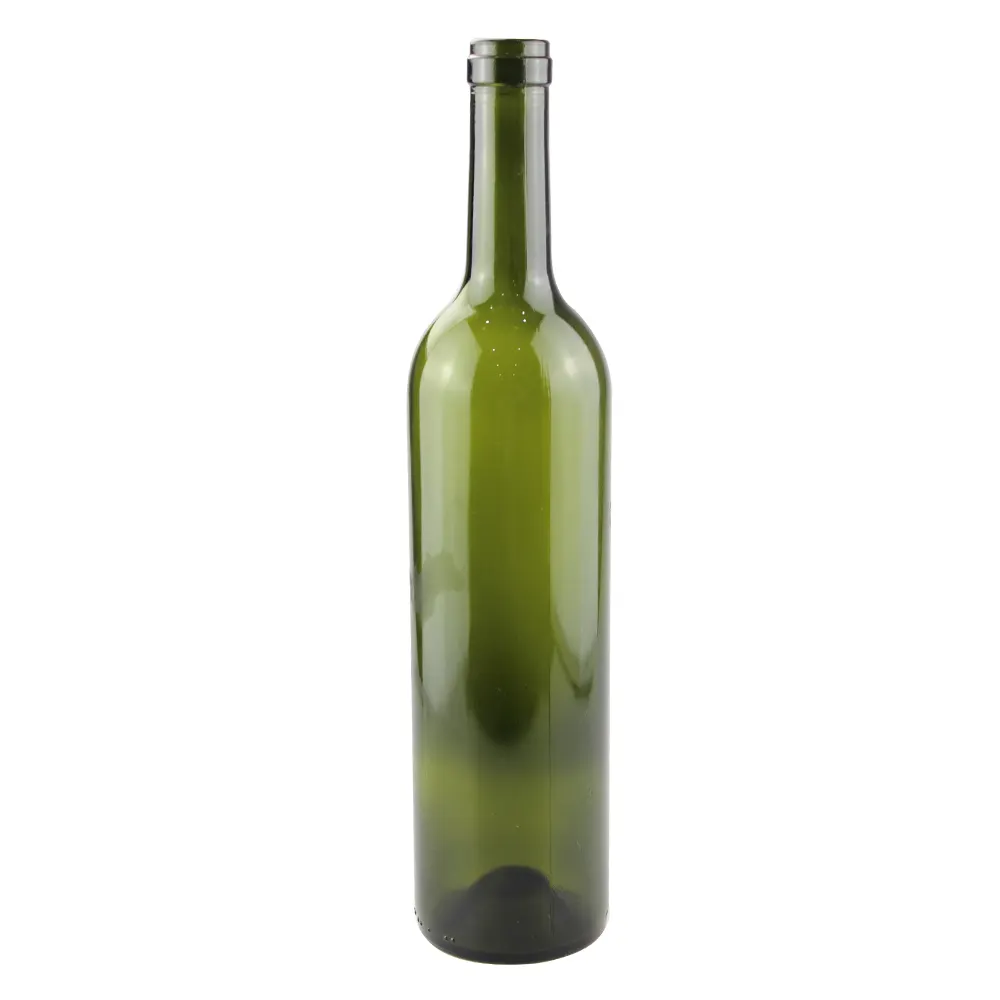
The punt is the dome pushed up into the base. It began in hand-blown glassmaking as a way to remove the pontil scar and steady the bottle. Depth is not regulated and says more about marketing than about the wine; plenty of expensive wines use a shallow one.
A well-designed punt has four jobs. It spreads stress across the base, which matters a great deal under the pressure of sparkling wine and only modestly for still wine. It keeps the bottle steady on an uneven surface. It stiffens the base against knocks in case handling. And it gives the thumb grip used in traditional service. It also helps sediment collect in aged reds.
On still-wine Burgundy bottles the depth usually falls between 15–35 mm. Past the point of stability, extra depth is appearance only. We suggest putting the glass into even wall distribution instead: uniform thickness does far more to reduce breakage than a further 10 mm of dome.
Cork or screw cap
The shape accepts both. The traditional cork finish has an 18.5 mm bore, takes a 24 mm natural or technical cork and is dressed with a capsule; the screw alternative is BVS 30×60. The market decides. Screw caps dominate in Australia and New Zealand and on aromatic whites, while natural cork is still expected in traditional European channels and on wines meant for ageing.
Line checks before committing to a mould
Burgundy bottles usually run on an existing line once change parts are adjusted, and height is similar across wine bottles. The body diameter is what differs. Go through four points with your bottling contractor:
- Star wheel and guide clearance for an 88–92 mm body, against the 76–80 mm parts used for Bordeaux.
- Corker or capper cone fit with the finish you have chosen.
- Labeler centring, plus the label-height limit under the shoulder. The slope gives the machine no straight reference, so the label has to be applied to the cylindrical body.
- Case packer and pallet pattern. A 12-bottle Burgundy case is wider than its Bordeaux equivalent.
We send 2D drawings and coordinate sample bottles so these checks can be run as a line trial before production.
Stock, modified stock or custom mould
| Route | When it suits |
|---|---|
| Stock mould | New vintages and market tests |
| Modified stock, with embossing or print | Estate branding on a proven mould |
| Full custom mould | A proprietary estate bottle |
For sparkling formats, see our guide to champagne bottle sizes; for the way cost scales with volume, the beer glass bottle collection gives a worked view of wholesale economics.
What to include in a sample and quote request
- Capacity (375 ml, 750 ml or magnum) and the glass weight you are aiming for
- Glass colour: antique green, flint, dead-leaf or amber
- Closure: cork finish or BVS 30×60 screw cap
- Annual volume and bottles per SKU
- Label dimensions and any limits of your bottling line
- Destination and the certifications required there
Send these through the sample and quote request form.
Frequently asked questions
Does a deeper punt mean better wine?
No. Depth is a styling decision. Specify it for appearance and for line compatibility, and do not read it as a mark of quality.
How heavy should a Burgundy bottle be?
That follows from positioning. The standard class suits most wines, the lightweight class suits volume and sustainability-led ranges, and the heavier classes add cost, freight weight and carbon footprint in exchange for shelf presence.
What is the MOQ for a custom Burgundy bottle?
It is quoted per project, because it depends on the mould and on the line it runs on.