Cobalt blue glass bottles get their colour from cobalt oxide melted into the glass, so the blue runs through the whole wall and cannot scratch off the way a sprayed coating can. Measured on a 3.0 millimeter wall, medium cobalt lets through 5–12% of UV-A and 45–60% of visible light, which places it between clear flint and amber for light protection. The stock shape is the Boston round, from 5 ml to 500 ml, on neck finishes from 18-415 to 28-410.
Mass-coloured cobalt versus a blue coating
The first thing to settle with any supplier is how the bottle became blue. In mass-coloured glass, cobalt oxide (a Co3O4 or CoO source) goes into the soda-lime batch before it is melted. A medium cobalt uses about 0.02 to 0.06 percent of total batch weight; a deep, saturated cobalt goes up to roughly 0.10 percent. The colouring ion ends up spread through the glass itself, so the shade is the same at the surface and in the middle of the wall, and filling, washing and transport cannot wear it away.
A coated bottle is clear or green glass with a thin pigmented film on the outside. That film is exposed to everything the bottle touches: the unscrambler on the filling line, neighbouring bottles in bulk transit, and essential-oil solvents running down the neck. It is also a second material that needs its own food-contact or cosmetic-contact declaration.
The risk is practical as well as technical. If the carton says "cobalt blue glass" and one deep scratch shows a clear substrate, the claim on the pack is no longer true. For anything shipped in bulk or handled often on shelf, specify mass-coloured glass and say so in the order.
One limit on what the glass can claim: cobalt blue made from compliant soda-lime batch is suitable for food and cosmetic contact, but it is not a preservative and does not make a formula shelf-stable by itself. It changes the light that reaches the product, nothing more.
UV and visible light transmission against clear flint and amber
Cobalt ions absorb the orange-red part of the visible spectrum and the near ultraviolet. The first effect is why the glass looks blue; the second is why it protects. On a wall of 2.8 to 4.0 millimeter, transmission at 365 nanometer (UV-A) is typically below 10 percent and often below 5 percent, and below 320 nanometers a calibrated spectrophotometer reads effectively zero.
Visible transmission across 400 to 700 nanometers stays in a 40 to 60 percent band depending on how saturated the colour is. That is why a cobalt bottle is still see-through and the fill level remains readable.
| Glass type | Wall (mm) | UV-B, below 320 nm | UV-A, 320–400 nm | Visible, 400–700 nm | Typical use |
|---|---|---|---|---|---|
| Clear flint | 2.8–3.2 | 70–85% | 80–90% | 88–92% | Display packs, fills that are not light-sensitive |
| Cobalt blue, medium | 2.8–4.0 | 0–2% | 5–12% | 45–60% | Essential oils, fragrance, cosmetics |
| Cobalt blue, deep | 3.0–4.0 | 0% | 2–6% | 35–50% | UV-sensitive lines |
| Amber | 2.8–3.6 | 0% | 0–3% | 25–35% | Pharma, tinctures, maximum protection |
These figures are indicative, taken on a 3.0 millimeter specimen with a calibrated sphere spectrophotometer. Read them as ranges that describe the glass type, and ask for the measured curve of the lot you are actually buying.
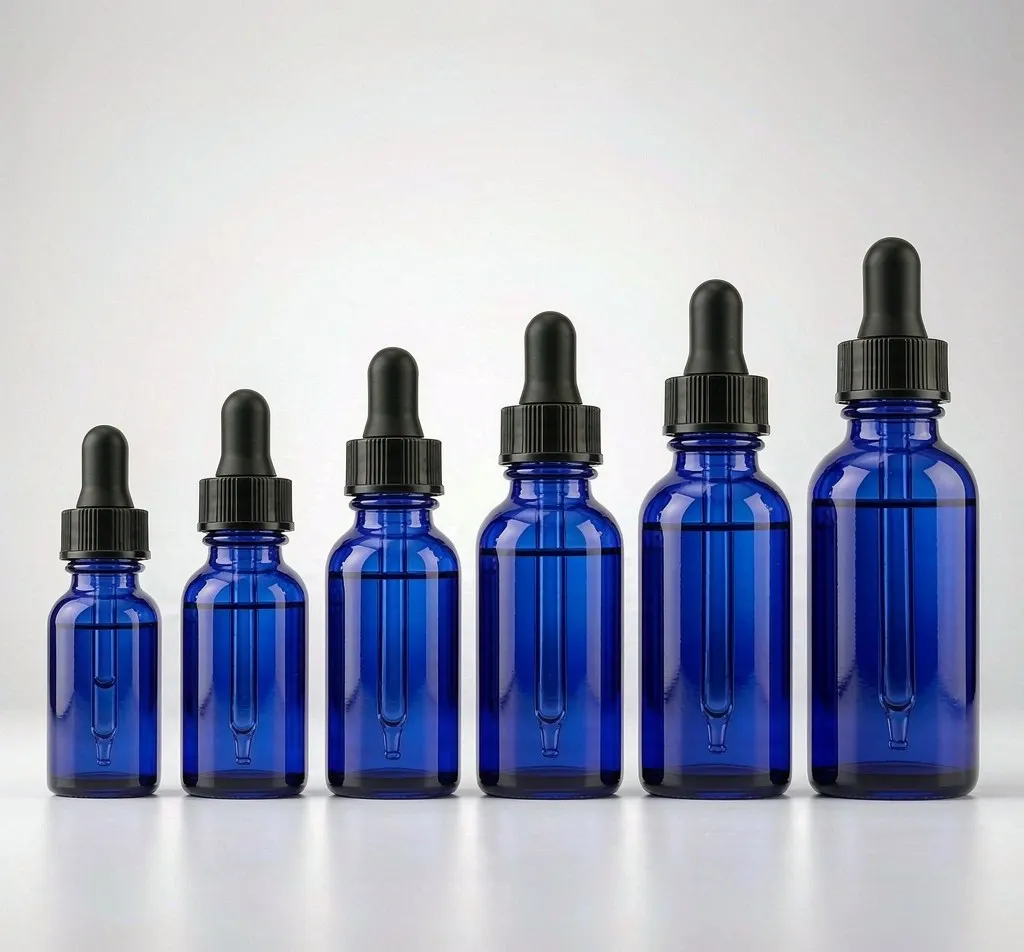
For a formulator the point is selectivity. Cobalt is strongest in the UV-A band, which drives much of the oxidation and top-note loss in oils and fragrances, and it also reduces violet and blue visible light that some actives and natural colourants react to. Green-yellow light still passes, so the consumer can see how much is left. Amber blocks more in total but brings the brown, medicinal look that many skincare and fragrance brands want to avoid; clear flint shows the product best and protects it least.
Colour tolerance to write into the order
"Cobalt blue" without a measured target is a description, not a specification. The working method is to fix a colour master in CIE L*a*b* coordinates and agree how far production may drift from it. A common clause holds Δa* and Δb* within plus or minus 1.5 and lightness L* within plus or minus 2.0 of the approved standard.
The plant checks this with a spectrophotometer reading on the first article and at intervals during the run. Ask for the master L*a*b* record and the tolerance clause in writing before the first production run. A brand that reorders the same SKU across several purchase orders and seasons depends on that clause to keep the bottles on shelf looking like one family.
Stock Boston round sizes and neck finishes
The Boston round is the main shape in the cobalt range, alongside a smaller choice of cosmetic rounds, cylinders and squat jars. It dominates essential-oil, tincture and serum packaging for plain reasons: the short shoulder and straight body leave a large label area, the shape survives drop testing better than a tall narrow neck, and it takes the continuous-thread and CRC closures that closure makers keep in volume. The same cobalt melt is used across the capacities, so a 10 milliliter serum bottle and a 250 milliliter body-oil bottle match in hue.
| Capacity | Neck finish | Body diameter (mm) | Height (mm) | Empty weight (g) | Closure type |
|---|---|---|---|---|---|
| 5 ml | 18-415 | 22 | 50 | 18 | Dropper / screw |
| 10 ml | 18-415 | 25 | 58 | 24 | Dropper / screw |
| 15 ml | 18-415 | 28 | 65 | 30 | Dropper / screw |
| 20 ml | 20-410 | 32 | 72 | 38 | Dropper / spray |
| 30 ml | 20-410 | 37 | 80 | 48 | Dropper / spray |
| 50 ml | 24-410 | 45 | 92 | 70 | Dropper / pump / spray |
| 60 ml | 24-410 | 48 | 98 | 82 | Dropper / pump / spray |
| 100 ml | 24-415 | 56 | 112 | 118 | Pump / spray / screw |
| 120 ml | 24-415 | 60 | 120 | 135 | Pump / spray / screw |
| 250 ml | 28-410 | 70 | 145 | 210 | Pump / screw / spray |
| 500 ml | 28-410 | 85 | 178 | 360 | Pump / screw |
Most sourcing mistakes on these bottles are neck-finish mistakes. The code reads as neck diameter in millimeters, then the thread style: 18-415 is an 18 millimeter neck with a 415 thread form. The 410 and 415 families are the usual ones in cobalt, and they are not the same thread. A 20-410 bottle and a 20-415 bottle both measure 20 millimeter across the neck, yet a cap from one will seat on the other and still leak. Order closures against the full code, never against the diameter alone.
Buyers who want one shape across a range can use the Boston round bottle range to put, say, a 30ml serum and a 250ml body oil on a single purchase order with matched colour masters. The straight wall helps with labelling too: one label die can serve neighbouring capacities with only a change in height.
Closures matched to the neck and the formula
Decide in this order: neck finish, then closure, then liner. That keeps the bill of materials short and the incoming-inspection checklist manageable. The mating hardware falls into four families, each made for a specific finish, with the liner chosen for chemical compatibility with the fill.
Droppers
Droppers are the default for essential oils and serums. The assembly is a rubber bulb, a polypropylene collar threaded to the neck, and a glass pipette of 2.0 to 3.0 millimeter outer diameter. The tip is calibrated for roughly 0.03 to 0.05 milliliter per drop, depending on viscosity, and the pipette is cut to the bottle height so that the tip always sits the same distance above the base.
Collars are finish-specific: a 24-410 dropper will not seal an 18-415 bottle. For oil-based fills, have the bulb compound and collar resin qualified against the actual oil, because some citrus and conifer oils swell unsuitable elastomers over a six-month shelf life.
Fine-mist sprayers and pumps
Fine-mist sprayers fit 20-410 or 24-410 necks and deliver 0.10 to 0.18 milliliter per stroke through an orifice of 0.20 to 0.35 millimeter. They suit facial toners, setting sprays and home fragrance mists. A bottle that takes a dropper will often take a sprayer as long as the finish is the same.
Lotion and treatment pumps are specified for 24-410 and 28-410 necks, with an output of 0.5 to 2.0 milliliter per stroke and a dip tube cut to bottle height. On a 250ml or 500ml bottle, a lotion pump gives a hand-and-body format from the same glass with no new mold.
Screw caps and liners
Aluminum screw caps come in 18-415, 20-410, 24-410 and 28-410. They are used on travel sizes and wherever a metal cap is part of the brand's look. Plastic screw caps cover simple reseal needs.
The liner matters more than the shell. Three options are common: a standard pressure-sensitive foam, a pulp-and-foil barrier for volatile oils, and an LDPE wedge for light chemical resistance. Caps that look identical from outside can carry any of the three, so name the liner in the purchase order. Where a formulation calls for child resistance, a 28-410 CRC closure is available, although most cosmetic and aromatherapy lines do not need one.
Tinctures and extracts that need UV protection and a dropper use the same 18-415 and 20-410 necks and the same collars as the essential-oil sizes, so the tincture bottle range and the cobalt range share closure specifications.
Where cobalt blue fits by product type
Cobalt is chosen in five product areas, and the reasoning shifts a little in each.
- Essential oils and blends. UV-A cutoff and dropper compatibility come first. The deep blue also suggests a pure, concentrated product without the apothecary feel of amber.
- Aromatherapy and reed-diffuser top-up liquids. The bottle has to withstand the slow solvent action of carrier oils and fragrance bases, and still look calm among competing oils.
- Skincare. Serums, facial oils and toners are the usual fits, where clear glass leaves the formula too exposed and amber looks too clinical.
- Fragrance. A 30ml or 50ml Boston round with a fine-mist or roller closure shows a hint of the liquid colour while cutting the UV that degrades delicate top notes.
- Home cleaning concentrates. A 250ml or 500ml pump bottle sits between a commodity clear refill and a designer amber bottle, without the cost of a fully custom shape.
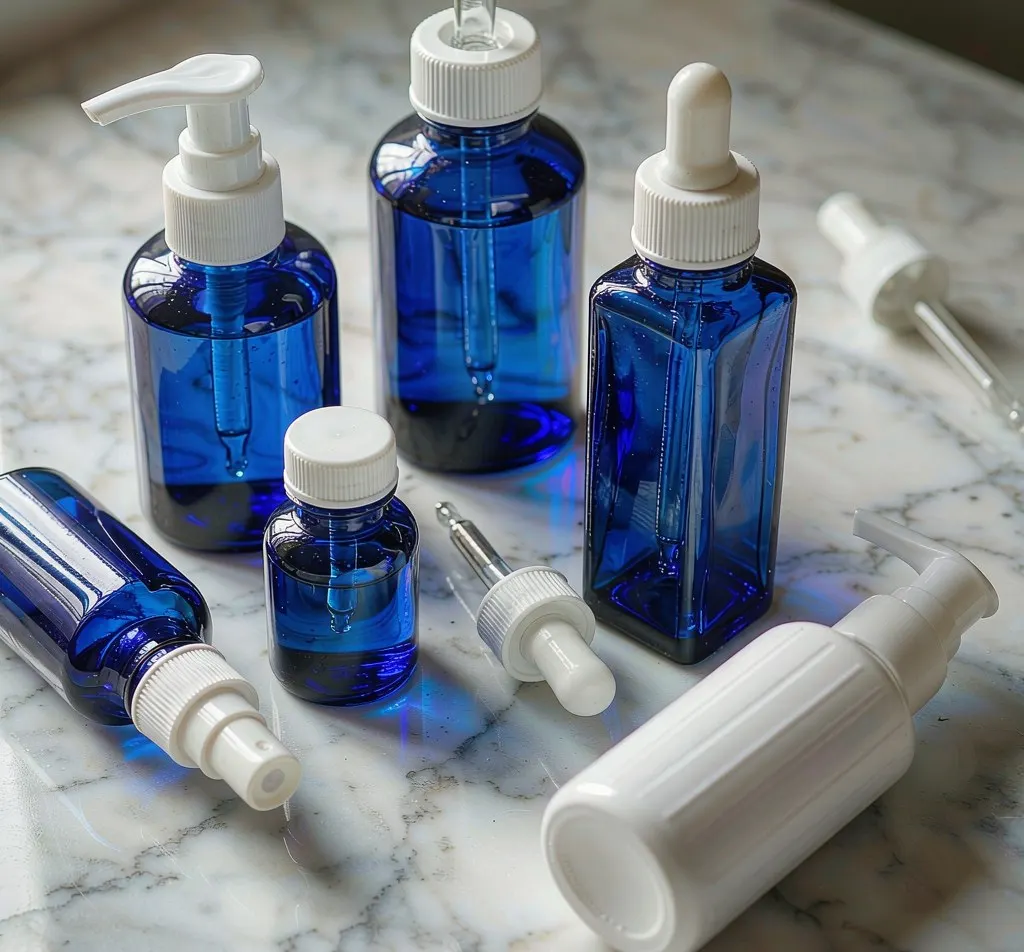
For oil brands moving from small batches to contract filling, the 5ml through 30ml dropper sizes in the essential oil bottle range come with matched cobalt colour and stock droppers, so one colour master covers the whole size ladder. The transmission data above is what protects a blend's volatile fraction during weeks under a warehouse skylight or in a sunny shop window.
Whatever the product, the order of work is the same. The colour master, the collar resin and the liner compound should all be qualified against the real formula before the production run. Finding an incompatibility at incoming inspection usually means a hold on a lot that is already filled and decorated.
Decoration on mass-coloured glass
Four decoration processes work well on cobalt, and none of them alters the UV profile, because the colourant is in the wall and decoration sits on the surface.
- Silk-screen printing puts one to three spot colours straight onto the curved surface. A typical print area on a 30ml bottle is 30 by 60 millimeters, larger on bigger formats, with registration held within plus or minus 0.3 millimeter. Cure is checked for rub and solvent resistance.
- Hot-stamp foiling presses a metallic or pigmented foil on under heat. It suits a logo or a cap-band mark and stands out strongly against saturated blue.
- Frosting is a surface etch that lightens the glass locally or all over, usually combined with print. A frosted cobalt bottle has the same UV behaviour as an unfrosted one.
- Pressure-sensitive labels and shrink sleeves need the least setup and suit short runs or artwork that changes by season. Some geometries have flat label panels to improve adhesion and registration.
Blue glass shifts the appearance of every ink printed on it. Approve colours on a decorated sample of the actual bottle, not on a digital proof or a white card.
A fully custom silhouette is possible from a 3D drawing, with a tooling cost and a first-article approval step, but most brands reach market sooner by decorating a stock shape. If you are planning cobalt, amber and clear versions side by side, the cosmetic glass bottle collection gathers closure, decoration and compatibility information so the same neck and liner combination is not qualified three times.
Documents and trade terms
Cobalt blue glass is normally sold FOB northern China. Ocean freight, destination drayage and any local compliance testing fall to the buyer unless DDP or DAP terms are agreed in writing. Pricing is quoted per project and moves with soda ash, cobalt oxide and ocean freight, as well as with quantity, decoration and whether a new mold is involved.
Four quality documents should travel with a shipment:
- a material declaration for the glass batch;
- a cobalt-content and heavy-metals screen suitable for a cosmetic-contact declaration;
- a dimensional inspection report against the approved drawing;
- a spectrophotometer reading against the colour master.
Importers into the EU or North America should confirm which heavy-metals and extractables documents their own market asks for. There is no single global standard for "glass", and the compliance obligation at the border sits with the importer.
Eight checks before committing to a supplier
These are the questions we put to a supplier before recommending it for a cobalt project, and a buyer can ask them directly. Record the answers in the supplier file.
- Colour method. Confirm the glass is mass-coloured and ask for the cobalt oxide addition rate and a description of the melt-in process. A photo of a painted sample does not answer the question.
- Transmission data. Get the measured UV and visible curve for the real wall thickness, and ask whether it is a lot average or one specimen.
- Colour master. Put the L*a*b* master and tolerance in the contract, with a rejection threshold for incoming inspection, so that disputes are settled by measurement.
- Neck finish. Check it is written in full diameter-thread form, for example 24-415, and that the proposed closures and liners are qualified to that exact finish.
- Formula compatibility. Ask for closure data against your formula, especially for citrus, conifer and high-alcohol fills, which are hard on elastomers and liners.
- Paperwork and terms. Confirm the document set, the incoterm and the payment structure in writing.
- Samples. Run a small first-article and decoration sample before the full order and measure it against the master yourself. Correcting a colour or liner mismatch after a full container has been filled costs far more than a sample round.
- Campaign continuity. Check that your capacity and finish are in the current production campaign. A shape that is listed but not currently running can delay delivery without anyone saying so.
Answers that come with documented numbers indicate lower risk than answers made of adjectives. The category includes both glass plants and trading intermediaries. A trader is not ruled out by default, but you should know whose data you are reading, because the colour master and the production schedule are held at the plant.
Frequently asked questions
Is the colour through the wall or only on the surface?
In true cobalt blue glass it is through the wall, because the cobalt oxide is added before melting. Coated blue bottles are also on the market and cost less, but a scuff exposes the base glass and the coating counts as a second contact material. Brands that print the claim on pack should specify mass-coloured glass.
Which neck finishes are standard on cobalt Boston rounds?
18-415, 20-410, 24-410, 24-415 and 28-410 cover the 5ml through 500ml sizes. Quote the whole code when ordering closures; the millimeter diameter alone is not enough to guarantee a seal.
What are the minimum order quantity and the delivery time?
Both are quoted per project. They depend on whether the size is a stock shape or needs a new mold, on the decoration setup, on the quantity, and on whether that capacity and finish are running in the plant's current campaign.
Can citrus essential oils go in cobalt blue bottles?
Yes, provided the closure is right. The glass handles the light; the dropper bulb, collar resin and cap liner have to be checked against the specific oil. Name the liner compound in the purchase order and run a compatibility check with the formula before the full run.
Does printing or frosting reduce UV protection?
No. Screen print, hot-stamp foil and frosting are all exterior treatments. The transmission profile is set by the cobalt in the melt and stays the same after decoration.