One of our guides on glass drink bottles; start there for the overview.
A custom kombucha bottle has to be specified as a pressure container first and a branded pack second, because the drink goes on fermenting once the cap is on. For 355 ml and 500 ml formats that means 280 to 360 grams of glass, a base 4 to 5 mm thick and a verified internal pressure rating of at least 5 bar with a safety margin. Embossing, spray colour and printing can all be added on top, provided none of them weakens the glass or eats into the flat label area that compliance text needs.
How much pressure the bottle has to hold
Secondary fermentation is the stage where leftover sugar turns into carbon dioxide inside the sealed bottle. It gives kombucha its natural fizz, typically 2.5 to 4 volumes of CO2, and it keeps building for weeks if the stock sits in a warm warehouse. A lively batch stored warm can go beyond 50 psi, around 3.5 bar. A bottle designed for still drinks will leak at the finish or break at the heel under that load.
Three things keep a bottle intact under sustained pressure, and each should appear in the specification:
- Glass weight and distribution. Stay inside the 280 to 360 gram range for 355 ml and 500 ml sizes, with the 4 to 5 mm base, and ask for the pressure rating to be verified rather than quoted as a design figure.
- Surface coatings. Hot-end and cold-end coatings go on during forming and stop the fine scratches that later become the starting point of a fracture. Request the coating application spec.
- Annealing. Residual stress left by poor annealing stacks on top of fermentation stress, and the breakages show up weeks later in distribution. Polariscope readings should show residual stress within grade.
Tell us on the brief whether you condition in the bottle or force-carbonate before filling. A force-carbonated product can run in a lighter mould and still keep a safe margin for any refermentation in warm distribution.
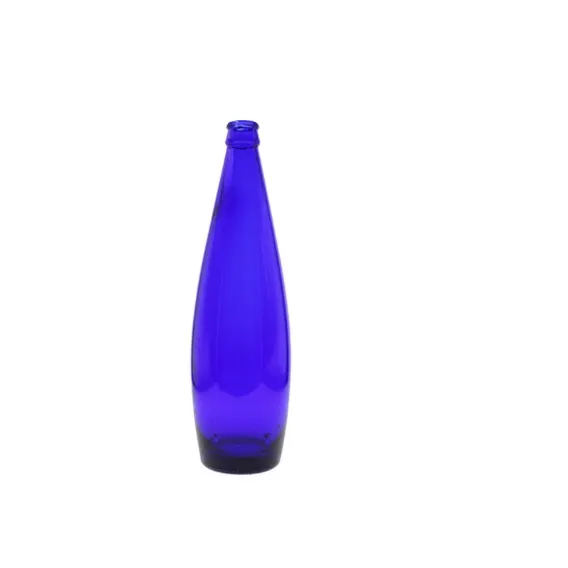
Bottle formats and closures
Most kombucha brands start from one of three established bodies, because the pressure behaviour of those shapes is already understood. The closure decides which one suits you.
| Format | Finish and closure | Where it fits | Point to check |
|---|---|---|---|
| 12 oz, 355 ml longneck style | 26 mm crown | Grab-and-go retail; the most pressure-secure and economical single-serve option | Crown finish geometry follows the 26 mm standard closely, so capper fit is rarely an issue |
| 16 oz, roughly 500 ml swing-top | Wire bail with a replaceable silicone gasket | Refillable and higher-end lines; copes with repeated fermentation cycles | Gasket supply for refills |
| Threaded bottle | 38-400 with an induction-sealed or foam-lined cap | Brands that want a reclosable pack without a swing-top | Thread profiles differ between suppliers, so buy cap and glass as one validated pairing |
Whichever finish you choose, confirm it against your capper early. For a stock reference with a pressure-rated body, see the 8460 beer bottle; the wider stock range is on our kombucha bottles page.
How far the shape can be changed
Adjusting a proven body is the lower-risk route. The usual changes are capacity by plus or minus 20 ml, shoulder angle, punt depth and neck length. A shape drawn from scratch is feasible too, but it should pass finite element stress analysis and prototype pressure cycling before anyone signs a mould order.
Decoration that does not weaken the glass
The decoration methods are the same as for other drinks glass. What changes is the test each one has to pass, since kombucha is sold cold and wet from a refrigerated display.
- Embossing. Keep the relief between 0.4 and 0.8 mm and position it clear of the heel and the shoulder transition, where stress is highest. The mould engineer should confirm that no thin section forms on the wall opposite the relief.
- Spray coating. Matte black, soft-touch pastels and frosted effects are applied over the annealed bottle and cured. A correctly specified coating passes a cross-hatch adhesion test after 24 hours of condensation.
- Fired ceramic screen printing. One to four colours, unaffected by condensation or an ice bucket.
- Paper labels. These need a wet-strength face stock and a cold-temperature adhesive, otherwise the edges lift in the cooler.
Our decoration services overview sets out each of these routes in more detail.
Label panel and fill level
A kombucha label carries more required text than most drinks: ingredients, a live culture statement, net contents, storage advice about refrigeration and, where it applies, an alcohol declaration, since bottle-conditioned products can develop trace alcohol. Plan a flat panel that takes this block and your branding. On a 355 ml bottle the back label alone needs at least 60 by 80 mm.
Put any embossing on the shoulder or a base band so the panels stay flat. Barcodes printed across a curve or a texture fail retail verification often. In the fill specification, allow 4 to 6 percent ullage, the empty headspace that gives fermentation gas room to collect.
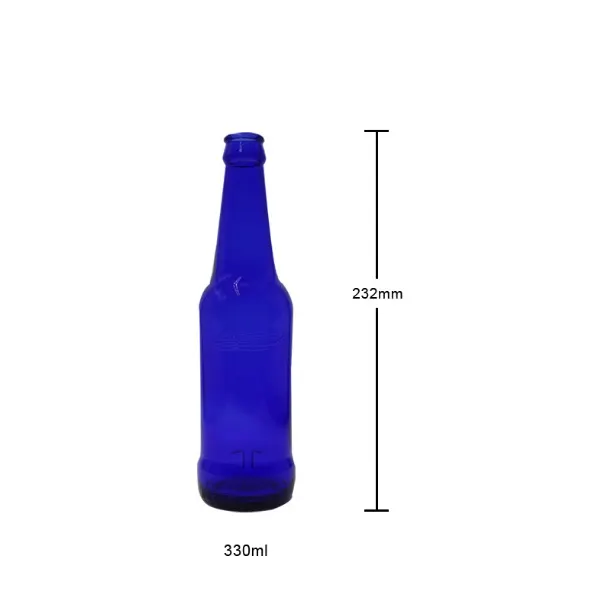
Tests to run before and during production
We set up validation in three layers and check the evidence at each one before a programme scales up.
- Design validation. Prototype bottles are pressure cycled to 5 bar for 72 hours and drop tested inside the final shipper.
- Process validation. The first production lots are sampled for capacity, weight, wall thickness by section, coating presence and pressure rating.
- Ongoing control. Every lot ships with a pressure certificate and an AQL 2.5 visual inspection.
Run your own thermal shock validation as well, at a 42 degree Celsius differential, because kombucha lines often put cool product into bottles at ambient temperature. The methods used for pressure-sensitive glass are described on our quality inspection page.
For packing, 355 ml bottles usually go 24 to a case, and a pallet holds around 2,400 to 3,400 units. If the same brand also fills still drinks, the requirements differ; see custom juice bottles.
Frequently asked questions
Which closure suits bottle-conditioned kombucha best?
For single-serve retail, the 26 mm crown is the tightest seal and the simplest to run. Swing-tops suit refillable lines, and a 38-400 threaded cap sits between the two when shoppers need to reclose the bottle.
Is an embossed logo safe on a pressure bottle?
Yes, within the 0.4 to 0.8 mm relief range and away from the heel and shoulder transition. Have the embossed design pressure cycled at prototype stage before the mould is committed.
What is the minimum order for custom kombucha bottles?
Minimums are quoted per project. They depend on the mould, the decoration and the production line the bottle is matched to.
What test documents should come with each shipment?
Ask for internal pressure certificates by production lot, polariscope stress readings, wall thickness mapping by section, coating presence checks and the AQL 2.5 visual inspection record.