A cork seals by compression, so the cork has to be wider than the neck bore: 1.5–2.5mm over for natural cork (about 25–30% compression on insertion) and 1.0–1.5mm over for technical corks with controlled density. T-corks for bar-top bottles are sized to the exact bore and need a ground or tooled finish. Write the bore tolerance of ±0.3mm on the bottle drawing, have the cork sized to the measured bore, and choose the cork grade by how long the product will sit in the bottle.
Cork-to-neck fit: diameter, tolerance and insertion depth
The fit is the purchasing decision most often skipped on a cork programme, and the one that causes most leakers. An oversized cork squeezes against the glass and then recovers, and that recovery is what holds pressure. Cork mills size their stoppers on the assumption that the bore is held to ±0.3mm. Unless the bottle drawing states that figure, nobody has actually agreed to it.
Insertion depth works against extraction force. A deeper cork has a longer contact band and a sturdier seal, but it is harder to pull. A shallow one can creep out under pressure in transit. For wine, total insertion sits in the 38–49mm band, set by the aging window, with the longer corks reserved for multi-year cellaring. A T-cork shank goes in about 20–30mm, because the cap carries the look and the shank does the sealing.
Cork show is the visible check on depth. Specify 3–5mm of cork above the lip after insertion. Driven deeper, the cork becomes hard to pull and may reach the liquid; left prouder, it wrinkles the capsule and looks wrong on the shelf. On a T-cork the cap seating governs the show instead. Whichever closure you use, the extraction tool (corkscrew, lever or T-handle) has to suit the depth you specify.
What to ask before committing a lot
None of the following is a certificate. Each is evidence that somebody measured the fit:
- the cork diameter and its tolerance band;
- the measured neck bore the cork was sized against;
- the insertion depth and cork show being specified;
- the insertion and extraction force range from the fit test;
- a first-article sample for your own inversion test.
Changing cork supplier means validating again
Nominal sizes do not transfer between mills. Two suppliers can print the same nominal diameter while differing in actual diameter, density, moisture content and the bore they assumed. A cork that seats well from one mill can under-compress and leak, or over-compress and give a hard pull with crumbs, when it comes from another. Measure the real bore again, specify the cork diameter to that measurement, and repeat the first-article fit test, meaning insertion and extraction force plus a 7-day inversion, before any production commitment.
Bottle families and the cork each one takes
Roughly 90% of wholesale demand for cork-finish bottles falls into four families: wine, olive oil and vinegar, spirits and liqueurs, and apothecary or diffuser bottles. Each has a cork pairing buyers expect to see. Staying inside these families keeps a project on existing moulds; a shape or cork outside them usually means private tooling.
| Bottle family | Typical capacity | Common bore | Cork type | Insertion depth | Extraction tool |
|---|---|---|---|---|---|
| Wine | 375–1500 ml (anchor 750 ml) | 18.5 mm | Natural, colmated or technical 1+1 | 38–49 mm | Corkscrew or lever |
| Olive oil and vinegar | 100–1000 ml (anchor 250–750 ml) | 18.5 mm or 31.5 mm | Technical 1+1 with pourer, agglomerated with capsule, or colmated | 20–44 mm | T-handle or lever |
| Spirits and liqueurs | 200–1000 ml (anchor 375–750 ml) | 18.5–21.5 mm | T-cork with natural shank (bar-top) | 20–30 mm | T-handle or lever |
| Swing-top beverage | 250–1000 ml | 18–22 mm | T-cork or natural stopper, gasket option | 18–28 mm | Lever |
| Apothecary and diffuser | 50–500 ml (anchor 50–200 ml) | 18–22 mm | Natural stopper, or T-cork with reducer | 15–25 mm | T-handle |
The bores above are the common ones. The cork finish differs by family and should be confirmed for each project.
Wine
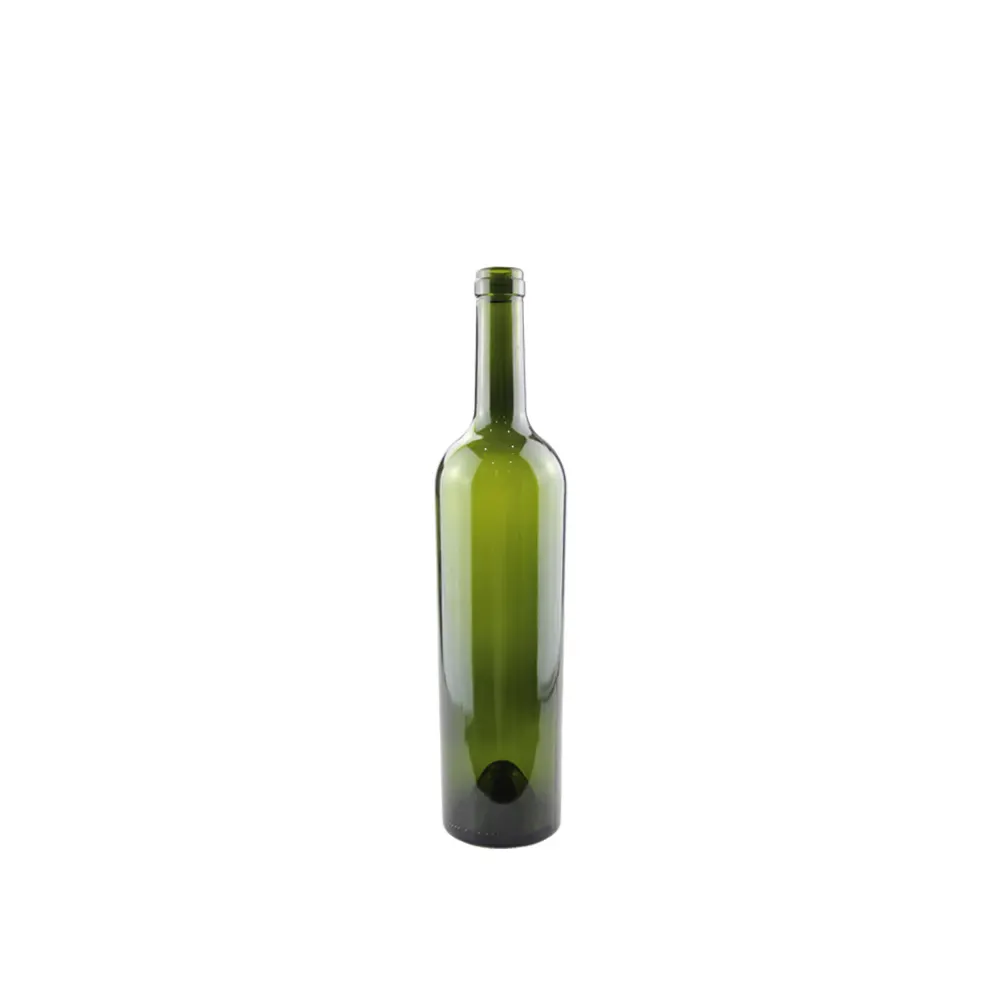
The 750ml Bordeaux and Burgundy with an 18.5mm bore are the anchor formats for natural and colmated corks, and the cork gets longer as the intended aging window lengthens. Long aging also calls for tighter TCA control. The wine bottle collection shows the shapes, and our page on wine bottles supplied with corks covers the paired programmes.
Olive oil and vinegar
Marasca (square) and dorica (round) bottles at 250ml, 500ml and 750ml lead this family, mostly in antique green or flint, with an 18.5mm or 31.5mm cork finish. The usual closure is a short technical 1+1 cork fitted with a controlled-dose pourer, not a long wine cork. Treat the pourer as a fitment specified with the closure. Estates that want a gift ritual move to a bar-top T-cork. The olive oil bottle range lists the formats, pourer options and the 31.5mm dorica family.
Spirits and liqueurs
Bar-top bottles at 375–750ml take a T-cork: a natural cork shank under a cap of wood, plastic or metal. The cap is decoration and the shank is the seal, so the two must be specified together. The shank is sized to the exact bore, which is why the neck needs a ground or tooled finish. A decorative neck without dimensional control will not seat the cap squarely.
Apothecary, diffuser and swing-top
Small apothecary and diffuser bottles at 50–200ml with 18–22mm necks use short natural stoppers that are decorative first and functional second. Pair them with a separate reducer or orifice if the oil has to be metered, since the cork will not control drip rate. A swing-top is a different concept altogether, because it seals on a gasket and not on the cork. Settle which closure concept you want before asking for a quote. Wide-mouth cork closures belong to another family, covered under glass jars with cork lids.
Cork grades compared
Grade is a shelf-life decision. It sets how much oxygen passes the closure over time, how the cork feels when pulled, how likely it is to crumble, and which documents you should ask the supplier to show.
| Grade | Construction | Oxygen transmission | Suits | What to request |
|---|---|---|---|---|
| Natural | One piece punched from the best bark planks | Lowest of the cork-based grades | Wine for cellar aging | Diameter tolerance (commonly ±0.3–0.4mm), surface treatment specification, TCA-control process, lot-traceable limit sample |
| Colmated | Natural piece with pores filled by cork powder and food-grade resin | Slightly higher than natural | Wine drunk within about two years | Food-grade confirmation for the binder, surface treatment specification, TCA-control description |
| Technical 1+1 | Natural disc bonded to an agglomerated body | Between natural and agglomerated | Olive oil with a pourer, held under 18 months | Disc thickness, food-grade documentation for the adhesive, diameter tolerance |
| Agglomerated | Cork granules in a food-grade binder | Highest, so shortest shelf life | Fast-turnover oil, spirits and diffuser products | Food-contact documentation for the binder, density specification |
| Synthetic | Moulded polymer, plant-based or conventional foam | Tunable, down to very low or near zero | Brands that want consistency and no TCA risk | Food-contact documentation in line with FDA and EU 10/2011, rating for fill temperature and alcohol content |
Natural cork has a closed-cell structure that springs back after compression. It pulls smoothly and seldom crumbles when moisture and diameter are controlled, but it is a natural material and an occasional flawed piece will turn up. Tolerance data and a limit sample you measure yourself are how that risk is managed.
Colmated cork costs less than natural and more than agglomerated. Its filled pores are less perfect than sound bark, which is acceptable for a short or medium hold and not for long cellaring. It leaves only minor surface dust on extraction.
On a technical 1+1 cork, the natural disc forms the face that touches the product and governs oxygen behaviour, while the agglomerated body lowers the cost. Extraction is consistent. The failures to screen out are a thin disc and a non-food adhesive.
Agglomerated cork is the economy grade. For an oil programme that turns over in 6–12 months, its shorter shelf life does not matter, and its crumb risk is near zero. Density is the figure to check, because density keeps the stopper from compressing out of round in the bore.
Synthetic closures carry no TCA risk by construction and give the most uniform extraction of any grade. Their cost is comparable to technical 1+1. The trade-off is a different feel on opening and a less traditional story on the shelf.
Common bottle and cork combinations
Within each family a buyer chooses three things: capacity (250/500/750/1000 ml tiers), glass colour (flint, antique green or amber) and the matched cork. Not every combination exists on a stock mould. The pairings below are typical of those that do.
| Style | Capacity | Glass colour | Neck bore | Matched cork |
|---|---|---|---|---|
| Marasca olive oil | 500 ml | Antique green | 18.5 mm | Technical 1+1 with pourer |
| Dorica olive oil | 750 ml | Green or flint | 31.5 mm | Agglomerated with capsule |
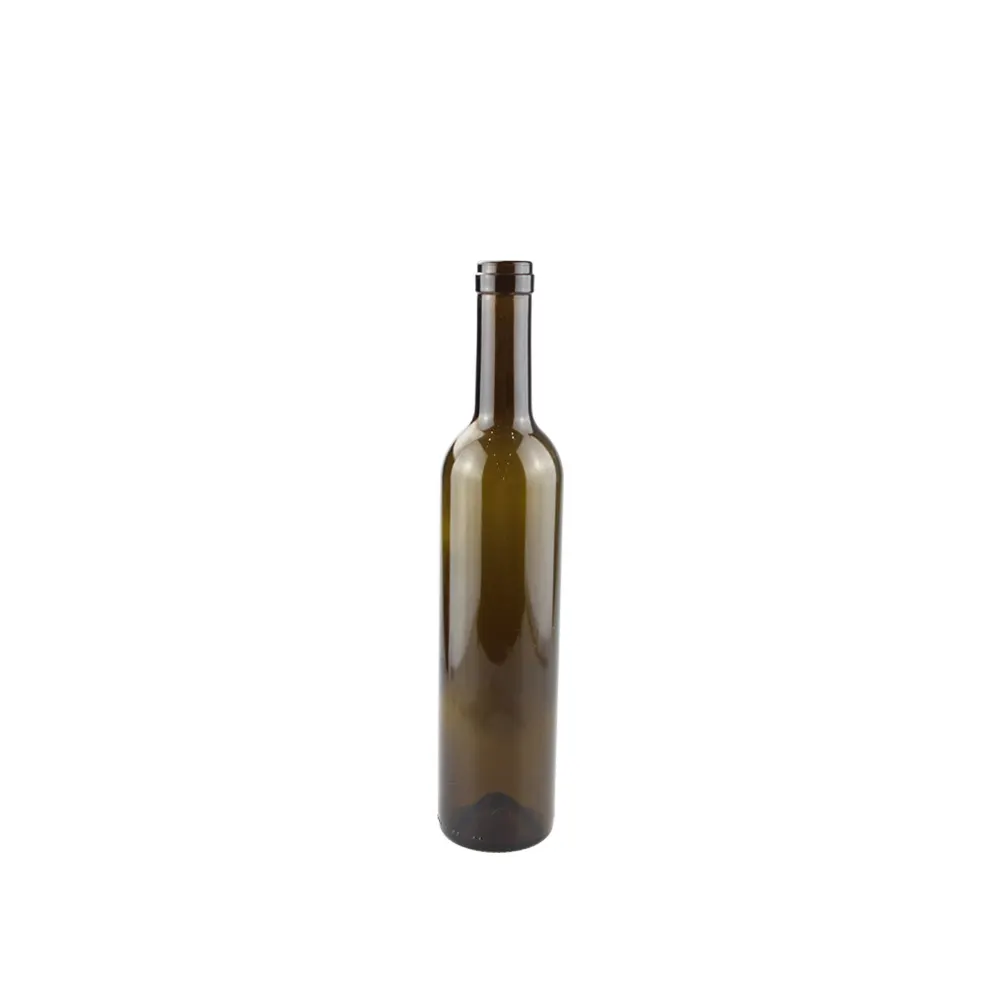
| Bordeaux wine | 750 ml | Green | 18.5 mm | Colmated natural, 44mm |
| Burgundy wine | 750 ml | Green | 18.5 mm | Natural cork, 49mm |
| Bar-top spirits | 500 ml | Flint | 18.5 mm | T-cork with wood cap |
| Apothecary diffuser | 100 ml | Amber or flint | 22 mm | Natural cork stopper |
A colour or cork outside these pairings generally turns the order into a production run. Stock bottles also limit how you brand: the mark goes on a capsule, a label or the cork top, not into embossing or a proprietary shape. The cork choice is narrower too. Technical 1+1, agglomerated and standard T-corks are the tooled options, whereas a 49mm natural wine cork or a custom T-cork cap is a private-mould decision.
What moves the cost
Prices are quoted per project, so this section describes direction only. Two things shift the cost of a bottle-and-cork set. Green and amber glass cost more than flint because of colourant and yield. Bar-top and natural wine corks cost more than agglomerated and technical ones.
A private mould or decoration fee is a fixed amount spread across the order. It nearly disappears per unit on a large run and dominates on a small one, which is why stock moulds exist. If you do go private, ask for the tooling fee as its own line and for the unit cost at each volume step, so you can see where the fee is recovered. Our companion page on bulk glass bottles with corks goes further into sealing and bulk orders.
Specifying for transit so corks do not leak
A filled bottle holds a pocket of gas above the liquid. Inside a summer container the temperature can swing from about 20°C to 55°C or more. The gas expands with the heat and the liquid barely does, so the pressure lands on the cork. If the cork is under-compressed or the headspace is too small to absorb the swell, the cork moves outward and the closure weeps. Air freight adds a pressure drop on ascent. These leaks come from the specification, not from a defect in the cork, and four lines on the specification prevent them.
- Headspace. Hold 3–5% so the expanding gas has room. This is a fill specification, and it belongs on the same drawing as the closure.
- Cork show. Keep 3–5mm above the lip, as described above, to prove the insertion depth is in band.
- Sealing surface. Confirm neck-bore concentricity and the lip chamfer on the bottle drawing, and the surface finish and diameter tolerance with the cork supplier. A chipped lip or an out-of-round bore defeats a sound cork.
- Packing posture. Upright packing keeps the cork out of constant contact with the liquid, which shortens the wick path if a cork is marginal. It is the usual choice for oil and spirits. Laying wine on its side keeps the cork moist in long storage, yet in transit it puts more cork against liquid. Transport posture and storage posture are separate decisions. Put the transport posture on the packing specification and test in that posture.
Before shipping, validate the pack with a 7-day 40°C inversion test. It exists to expose a gap in the specification while the goods can still be corrected.
What to include in a cork bottle brief
We check the drawing, match the project to a suitable glass plant and coordinate samples, so a fuller brief produces a tighter answer. Send what you already know through the quote form:
- bottle family and shape (marasca, dorica, Bordeaux, Burgundy, bar-top, apothecary or diffuser);
- capacity and glass colour;
- neck finish or bore, with the ±0.3mm tolerance you will hold;
- cork type and grade, cork diameter with tolerance, and the insertion depth and cork show required;
- the extraction tool the end user will have;
- the target market and its food-contact rules (FDA, EU 10/2011 or other);
- quantity, destination port and decoration (capsule, label, cork print).
For reference, physical testing of cylindrical cork stoppers follows ISO 9727. Food-contact compliance is assessed against FDA 21 CFR 174–186 and EU Framework Regulation (EC) No 1935/2004.
Frequently asked questions
Which cork grade suits olive oil, and which suits spirits?
Olive oil sold within 12–18 months does well with an agglomerated or technical 1+1 cork carrying a food-grade paraffin-silicone surface treatment. Spirits aged in the bottle, or oils held 2+ years, justify a colmated natural cork or a bar-top with a natural cork shank. Match the grade to the hold time.
What is the minimum order for cork bottles?
Minimums are quoted per project. They depend on whether the bottle runs on a stock mould or a private one, and on the decoration and cork you choose.
What should I budget for cork-finish bottles?
There is no single band. The quote moves with the mould, the glass colour, the cork grade, decoration, quantity and freight terms.
Will cork-sealed bottles leak in air freight or a summer container?
They can. At container temperatures of 45–55°C, a pack with the wrong headspace or an under-compressed cork will weep. The 3–5% headspace, the 3–5mm cork show and the inversion test described above are the controls.
Can bottles and corks arrive as one kitted shipment?
Yes. We coordinate bottles with matched corks, capsules and shrink bands as a single SKU, so the filler receives a line-ready pack. That also gives you one inspection point and one lot number to trace if a fit problem shows up on the line.
How do I check a cork supplier's TCA control before ordering?
Ask for the diameter and its tolerance band, the surface treatment specification, a written description of the TCA-control process (steam, CO2 or other treatment steps), and a lot-traceable limit sample you can measure and smell. Read the documents instead of filing them, and put the lot number on the purchase order. Do not accept a claimed third-party certification you have not seen.