For glass chemical bottles, choose the glass first: soda-lime (hydrolytic class HGB 3, USP Type III) for neutral and mildly acidic or alkaline liquids at ambient temperature, and borosilicate 3.3 (HGB 1, USP Type I) for concentrated acids, high-purity solvents and autoclaving at 121°C. Then fix the neck finish, which for laboratory reagent bottles is the GL45 thread under ISO 4796, and match the cap liner to the contents. If the filled bottle will travel as dangerous goods, the bottle, closure and carton have to be specified together as one UN-tested package.
Bottle formats, capacities and neck finishes
Three formats cover most laboratory and repacking demand. The GL45 reagent bottle is the square-shouldered laboratory standard with a blue polypropylene cap and pour-out ring. The Winchester is the traditional long-necked, narrow-mouth solvent bottle used for acids, bases and cleaning solvents. Amber storage bottles, narrow or wide mouth, hold light-sensitive reagents, essential-oil feedstocks and fragrance concentrates.
| Bottle type | Capacities | Neck finish | Glass | Usual case pack |
|---|---|---|---|---|
| GL45 reagent bottle, square shoulder | 100 / 250 / 500 / 1000 / 2000 / 5000 ml | GL45 screw thread, PP cap and pour ring | Soda-lime or borosilicate 3.3, clear or amber | 24 pcs (100–500 ml), 12 pcs (1 L), 6 pcs (2–5 L) |
| Winchester solvent bottle | 500 / 1000 / 2500 ml | 28 mm or 31 mm screw / ROPP | Soda-lime, amber as standard | 20 pcs (500 ml), 12 pcs (1 L), 6 pcs (2.5 L) |
| Narrow-mouth reagent bottle | 30 / 60 / 125 / 250 / 500 ml | 18–28 mm screw, phenolic or PP cap with cone liner | Soda-lime, clear or amber | 48–144 pcs by size |
| Wide-mouth storage bottle | 60 / 125 / 250 / 500 / 1000 ml | 33–70 mm screw | Soda-lime, clear or amber | 24–72 pcs |
| Dropping bottle, glass body with LDPE dropper | 30 / 60 / 125 ml | 18–22 mm | Soda-lime, amber | 72–144 pcs |
Cartons are five-ply corrugated masters with divider cells, sized so that a 20GP container carries a predictable count of sellable units; for the 500 ml amber GL45 bottle that is roughly 22,000–26,000 units. In a private-label reagent line, amber GL45 in 500 ml and 1 L typically accounts for about 60% of reorder volume, so those two SKUs are a sensible base for a first container before Winchester formats are added.
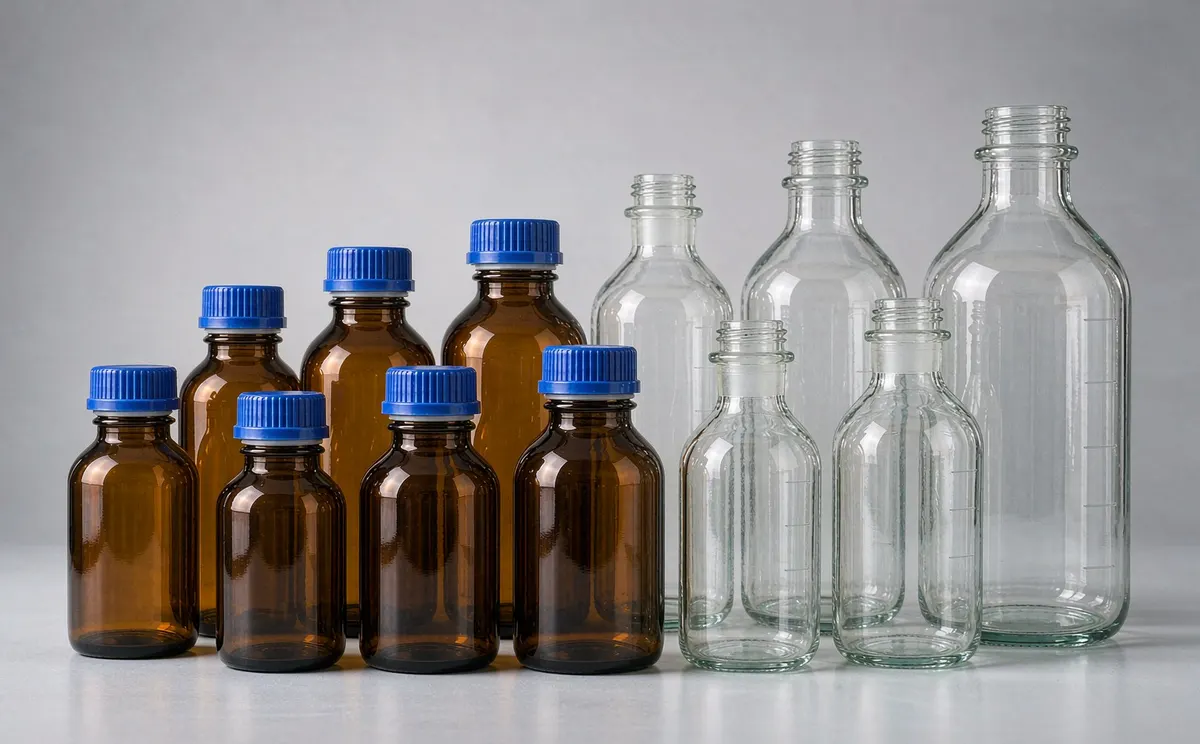
Soda-lime or borosilicate 3.3
Glass composition has more consequences than any other line in the specification, and it is the one most often settled on cost alone. The two materials behave differently under heat and under chemical attack.
| Property | Soda-lime | Borosilicate 3.3 |
|---|---|---|
| Hydrolytic resistance | HGB 3 / USP Type III | HGB 1 / USP Type I |
| Thermal expansion coefficient | approximately 9 × 10⁻⁶/K | 3.3 × 10⁻⁶/K |
| Heat handling | Copes with warehouse temperature swings; not for repeated autoclaving or sudden shock above roughly 80°C differential | Autoclaving at 121°C and repeated sterilisation cycles |
| Suitable contents | Dilute cleaning chemicals, fragrance bases, glycols, alcohols below high proof, most aqueous reagents | Concentrated acids (not hydrofluoric, not hot concentrated phosphoric) and high-purity solvents held long term |
| Typical use | Winchester bottles, economy reagent lines, industrial repacking | GL45 bottles for analytical, university and quality-control laboratories |
Borosilicate matters for high-purity solvents because ions leach slowly from a soda-lime wall and contaminate the contents over long storage. Laboratories usually leave no room for debate: the end user's SOPs name borosilicate 3.3, so a distributor serving them has to carry it.
Most distributors therefore run two tiers. Soda-lime, the less costly glass, carries the volume side: solvent repacking, cleaning-chemical filling, and storage of fragrance and flavour raw materials. Borosilicate serves the laboratory side, where compliance with the specification decides the purchase. A borosilicate bottle should carry permanent capacity and graduation marks in high-temperature ceramic enamel, a retrace code, and a "Boro 3.3" mark moulded into the base, which lets a downstream customer confirm the material without paperwork.
Chemical bottles are the wrong starting point for ingestible or nutraceutical products. Those fills need food-grade liner systems, as used on glass jars for supplements, not chemical-grade phenolic caps.
GL45 thread and closures
GL45 is a screw thread of 45 mm nominal diameter, standardised under ISO 4796. Its value is the family of closures built around it, which lets one bottle body serve for storage, transport and dispensing.
- Standard cap: blue polypropylene with an internal sealing lip, rated for autoclaving to 140°C, used with a pour-out ring for drip-free decanting.
- Tamper-evident cap: an integral breakaway band shows whether the bottle was opened in transit. It is the usual choice for solvents with high vapour pressure.
- PTFE-lined cap: for aggressive solvents.
- Adapter cap: takes tubing connectors, stopcock fittings and pump dispensers, turning a storage bottle into a bench-top dispensing station.
Bottles are best supplied with cap and ring already fitted to a controlled torque, so a carton arrives ready for the shelf and not as three loose parts.
Thread accuracy
Thread consistency is where supply goes wrong quietly. A GL45 thread that is off-spec by as little as 0.3 mm still accepts a cap, but loses torque retention after the first autoclave cycle. The result is slow seepage that the end user finds weeks into storage.
The checks we ask a plant to document are a go/no-go ring gauge test against ISO 4796 on every production lot, and a cap torque retention test: 48 hours standing inverted at 40°C. Having both recorded on the lot certificate helps when your own customers audit you.
Keep GL45 stock clearly separate from dispensing finishes. Glass pump bottles for lotions and soaps use 24/410 and 28/410 necks, an entirely different closure system, and mixing the two in a warehouse leads to mis-shipments.
Liners and torque for a leak-free seal
Three details prevent leaks at bottle level: the liner, the application torque and how the seal is tested.
| Contents | Liner or closure |
|---|---|
| Aqueous reagents | PE foam liner, adequate and more economical |
| Organic solvents such as acetone, toluene or hexane | PTFE-faced silicone liner or a full PTFE closure |
| Undiluted aromatics and aroma chemicals | Cone-seal phenolic cap |
Plain polypropylene caps and ordinary polyethylene foam liners swell or degrade when exposed to solvent vapour for long periods, which is why organic solvents need PTFE.
Application torque is specified at 8–12 N·cm for GL45 PP caps and 6–10 N·cm for 28 mm phenolic caps. Repackers should check their capping heads against a torque meter every quarter.
Temperature is the third factor. A bottle filled at 20°C and then carried through a 45°C container crossing builds internal pressure, and that pressure finds any marginal seal. Run the inverted-stand leak test at 40°C, not at ambient.
Amber glass and light protection
Around a third of laboratory reagents are light-sensitive, and the share is far higher among fragrance raw materials. Silver nitrate solutions, hydrogen peroxide, iodine tinctures, many essential-oil isolates and most aromatic aldehydes break down measurably under UV and short-wavelength visible light.
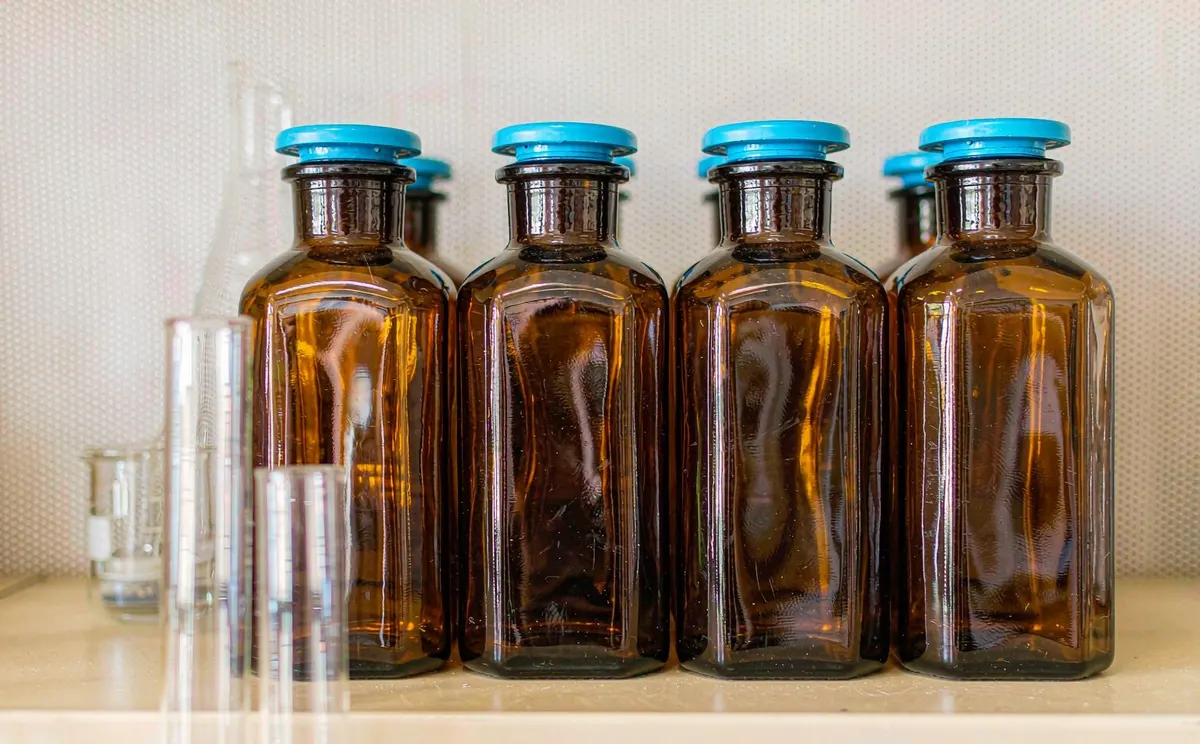
Amber glass absorbs light below approximately 470 nm. In the 290–450 nm UV band it holds transmission under 10%, the threshold that pharmacopeial light-protection standards refer to.
Specify glass that is amber-melted through the full wall. Spray-coated amber bottles circulate in the wholesale market, and a surface coat can scratch, delaminate or wash off during crate washing, which fails exactly those buyers who rely on the protection. The point is worth stating in your own catalogue copy.
On decoration, screen-printed hazard pictograms and writable matte panels are useful extras for the teaching-laboratory market. Brands that span personal care and laboratory lines can run printing and frosting together with their cosmetic glass bottles, so one artwork approval covers both categories.
What each buying channel usually specifies
| Channel | Typical bottles | What matters most |
|---|---|---|
| Laboratory consumables distributors | GL45 from 100 ml to 5 L, narrow-mouth reagent bottles in the 30–500 ml range, dropping bottles, wide-mouth storage bottles | Wide SKU spread at moderate depth; mixed-SKU pallets and mixed containers, with up to 40 chemical-bottle SKUs in one 20GP |
| Industrial chemical repackers | Amber Winchester, 500 ml–2.5 L, with 28 mm tamper-evident caps, filled from 200 L drums | UN-rated packaging for the filled product, closures that stay tight on vibrating truck routes, landed cost per filled unit |
| Fragrance and flavour raw-material traders | Amber narrow-mouth bottles in 100 ml, 250 ml and 500 ml with cone-lined phenolic caps | Through-coloured amber, caps that resist undiluted aromatics, screen-printed branding for bottles kept on customers' shelves |
| Teaching-laboratory suppliers | Clear soda-lime GL45 and narrow-mouth reagent bottles | Graduation marks, durable caps and resistance to breakage in student hands |
For repackers, liability sits on the filled package and not on the empty bottle. Bottle, cap and carton should therefore be specified and validated as a single system instead of being bought as loose components.
For student use, the heavier 250 ml and 500 ml square-shoulder reagent bottles, which run 15–20% heavier than economy-grade equivalents, stand up better to handling.
Distributors who serve both laboratory and aromatics customers can simplify cap stock with Boston round glass bottles. Their 30–500 ml amber rounds take the same cone-lined cap finishes, and they suit non-corrosive liquids that do not need a chemical-grade bottle.
UN packaging groups for filled bottles
Liquids classed as dangerous goods are assigned to UN Packaging Group I (high danger), II (medium) or III (low). The outer packaging must bear a UN mark confirming that it passed drop, stack and pressure tests for that group.
Winchester bottles in 500 ml, 1 L and 2.5 L, with specified closures and five-ply divider cartons, are available as UN-tested combination packaging rated for Packaging Group II and III liquids. That covers most solvents, cleaning chemicals and laboratory reagents moved by road and sea.
A UN mark is valid only when the package is assembled exactly as it was tested. Ask for the test reports together with the assembly specification behind the certificate: closure torque, carton grade, divider layout, and tape and strapping pattern.
For filled goods going by sea, add desiccant bags inside each master carton and stretch-wrapped pallets with corner protection.
Order planning and lot documents
Minimum quantities, unit cost and production timing are quoted per project. What drives them is the format and glass type, any mould or decoration work, the quantity, whether the order fills a 20GP or 40HQ container or ships by the pallet, and the freight terms.
Whatever the order size, ask for a certificate per production lot. It should cover glass composition, hydrolytic class, thread gauge verification, cap torque retention and visual AQL results.
If you are extending from general round bottles into chemical-grade packaging, both categories can be quoted on one proforma, so the landed cost of each can be compared directly. A SKU list, or a photo of the bottle you buy now, is enough to start the specification.
FAQ on glass chemical bottles
How do soda-lime and borosilicate reagent bottles differ?
Soda-lime is USP Type III glass for neutral or mildly reactive liquids kept at ambient temperature. Borosilicate 3.3 is USP Type I: it withstands concentrated acids, thermal shock and repeated autoclaving, and analytical and university laboratories specify it as standard.
What does GL45 mean?
It is the 45 mm laboratory screw thread defined in ISO 4796. Any GL45 closure fits any GL45 bottle, including standard caps, tamper-evident caps and dispensing adapters.
Which liner suits organic solvents?
A PTFE-faced silicone liner or a full PTFE closure. Keep PE foam liners for aqueous reagents.
Is the amber colour a coating?
It should not be. Amber chemical bottles are specified as through-coloured glass, melted amber across the whole wall, so the light protection cannot wear away in cleaning.
Can the bottles ship UN-rated dangerous goods?
Yes, as a tested combination. The Winchester sizes with specified closures and divider cartons are rated for Packaging Groups II and III, provided they are assembled to the tested specification.
What is the minimum order?
It is quoted per project and depends on the mould and the line the bottle runs on.
How long do samples and production take?
Timing is confirmed per project once the mould, decoration and line schedule are known.