Filed under brown glass bottles; the moulds we quote for this are pictured at the foot of the page.
For a dry supplement, the usual glass answer is an amber packer: a straight-sided, wide-mouth soda-lime bottle in sizes from 60 cc to 500 cc, with a GPI continuous-thread finish between 33-400 and 53-400, a child-resistant polypropylene cap, an induction foil seal and a desiccant matched to the headspace. Amber glass specified to pass less than 10 percent of light below 450 nm protects light-sensitive actives, and the foil-plus-desiccant stack keeps powders and probiotics dry. Which size, neck and liner you need depends on the product form, so the sections below are organised around that choice.
What the container has to protect against
Light is the first risk. Riboflavin (vitamin B2), vitamin D3, folic acid, astaxanthin, CoQ10 and curcumin all lose potency under visible light in the 400 to 500 nm band, and clear or frosted PET and HDPE let 70 to 90 percent of that band through. On a retail shelf lit at 800 to 1,500 lux for 90 days, an unprotected fill can lose 8 to 15 percent of its riboflavin and 5 to 12 percent of its vitamin D3.
Moisture is the second risk, and the one behind most returns. Hygroscopic powders such as collagen peptides, magnesium citrate, ascorbic acid and instantized B-complex blends start caking once relative humidity passes 35 percent; at 55 to 65 percent RH they set into lumps the scoop cannot break. A continuous-thread cap with no liner passes roughly 0.3 to 0.8 grams of water vapor per 100 square inches per 24 hours at 38 degrees Celsius, far too much for probiotic or electrolyte products. A heavier wall does nothing about this. The barrier has to be built at the mouth, with a foil membrane and a correctly sized desiccant.
The third factor is how the pack feels. Shoppers in the vitamin aisle tend to read HDPE and PET as value-tier, and amber glass as pharmacy-grade. A 500 cc amber packer weighs 215 to 230 grams, where an HDPE bottle of the same volume weighs 22 to 28 grams, and the customer notices that difference before reading the label.
Standard sizes and neck finishes
Packers are sized in cubic centimeters (cc). One cc equals one milliliter for a water-density fill, and working in cc lets you size the bottle to the settled bulk density of the product instead of to a fluid ounce. As a guide, a 60 cc packer takes about 50 to 70 grams of average-density vitamin tablets, 35 to 50 grams of a fluffy probiotic powder, or 40 to 60 grams of collagen peptides, depending on particle size and tap density.
The neck follows the GPI continuous-thread (CT) standard of the Glass Packaging Institute. The code gives diameter then thread style: 38-400 means a thread diameter of about 38 mm with a 400-series single-start thread at 1/4 inch pitch, so the cap closes in one full turn. The standard amber series runs as follows, with height measured over the finish and diameter at the widest point of the body.
| Capacity (cc / approx oz) | GPI finish | Height (mm) | Body diameter (mm) | Closure |
|---|---|---|---|---|
| 60 cc / 2 oz | 33-400 | 58 | 43 | CRC PP, foil-ready |
| 100 cc / 3.4 oz | 38-400 | 70 | 50 | CRC PP, foil-ready |
| 120 cc / 4 oz | 38-400 | 82 | 53 | CRC PP, foil-ready |
| 150 cc / 5 oz | 38-400 | 92 | 56 | CRC PP, foil-ready |
| 200 cc / 6.7 oz | 45-400 | 98 | 62 | CRC PP, foil-ready |
| 250 cc / 8.4 oz | 45-400 | 110 | 65 | CRC PP, foil-ready |
| 300 cc / 10 oz | 45-400 | 120 | 68 | CRC PP, foil-ready |
| 400 cc / 13.5 oz | 53-400 | 132 | 78 | CRC PP, foil-ready |
| 500 cc / 16.9 oz | 53-400 | 150 | 82 | CRC PP, foil-ready |
Pick the finish from the filling method and the dispensing tool, not from appearance. A 33-400 mouth suits tablet and capsule counting lines because the narrow opening spills less. Powder products that ship with a 15 to 25 mm scoop need 45-400 or 53-400 so the scoop goes in and out cleanly. The larger bottles move to the wider finishes for a second reason as well: more thread engagement spreads the capping torque, which lowers the chance of a stripped or cocked cap on a tall bottle.
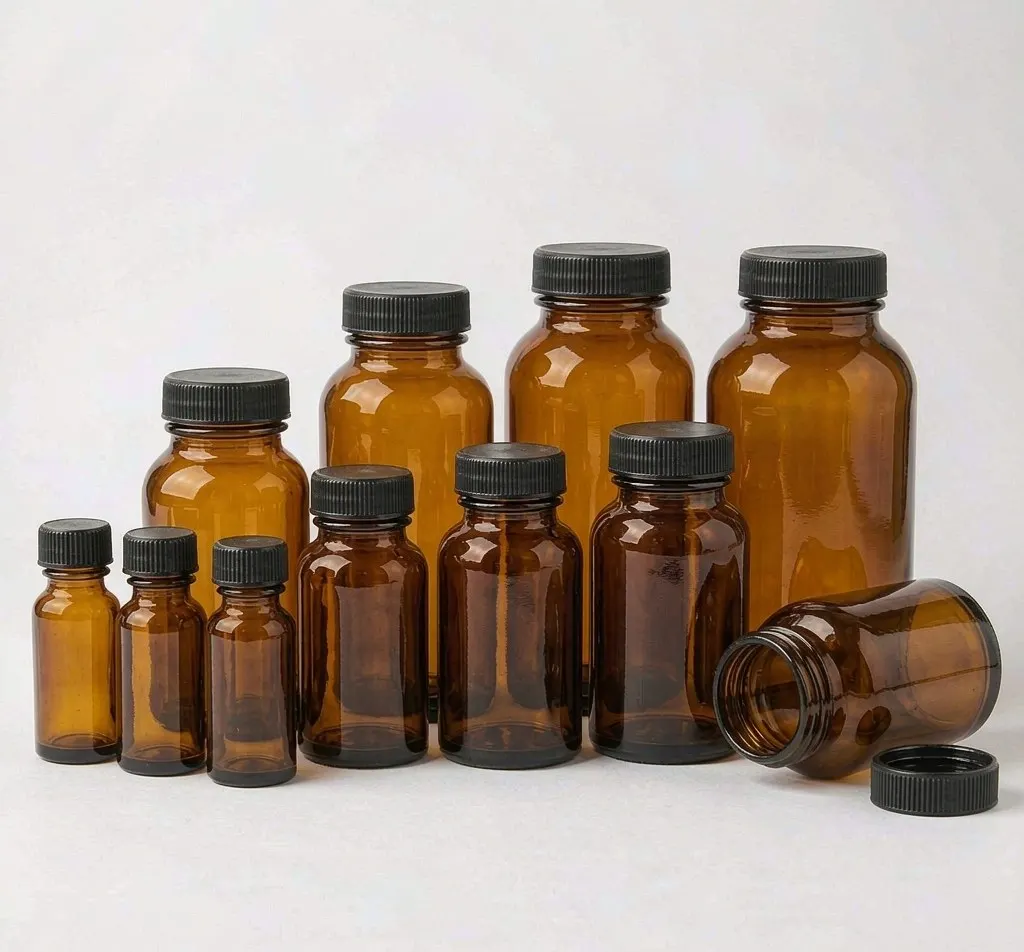
Glass specifications to write into the drawing
Light transmission
The amber color comes from iron, sulfur and carbon species added to the soda-lime melt, which make the glass absorb short-wavelength visible and near-UV light. On a UV-Vis spectrophotometer, amber soda-lime glass passes less than 10 percent of light below 450 nm and typically under 5 percent below 400 nm. That takes out the 315 to 400 nm UV-A band and the violet-blue region where riboflavin and carotenoids absorb.
Treat this as a measured requirement. We specify a 450 nm transmission (T-450) below 10 percent at a 2.0 mm wall, tested per ASTM E903, and ask for the actual T-450 figure on a lot-level Certificate of Conformance. For an active with a light-stability claim, that number decides whether a 6-month accelerated photo-stability study holds potency inside the 90 to 110 percent label window that supplement shelf-life protocols commonly use.
Wall and finish dimensions
Body wall should sit at 2.0 to 2.4 mm and the finish at 3.0 to 3.6 mm, enough for the neck to take the 1.8 to 2.4 N.m torque of a rotary capper without cracking. Finish concentricity is held within 0.4 mm, and the land (the flat top rim the liner seals against) must be flat enough that the liner seats without bridging.
The finish is where packer quality is decided. A neck that is 0.2 mm out of tolerance can pass a torque test and still let moisture past the induction seal, so finish gauging matters more than any other dimensional check.
Closure, liner and desiccant
The closure stack does three jobs: it resists children, seals the bottle hermetically, and recloses after opening.
Child-resistant cap
The standard cap is a two-piece polypropylene push-and-turn design, in which a spring or ratchet ring has to be pressed down before the cap will rotate. It is designed to the performance protocol of 16 CFR 1700.20, the test method under the U.S. Poison Prevention Packaging Act: 85 percent of adults must be able to open the pack and 80 percent of children under five must not. Closure lots are torque-verified to an engagement range of 1.6 to 2.2 N.m so the cap seats without stressing the glass. "Foil-ready" means the cap accepts an induction liner applied on your line, and it also runs with a pressure-sensitive or pulp-and-foil liner where there is no induction sealer.
Liner options
| Liner | How it seals | Barrier | Use for |
|---|---|---|---|
| Induction foil | 0.02 mm aluminum foil on a 0.25 to 0.40 mm pulpboard and film backing, welded to the finish land under a coil at 400 to 1,200 watts for 0.3 to 1.2 seconds | Hermetic; seal strength 25 to 45 N per 25 mm width; also gives tamper evidence | Powders, probiotics, gummies, anything moisture-sensitive |
| Pressure-sensitive (PS) foam | Bonds to the finish on first application and reseals at each reopening; no sealing equipment needed | Not hermetic; roughly 0.1 to 0.3 g/100 in²/24 h of vapor | Tablets and capsules with low moisture sensitivity |
Choose the liner from the product's critical relative humidity, not from what is easiest on the line. With an induction seal and a 1 to 2 gram desiccant canister, a 120 cc packer holds internal RH under 15 percent for 12 months. We record the agreed liner in the packing specification for each lot.
Desiccant format and sizing
There are three ways to add desiccant:
- Drop-in canister of silica gel or molecular sieve 3A, in 1, 2, 3, 5 or 10 gram sizes. It sits in the neck shoulder above the fill line and is the standard for powders and probiotics.
- Packet of 1 to 5 gram. It costs less and works where a loose sachet among tablets or capsules is acceptable.
- Desiccant ring molded into the cap. This removes the canister step from the filling line and suits high-speed operations.
Size it to the headspace: one gram of silica gel for every 30 to 50 cc of headspace when the target is under 25 percent internal RH. Confirm the choice with a chamber study at 40 degrees Celsius and 75 percent RH before the specification is locked, and do not copy the canister size from a competitor's bottle.
Recommended set-up by product form
| Product | Packer and finish | Seal | Desiccant and headspace |
|---|---|---|---|
| Vitamin tablets, 500 to 1,500 mg | 100 cc or 120 cc, 38-400 | Foil optional; recommended for distribution zones above 90 percent RH | Fill to 60 to 70 percent of volume; 1 gram canister plus a cotton or rayon coil |
| Gummies | 120 cc or 200 cc; 45-400 from 200 cc up | Induction foil, CRC cap | Small canister or moisture-absorbing packet above the fill |
| Powders such as collagen | 200 cc or 300 cc, 45-400 or 53-400 | Induction foil, mandatory | 15 to 25 percent headspace; 2 to 5 gram canister |
| Capsules and probiotics | 120 cc or 150 cc | Induction foil, leak-tested | 3A molecular-sieve canister sized for under 20 percent RH |
| Herbal powders and cut leaf | 150 cc or 250 cc, 38-400 or 45-400 | Foil for storage above 70 percent RH | Canister where the herb contains essential oils that oxidize |
Tablets. The cotton or rayon coil keeps tablets from rattling in transit, and humidity is the enemy of the film coating. Set capping torque at 1.8 to 2.0 N.m: too much cracks the neck, too little lets in the moisture that makes the coating bloom.
Gummies. Gummies carry a lot of surface moisture, which migrates to the closure land and collects there, so a breathing bottle brings texture and microbial risk. The wider 45-400 neck lets the pieces come out without tearing. Because gummy actives are usually stabilized, amber matters less for potency here, though it still protects the product color.
Powders. This is the strictest case. The mouth has to clear a 20 to 25 mm scoop, and the fill must stop below the shoulder. Collagen and similar peptides cake irreversibly above 40 percent internal RH, which is why the foil is not negotiable. Results are best with a nitrogen sweep, or at least a slow auger fill that traps little air, and with the seal applied within 30 seconds of filling so the desiccant is not spent before the membrane welds.
Capsules and probiotics. Probiotics need the driest interior of any supplement. Lactobacillus and Bifidobacterium strains lose log-count viability above 50 percent RH and above 25 degrees Celsius. Several formulations also use light-sensitive carriers, so the amber tint is doing real work. For a probiotic shipped without cold chain, desiccant, foil and amber glass are the whole defense, and seal integrity should be documented for every lot.
Herbal products. These fall between tablets and powders. Amber protects the volatile compounds and keeps the green-to-brown color that buyers take as a sign of potency.
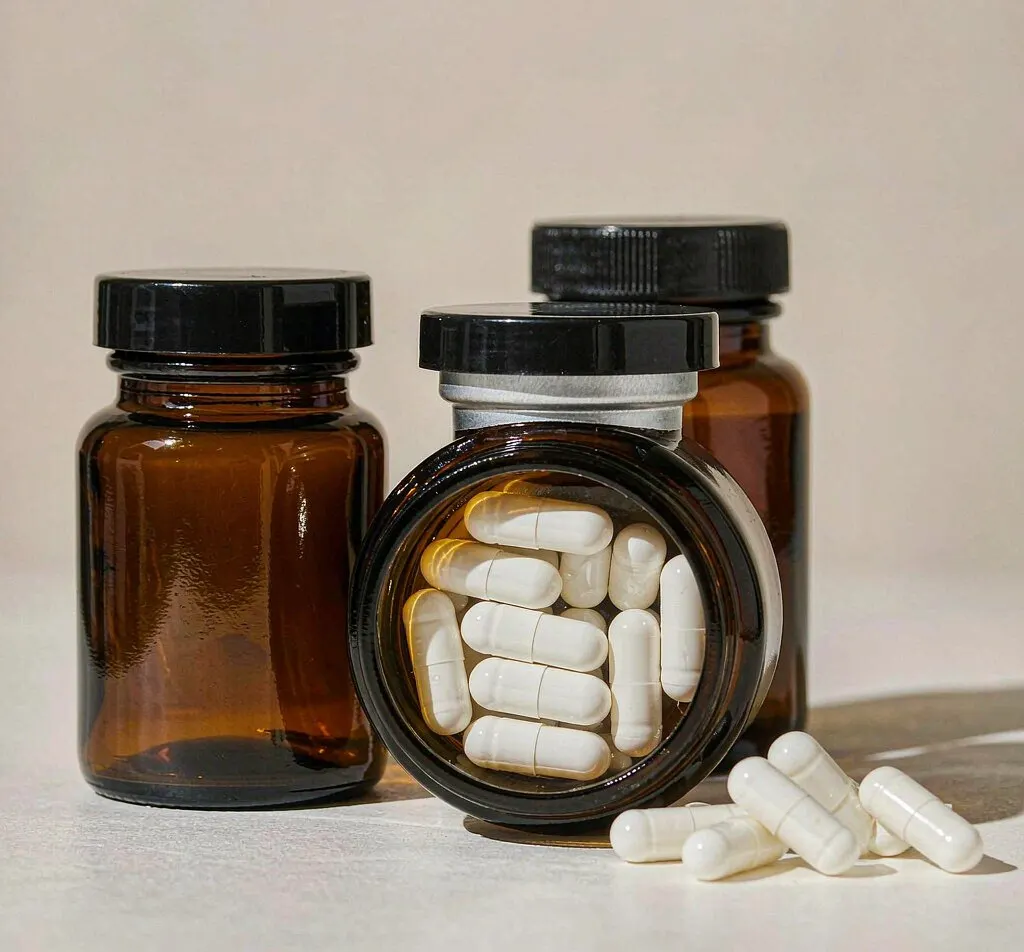
Amber glass compared with HDPE and PET
| Attribute | Amber glass | HDPE | PET |
|---|---|---|---|
| Water-vapor transmission | Impermeable | 0.2 to 0.4 g/100 in²/24 h | Around 0.1 |
| UV and oxygen | Blocked by the glass itself | Needs tint or coating to block UV | Needs tint or coating to block UV |
| Weight, 60 cc | 42 to 48 grams | 6 to 8 grams | — |
| Weight, 500 cc | 215 to 230 grams | 22 to 28 grams | — |
| Transit breakage | 0.3 to 1.0 percent with proper dividers | Near zero | Near zero |
For a light- or moisture-sensitive active, glass removes a whole category of failure that plastic can only reduce with multilayer structures. The choice is also about brand tier: brands that sell on purity and potency generally see the heavier pack pay back through shelf positioning and fewer returns.
Weight is the real cost of glass. By weight, a 40-foot high-cube container carries roughly 18,000 to 22,000 amber 120 cc packers against 70,000 to 90,000 HDPE units, so freight per unit is several times higher. The practical response is to ship full containers, consolidate SKUs, and pack with partitioned trays and enough cushioning to keep breakage inside the range above. Air freight defeats the purpose.
On sustainability, both sides have a case. Glass can be recycled indefinitely, and amber melts typically carry 25 to 40 percent cullet (recycled glass), which is estimated to cut virgin batch energy by 10 to 15 percent. HDPE is recyclable too, but in practice it tends to end up in lower-value streams, and glass gives back part of its advantage in transport.
Decoration routes
Three methods turn a stock packer into a branded pack.
- Direct silk-screen. From 1 to 4 spot colors of UV-cured ink on the amber body, registered within 0.3 mm. The cured print stands up to alcohol-based label remover and 40-degree-C washdown, which makes it the choice where labels would peel in a humid warehouse.
- Pressure-sensitive label. A wrap-around or front-and-back self-adhesive label on 50 to 70 micron PP or PET face stock with permanent acrylic adhesive, printable to 175 lines per inch. Artwork can change with every batch, which suits seasonal products and contract manufacturers. The bottle needs a flat or lightly tapered shoulder so the label does not tent, and the label panel dimension is held to plus or minus 0.5 mm.
- Shrink sleeve. A 40 to 60 micron PVC or PET-G film shrunk over the whole body for 360-degree graphics in matte or gloss, printed in up to 8 colors. A perforated tear-strip adds a second layer of tamper evidence on top of the foil.
Closures can be finished to match. For a product that sits between nutraceutical and cosmetic, the cap can be supplied in metallic gold, in the manner of the 4 oz cosmetic jars with gold lids.
Using one closure specification across product lines
Because the packer uses standard GPI finishes, a closure and liner qualified for supplements can carry over to neighbouring products. The airtight-lid glass jar range uses the same GPI finishes and CRC closures, so a brand can add dry-goods products without qualifying a second closure vendor.
The 38-400 and 45-400 finishes also appear on cosmetic jars bought in bulk and on jars for bath salts, so one qualification can cover supplements, cosmetics and bath products. For larger dry-storage formats, the wholesale storage jar range applies the same GPI standards at bigger capacities, with no change to the capping line.
Who is responsible for compliance
In the U.S., the glass and closure are food-contact articles. They fall under 21 CFR 175.300 for resinous and polymeric coatings and the FDA food-contact substance framework, and the amber colorants are listed inert glass components.
Under the DSHEA framework, the brand is responsible for the finished supplement: its claims, labeling and good manufacturing practice. The packaging side supplies an inert, dimensionally stable, food-contact-compliant container and certifies its materials. In practice that means a Declaration of Compliance and, where your quality team asks for one, a glass extractables profile to complete incoming-component qualification.
Checks to run before approving a packer supplier
We treat supplier selection as a qualification exercise and run these checks when matching a supplement project to a glass plant.
- Certification. ISO 9001, ideally with a food-safety system such as BRC or HACCP aligned to food-contact packaging, and a documented Declaration of Compliance for glass and closure materials.
- Measured amber cutoff. A lot-level transmission report showing T-450 under 10 percent. A plant that cannot produce a measured figure is guessing at its amber chemistry.
- Finish control. A GPI finish gauge report with concentricity and land flatness data, plus sample bottles that run on your capper at 1.8 to 2.2 N.m and hold under a 0.5 bar pressure-decay test.
- Seal qualification on your own equipment. Foil samples run on your induction sealer and checked at 25 to 45 N peel. A foil that welds on a laboratory coil may bridge on a production coil if the land is out of tolerance.
- Tooling depth. A standing mold library with 20 plus packer cavities shortens development and lowers first-order risk.
- Quality record. The rejected-unit rate for the last three months, with a target under 2 percent, and a clear non-conformance and replacement procedure.
It is also worth confirming that the supplier understands the DSHEA split described above and makes no claims about the supplement itself.
Frequently asked questions
Which GPI finish goes on a 4 oz supplement packer?
A 4 oz packer is nominally 120 cc and normally takes 38-400. Go up to 45-400 if the product is a scooped powder or the fill volume rises past 150 cc. Reserve 33-400 for small tablet or capsule counts under 60 cc, where the narrow mouth helps line speed.
Does amber glass stop all UV and visible light?
No. Amber is built to a cutoff, not a blackout. It removes most light below 450 nm and lets longer visible wavelengths through, which is acceptable because those wavelengths do not drive the known degradation pathways of supplement actives. For an extremely light-sensitive product, add an opaque shrink sleeve or a carton.
Do the child-resistant caps meet U.S. requirements?
The CRC polypropylene caps are designed and torque-verified, lot by lot, to the 16 CFR 1700.20 performance protocol. The brand still has to verify the closure on its own filled product and check any state-specific packaging rules.
How much desiccant does a collagen powder need?
Work from headspace, not fill weight. A 200 cc packer filled to 75 percent with collagen needs roughly 2 to 3 grams of silica gel in a drop-in canister above the fill line, together with the induction foil applied promptly after filling.
Is glass or HDPE the better choice for probiotics?
Amber glass is the stronger technical choice. It lets no oxygen or water vapor through, while HDPE passes moisture and blocks UV only with additives that cloud it. Glass costs more to ship; a barrier failure costs the viable count of the product.
Can the logo be silk-screened, and what is the minimum?
Yes, silk-screen printing is available on amber packers. The minimum quantity is quoted per project, because it depends on the mould, the decoration method and the run size.
What are the price and payment terms on a first order?
Pricing is quoted per project. It moves with the mould, the decoration, the quantity and the freight terms.
Can a new supplier be qualified without a full audit?
A supplier that clears the certification, transmission, finish-gauge, seal and reject-rate checks listed above can be qualified on a single first-article sample instead of a lengthy audit.