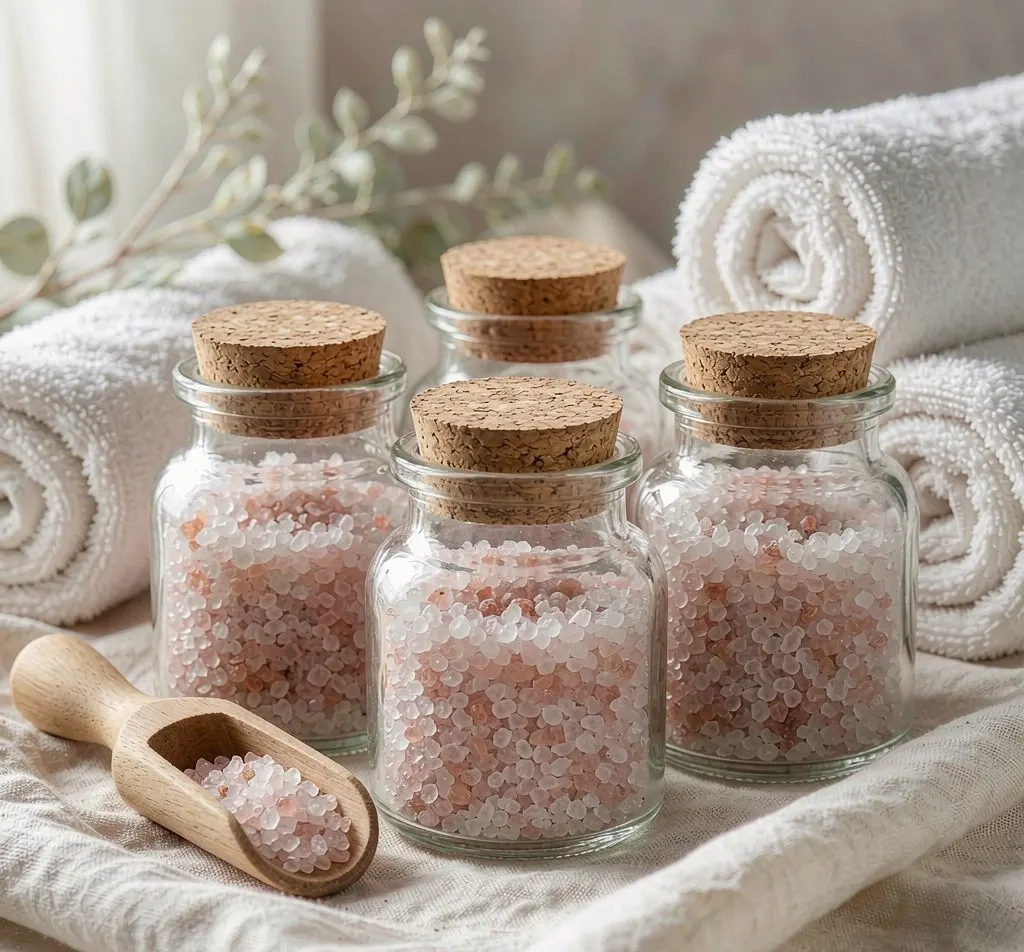
A wholesale bath salt jar is normally a wide-mouth, straight-wall glass cylinder in 100 ml, 150 ml or 250 ml, closed with cork, bamboo or aluminum and supplied with a wooden scoop. The detail that matters most is the seal: a cork disc backed by a silicone ring kept a salt blend free of clumps for 30 days in a humidity chamber, while a cork-only closure started to bridge at 9 days. Settle three things before you compare offers: the jar diameter at the seal ledge, the cap material, and whether the scoop is held captive.
Why bath salt needs more than a decorative lid
Bath salts are hygroscopic. A typical magnesium sulfate or sodium chloride blend starts pulling water from the air at 55 percent relative humidity, and after 14 to 21 days of exposure the granules fuse into a block nobody can scoop. Moisture gets in along the seal line, so a loose metal lid or a thin plastic cap does not help.
Two further problems come from the pack format. If the scoop travels loose in the carton, it reaches the fulfillment center separately from the jar and is either left out or has to be matched by hand. And on shelf, a narrow neck makes a wide spoon jam at the opening, while untreated clear glass shows fingerprints and uneven fill lines that shoppers read as defects. Jar geometry, the seal stack and a captive scoop solve all three.
Standard sizes and dimensions
The straight-wall cylinder is used on purpose. With a mouth 38 mm to 58 mm wide, a bamboo or beech scoop of 25 mm to 35 mm goes in and out without scraping, and the flat body gives the largest possible area for print or a label. The standard program looks like this.
| Model | Capacity (ml) | Mouth (mm) | Body (mm) | Height (mm) | Glass weight (g) | Standard cap |
|---|---|---|---|---|---|---|
| GBS-100 | 100 | 48 | 56 | 72 | 115 | Natural cork |
| GBS-150 | 150 | 53 | 62 | 80 | 138 | Natural cork |
| GBS-250 | 250 | 58 | 68 | 92 | 162 | Natural cork |
| GBS-100-B | 100 | 48 | 56 | 72 | 115 | Bamboo with silicone |
| GBS-150-B | 150 | 53 | 62 | 80 | 138 | Bamboo with silicone |
| GBS-250-A | 250 | 58 | 68 | 92 | 162 | Aluminum screw cap |
Dimensions are nominal. The working tolerance after annealing is plus or minus 0.5 mm on diameter and plus or minus 1.0 mm on height, and glass weight is controlled across the run.
The 48 mm to 58 mm cap platform is the same one used on cosmetic jars bought in bulk. A brand that also sells scrubs or masks can therefore run one cap inventory across several products.
Cork, bamboo or aluminum caps
| Cap | Look and position | Sealing behaviour |
|---|---|---|
| Natural cork | Classic spa style; renewable, light, artisanal in feel. The default choice. | Works with a silicone ring for moisture control |
| Bamboo or beech with integrated silicone ring | Higher tier, with a crisper finish | Tighter seal than plain cork |
| Aluminum screw cap, anodized matte black, rose gold or silver | Modern, minimalist ranges | Best seal retention after repeated opening, because the thread engages the glass neck directly |
For a spa gift set at the top of a range, the bamboo or beech cap with its built-in ring is the usual recommendation, paired with a spoon mounted on the lid.
How the seal keeps salt from clumping
The standard cork closure has two parts: an agglomerated natural cork disc 6 mm thick, and a food-contact-grade silicone ring seated in a groove under the cap. The cork supplies the natural look. The ring closes the vapor path.
The ring matters more than cork thickness because of how vapor travels. It diffuses through the gap between cap and glass ledge, and flat cork pressed on flat glass leaves micro-channels. A silicone ring compressed to 18 to 22 percent deflection fills those channels and cuts the effective diffusion rate by roughly an order of magnitude. Shore A 40 to 50 silicone is specified because it recovers better after repeated opening than a softer compound and resists the slight oil migration some blends show.
The chamber data behind this: a GBS-150 jar filled with a 12 percent moisture sodium chloride blend, held at 75 percent relative humidity and 25 degrees Celsius, showed no measurable clumping at 30 days with the cork-plus-silicone stack. A 4 mm solid cork closure with no ring began to bridge at 9 days. The same ring closure is used on airtight-lid glass jars for pantry and apothecary dry goods, so one seal specification can cover several categories.
Desiccant and oil barrier
For tropical or high-humidity distribution, plan a desiccant in the headspace. The straight-wall jars take a 1 gram to 2 gram silica gel canister or a humidity-indicator card under the scoop, and the wide mouth makes it easy to insert on the filling line. Because formulations vary, the desiccant is added by your co-packer; canisters can be supplied loose alongside the jars so it happens in one operation.
Blends carrying essential oils above 3 percent loading need a barrier between salt and cork. Some citrus and mint oils migrate into natural cork over months and change its compression set. A 0.08 mm PET disc liner retained in the cap prevents this.
Storage before retail
Keep sealed jars below 65 percent relative humidity and below 30 degrees Celsius, and do not stack pallets against cold exterior walls where condensation can form. It is worth printing this on the carton for your 3PL.
Keeping the scoop with the jar
A captive scoop can be built in three ways:
- Scoop-rest insert. A food-grade PET cradle clips under the lid and holds a 90 mm to 120 mm beech spoon horizontally, so jar and spoon ship and display as one unit.
- Lid-mounted saddle. A small recess on top of a bamboo cap seats the spoon vertically, which suits gift-set presentation.
- Neck-ledge clip. On aluminum-cap lines the spoon clips to the inside ledge of the neck and is taken out on first opening.
For the wood itself, specify FSC-certified beech or bamboo finished with a food-contact-safe hardwax oil. A film lacquer can crack at the screw line and drop flakes into the product. Wood should be dried to 8 to 10 percent moisture content before machining so caps do not warp later. To head off splinter complaints, spoons are tumble-sanded to a 600-grit finish and inspected at 5 per 1,000 units on a sliding AQL 2.5 plan.
Decoration options
| Process | What it gives | Specification to hold |
|---|---|---|
| Frosting (hydrofluoric acid bath or ceramic matte spray) | Soft translucent look that hides fill-line variation | Frost opacity of 70 to 85 percent on a reflectance check |
| Color spraying | UV-stable coating matched to Pantone or RAL, with a clear topcoat | 12 to 18 micron coating; scratch resistance to 500 rubs on the tape test |
| Silk screen | Logo and a short claim line in 1 to 4 colors; the cured ink withstands bathroom humidity | Registration within plus or minus 0.3 mm |
| Hot stamping | Metallic foil, typically gold or rose gold, as an edge line on the lid or a thin shoulder band | Die and foil confirmed before the run |
| Cured decal | Full-wrap artwork with photographic detail | 120 to 175 line screen |
With a full-wrap decal, leave the lower 15 mm of the body clear so the inspector on your filling line can still see the fill level. Color is matched against a signed target chip and held to plus or minus 1.5 Delta E, which keeps a reorder months later consistent with stock already on shelf.
If your range already uses gold accents, the anodized and hot-stamped gold seen on 4 oz cosmetic jars with gold lids can be carried over to bath salt caps. Screen preparation, stamping dies and coating-line slots all take time, so fix the decoration schedule before you announce a launch date; the timing is confirmed per project.
Gift sets and packing
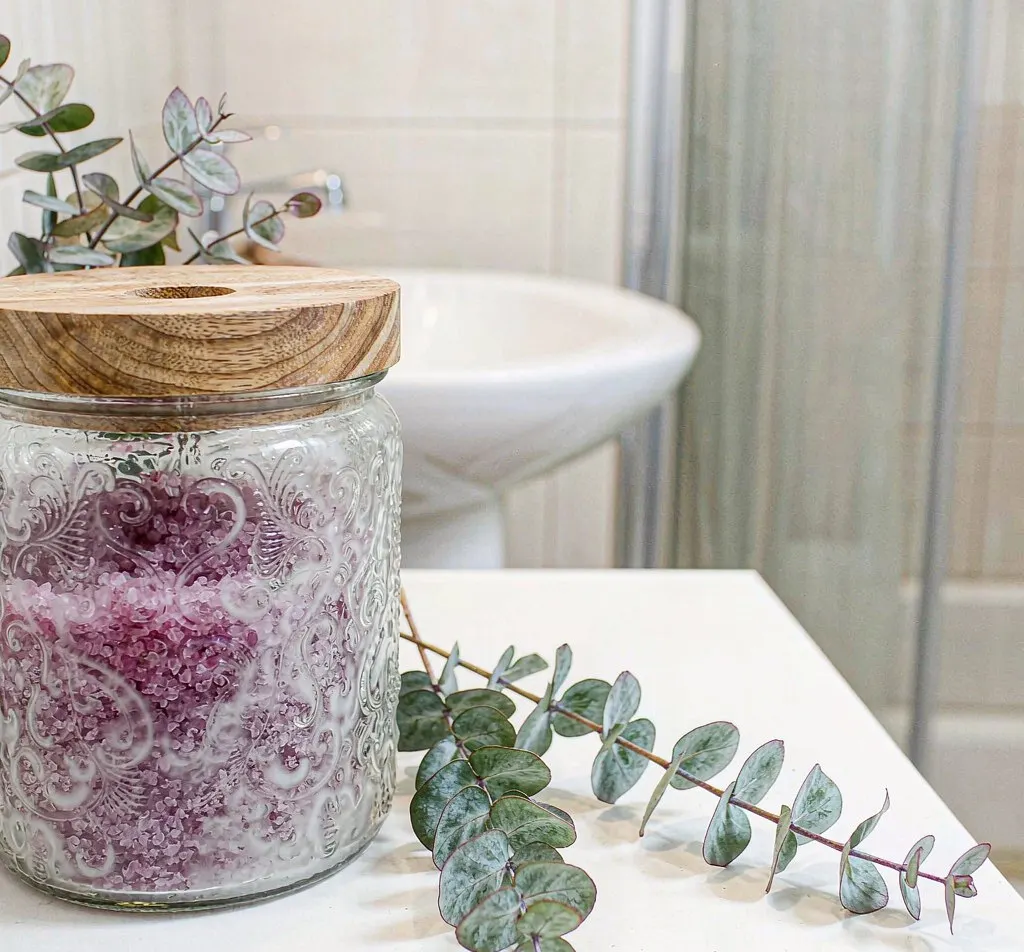
A two-piece or three-piece set usually combines a 150 ml or 250 ml bath salt jar with a body scrub jar or a matching storage jar in the same decoration. Both sit in a rigid paper carton with a die-cut insert that holds jars and spoon without rattle. The shared cap platform is what keeps mixed sets simple, since one closure fits several product types.
For holiday and corporate-gift programs, jars can ship knocked down, with caps and spoons in separate compartments of one master carton. Your packer assembles the set at the final mile, and you avoid paying air freight on empty carton volume. A packing specification for a contract packager can cover scoop orientation, desiccant placement and a tamper-evident neck band where the retailer asks for one.
The body can carry a pressure-sensitive label panel or stay clear for your own labeler. Standard counts are 12 or 24 jars per inner box and 48 or 96 per master. Pallets are planned at 1.2 by 1.0 meter Euro or 1.0 by 1.2 meter standard footprint, stacked to a maximum of 1.6 meters to clear typical container doors.
What to ask a supplier for
We treat this as a specification decision first. A low quote often conceals a gap in the seal, the tolerances or the paperwork. When we check an offer on a buyer's behalf, these are the points we look at:
- Humidity test data. A 30-day chamber result with stated RH and temperature, not a general claim of airtightness.
- Compression set. Silicone ring recovery above 90 percent after 5 open-close cycles.
- Glass standard. Limits for cord, seed and wall thickness. Thin spots below 1.8 mm on a 250 ml jar are a cracking risk.
- Shared cap platform. A closure common to your other SKUs lowers total inventory; the cosmetic glass packaging collection shows the related formats.
- Traceability. A material certificate for the glass, a food-contact statement for cap and scoop finishes, and a lot code etched on the jar base. Private label programs can have their own lot code and fill-by window on the base or carton.
- Continuity. Bath salt is a repeat purchase, and a supplier retiring a mold forces a redesign. Ask how the mold and the decoration slot are kept available for reorders.
On regulation, the EU and UK call for a glass food-contact declaration under Framework Regulation 1935/2004, plus a declaration that cap and scoop finishes meet the relevant food-contact and toy limits where these apply. For the US, confirm that the glass meets FDA food-contact expectations for the intended use and that printed inks are compliant for incidental contact.
Frequently asked questions
What is the minimum order for custom printed bath salt jars?
It is quoted per project. The mould, the line it runs on, the decoration process and the total quantity all move the figure.
What lead time applies to an order with custom color spraying?
Lead time is confirmed per project once the mould, the decoration and the line schedule are fixed. Decoration is the stage buyers most often underestimate.
Is private label available?
Yes. A logo applied by silk screen or hot stamp and a brand's own lot code are standard requests.
Which closure is the most economical?
Natural cork is the lowest-cost of the three cap families, and it still accepts the silicone ring that controls moisture.
How are the jars protected in sea freight?
Each jar is wrapped or partitioned inside its inner box, and inner boxes are packed into masters and palletized within the stack height given above.