A glass sugar dispenser for foodservice is specified on four points: a soda-lime body in 7 oz, 12 oz or 16 oz, a 58 mm or 63 mm continuous-thread finish, a 304 stainless pourer cap at 0.6 mm, and a pour aperture sized to the product — 6.0 mm for granulated sugar, 3.5 mm for cinnamon or cocoa. Fix those, plus a thermal-shock figure in °C and a named inspection level, before the order is placed. Most complaints we are asked to diagnose trace back to a cap that was never properly specified.
Sizes, finishes and cap types
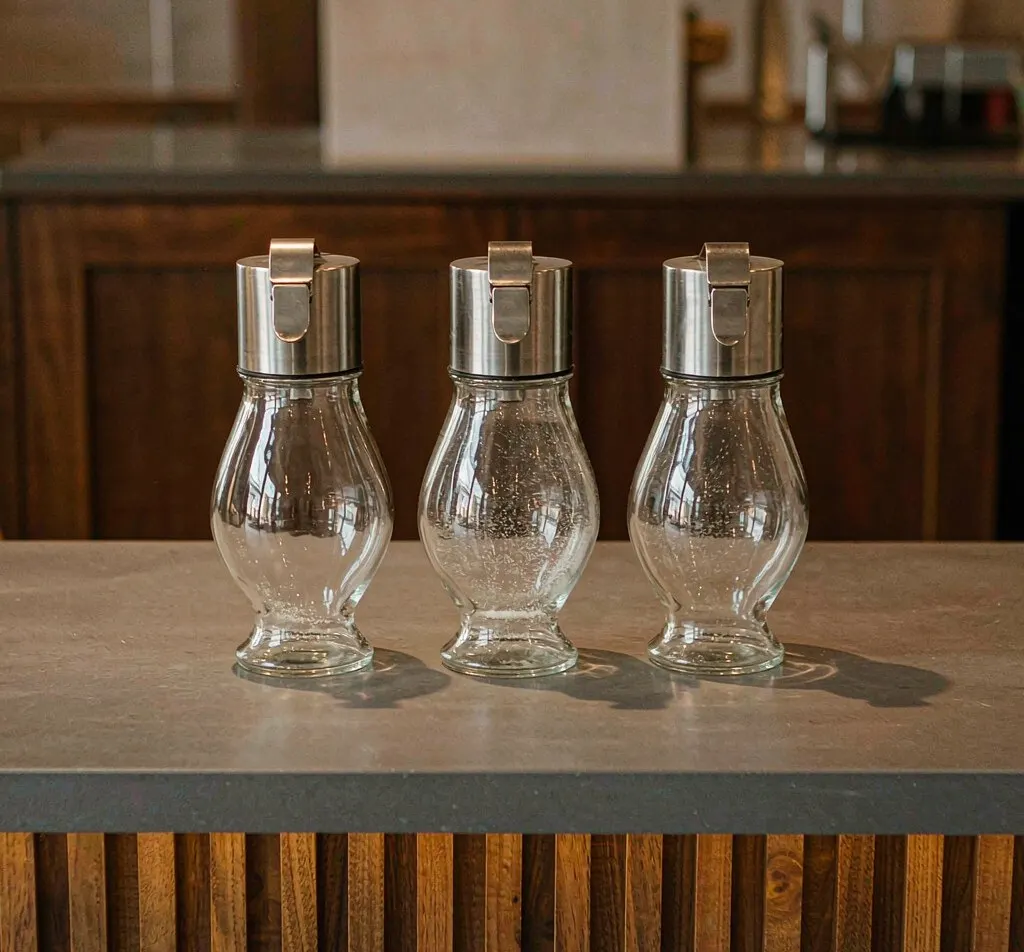
The range is built on the classic 12 oz restaurant profile, which drops into standard North American and EU caddy wells. A 7 oz countertop mini and a 16 oz high-capacity body for self-service stations sit either side of it. Every body is straight-sided soda-lime glass with a reinforced shoulder and a tooled threaded finish.
| Model | Capacity | Finish | Cap type | Cap material |
|---|---|---|---|---|
| OG-SG07 | 7 oz / 207 ml | 58 mm CT | Flap top pourer | 304 SS, 0.6 mm |
| OG-SG12 | 12 oz / 355 ml | 63 mm CT | Flap top pourer | 304 SS, 0.6 mm |
| OG-SG12C | 12 oz / 355 ml | 63 mm CT | Chrome zamak pourer | Chrome-plated zamak |
| OG-SG12B | 12 oz / 355 ml | 63 mm CT | Barista dusting top | 304 SS, 0.5 mm |
| OG-SG16 | 16 oz / 473 ml | 63 mm CT | Slotted shaker top | 304 SS, 0.6 mm |
These bottles are for dry granular and powder products only: sugar, sugar substitute, cinnamon, cocoa and grated-cheese-style toppings. Wet sauces belong in squeezable condiment bottles, and liquid sweeteners in a honey dispenser with a dipper and base warmer. On menus that carry both, keep the dry pourer and the honey dispenser visually distinct so guests do not confuse them.
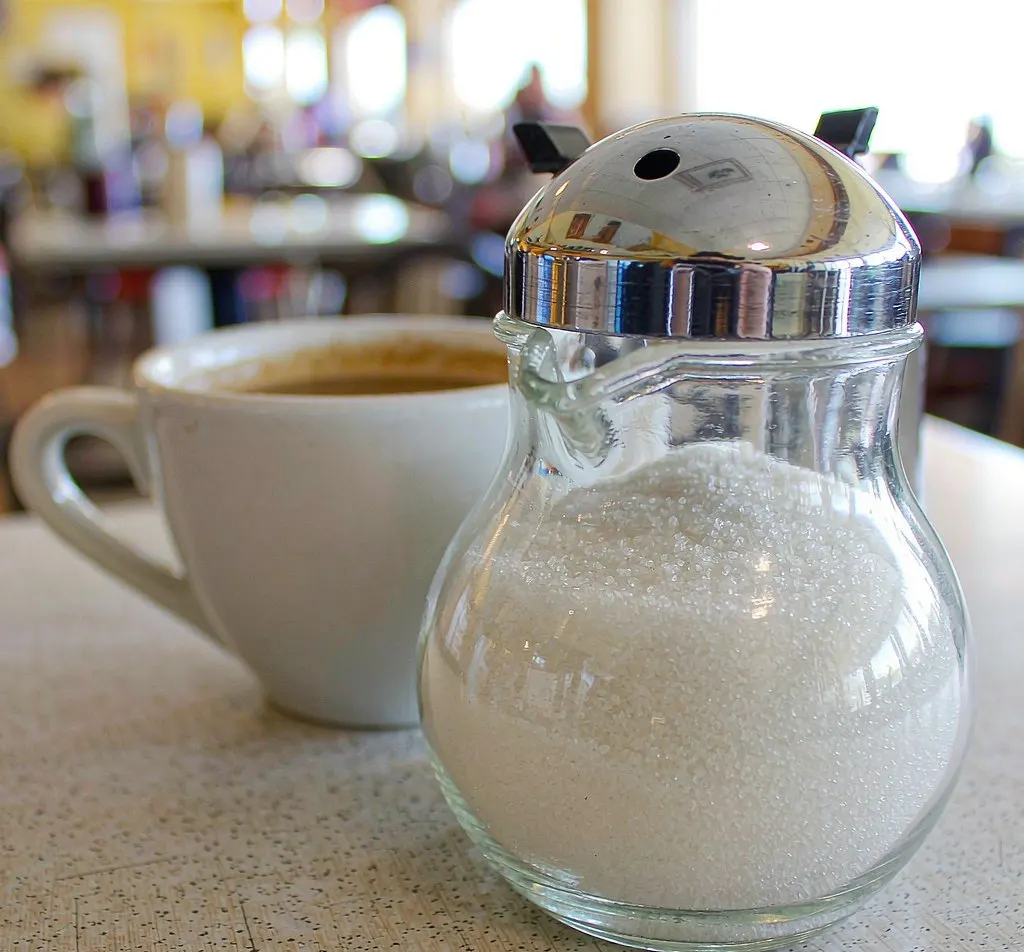
The closest relative is a spice jar, and the difference is the closure. A sugar pourer has a wider aperture and a flap that shuts completely; a spice jar usually has a fixed sifter that cannot reseal. In a commercial kitchen an open sifter left on a prep counter is a recognised contamination route, so the resealing flap matters for pest control and for HACCP records. The cap family does match selected glass spice jars in diameter, which lets one custom cap colour run across a sugar-and-spice set.
Which model suits which channel
Treating every sugar dispenser as interchangeable is how buyers end up with over-built units in one outlet and early failures in another. The four common settings ask for different things.
| Setting | Recommended build | Reason |
|---|---|---|
| Restaurant tabletop | 12 oz flap top, 304 stainless cap | Holds a full service day; flap closes against fruit flies and bus-tub splash; cap tolerates the dish pit |
| Coffee bar | 12 oz barista dusting top | Repeatable dusting of cinnamon, cocoa and spiced sugar on lattes and mochas |
| Self-serve cold-brew or iced-coffee station | 16 oz shaker | Fewer refills during peak hours |
| Hotel breakfast buffet | 16 oz shaker, 304 cap, hydrophobic interior coating | Long open dwell time; humidity from coffee urns speeds caking |
| Retail counter or gift set | Chrome zamak cap with decorative enamel | Reflective finish; washed by hand at home, so the lower thermal rating does not matter |
On a restaurant floor the usual allocation is one sugar bottle and one sugar-substitute bottle per four-top. Bodies for caddy use have a flat 60 mm base so they sit in standard chrome caddies without rocking.
The barista top uses seven 3.5 mm holes arranged as a rosette, with dosing validated at 0.35 g per three-second shake, because a dusting has to look the same from one drink to the next. For hotels that rotate stations between shifts, a tamper-evident band on the cap lets a manager confirm that a dispenser stayed closed between services. Retail is the only setting where we suggest zamak, typically with a printed story card alongside the decorated jar.
Pour aperture and flap design
Three dimensions control how the bottle pours: the aperture diameter, the travel of the flap, and the venturi gap between the cap skirt and the glass finish. Of these, the aperture is the one to write into the specification.
- Granulated sugar (average crystal 0.4–0.6 mm): 6.0 mm ± 0.2 mm.
- Cinnamon and cocoa dusting: 3.5 mm ± 0.15 mm.
- Too large: above 7 mm the contents dump out of control once the bottle tips beyond 45 degrees.
- Too small: below 5 mm, damp sugar blocks the hole inside one service day in a humid climate.
Cap batches are checked with a 50-cycle pour test on standardized 0.5 mm test media, held at a fixed 30-degree tilt and measured in grams delivered per second. A lot that strays more than ±12% from the master sample is rejected. If your sugar is coarser or finer than the standard crystal, send the sieve distribution so the aperture can be re-tooled to stay inside that dosing tolerance.
The flap is a hinged lid on a 1.2 mm stainless pin with no spring. Springs trap sugar, corrode and give up in the dishwasher, so the flap is designed to close under its own weight onto an EPDM or silicone gasket. A thumb pad with a 0.4 mm diamond knurl sits 8 mm above the hinge axis, which lets a server open, tilt and close with one hand in a single 1.2-second motion while still carrying a tray. Actuation force is measured at 1.8–2.4 N: light enough for staff who do this all shift, firm enough that the lid stays shut when a caddy is knocked.
One substitution to rule out: a liquid pourer from a glass sauce bottle does not belong on a sugar bottle. Its 2.0 mm orifice is sized for liquid and blocks at once with granulated sugar, and its thread is cut for a flexible silicone stopper, not a rigid steel flap. Mixed cap families across product lines are the most frequent cause of the field failures we investigate.
Keeping sugar from caking
Caking is controlled at the seal, the vent and the inside wall of the glass. When the flap is closed the gasket compresses by 0.8 mm, holding moisture ingress under 0.3 g water per 24 h in a 75% RH chamber. That figure is the point at which granulated sugar starts to cake.
Opposite the pour hole, a 1.0 mm vent slot equalizes pressure. A freshly filled bottle holds warm air, and without the vent the sugar packs against a partial vacuum when it should be flowing.
Inside, the glass is fire-polished to an Ra below 0.8 µm so crystals have no micro-roughness to bridge on. An optional food-grade fluoropolymer coating, 8–12 µm thick, makes the interior hydrophobic and reduced sugar adhesion by roughly 40% in accelerated humidity testing. It is not needed everywhere. In a dry, climate-controlled dining room the uncoated body performs to spec; coastal and tropical sites are where the coating earns its place through reduced waste.
Dishwasher and thermal limits
"Dishwasher safe" means nothing without a temperature figure. The standard body withstands a thermal shock differential of 45 °C at a controlled ramp of 2 °C-per-minute. In a dishroom that translates to a 65 °C sanitize cycle followed by a 20 °C cold rinse without cracking, as long as the hot bottle is not set straight onto a cold metal rack.
| Component | Rating | What to expect |
|---|---|---|
| Glass body, 1.8 mm wall at the shoulder | Commercial dishwasher, up to 500 cycles | First cosmetic clouding at the base around that point; structural failure below 0.5% at 500 cycles in accelerated testing |
| 304 stainless cap | Continuous commercial dishwasher exposure | The choice for any high-volume kitchen |
| Chrome-plated zamak cap | Hand wash or low-temp warewash only | Base-metal creep at the hinge after roughly 200 high-temp cycles |
| Silicone gasket | 120 °C | Food-grade, peroxide-cured, replaceable |
The gasket is available on its own in refill packs, so an aged seal does not mean scrapping the whole cap.
Food-contact compliance and HACCP records
The soda-lime body conforms to US FDA 21 CFR 175.300 for food-contact surfaces and to EU LFGB §31. No lead-based enamel is used on the body or its decoration. Ceramic decals and enamels are lead- and cadmium-free to California Proposition 65 limits and to the EU 84/500/EEC extractable thresholds: Pb < 0.8 mg/dm² and Cd < 0.07 mg/dm² in the 4% acetic acid leach test.
Each production lot is held until a third-party migration test report is on file. The report reference goes on the commercial invoice, so your QA team can verify it without commissioning a repeat test.
For HACCP files, the documents available are a glass-fragment risk statement and a metal-detection protocol for the cap line. Stainless caps are detectable at 2.0 mm ferrous / 2.5 mm non-ferrous on a typical tunnel detector, which gives a foreign-material control plan something concrete to cite.
If you fill and cap in-house, the 63 mm finish is a single-start continuous thread with a 6.0 mm pitch. It matches standard capping heads, so no custom tooling is required on your line.
Decoration and private-label options
Three surfaces can carry a brand: the glass, the cap, and the gasket or insert, which can be supplied in scent-free silicone in a Pantone-matched shade. For a logo on the glass there are two durable routes, and the wash regime decides between them.
| Method | Process | Durability | Use it for |
|---|---|---|---|
| Baked ceramic enamel | Decal fired at 580–620 °C | 500+ dishwasher cycles without fade | Anything that goes through a commercial dish pit |
| Screen print | Two-part epoxy ink | 200+ cycles | Retail or light-use items; the ink clouds sooner under alkaline warewash chemicals |
Other body options are full or partial frosting (acid-etched to a depth of 20–40 µm), a coloured base ring, and a measurement scale printed on the shoulder for sites that pre-portion sugar. Paper labels are not offered on foodservice bottles. They peel in the dishwasher and the loose label becomes a slip hazard, so commercial orders carry baked or printed decoration only.
Standard cap finishes are bright polished, satin brushed, matte black and copper-tone. Custom Pantone colours on 304 stainless are applied by PVD or electrocoat. Coffee chains often ask for a single cap colour across front and back of house; a shared cap-colour register keeps the sugar bottle, spice jar and pepper shaker matched from one order to the next.
Inspection levels and packing
The defect allowance is 1.5% AQL for cosmetic faults, such as enamel bubbles or a slightly uneven knurl, and 0.65% for functional faults, meaning a cap that fails to seal or an aperture outside tolerance. Functional faults are remedied by replacement or credit.
Bottles ship in 24-unit inner cartons, with 96–120 units per outer carton, protected by corner board and stretch wrap. Pallets can be labelled to your WMS specification on request.
Six checks before you place an order
A sales sheet and a delivered carton do not always agree. One example we see from resellers is a "stainless steel pourer" that turns out to be 0.3 mm electroplated mild steel, which pits in contact with humid sugar and then leaves rust on the table linen. These six requests expose that kind of gap early.
- Migration reports. Ask for the FDA and LFGB test reports with lot numbers, current within 12 months. A generic catalogue certificate is not the same thing.
- Cap mill certificate. Genuine 304 stainless shows 18% chromium and 8% nickel. A supplier who cannot produce the certificate is probably shipping plated mild steel.
- Thermal-shock method. Get the test method and the recorded pass differential in °C.
- Gasket data. Confirm food-grade silicone, with a durometer and a temperature rating, and confirm you can reorder it as a spare part.
- Inspection terms. Have the AQL level and the remedy for functional faults put in writing.
- Cap source. Establish who makes the cap. It accounts for 70% of the field-failure risk, and most glass plants buy it in.
We supply all six on request, together with lot traceability that ties a dock receipt to a specific glass run and cap batch. Buyers consolidating several dry-goods and condiment containers can review the wider food glass jar and bottle range, where sugar bottles, spice jars, honey dispensers and condiment bottles sit under one quality system and one commercial contact. That makes audits simpler than chasing four separate vendors.
Frequently asked questions
What is the minimum order for custom-printed sugar bottles?
Minimums are quoted per project. They depend on the mould, the decoration method, the cap colour and the line the job runs on.
How long does an order take, and what are the payment terms?
Both are set per project once the mould, decoration, quantity and freight terms are confirmed.
Can the bottles go through a commercial dishwasher?
With the 304 stainless cap, yes, within the 65 °C sanitize and 45 °C differential limits described above. Keep the chrome zamak cap to hand washing or low-temp warewash and to retail gift use.
Can the cap be supplied in our brand colour?
Yes. A Pantone-matched colour is applied to the 304 stainless cap by PVD or electrocoat, and the same colour can be registered for matching spice jars and shakers. Quantity thresholds for a custom colour are confirmed with the quotation.
Will they fit our caddies if we use the smaller size?
The 58 mm version exists for operations standardizing on the smaller 7 oz caddy well. The larger bodies use the flat 60 mm base that suits standard chrome caddies.