For comparison, most wine, spirits and oil programmes start from 750 ml glass bottles.
A 12 oz (355ml) glass bottle is the most standardised beverage container you can buy, so the real choices are narrow: body style, neck finish and glass colour. Pick the industry-standard longneck with a crown finish for beer, a stubby or a 28-400 continuous-thread bottle for still cold brew, and a woozy-style round for sauce. Pricing is quoted per project, but because many plants hold moulds for this size, the things worth comparing are pressure test data, lot consistency and how the cases are packed.
What the standard size gives a buyer
Shoppers in the US read 355ml as a single serving, and retailers already plan shelves around 12 oz six-packs and cases. Closure makers, capper builders and case packers are all tooled for it. In practice that means several plants can quote against the same mould, closures are easy to source, and you can change supplier later without redesigning the pack.
Handling is the other reason the size has lasted. A filled bottle weighs about 1.1 to 1.3 pounds, which is comfortable in one hand, and a case of 24 stays under 35 pounds, within what warehouse and store staff lift by hand. Moving to 8 oz or 16 oz gives up part of that balance. If you are weighing the larger single-serve option, see our notes on 16 oz bottles for beverages and sauces; for a metric alternative, the closest is the 500ml glass bottle.
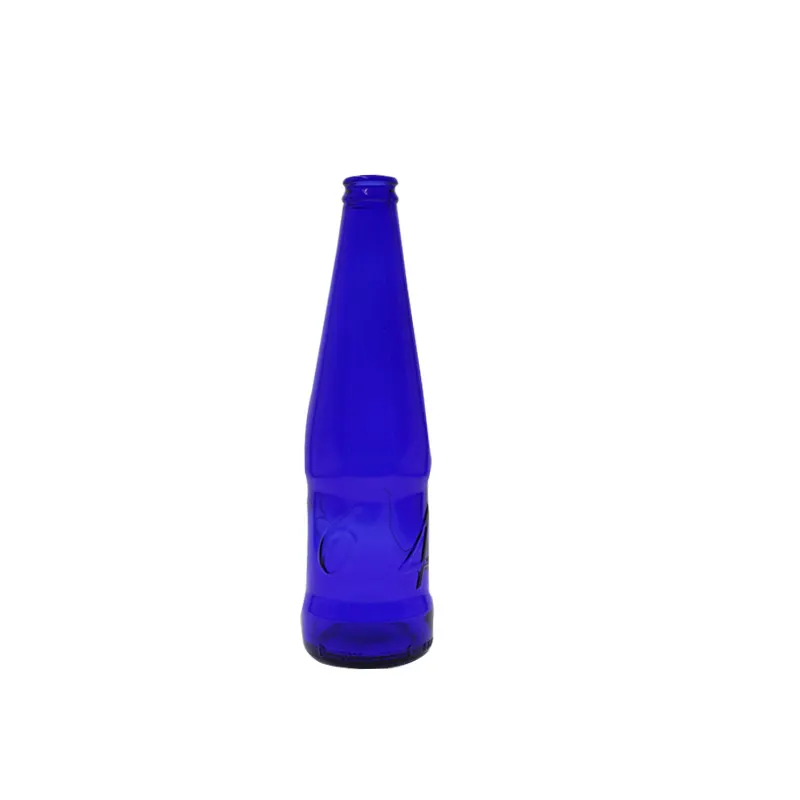
Body styles compared
| Style | Shape | Typical use | What to watch |
|---|---|---|---|
| Longneck (industry standard bottle, ISB) | Tall, narrow shoulder, around 200 to 215 grams in amber | Craft beer, soda | Runs on almost any line; the lowest-cost option |
| Heritage or Belgian-style | Bulbous neck, heavier stance | Specialty ales, craft sodas | More glass per bottle, so it costs more than the longneck |
| Stubby | Short and wide | Cold brew coffee | Needs its own case dimensions |
| Woozy-style round | Round body with a 24-414 or 28-400 continuous-thread finish | Hot sauce and condiments | Check label fit on the shoulder curve |
| Flask | Flat-sided | Mixers | Line trial needed before ordering |
Decide the style for the shelf first, then confirm it on the line. Any shape outside the longneck family should be run on your filler and labeller before the purchase order, because change parts and guide adjustments are a cost your co-packer will pass on. Cold brew brands often choose the stubby precisely because it separates them from beer sitting on the same shelf. The beer-side shapes are described in more detail in our beer bottle collection.
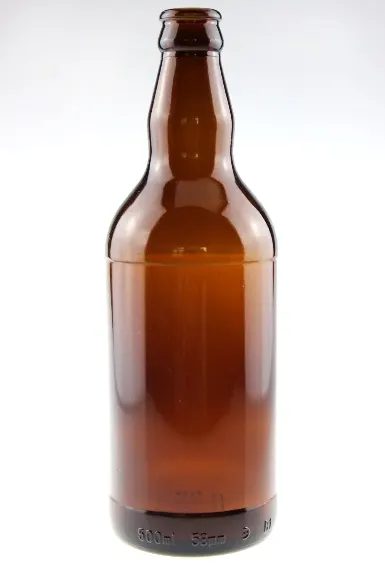
Neck finishes and pressure ratings
Crown finishes come in pry-off and twist-off versions. The two geometries are different and a twist crown needs a matching finish, so write "pry-off" or "twist-off" on the order instead of leaving it to assumption. Twist-off matters where your market expects to open the bottle by hand. Swing-top bottles are also available; the closure is assembled onto the bottle, which adds to the cost.
Continuous-thread (CT) finishes, most often 28-400 at this size, suit still and lightly carbonated products: cold brew, sauces, syrups and ready-to-drink cocktails.
For anything under pressure, ask for internal-pressure test data on every lot, whatever the finish:
- Beer and kombucha: 6 bar minimum
- Sodas: 4 bar
Standard beer longnecks normally meet this, but get it confirmed in writing. A flint specialty bottle should never be assumed to be pressure-rated without documents.
Glass colour and specification by product
Beer
Specify amber, which protects against light-struck flavour, and a bottle weight of 200-plus grams so it survives distribution. Also check that the brimful capacity leaves the legally required headspace at your fill temperature.
Soda and cold brew
Soda brands increasingly choose flint (clear) glass to show the colour of the drink. The trade-off is a shorter flavour life under light, which they manage with closed case packaging and faster stock turns. Cold brew goes two ways: flint stubbies on CT finishes for still product, or amber longnecks when the brand is placed next to beer in the cooler. Carbonated soft drinks have their own requirements, set out on our soda bottle page.
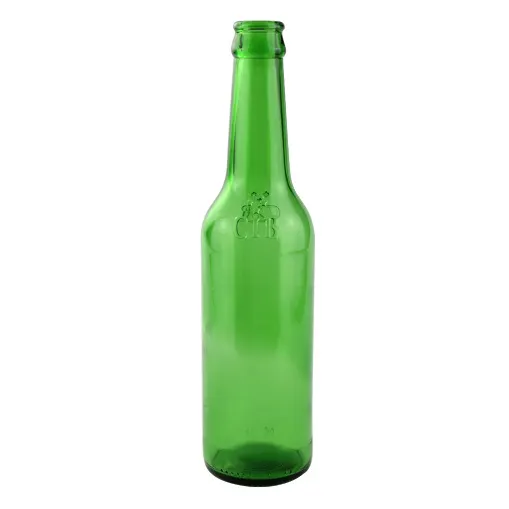
Sauces and condiments
Buyers here are usually stepping up from a 5 oz woozy to a value size. The priorities change: a wider mouth for viscous product, a CT finish with an induction-seal liner for shelf life, and a label panel that will not wrinkle where the shoulder curves. Our hot sauce bottle guide goes further into that category.
Case and pallet quantities
Longnecks pack 24 to a case. A pallet takes 56 to 72 cases depending on the case style and stacking pattern, which works out to roughly 1,400 to 1,700 bottles. Across 20 pallets, a 40HQ container carries 28,000 to 34,000 bottles. Each case of longnecks weighs about 27 to 30 pounds.
Stubbies are shorter, so more cases fit on a pallet, but the piece count ends up similar because the cases also hold 24.
Breakage risk is highest when part-pallets travel by domestic LTL. Keep sound dividers in the case specification and photograph pallets when they arrive. The layouts we work to are in the packing specification.
What moves the quote
Unit cost on a commodity size follows a few variables: colour (flint is slightly cheaper than amber), shape (heritage and specialty bodies cost more than the longneck), swing-top assembly, and volume. Crowns and caps are quoted separately and deserve their own negotiation on larger orders.
At container quantities the gap between competing offers is very small. Annealing records, consistency from lot to lot and how a supplier deals with damage claims matter more than the last fraction of unit cost, and those are the things we check when matching a project to a plant.
If one programme covers both beer and a non-carbonated product, keeping both bottles in the same weight class and finish family simplifies closure stock and line changeovers, even when the shapes differ.
FAQs about 12 oz glass bottles
What do 12 oz glass bottles cost wholesale?
There is no list price; each project is quoted. The figure depends on the mould, colour, decoration, quantity and freight terms, with closures priced as a separate line.
How many bottles fit on a pallet and in a container?
About 1,400 to 1,700 per pallet in 24-count cases, and 28,000 to 34,000 in a 40HQ.
Amber or flint?
Amber when light would spoil the product, as with beer. Flint when the colour of the liquid helps sell it, as with craft soda and cold brew.
Can a 12 oz bottle hold kombucha safely?
A standard beer longneck can, provided each lot comes with internal-pressure test results at 6 bar or above.
Is 12 oz a usable hot sauce size?
Yes. The woozy-style round on a 24-414 or 28-400 finish is the usual value-size format, closed with an induction-seal liner.