One of our guides on glass drink bottles; start there for the overview.
For most ready-to-drink cold brew, the safe starting specification is a 16 oz Boston round in amber glass with a 38-400 finish and a ROPP aluminum closure carrying a foil/EPE liner. Cold brew is still, close to neutral (pH 4.8–6.2 depending on roast and dilution) and easily damaged by oxygen and light, so the bottle has to keep air and UV out rather than hold pressure in. Everything else on the drawing — shape, capacity, liner, label — follows from the shelf-life claim you intend to print and the process your co-packer runs.
Why cold brew is not specified like kombucha or juice
Buyers often borrow a specification from a neighbouring drink category, and it is the costliest mistake in this segment because the bottle runs well on the filling line and only fails weeks later on the shelf.
A kombucha bottle is designed around 2–4 volumes of CO2, with a crown or ROPP closure rated for 6–10 bar and a liner chosen to retain gas. Cold brew has no carbonation, so that pressure rating is paid for and never used, and the gas-retention liner is not the one that best excludes oxygen.
The opposite error is copying a glass juice bottle. Juice is frequently hot-filled at 85–95 °C or pasteurized, and it tolerates acid and oxygen better than coffee does. Cold brew is rarely hot-filled and is far more sensitive to oxygen, so the closure and liner choice reverses.
Three package-related failures account for most trouble in chilled retail, and two of them are worth planning for at the drawing stage. One is seal leakage: pallets cycle between a 4 °C cold chain and a 22 °C shop floor, typically 4–8 times per trip, and the glass and the cap expand at different rates. On a poorly specified closure that produces micro-leak rates of 0.4–2.1%, and a 180-day date code shrinks to 60–90 days of real life. The other is condensation, which destroys labels meant for dry goods and ends in retailer chargebacks.
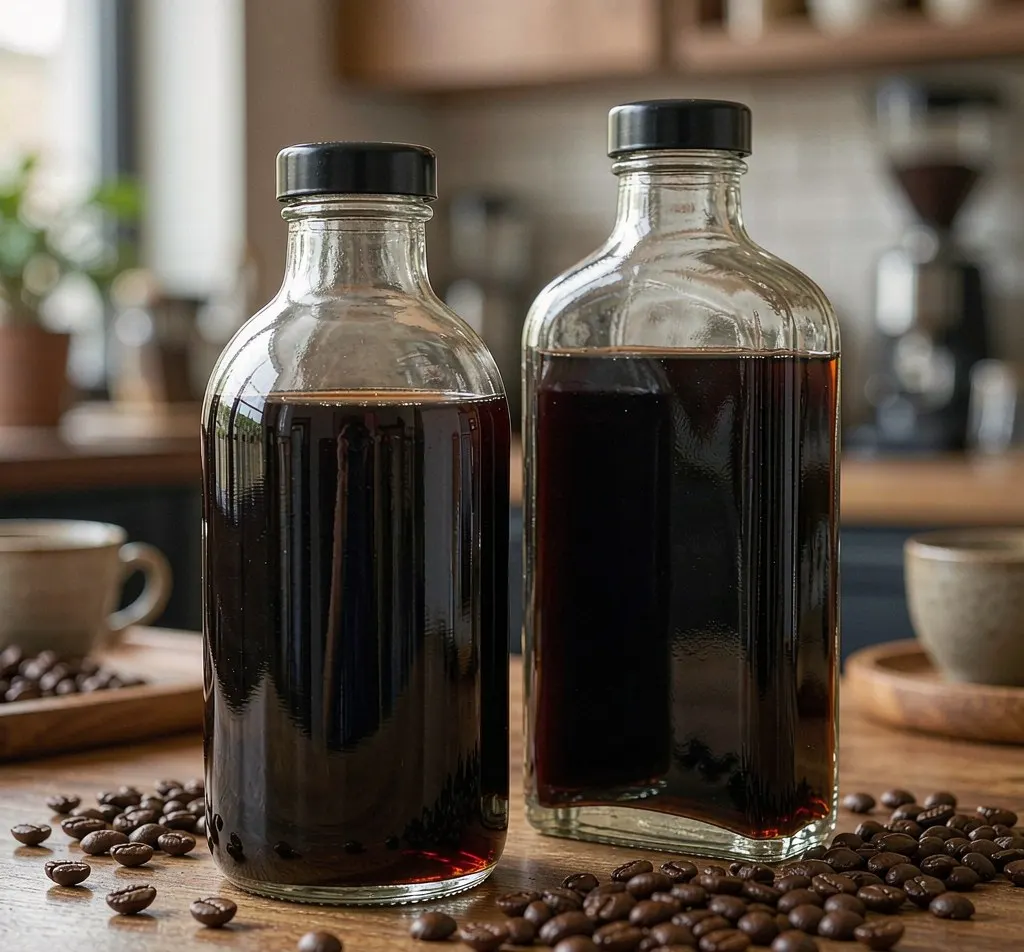
Choosing the bottle shape
Four glass shapes cover nearly all cold brew retail formats. Pick on shelf footprint, fill weight and transit behaviour first; appearance comes after.
| Shape | Usual capacity | Facings per shelf foot (relative) | Cold-chain breakage | Vacuum distortion risk | Where it fits |
|---|---|---|---|---|---|
| Boston round | 8–32 oz (250–946 ml) | Baseline 100% | 0.3–0.6% | Low | 16–32 oz flagship RTD and multi-serve |
| French square | 8–16 oz (250–473 ml) | 118–122% | 0.5–0.9% | Low–medium | Brands that need the most shelf presence per foot |
| Flat oval | 8–12 oz (250–355 ml) | 130–140% | 0.4–0.7% | Medium | Single-serve bottles for cooler doors |
| Stubby | 8–16 oz (250–473 ml) | 95–100% | 0.2–0.3% | Low | Freight-sensitive DTC and club packs |
The facings column assumes a standard 24-inch cooler shelf and a 4-inch bottle diameter envelope. A retail buyer will work from a tighter figure, but the ranking between shapes stays the same.
Boston round
The round shoulder and body spread vacuum and thermal stress more evenly than any of the other shapes, and the bottle runs on standard cappers and ROPP heads without a changeover. A Boston round bottle programme is also the lowest-risk way in, because the mould is a stock design and the 16 oz and 32 oz sizes share one finish.
French square
Also sold as the apothecary square, this shape gives up to 22% more facings and a flat panel that keeps the logo square to the aisle. The trade-off is stress at the four corners. We ask for a 6 mm corner radius and a sidewall of 2.8–3.2 mm, compared with the 2.2 mm minimum used on rounds.
Flat oval
The flat oval, or book bottle, suits 8–12 oz single-serve bottles that must stand in a cooler door without turning. Its narrow dimension is 32–38 mm. The wide panels can be drawn inward by vacuum, so the shape needs a wider cap seal and a stiffer liner.
Stubby
With a squat 2.2:1 ratio at 8–16 oz, the stubby packs 11–14% more units per case and has a low centre of gravity, which is why it shows the lowest breakage in the table.
Capacity, fill volume and neck finish
Net fill sits a little under the nominal size. An 8 oz concentrate bottle normally takes 220–240 ml with 10 mm of headspace, a 12 oz RTD takes 330–355 ml, a 16 oz takes 440–473 ml and a 32 oz multi-serve takes 900–946 ml.
Plan headspace at 6–10% of nominal volume for cold-filled product. Unlike a hot-fill juice line, a cold-fill line does not pull the headspace down as the liquid cools, so the bottle needs room for a nitrogen blanket or, if you use one, an oxygen scavenger.
For the neck, we recommend a 28-400 finish on 8–12 oz bottles and 38-400 from 16 oz upward. The 38 mm bore calms the fill stream, reduces foaming on coffee that carries fine sediment, and accepts a sturdier double-seal liner. Keeping a range on one finish also means the capper is set up once.
The combinations below are the ones we most often put on a cold brew drawing. Weights are nominal empty-glass figures at standard wall thickness.
| Size | Volume (ml) | Finish | Closure and liner | Glass weight (g) |
|---|---|---|---|---|
| 8 oz | 250 | 28-400 | ROPP aluminum, EPE liner | 165 |
| 12 oz | 355 | 28-400 | CT plastic, pressure-sensitive liner | 195 |
| 16 oz | 473 | 38-400 | ROPP aluminum, foil/EPE stack | 240 |
| 16 oz flat oval | 473 | 38-400 | CT plastic, induction liner | 255 |
| 32 oz | 946 | 38-400 | ROPP aluminum, double seal | 420 |
| Stubby 9.5 oz | 280 | 38-400 | CT plastic, PS22 liner | 210 |
Pricing is quoted per project. It depends on the mould, the decoration, the quantity and the freight terms.
Closures, liners and vacuum
Shelf life is decided mostly at the closure, and inside the closure the liner matters more than the shell. Two families are in common use: ROPP (roll-on pilfer-proof) aluminum and continuous-thread (CT) plastic.
ROPP aluminum
On a 38-400 finish we specify a foil/EPE (expanded polyethylene) composite liner of 0.8–1.2 mm total thickness. The aluminum skirt is rolled onto the glass threads and crimps the liner into a hermetic seal, with oxygen transmission at the seal below 0.02 cc/pkg/day at 23 °C. That is two orders of magnitude better than an unlined CT cap. The breakaway band is also built-in tamper evidence, which retail buyers in North America and the EU increasingly ask for.
CT plastic
Here the liner is chosen by job. A pressure-sensitive liner, typically PS22 on a 20-micron PET backing, bonds to the glass on contact and suits cold-filled product that sells through in under 90 days; it stops liquid but does not keep oxygen out over the long term. A PVDC-coated liner adds an oxygen barrier and is inert to the caffeic acids in coffee. Its water-vapor transmission stays under 0.5 g/m²/day, and it neither scavenges nor tints the drink.
Vacuum and capping torque
Vacuum is the figure that gets left off the specification. A bottle filled and capped at 4 °C and later warmed to 22 °C develops roughly 18–25 kPa of internal vacuum. If the finish and closure cannot hold it, the liner lifts slightly and oxygen starts to enter.
Application torque is set at 18–22 N·m for ROPP and 12–16 N·m for CT, depending on the liner. Seal integrity is checked by vacuum decay testing to ASTM F2338 and by a 14-day accelerated oxygen-transmission study at 40 °C. When a co-packer caps at ambient temperature the vacuum is lower and the oxygen risk higher, so we suggest cold capping or a nitrogen flush that brings residual headspace oxygen below 1.0% by volume.
A resealable swing-top bottle with a ceramic stopper and rubber gasket can work for a 32 oz multi-serve. The gasket is the weak point for oxygen, so treat that format as good for 60–90 days refrigerated rather than a 180-day ambient claim.
What the glass has to survive in process and distribution
Tunnel pasteurization and hot-fill
Most cold brew is filled cold, but some co-packers pasteurize in a tunnel at 65–85 °C to gain shelf life without refrigeration. Standard soda-lime glass is rated for a 42 °C thermal-shock differential. It will accept 85 °C product into a 4 °C bottle only when the temperature ramp at the base stays under 5 °C per minute, and a base of 3.0–3.4 mm on 16 oz and larger helps absorb the gradient without cracking. Above 85 °C, or with a ramp faster than 8 °C per minute, the project needs borosilicate or a heavier base.
High-pressure processing
HPP at 400–600 MPa suits cold brew because it is a cold treatment and leaves the volatile aromatics that heat would drive off. Glass does not compress at 600 MPa as a plastic bottle does. The closure is the part under test: it has to stay sealed for 3–6 minutes at 4–8 °C under water pressure from every side.
ROPP aluminum with a foil/EPE stack holds. A thin CT cap with a pressure-sensitive liner can weep at the skirt, because the external load moves the cap wall and that movement reaches the seal. For an HPP product, specify ROPP or a reinforced CT with a molded tamper band, and turn down any cap offered only for cold fill.
Temperature swings at the finish
A bottle that leaves a 4 °C warehouse, waits on a 26 °C loading dock and goes back into the cold sees a 22 °C swing, well inside what the glass tolerates. The stress concentrates at the finish, where the cap conducts heat differently from the glass. We specify a finish wall of 2.5–3.0 mm and have the sealing land checked to ±0.15 mm. A finish that is 0.3 mm out can be the difference between a cap that seats at 18 N·m and one that cams out at 12 N·m and leaks.
Condensation and labels
Take a 4 °C bottle into a 24 °C aisle at 60% RH and a visible film of water forms within 60–90 seconds, about 0.02–0.08 mm thick. Any adhesive not rated for wet bonding soaks it up. This is the usual reason a correctly specified bottle still fails at retail.
The reliable options are a pressure-sensitive polypropylene label with an acrylic emulsion adhesive rated to 90% RH, or direct screen print or ceramic decoration, which has no adhesive at all. Paper labels need a 12-micron PET laminate over the print; without it, delamination chargebacks of 3–7% are reported on chilled lines in humid markets. Shape plays a part as well, since a flat panel and a curved wall collect condensate differently at the label edge.
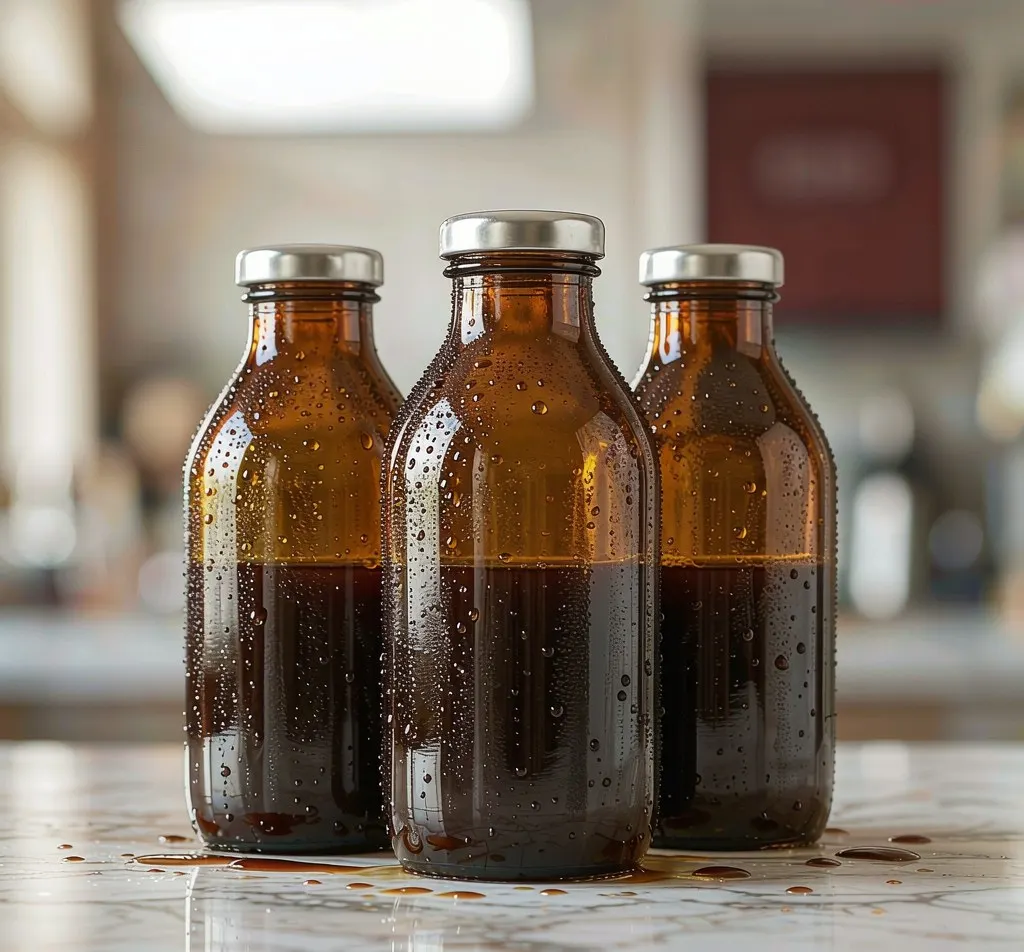
Specifications by product type
| Product | Bottle | Closure and liner | Reasoning |
|---|---|---|---|
| Black cold brew, 16 oz RTD | 38-400 Boston round, amber or UV-green where shelf light is unavoidable | ROPP with foil/EPE, cold capped with nitrogen flush | Supports a 180-day refrigerated claim |
| Iced latte with dairy or oat milk | Same glass, filled on a dedicated run | Induction-sealed CT, or ROPP with PVDC liner | Fat and protein raise spoilage risk and lower the acceptable oxygen transmission |
| Concentrate, 8–12 oz | Clear glass is acceptable | CT with firm reclose torque and a liner that survives 5–10 openings | Opened repeatedly and stored cold and dark at home |
| Tea-coffee blend | As for black cold brew | PVDC or foil liner, not plain EPE | Tannins and a pH of 4.5–5.0; plain EPE can absorb tannin and tint over 120 days |
| Club and DTC multi-serve | 32 oz amber Boston round | ROPP double seal, or a 38-400 dispensing closure for a resealable version | Shares the finish of the 16 oz bottle |
Latte runs deserve one more note. To avoid flavour carry-over from a previous product, they are best filled as a separate campaign with sanitation validation recorded per batch.
The tea-coffee blend is the format most often given the wrong bottle. Its acidity is close to kombucha, yet it has no carbonation, so it needs acid-resistant liner contact and no pressure rating.
For foodservice sizes of 1-liter and above, a 38-400 wide-mouth bottle that accepts a pump or pourer keeps the same look from café to shelf. Related jar and bottle formats are collected in our food glass packaging overview.
On glass against PET, the crossover is at about 90 days of refrigerated life. Below that, PET usually costs less in total; beyond it, the oxygen barrier of glass is what protects the date code.
What to verify before committing to a supplier
Ask for evidence on four points before placing a programme:
- Production source. The bottles should come from a named line with a documented campaign history, not spot purchases where tolerances drift from lot to lot.
- Finish dimensions. A dimensional report on the land and thread to ±0.15 mm. An error of 0.3 mm is enough to make a capper cam out.
- Seal validation. ASTM F2338 vacuum decay results and an oxygen-transmission figure at the seal. A line reading "leak test passed" is not enough.
- Label performance. Cold-chain data for the label and adhesive, or a switch to direct decoration so the question disappears.
We recommend qualifying in stages: a pilot run with your actual closure and filling process, an accelerated shelf study over 14 days, a first limited campaign, and only then full volume. The pilot is where capper torque mismatch, liner weep and wet-label failure show up. Finding a 1.5% leak rate after a large run has shipped means a stopped co-packing line and retailer chargebacks. Starting on a Boston round shortens the work, since qualifying one size partly covers the other on the same finish.
At inspection, cosmetic defects are judged to AQL 2.5, while functional defects such as an out-of-tolerance finish or a flaw on the sealing surface are not accepted at any level.
Frequently asked questions
Which glass colour gives cold brew the longest shelf life?
Amber, with a sidewall of 2.0–2.5 mm. UV protection comes from the depth of colourant in the wall as well as the hue, so a thin tinted bottle protects less. Clear glass is suitable only where stock is kept dark or sold within a short 60-day refrigerated cycle.
Is a plastic screw cap enough, or does cold brew need ROPP?
It depends on the claim. A plastic CT cap with a pressure-sensitive or induction liner is resealable and works for cold-filled product with 60–90 days of life. A 180-day refrigerated claim, or any ambient claim, calls for ROPP aluminum with a foil/EPE liner.
Can glass cold brew bottles go through HPP?
The glass can; the closure decides the outcome. Use ROPP or a reinforced CT with a molded tamper band, and ask the cap supplier for validation at your pressure and hold time. Thin CT caps with a pressure-sensitive liner are the ones that weep.
How are order quantity and timing set for a custom bottle?
Both are quoted per project. They depend on whether a new mould is needed, the line the bottle runs on, the decoration, the quantity and the freight terms.
Which finish suits an 8 oz or 12 oz single-serve?
A 28-400 finish is the usual choice where a narrower neck is acceptable. If the same range includes 16 oz or 32 oz bottles, weigh that against keeping every size on 38-400 so the capper needs one setup.