A custom syrup bottle is specified around the sugar rather than the silhouette. Syrup can be up to 67 percent sugar by weight, so it crystallizes on threads, cements caps in place and still has to flow through a pump or pourer after months of sticky use. Settle the closure and neck finish first (28-400 for coffee pumps, 38-400 or 43-400 for maple), then the brimful capacity, glass weight and corner radius, and use embossing for the branding that has to outlast a commercial dishwasher.
Formats by syrup category
Coffee, maple and cocktail syrups have each converged on their own sizes and shapes, largely because of how the product is dispensed.
| Category | Usual sizes | Shape | Typical closure |
|---|---|---|---|
| Coffeehouse flavoring syrup | 750 ml and 1 liter | Tall round or square, slim enough for a speed rail | Portioning pump on a 28-400 finish |
| Maple syrup, retail | 250 ml and 375 ml | Flat flasks and handled jugs that pour without glugging | 38-400 or 43-400 screw cap with an induction-sealed liner |
| Cocktail syrup and craft mixers | 375 ml and 750 ml | Long-neck bar bottles for controlled free-pouring | Pour spout, or a 24-410 / 28-410 disc-top or flip-top for thin syrups |
If you need a compact size to hold in your hand before committing, the 250 ml bottle in our catalog is a useful reference.
Capacity, weight and corners to put on the drawing
State the brimful capacity as well as the nominal fill. A 750 ml coffee syrup bottle is normally blown to 780 to 790 ml brimful, which leaves the fill line clear of the pump closure.
Glass weight and where that glass sits need their own lines in the specification. In soda-lime flint, a 750 ml syrup bottle should come in at 420 to 520 grams, and the base should be no thinner than 4 mm: a café bottle gets banged down on a steel counter dozens of times a day.
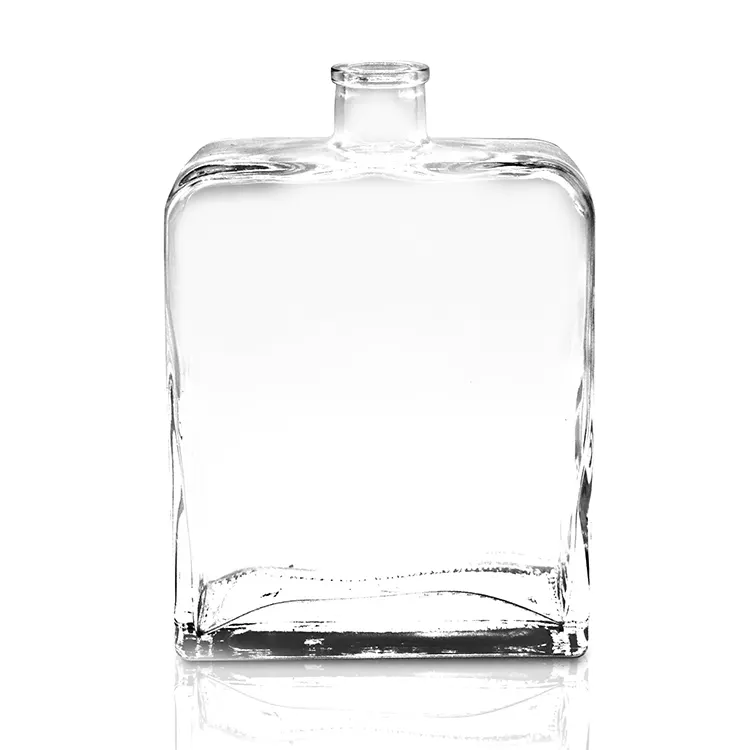
Square bottles look crisp on a shelf, but their corners are where stress collects. Ask for the corner radius to be dimensioned. On a 750 ml square bottle, anything tighter than 8 mm invites breakage claims.
Closures and the neck finishes they require
Because the dispensing system dictates the finish, choose it before the bottle is drawn.
- Portioning pumps. Coffee syrup pumps need a 28-400 finish and deliver 7.5 ml, a quarter ounce, with each stroke. Ask for food-contact-compliant polypropylene, a stainless spring and a head that locks down for transport.
- Bar-top pour spouts. These have a tapered poly or cork-fitment shank that seats in an 18.5 to 21.5 mm bore. They are sold as free-flow, measured and screened types; the screen holds back fruit pulp and spice particles.
- Disc-top and flip-top caps. Squeeze-style caps in 24-410 and 28-410 suit thinner cocktail syrups.
- Screw caps for maple. Jugs take 38-400 or 43-400 caps fitted with induction-sealed freshness liners.
Buy glass and closure through a single accountable source, or else prove the pairing with torque and leak tests. A pump that seals on another supplier's 28-400 bottle may leak on yours when the thread start sits half a turn away. Our guide to closure families for glass bottles explains the wider options.
Designing the finish so sugar does not lock the cap
Capillary action draws syrup up into the thread. The water then evaporates and the sucrose left behind sets hard, which can double the removal torque in a matter of weeks. The finish design can limit this in three ways.
- Go wider where the category permits. For viscous maple and dessert syrups, 38-400 is a better choice than 28-400: the larger land is easier to wipe and the thread engagement is shorter.
- Round the thread profile. Crystals begin forming at scratches and sharp edges, so ask for smooth threads with no sharp crests.
- Stop syrup reaching the finish. A drip-free pour lip, or an internal fitment that cuts the stream cleanly, keeps the threads dry from the start.
Hot-fill requirements
Many producers fill at 85 to 90 degrees Celsius to make the syrup shelf stable. The bottle then has to withstand both that temperature and the vacuum that forms as the contents cool. Write a thermal shock requirement of at least 42 degrees Celsius differential into the specification, and check that the closure liner is rated for hot-fill vacuum.
Embossing and decoration that survive the dish pit
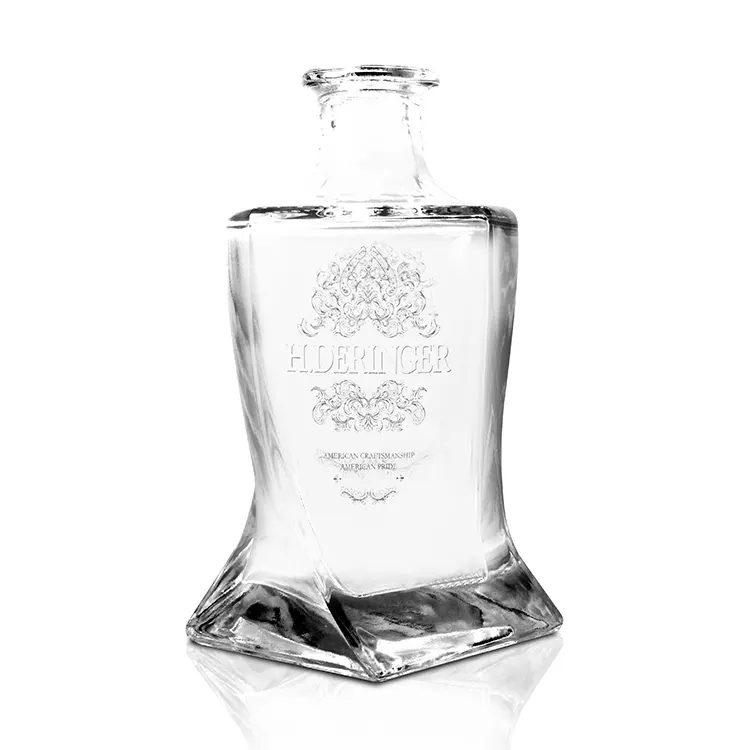
Embossing means the logo, brand name or pattern is cut into the mould and stands proud of the glass, usually by 0.4 to 0.8 mm. Below 0.4 mm the mark gets lost once printing is added nearby. Above 0.8 mm on a lightweight bottle, the glass opposite the relief can end up thin.
The embossed area belongs on the shoulder or lower body, clear of both the label panel and the vertical seams. We ask the plant for a plaster or 3D-printed proof before any steel is cut. Tooling scope differs a great deal: embossing plates added to a stock mould are a partial-mould job, whereas a fully proprietary embossed bottle needs a complete mould set.
Flavors within a range are usually told apart with applied ceramic labeling or a single-color screen print alongside the embossing. Café bottles are washed every night, so surface decoration has to stand up to alkaline detergent at 60 degrees Celsius over hundreds of cycles. Fired ceramic ink does; organic inks and adhesive labels do not. The methods are compared on our decoration services page.
Packing and programme scope
For export, 750 ml bottles are packed 12 per case with dividers and stacked 60 to 72 cases per pallet, while 375 ml flats go 24 per case. If cases will travel through parcel networks to individual cafés, ask for an ISTA 3A test report on case drop performance.
Cost and quantity are quoted per project. The main drivers are the tooling route (stock bottle, added embossing plates or a full mould set), the decoration, the closure pairing, the order quantity and the freight terms. While a custom mould is being developed, the stock syrup bottle formats can cover early production, and handled jugs are treated separately under maple syrup bottles.
Frequently asked questions
Which sizes suit coffeehouse syrups?
Tall 750 ml and 1 liter bottles on a 28-400 finish are the norm, because they fit a speed rail and take a pump that meters 7.5 ml per stroke. Brimful capacity is generally 30 to 40 ml over nominal.
Can a logo be embossed into the glass itself?
Yes. It is cut into the mould, either as plates added to a stock mould or as part of a proprietary mould for an exclusive shape.
What closure works for maple syrup?
A 38-400 or 43-400 screw cap with an induction-sealed liner, on a flat flask or handled jug. The wide finish is simpler for the consumer to wipe and less prone to sugar build-up than a narrow thread.
What is the minimum order for a custom embossed syrup bottle?
There is no single figure. It is set per project by the mould and the production line the bottle runs on.
Can these bottles be hot filled?
Yes, provided thermal shock resistance and the closure liner are specified for it, as described in the hot-fill section above.