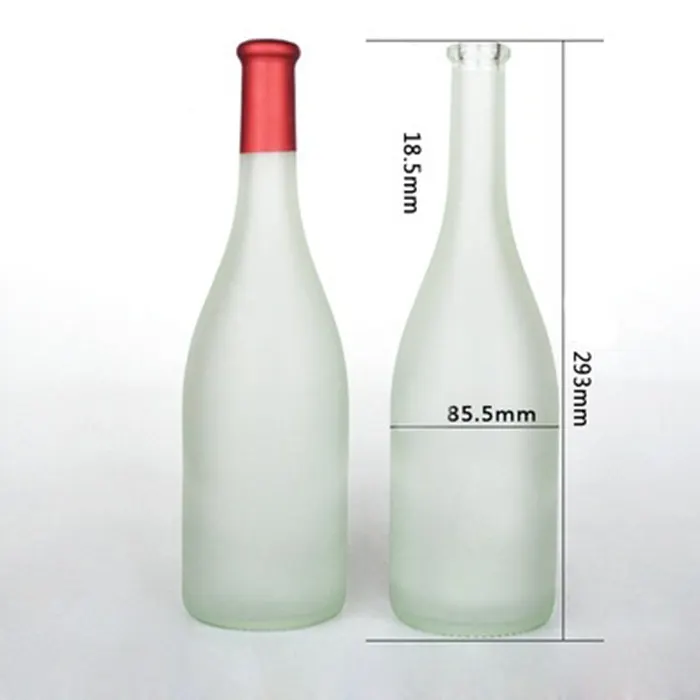
Part of our matte glass bottles range; the stock moulds are pictured at the end of this guide.
For wine that will be cellared or served from an ice bucket, specify acid etch: the satin surface is the glass itself, so it cannot peel, flake or fade. Spray frost is a translucent polymer coating that gives a similar look in any tint, which makes it the practical choice for seasonal, gift and promotional bottles. Whichever you choose, write the process into the purchase contract and decide where the label goes before the bottles are frosted.
Acid etch and spray frost compared
Acid etching treats the bottle, by immersion or spray, with a compound based on hydrofluoric acid that dissolves a microscopic layer of the surface. What remains is a fine, even satin texture with a soft, deep luster. Ice buckets, dishwashers and damp cellars do not affect it. The limits are on the production side: the chemistry needs a specialised line, the depth of etch has to be controlled, and the only colour available is the natural satin white of etched glass.
Spray frosting lays a translucent coating over smooth glass. It opens up colour, such as blush pink, champagne gold or smoky gray, and it suits small batches. Current coatings perform much better than their reputation suggests, but they are still coatings. Abrasion between stacked bottles can scuff them, cheaper formulations can turn cloudy after long exposure to moisture, and a close look shows that the finish sits on the glass and is not part of it.
| Attribute | Acid etch | Spray frost |
|---|---|---|
| What the surface is | Micro-etched glass | Polymer coating over glass |
| Durability | Permanent | Good, but can scuff or cloud |
| Colour | Natural satin white only | Any tint |
| Ice-bucket service | Excellent | Good when the coating is a quality one |
| Where it fits | Ice wine, dessert wine, long cellar life | Seasonal, gift and promotional SKUs |
This article deals with wine only. Tinted and frosted containers for spirits and food are covered in our guide to frosted and colored bottles, and pressure-rated formats for traditional-method sparkling wine are on the sparkling wine bottle page.
Why sweet and gifting wines are frosted
Ice wine established the convention, and late-harvest Riesling, Vin Santo, Sauternes-style wines and gifting cuvees followed it. Frost does three jobs for these wines. It diffuses light, so a golden wine glows instead of glaring. It changes how the bottle feels in the hand. And it hides the condensation and sticky drips that come with serving sweet wine cold.
The finish also suits the tall, slim 375 ml and 500 ml shapes that ice wine traditionally uses. In the sweet, fortified and gifting categories frosting has become what buyers expect to see, so a plain flint bottle on the same shelf tends to look like a saving on packaging.
Deciding the label area before frosting
Ordinary wine labels are designed for smooth glass. On a frosted texture a pressure-sensitive label bonds poorly unless the stock carries a high-tack adhesive, and paper laid over frost tends to look like an afterthought. There are three workable approaches:
- Masked clear panel. The label area is masked during frosting, leaving a polished window. The label gets normal adhesion and the remaining surface stays frosted.
- Direct screen printing. Ink is printed onto the frost itself. This suits minimalist designs, and because there is no label, nothing can lift in a humid cellar. It is worth considering for any wine meant to age.
- High-tack synthetic label. The option to use when the artwork has to keep a paper-like appearance.
Timing is the point buyers miss. A clear panel cannot be added once a bottle has been frosted, so the masked zone must be drawn into the frosting artwork before production starts.
Tests and contract wording for frosted bottles
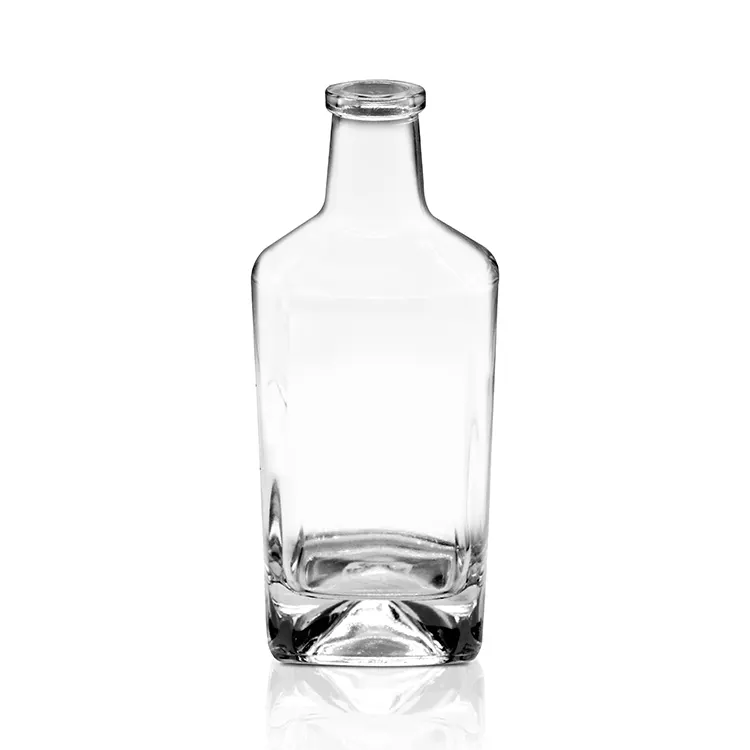
A frosted bottle has to clear the same mechanical tests as a clear one. Etching removes a thin layer of glass, and etching too deep measurably lowers surface strength, so the plant should control etch depth and inspect again afterwards. We ask for the following when we review a frosted wine project:
- Thermal shock to ASTM C149. A 42 °C differential is the minimum for still wine. Bottles that will sit in ice buckets justify a wider margin.
- Internal pressure to ASTM C147 for anything sparkling. The test should be run on frosted production bottles, not on the clear bottle before frosting. Sparkling wine also needs a frosted design that is pressure-rated from the start; a still-wine mould frosted afterwards is not a substitute.
- Etch uniformity. Hold a sample in front of a printed page. Streaks or thin patches point to a line-speed problem at the etching station.
- The process named in the contract. The single word "frosted" leaves room for spray to be supplied where etch was expected, and it gives you little to stand on in a claim.
Brands that pair frosted wine bottles with a wider gift range often run decorative jars or spirits bottles through the same etching line. The decoration economics that apply to both are set out in our guide to fancy glass jars.
Frequently asked questions
Will a spray-frosted bottle survive an ice bucket?
A well-formulated coating copes with it. The risk lies with cheaper coatings, which can cloud after long contact with moisture, and with scuffing when bottles rub together. Acid etch has neither weakness, which is why it is the safer choice for ice wine and for bottles that will spend decades in a cellar.
Can frosted glass be used for sparkling wine?
Yes, provided the bottle is designed and pressure-rated as a frosted sparkling bottle and the ASTM C147 check is carried out on the frosted production run.
How is wholesale pricing for frosted wine bottles set?
It is quoted per project. The figure depends on the mould, the frosting process and any other decoration, the quantity and the freight terms.
What minimum order applies?
Minimums are also set per project, because they follow the mould and the line it runs on.
Can I compare the two finishes before ordering?
We can coordinate sample sets on 375 ml and 750 ml wine moulds in acid-etched, spray-frosted, masked-panel and screen-printed versions, so you can compare luster, label adhesion and ice-bucket behaviour side by side. Send your target format through the sample request form.