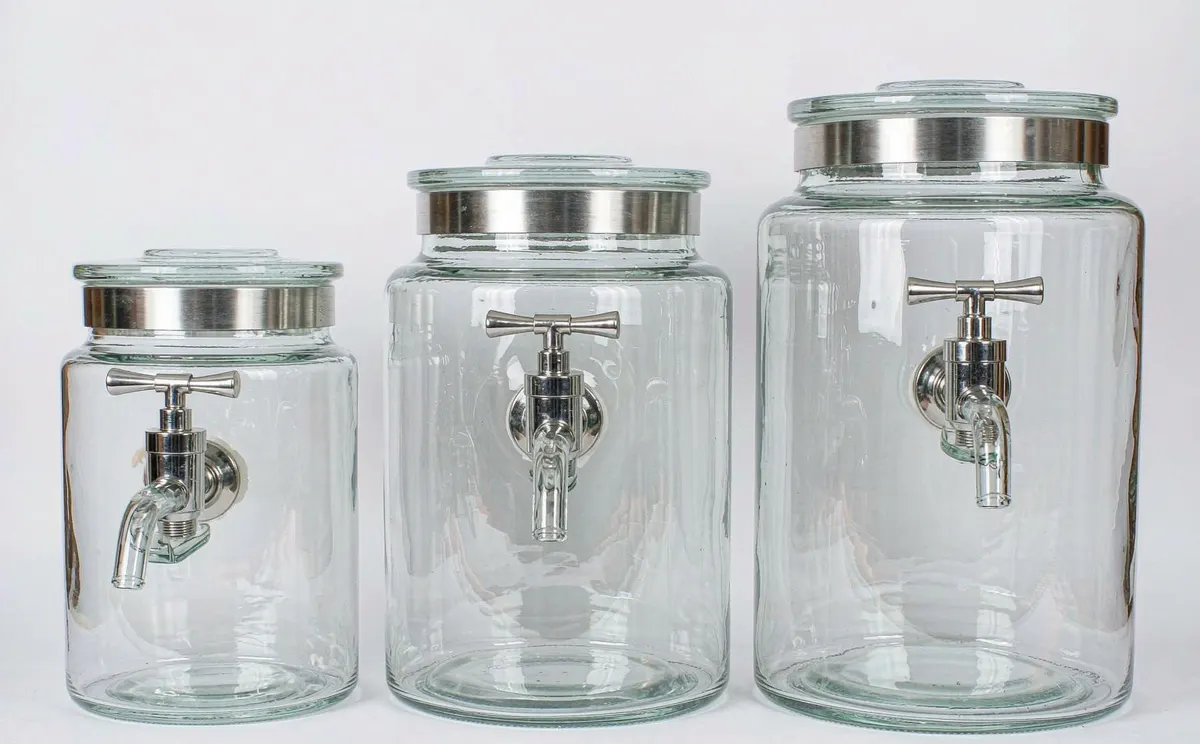
Wholesale glass beverage dispensers come in four standard capacities: 3 L (101 fl oz), 5 L (169 fl oz), 8 L (271 fl oz) and 10 L (338 fl oz). All four are thick-wall soda-lime glass with a wide mouth and the same food-grade 304 stainless steel spigot, so lids, washers and spare taps interchange across the range. They are made for cold and ambient drinks such as iced tea, lemonade, cold brew and fruit-infused water, and are not suitable for hot-fill or stovetop use.
Sizes, wall thickness and weight
Wall thickness rises with capacity, from 3.0 mm to 3.8 mm, because a large dispenser loaded with ice and liquid needs more structural margin when staff carry it from cold storage into a warm room. Height and diameter are approximate and shift a little with the lid chosen.
| Capacity | Imperial | Wall thickness | Height (approx.) | Body diameter (approx.) | Net weight (approx.) |
|---|---|---|---|---|---|
| 3 L | 101 fl oz | 3.0 mm | 280 mm | 160 mm | 1.3 kg |
| 5 L | 169 fl oz | 3.2 mm | 330 mm | 185 mm | 1.8 kg |
| 8 L | 271 fl oz | 3.5 mm | 380 mm | 210 mm | 2.6 kg |
| 10 L | 338 fl oz | 3.8 mm | 420 mm | 230 mm | 3.2 kg |
The mouth on every size is wide enough for ice blocks and fruit slices, and an ordinary brush reaches the base through it. A dispenser is the hands-free option; where staff pour at the table instead, glass water jugs cover the same drinks service.
Which capacity suits which buyer
As a rule, the 3 and 5 L sizes serve one table or a small buffet, and the 8 and 10 L sizes serve a crowd between refills. The channel you sell into narrows the choice further.
| Channel | Usual sizes | What matters most |
|---|---|---|
| Hotels and hospitality groups | 5 and 8 L | Lasts through a breakfast rush yet fits a standard chafing-height table; clear glass that shows off a fruit infusion |
| Restaurants and cafes | 3 L for a small counter, 10 L for high traffic | Quick cleaning at close; a tap that keeps the pass and the floor dry |
| Event rental companies | 8 and 10 L | Durability over dozens of events per season; one spare spigot type for the whole fleet |
| Kitchenware and private label brands | Chosen per collection | How the piece photographs; lid and decoration options |
| Online marketplace resellers | Chosen per listing | Arriving intact; a consistent mould and a tap that does not leak in customer photos |
Hotels place dispensers at breakfast buffets, lobby welcome stations and banquet pre-function areas, where the vessel is part of the display. Rental houses put each piece through transport, set-up, guest use and return washing again and again; for them the export carton also works as a storage crate between bookings.
Marketplace sellers depend on review ratings. A carton with moulded inserts protects those ratings on long-haul delivery, and for this group a dependable drip-free tap is worth more than a cheaper product whose quality varies.
Brand owners usually build the dispenser into a hosting range. It pairs with a glass honey dispenser on the condiment side of the table and with iced tea bottles as the single-serve item guests take away, while glass jars with bamboo lids carry the same look into pantry and infusion jars.
Regional differences
Stock by market, not by an even split across the range. In North America the 5 and 8 L sizes lead, driven by hotel breakfast buffets and rental fleets. In Europe the 3 and 5 L sizes sell well to smaller cafes and to the gifting and hospitality collection market. Importers following the cold brew and infused-water trend ask for 8 and 10 L for locations that pour continuously.
Spigot and lid options
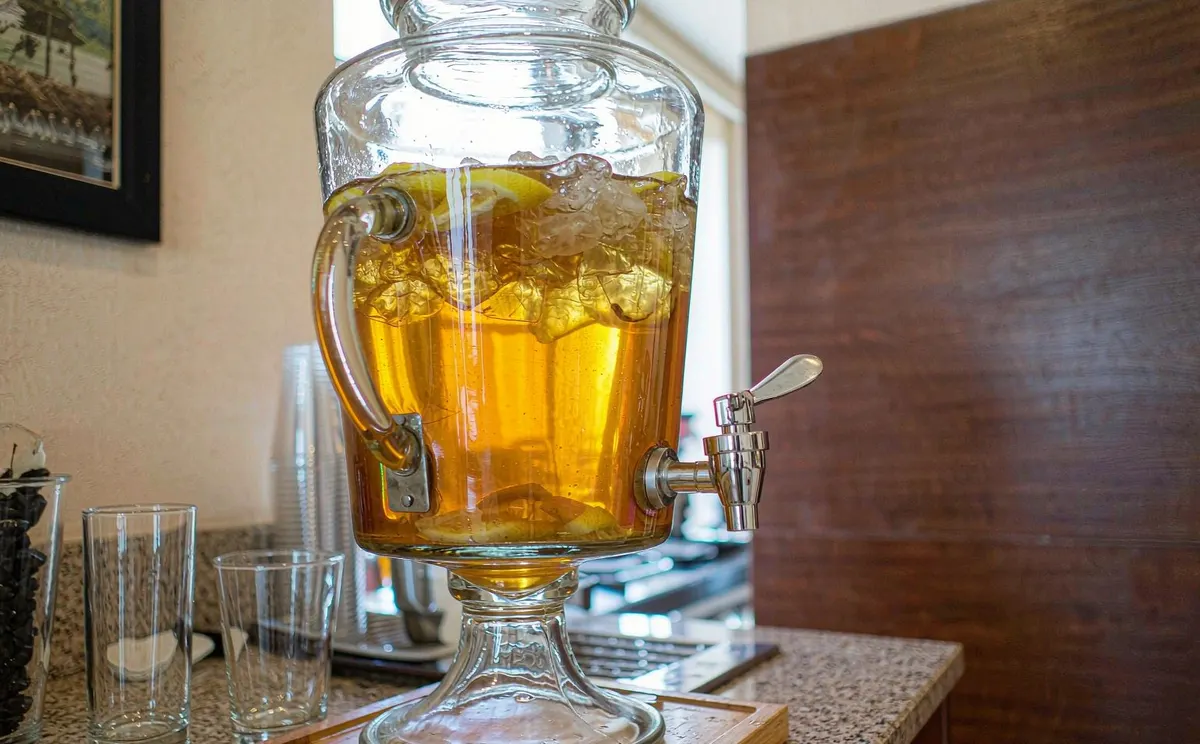
The spigot is the part that generates complaints, so specify it carefully. The standard tap is 304 stainless steel with a chrome-like finish. It seals through a silicone or food-grade rubber washer, which a threaded collar compresses against the glass wall, and its internal seat is designed to shut off cleanly without a drip. The washer is replaceable. Three variants are available, all with food-grade contact materials:
- a brushed stainless finish;
- a longer stem for thick-wall configurations;
- a push-lever tap for busy self-service points where a turn handle is awkward.
The rim is ground or moulded to take one of three lids, and the lid has no effect on how the spigot fits.
| Lid | Typical buyer |
|---|---|
| Clear glass | Buyers who want an all-glass look |
| Bamboo-wood with silicone gasket | Hospitality and gifting collections; the most requested, for its warm, natural look |
| Stainless steel | Commercial kitchens that prefer all-metal hygiene |
How the glass is made and tested
Soda-lime glass is used for its clarity, its weight balance and its cost in high-volume service. The body is formed on automatic lines and then annealed in a lehr, an oven that cools the glass slowly to release internal stress. Annealing is what allows a dispenser to go from a refrigerator at 4 °C (39 °F) to a counter at 25 °C (77 °F) in normal service without cracking.
After annealing, each piece is inspected for even wall thickness, a flat base and the machined opening that receives the tap. A buyer should also ask for three functional checks on each production lot:
- Thermal shock. Sample dispensers are moved between a cold and a warm water bath.
- Spigot cycling. The tap is opened and closed repeatedly to confirm the seal still seats without weeping after hundreds of uses.
- Rim flatness. The rim is finished evenly so that the lid sits level and its gasket seals.
Glass and contact materials are selected for food use, and compliance documentation can be provided for the importing market. Glass also does not stain or hold flavour as some plastics do: after a simple wash, a vessel that held hibiscus tea in the morning can serve cucumber water in the afternoon with no carryover.
On sustainability, the defensible claim is a modest one. The dispenser is fully recyclable and built for years of reuse, which cuts the single-use plastic waste of disposable drink servers, and the export carton is recyclable pulp. That is enough for a B2B catalogue and does not overstate the case.
Private label and custom options
Under OEM and ODM programmes, a dispenser can be differentiated in four areas.
- Decoration. Logos and volume marks are screen printed and ceramic fired on the body or shoulder, or a logo is embossed on the base or shoulder as a permanent mark. Screens and colour codes are kept on file so that repeat orders match.
- Lid and spigot. Any of the lids and tap variants above can be combined into a kit.
- Packaging. Export cartons carry your artwork, barcode and pallet plan, with multilingual care cards inside.
- New shapes. A new silhouette, a footed base or a paired stand can be co-developed, subject to tooling and a food-contact review.
Mould stability matters more here than on most glassware. Lids, gaskets and spare spigots are designed to a fixed opening dimension, so any drift between production runs breaks the fit. The mould history is therefore kept, so that a reorder two years later yields an identical piece and catalogue copy and shelf plans stay valid.
For destinations with strict rules, the decoration and the glass recipe can be aligned with regional food-contact expectations and supported by the corresponding test reports. Custom decoration and lid kits take longer than a standard order, so plan the change around your sales calendar.
Ordering, shipping and documents
Minimum quantity, timing, samples, inspection and claims terms are agreed per project before an order is placed. The minimum and the schedule depend on the mould, the decoration and the line the job runs on.
Shipments go FOB, CIF or DDP according to your incoterm. Under DDP, a freight partner handles clearance and delivery to your warehouse, so you do not manage customs yourself. The export carton is engineered for stable palletization and to protect the two vulnerable points, the spigot and the rim.
Each shipment travels with a commercial invoice, a packing list, a bill of lading and, where the destination requires it, a certificate of conformity for food-contact glass. Buyers taking several glass lines can consolidate them through the food glass packaging hub, which spreads freight over more units and reduces the paperwork to a single customs entry.
Regular buyers can work to a rolling forecast: a confirmed quarterly plan reserves mould time and raw glass ahead of peak season, which steadies availability when soda-ash and energy costs move.
Frequently asked questions
Can the dispensers hold hot drinks?
No. They are intended for cold or ambient service only. Annealing covers the step from refrigerator to counter, not hot-fill or stovetop use, and staff should be briefed accordingly.
Does one spigot fit every size?
Yes. All four capacities use the same spigot platform, so a hotel group or rental house needs to hold only one type of spare.
Can a hotel or brand logo be added?
Yes, by screen printing with ceramic firing or by embossing. Lid kits, spigot finishes and printed export cartons can be customised as part of the same order.
What is the minimum order for B2B buyers?
It is quoted per project, because it depends on the mould and on the production line used.