Filed under wine bottles wholesale; the moulds we quote for this are pictured at the foot of the page.
A ginseng wine bottle is specified around the root: a presentable Panax ginseng root for a 750 ml display bottle is 40–70 mm across the crown, so the finish has to be 70–100 mm, two to three times a standard spirits neck. That width means press-and-blow forming, low-iron flint for clarity, and tight annealing control at the heavy base. We are a sourcing desk, so our part is to specify the bottle, check the drawing and match it to a plant that runs wide-mouth display glass.
What the wide mouth requires in production
The finish diameter includes working clearance, because the root is put in by hand and its lateral roots snap easily. A mouth that size cannot be made on a narrow-neck blow-and-blow line. Three things follow:
- Press-and-blow forming. A plunger shapes the wide parison evenly. Suitable plants run press-and-blow IS machines set up for finishes above 63 mm.
- Controlled wall thickness. Glass has to spread evenly between a mouth as wide as 100 mm and the body below it, which calls for heavier tooling on the blank side. Aim for 3.0–4.0 mm in the body and have first articles checked with an ultrasonic gauge.
- A tight finish. Hold the mouth to ±0.4 mm. A large glass stopper or ROPP cap will not seal on a rim that wanders further than that.
At the filler, the root goes into a dry bottle with a gloved hand and the spirit is filled around it. So the bottle cannot arrive bulk-packed like ordinary spirits glass: ask for it washed, air-knifed and bagged, with interior cleanliness written into the spec.
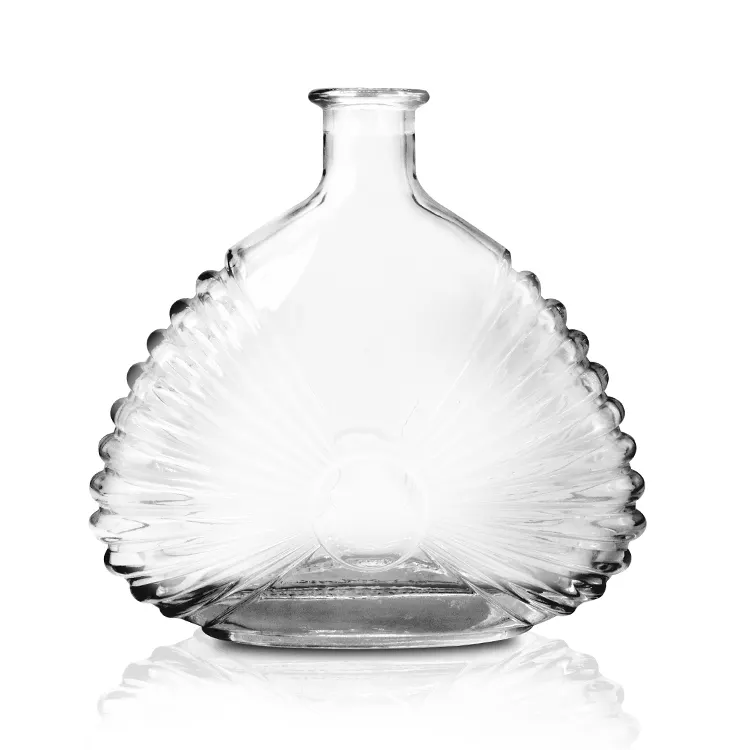
Display profiles and closures
| Shape | Size | Mouth | Closure | Glass weight |
|---|---|---|---|---|
| Square apothecary on a pedestal base | 500 or 750 ml | 70 mm | Glass stopper | 620–780 g |
| Round with a deep punt | 700 or 750 ml | 80 mm | ROPP cap | 580–720 g |
| Custom teardrop or gourd | 500–1000 ml | 70–100 mm | To suit the mouth | 550–900 g |
| 3 L carafe | 3000 ml | 100 mm | Glass stopper | 1,650 g |
A 100 mm mouth on a 3 L bottle is the upper limit for press-and-blow. At that size the closure should be a glass stopper with a ground seat, because rolling an aluminium ROPP cap at that diameter gives inconsistent torque.
Keeping the root upright and centered is partly a matter of shape. The base is given a slightly convex pocket and the shoulder is set at 35–45°, and between them they hold the crown in place; ask for the pocket drawing with every display bottle. Filling temperature matters too. Spirit goes in at 15–20°C, cool enough that convection does not float the root off its seat.
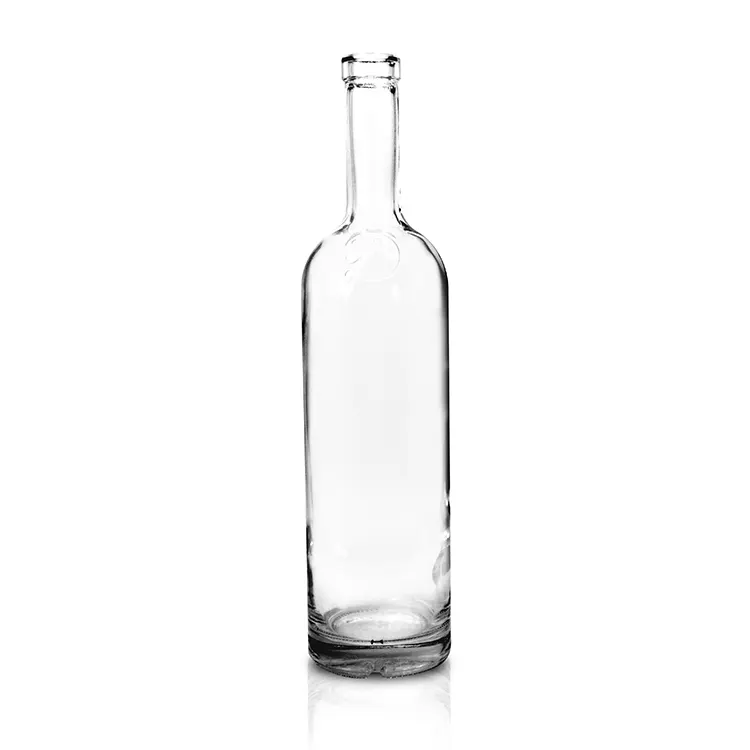
Clarity and annealing checks
The glass has to work as a lens. Ordinary flint looks green at the edges once the wall reaches 4 mm, so ginseng bottles are run in a low-iron batch (Fe₂O₃ ≤ 0.04%). Cosmetic inspection is stricter as well. In the zone where the root is viewed, blisters and any seeds >1 mm are classed as major defects and judged at AQL 1.0; back-bar spirits glass is normally accepted at 2.0.
The shape itself is awkward, with a heavy pedestal base under a thin-shouldered body. Residual stress collects at the heel, and a bottle with too much of it can crack on a retail shelf half a year after it was filled with 40% ABV spirit. Annealing should follow ASTM C148, and each bottle design should be checked under a polariscope to confirm stress is under 50 nm/cm. Add internal-pressure screening to ISO 7458 on first articles. If the infusion is filled warm, as some tonic producers do at 40–50°C, the release plan also needs a thermal-shock test to ISO 7459.
Leaching is not the concern buyers sometimes expect. Ethanol at 35–55% ABV does not attack soda-lime glass of this thickness in any meaningful way, and the food-contact declaration for each lot should still report Pb and Cd migration. What shortens the life of a bottle displayed for years is stress corrosion, which is why annealing gets the attention.
Decoration, packing and briefing
For gifting, the options are ceramic screen print fired onto the glass, gold-band decals (these are fired at 560–600°C), frosting and metallic spray coats. Each 3 L bottle travels in its own foamed carton, with six cartons to a master case, and the pack is drop-tested to ISTA 1A. Plan landed cost early for that size, because its volume dominates the freight.
Cost and minimum quantity are quoted per project and move with the mould, the line it runs on, decoration, quantity and freight terms. A brief should give container, closure, decoration, quantity and destination. Samples of existing display shapes follow our sample request process. For neighbouring formats, see the guide to alcohol bottle types and the liquor bottle collection.