Filed under frosted glass bottles — start there for the stock moulds, then use the detail below to narrow the spec.
A gradient (ombre) glass bottle gets its fade from several overlapping spray passes applied through a masking fixture, then oven-cured at 180–220°C. It works on most stock perfume, serum, mist and room-spray bottles from 30 to 100 ml, so a brand can stand apart on the shelf without paying for a private mould. What separates a clean fade from a banded, peeling one is process control: a fixed fixture, measured film thickness, a signed Pantone master chip and a written test report with every batch.
Choosing between single, dual and inner-spray gradients
Name the gradient family in your brief. Each of the three behaves differently on the line and fails in a different way.
| Gradient type | What it looks like | Main risk | Best suited to |
|---|---|---|---|
| Single colour | One hue, pale at the base and fully saturated at the shoulder, such as a near-nude dusty rose deepening to mauve | Lowest of the three: one pigment system, one fixture set, the most forgiving thickness tolerance | A first gradient SKU |
| Dual blend | Two pigments sprayed from opposite ends that interleave in the middle, such as teal into warm amber or violet into blush pink | A muddy or hazy mid-band if the two coatings crosslink differently | Signature colour stories and gift editions |
| Inner spray | Colour on the inside wall, seen through glossy, uncoated glass | Pooling at the base, uneven coverage, and coating in contact with the product | Bottles whose outer surface must stay clean or take a screen print |
A dual blend costs more than a single gradient because it needs a second pigment, a second fixture edge and a slower line speed to keep the bands clean. Before a run is approved, overlap coupons should be sprayed and cured together to prove the two systems are compatible, and the overlap band is held to a tighter 15–20 mm window so the meeting point looks deliberate.
Inner spray is a considered specification, never a default. The spray has to wet the whole interior contour, so bottles with complex internal shoulders are ruled out, and because the coating touches the fill, it has to be validated against your product-contact and fill-line cleaning requirements. Of the three families it needs the most engineering review.
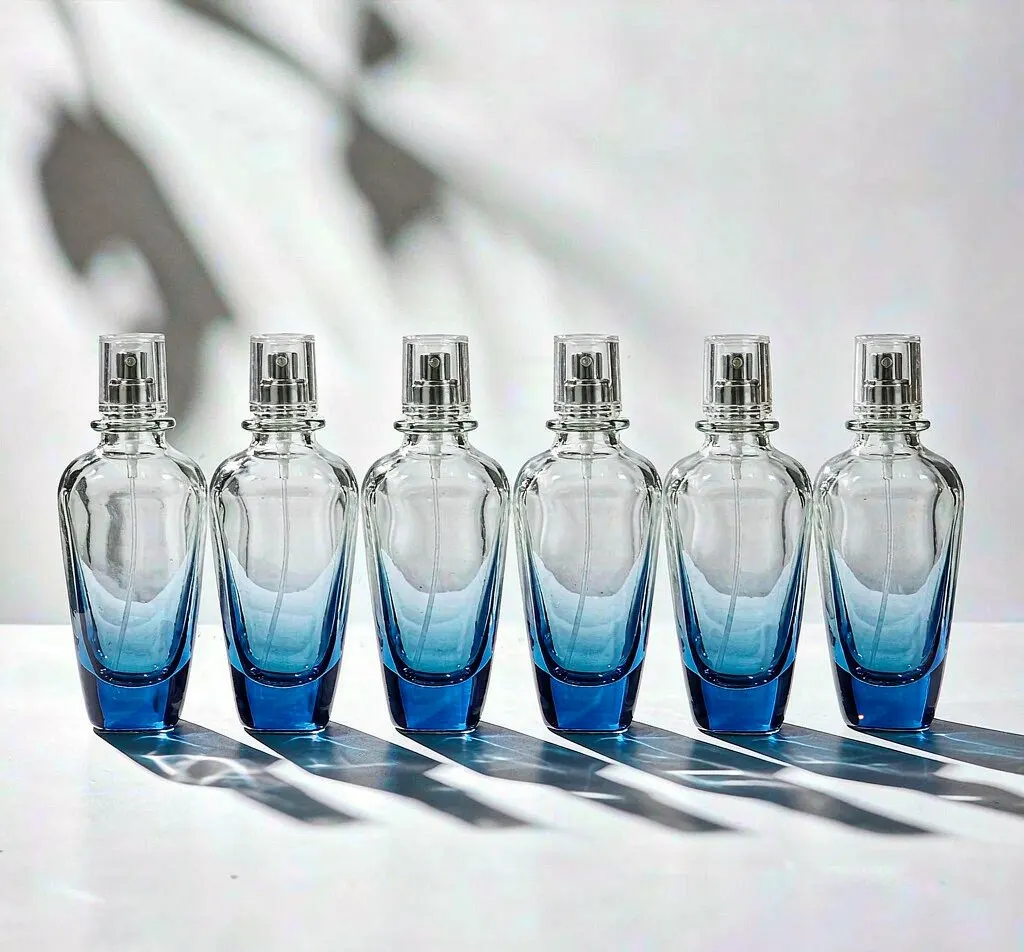
Bottle formats that take a gradient well
Gradient coating can go onto most flint, clear or pre-frosted bottles in the 30–100 ml range. The practical limits are geometric: the fixture needs a stable seat at the base and the mask needs a clean shoulder to work against, so extreme custom shapes add tooling time. These are the configurations most often run as gradient programmes on public moulds.
| Capacity | Bottle style | Neck finish | Closure | Glass weight | Gradient type |
|---|---|---|---|---|---|
| 30 ml | Round perfume / parfum | 15 mm | Snap cologne cap | 95 g | Single or dual |
| 30 ml | Serum / essence dropper | 18 mm | Dropper cap | 110 g | Single (base fade) |
| 50 ml | Rectangular mist bottle | 20 mm | Mist sprayer | 135 g | Single, dual or inner |
| 50 ml | Tall cylindrical perfume | 18 mm | Magnetic cap | 140 g | Dual blend |
| 100 ml | Slim essence / toner | 20 mm | Pump or disc cap | 175 g | Single or inner |
| 100 ml | Room / linen spray | 20 mm | Mist sprayer | 180 g | Dual blend |
If you already buy a bottle elsewhere, it can usually be coated as it is. Very thin-walled or highly irregular shapes may need a modified fixture or a different gradient approach, which adds tooling time but rarely calls for a new mould. To see where gradient sits beside frosted, clear and printed finishes, the cosmetic glass bottle collection groups finish types by bottle family.
How the use case changes the specification
- Perfume, 30–50 ml. The fade carries the scent story, for instance warm amber at the base for a citrus or blush at the shoulder for a floral. Buyers here judge the cleanliness of the transition and the contrast with the cap.
- Essence, serum and toner. A base fade on a 30 ml dropper moves the pack away from a generic private-label look, and a hard-cured exterior copes with bathroom use. Where a silicone serum should not meet an outer coating, inner spray is the usual answer; our glass toner bottle page lists neck and cap pairings that accept it without retooling.
- Room and linen spray, 100 ml. These bottles sit on a shelf or windowsill for months, often in sunlight. Ask for UV-stabilised pigment and a 500-hour xenon-arc fade test in which delta-E stays under 3.0. Sprayer and overcap combinations are covered under room spray bottles.
- Gift and holiday sets. A 50 ml public-mould bottle that is clear in the core range can become a dual-blend ombre edition with no new mould, usually finished with a foil band.
How the fade is built on the coating line
Understanding the process helps you read a supplier's answers. The bottle is loaded onto a fixture and passed through an ionised air wash, which strips dust and static; one stray fibre under the coating shows up as a defect right in the gradient band. An adhesion-promoting primer follows at 8–12 microns to key the colour to the flint or soda-lime glass.
Colour then goes on in stages. A CNC-cut or 3D-printed shield, indexed to the bottle shape, blocks the shoulder and neck while the first pass covers only the lower zone. The second pass extends coverage upward and the third builds the saturated top. Each pass lays down 12–20 microns of wet film, and it is the overlap between passes that produces a continuous fade instead of a step.
The fixture matters more than any other tool. Freehand spraying can produce an acceptable first bottle and a visibly different fiftieth, whereas a fixed mask on a rotary indexing table repeats the same deposition on every piece. On a typical 50 ml ombre perfume bottle, the base zone is held at 18–22 microns and the shoulder at 35–45 microns, with a transition band of roughly 25–35 mm across which thickness rises linearly. That steady rise is what the eye reads as smooth.
Why the cure window is fixed
Gradient coatings are thermoset systems, either UV-hybrid or two-component polyurethane, cured at 180–220°C for 12–20 minutes depending on bottle mass and chemistry. Below 180°C the polymer does not crosslink enough to resist alcohol, so it softens against ethanol-based perfume or 75% alcohol sanitiser wipes. Above 220°C the glass and any earlier decoration are at risk of thermal shock and neck distortion, which later shows up as a failed capping torque test. A three-zone oven (ramp, soak, controlled cool) keeps the bottle wall from seeing uneven heat and building stress.
Colour matching and lot-to-lot drift
Colour is specified against the Pantone Matching System and judged under D65 daylight-simulated viewing. Supply a chip reference for each zone, for example Pantone 15-1916 TPX, a rose quartz, or Pantone 18-3838, an ultra violet. A screen or PDF is not a usable target: pigment shifts with the light source, and a fade that is right under 5000K showroom lighting can read pink where it should be lilac under 6500K retail lighting.
The reference is a signed master chip kept in the quality file, and each production lot is compared with it in a controlled light box. Drift between lots is the quiet failure in gradient work, because a bottle from the first lot and one from the sixth can each pass on the line and still disagree on the shelf.
The control to ask for is a delta-E of ≤1.5 between any two qualified lots, read with a spectrophotometer on the saturated zone, where drift shows most, and separately on the base zone. Pigment should arrive pre-dispersed in fixed master-batch lots, leaving line speed and gun pressure as the only variables, both logged for every run. Request the delta-E report with the batch certificate. A plant that cannot produce one is matching by eye, and that will not hold across a six-SKU seasonal range.
Test results to request in writing
A gradient that looks right in a showroom and fails in a warehouse is a recall risk, so the figures below belong on the batch certificate.
| Property | Method | Pass level |
|---|---|---|
| Adhesion | Cross-cut per ASTM D3359 / ISO 2409: a 6×6 lattice of 1 mm cuts down to the glass, 3M 600 or equivalent tape applied and pulled, rated on the 0–5 scale | 4B or better (fewer than 5% of squares detached); 5B for humid tropical markets with heavy condensation cycling |
| Abrasion | RCA abrasion tester with a 175 g load | 300+ cycles before breaking through to glass, against 150 cycles for an uncured or thin single-coat reference |
| Alcohol resistance | Wiped 200 times with 95% ethanol at 500 g linear load, then checked for gloss retention and colour shift | Delta-E under 2.0 |
| Fragrance oil resistance | 24-hour spot test with fragrance oil at 40°C | No blistering, no adhesion loss at the cross-cut, no measurable haze under 60° gloss measurement |
The oil test matters because perfume concentrates, citrus oils and silicone-based serums all attack soft coatings, and alcohol resistance alone does not prove the finish will survive them.
Adding foil, screen print or frost
Most gradient bottles carry a second decoration. The order of work is set by temperature: anything applied after the gradient must cure cooler than the gradient did, and anything applied before it would be destroyed in the gradient oven.
| Second process | Applied at | Check before or after |
|---|---|---|
| Hot-stamp gold or silver foil | 110–140°C on a stamping die, after the gradient is fully cured | Tape pull on the foil edge, 4B or better |
| Screen print (logo, batch code, rule line) | UV cure at 80–100°C | Surface-tension test first: dyne level of 38 mN/m or higher so the coating accepts ink |
| Partial frost, usually on the lower body | Sprayed over the cured gradient | Chemical compatibility with the coating |
Foil is normally placed at the shoulder or neck, where the saturated end of the fade gives it the strongest contrast, and the adhesive has to suit a thermoset surface. On an inner-spray bottle the print simply goes onto the bare exterior glass. A one-colour print in a tone taken from the pale end of the gradient makes the logo look like part of the bottle.
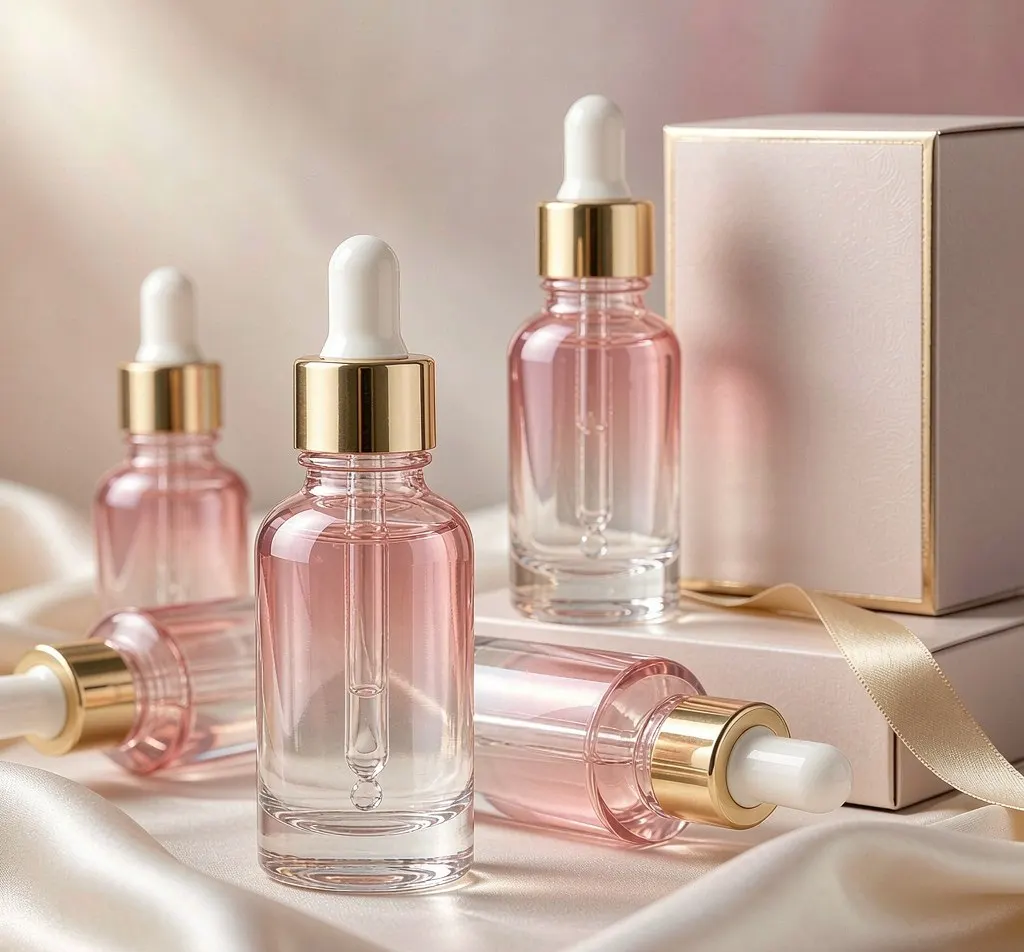
Frost gives a gloss-to-matte contrast popular with indie skincare: saturated and shiny at the shoulder, soft at the base. It has to be a sprayed frost. A full acid etch would attack the edge of the coating. The standalone frost options, and how they share a run with gradient, are set out on the frosted glass bottle page.
From brief to released lot
- Brief. Send the target capacity, the bottle family or a sample bottle, a Pantone reference for each zone, the gradient direction (base-to-shoulder or horizontal) and any secondary decoration.
- Engineering review. We check with the plant that the geometry will hold a mask edge, that neck finish and wall thickness suit the cure, and that the coating chemistry fits the fill: ethanol-based perfume, oil-based serum or water-based mist.
- Sample. Typically 3–5 physical units made on the production fixture, not sprayed by hand, so the transition you approve is the one the line will repeat.
- Qualification run. After the order is placed, the first 200–500 units are pulled for cross-cut, abrasion, alcohol and delta-E testing before the rest of the lot is released.
- Batch certificate. It should state the adhesion rating, RCA cycle count, ethanol-wipe result and the delta-E comparison of lot to master.
Treat the approved sample as a contract. The signed master chip and the sample bottle are the acceptance standard, and a purchase order that does not cite them gives the plant nothing binding to match. Both should stay on file for the life of the programme so that a reorder twelve months on is compared with the original. The same fixture and process serve perfume mists and treatment sprays alike; sprayer and actuator choices are on our custom glass spray bottle page.
Questions that qualify a coating plant
These are the points we raise when matching a gradient project to a plant, and any buyer can ask them directly.
- Process control. Fixed masks on an indexed line, or freehand? Ask for a photo of the fixture, and ask whether film thickness is gauged on pulled coupons or judged by eye.
- Test reporting. Are adhesion, abrasion, ethanol-wipe and delta-E results written on every batch certificate?
- Cure discipline. What is the cure window, and does the line stop when the oven drifts outside it?
- Colour governance. Is there a signed master chip, and does pigment come as fixed master-batch?
- Reorder fidelity. Can the original master be retrieved and matched a year later?
- Realistic capacity. Daily output is capped by oven cycle time and fixture changeover. A schedule for a dual blend that ignores those limits means an overloaded line or a shortened cure.
- Compliance paperwork. The certificate should document the coating as low-migration and heavy-metal-controlled, which cosmetic and food-adjacent brands will want on record.
Frequently asked questions
What is the minimum order for a custom gradient bottle?
It is quoted per project. The figure depends on the mould, the number of colours and fixtures involved, and the line the job runs on.
How long do sampling and production take?
Timing is confirmed per project once the bottle, the decoration steps and the line schedule are known.
Does a gradient change bottle weight, cap fit or filling?
No. The film is microns thick and adds a negligible fraction of a gram. The fixture masks the neck, so the finish stays bare and caps and sprayers mount as usual. A hard-cured exterior coating does not flake or off-gas on a filling line.
Will the coating stand up to perfume and sanitiser wipes?
A correctly cured thermoset gradient will, and the ethanol-wipe and fragrance-oil results on the batch certificate are the proof. Softening on contact with ethanol points to a coating cured below the temperature floor or built too thin.