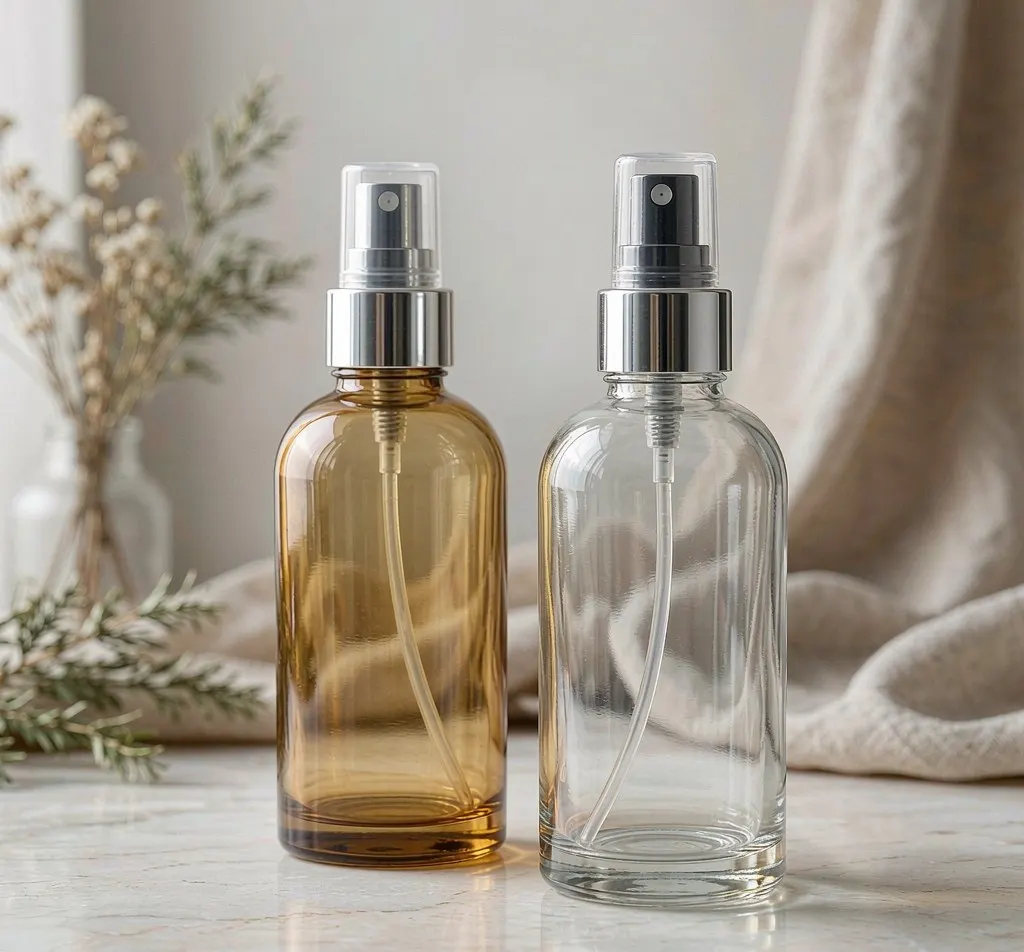
Filed under glass cosmetic packaging; the moulds we quote for this are pictured at the foot of the page.
A glass toner or facial mist bottle is defined by three choices made before any decoration: capacity, neck finish and shoulder profile. The standard range runs from 30 ml to 150 ml in cosmetic-grade soda-lime glass on 18/415, 20/410 or 24/410 necks, each paired with a fine mist sprayer that releases 0.12 ml to 0.14 ml per actuation. The glass is rarely what limits a project. The sprayer, its gasket and the closure torque decide whether the pack mists evenly and arrives without leaking.
Sizes, neck finishes and shoulder profiles
Seven capacities cover the category. Wall thickness goes from 2.2 mm to 3.0 mm and increases with size. The 30 ml and 50 ml bottles are handbag mists and travel toners; 100 ml to 150 ml suits a vanity or a spa back-bar, where a bigger dose per use is fine.
| Capacity (ml) | Neck finish | Shoulder | Sprayer | Output per spray (ml) |
|---|---|---|---|---|
| 30 | 18/415 | Rounded | Fine mist, matte collar | 0.12 |
| 50 | 20/410 | Rounded | Fine mist, matte collar | 0.13 |
| 60 | 20/410 | Rounded | Fine mist, shiny collar | 0.13 |
| 80 | 20/410 | Flat | Fine mist, shiny collar | 0.13 |
| 100 | 24/410 | Flat | Fine mist, shiny collar | 0.14 |
| 120 | 24/410 | Flat | Fine mist, shiny collar | 0.14 |
| 150 | 24/410 | Flat | Fine mist, shiny collar | 0.14 |
In a finish code, the first figure is the outer diameter of the neck in millimeters and the second is the thread class. Get it wrong and the sprayer will not seat; push it on anyway and the glass shoulder cracks.
Shoulders come in two families. The rounded shoulder on 30 ml to 60 ml looks softer on a beauty shelf. The flat or tapered shoulder on 80 ml to 150 ml packs more tightly in an e-commerce mailer, needs less void fill in the carton, and gives a flatter plane for decoration.
One detail matters to anyone planning a filling line. The 18/415 neck has a narrower entry for the dip tube, so its sprayer stem needs a 1.8 mm inner bore, while 20/410 and 24/410 sprayers use 2.0 mm. A 2.0 mm stem fitted to a 30 ml bottle bottoms out and starves the spray, which is why we advise treating the 30 ml actuator as a separate SKU even when one sprayer is shared across the larger sizes.
Compared with the rest of our cosmetic glass bottle collection, toner and mist bottles are the one family built around an actuator below 0.15 ml per stroke, where serum and lotion packs rely on droppers and lotion pumps.
Fine mist sprayer performance to specify
A skincare mist sprayer is a small air-assisted siphon, a different device from the trigger on a household cleaner. Brief it with numbers; "fine mist" alone tells a supplier very little.
| Parameter | Target for this range | Why it matters |
|---|---|---|
| Output per full actuation | 0.12 ml to 0.14 ml | Covers the face without runoff |
| Spray angle | 50 to 65 degrees | Sets the width of the cloud |
| Droplet mass median diameter (MMD) | 40 to 80 microns | Feels cooling, lands before it evaporates |
| Actuation force | 3.0 N to 4.0 N | Comfortable in daily use |
| Spring return | Within 0.4 seconds | Ready for the next press |
The droplet band has a reason at each end. Around 100 micron and above, skin registers a wet splash. Near 20 micron, the liquid evaporates before it reaches the face. The return spring is stainless steel 304 rated for 48 hours of salt spray, because a humid bathroom and dried formula residue are hard on metal parts.
Viscosity
A toner at 1 to 5 centipoise or a mist at 1 to 10 centipoise works with the standard sprayer unchanged. Add a solubilized oil phase, glycerin above 5 percent or a colloidal suspension and the 0.13 ml sprayer starts to under-deliver and spit. The fix is a wider dip-tube bore, a softer 2.5 N spring and a larger swirl chamber, which keeps the MMD under 90 microns.
A spray test with water does not predict how a surfactant system behaves. We ask for a 200 ml reference sample of the real formula before any tooling is signed off.
Dip tube length
Tube length is measured from the seated collar to the inner radius of the base and cut to plus or minus 1.5 mm against the filled bottle height. On the 150 ml flat-shoulder bottle the tube is 118 mm; on the 30 ml rounded bottle it is 61 mm. A tube 3 mm short strands 4 to 6 ml of product at the bottom, which customers read as a short fill. One that is 3 mm long curls against the wall and rattles.
Matching the closure to the formula
Soda-lime glass is inert to nearly all water-based toners and hydro-alcoholic mists, which is its main advantage over PET and recycled plastic here. The glass in this range meets the cosmetic contact standard, with extractable heavy metals below 1 ppm and a hydrolytic resistance class confirmed by the powdered-glass test. Compatibility problems come from the sprayer.
- Alcohol. Up to 75 percent v/v, the gasket should be EPDM or FKM. Standard nitrile swells and hardens in ethanol across a six-month shelf life and then weeps. EPDM stays dimensionally stable through 12 months at 40 degrees Celsius without measurable drift in output.
- Essential oils and botanical extracts. Citrus terpenes and menthol derivatives attack some plastics, and a soft actuator stem can cloud or craze. The dip tube and stem are checked against the brand's actual oil load in a 28-day immersion panel; for high-terpene formulas a POM stem is used.
- Closure torque. On an 18/415 neck, more than 18 Ncm can stress-crack the glass land, and less than 10 Ncm lets the collar work loose on the line. Fillers who would rather not manage this can ask for sprayers crimped at the plant to a fixed 14 Ncm; otherwise a torque chart per size goes with the order.
Glass color and light protection
Clear glass passes the whole 290 nm to 700 nm spectrum, so it does nothing for light-sensitive actives. A vitamin-C derivative or a botanical flavonoid can degrade measurably within two weeks in a shop window.
| Glass | Light blocked | Use it when |
|---|---|---|
| Clear | None | The formula is light-stable |
| Amber | 99 percent below 450 nm, 92 percent below 550 nm | Actives need full protection |
| Light amber or smoke grey | 85 percent below 450 nm | A softer, neutral look is wanted |
| Frosted clear | None; visible light is only diffused | Paired with an interior UV-absorbing coating |
The amber figures were measured on a 2.0 mm wall at 30 ml. Frosting is often mistaken for protection, so it is worth stating in the brief whether the formula needs a UV barrier or only a matte finish.
Leak control for air freight and e-commerce
Low-grade sprayers tend to fail in transit, where vibration works the stem and pumps liquid past the gasket. A turn-to-lock collar prevents this: the actuator turns 90 degrees from "spray" to "lock" and the stem can no longer travel. For parcels that go through pressure changes, a shrink band over the collar adds a second barrier.
In drop-and-inversion testing, the locked sprayer showed zero weeping after 72 hours at 50 degrees Celsius and after a 1.2 meter free fall onto concrete. Those two conditions stand in for a hot warehouse stack and a courier's handling.
Decoration options and their limits
The treatments below are the standard ones for this range. Each has its own tooling, and each fits some bottle shapes better than others.
| Treatment | What you get | Constraint |
|---|---|---|
| Acid-etched frosting | Surface roughness of 0.8 micron to 1.2 micron, light transmission down 30 percent to 40 percent, permanent and scratch-resistant | No UV protection |
| Spray matte lacquer | Ceramic feel, slightly warmer to the touch, 2 to 3 H pencil hardness | A coating, so less durable than etching; suits short runs |
| Gradient spray | Base coat, mid fade and tip coat in two to four passes, with a soft 15 mm transition band | Adhesion checked by cross-hatch test, ASTM D3359, grade 4B minimum; 60 degree gloss logged per batch |
| Silk screen | Logo, volume mark and claim line in one to four spot colors, 0.15 mm registration | The better choice on rounded 30 ml to 60 ml bodies |
| Hot-stamp foil | Gold, rose gold or holographic, 0.2 mm edge tolerance | Needs a flat or gently curved plane, so 80 ml to 150 ml flat shoulders |
Common gradients are clear-to-rose, smoke-to-amber and a three-color "aurora" that moves from teal at the base through violet to a champagne shoulder. Where a metallic look is wanted without foil, a dense silver or gold ink is the alternative. Decoration inks are low-migration, sit on the outside of the bottle and comply with EU and US packaging substance rules; they never touch the formula.
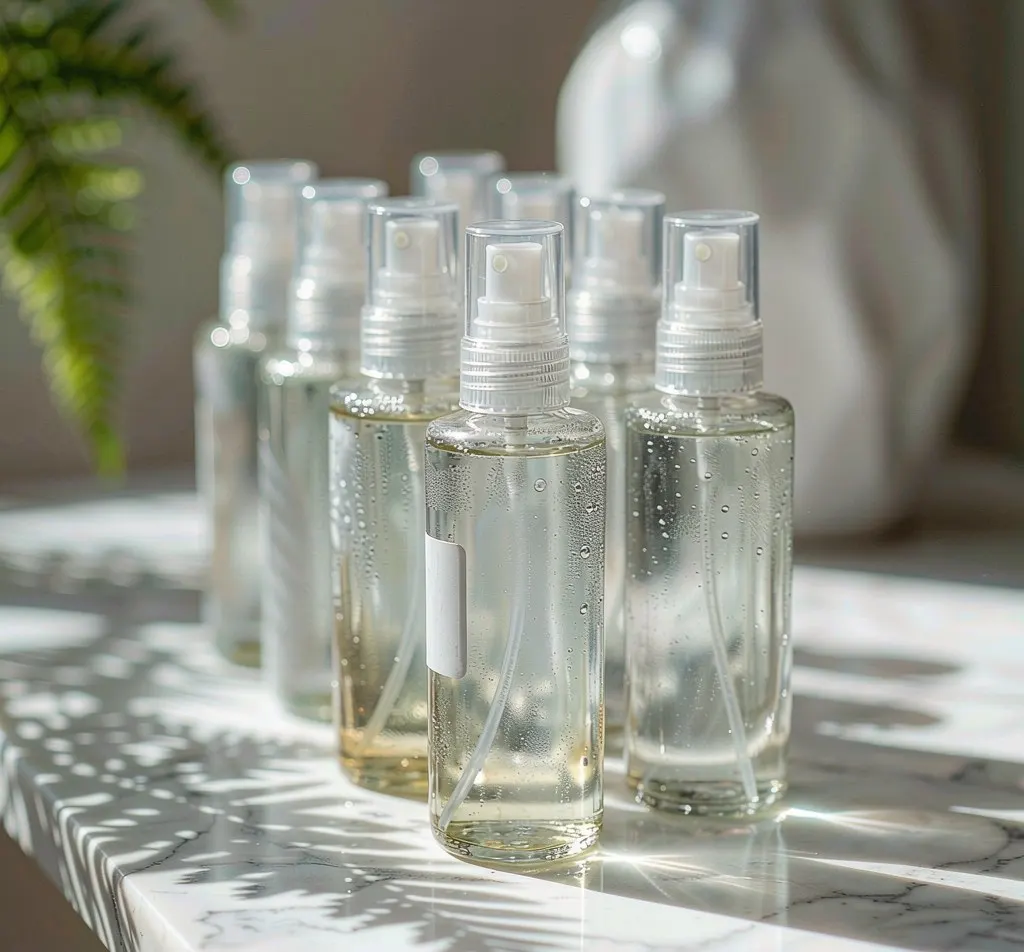
Color can be matched to a Pantone reference or a physical chip within 0.8 Delta-E under D65 light. A library of 140 stock glass tints, transparent, translucent and opaque, means most brands do not need a custom melt. A new tint is a bigger commitment, because the colorant goes into the glass batch and cannot be sprayed on afterwards.
Trigger and continuous-spray actuators, 200 ml to 500 ml formats and dual-chamber mist systems fall outside this range; they are handled as custom glass spray bottle projects.
Coordinating toner, serum and lotion bottles
A toner seldom launches by itself. Specifying the serum and moisturizer packs alongside it keeps glass tint, collar finish, shoulder curve and print registration consistent across the routine, and lets all three share one decoration mask.
- Serum: 5 ml, 10 ml, 15 ml and 30 ml with dropper or pump. Dropper serum bottles use the same 18/415 and 20/410 necks as the small toner sizes, so a 30 ml mist and a 30 ml serum have one footprint and fit side by side in a gift carton.
- Lotion: 100 ml, 120 ml, 150 ml and 200 ml with lotion pumps. The larger glass lotion bottles take 24/410, the finish of the 100 ml to 150 ml toner, so the collar looks the same while each pack keeps the actuator suited to its viscosity.
When the three are ordered together, the glass can be drawn in one production schedule, which steadies tint and wall thickness between SKUs, and export cartons can be consolidated. A launch set can also be pre-kitted in a single master carton with dividers, ready for the filler, which removes one handling step and one chance of damage. Projects that add treatment pumps go through the glass pump bottle range.
Mold choice, inspection terms and supplier checks
With a stock mold the shape already exists, so work starts at decoration and assembly. With a custom mold, settle exclusivity in writing at contract stage: a non-exclusive shape may later be offered to other buyers.
The purchase order should carry the quality terms. A sound baseline is AQL 2.5 at general inspection level II for cosmetic defects, plus a leak-test sub-lot of 1 percent that is pulled and stored inverted for 24 hours.
Before comparing quotes on unit cost, ask each supplier for five documents:
- The hydrolytic class certificate for the glass.
- An independent lab report on sprayer output and MMD.
- The gasket material data sheet, including ethanol compatibility.
- A drop-and-inversion leak test video run at your formula's viscosity.
- An ISO 9001 certificate whose scope names cosmetic glass, not only industrial containers.
Then ask about practice. Request the Delta-E log from the last three production runs to judge tint consistency. Ask what actuator life test is run and when a unit counts as failed; 500 actuations with under 0.01 ml drift is a fair benchmark. Ask how a short-fill or leak claim is handled. A supplier who cannot state the dip-tube tolerance, the actuation force in Newtons or the gasket material is probably reselling stock it does not understand.
Frequently asked questions
How does a fine mist sprayer differ from a lotion pump on a toner?
The mist sprayer atomizes a small dose through a swirl chamber. A lotion pump is a positive-displacement device meant to push out 0.5 to 2.0 ml of thick cream through a large orifice, with no atomization, so on a watery toner it delivers a heavy blob. Neck finish, stem bore and spring rate differ between the two, and they cannot be swapped. Use the mist actuator for anything under roughly 15 centipoise.
What output and droplet size suit a facial mist?
Start from 0.13 ml per spray, an MMD of 50 to 70 microns and a spray angle near 60 degrees, which covers the face in two to three pumps without dripping. Drop to 0.12 ml for a very watery, low-alcohol formula to avoid over-wetting. For a light oil phase, move up to 0.14 ml with a widened swirl chamber.
Can the bottles hold witch hazel and alcohol-based toners?
Yes. The glass is unaffected by witch hazel distillate and by the alcohol loads described above. What needs checking is the sprayer, so send the formula sample for the immersion panel before sign-off instead of assuming it will be compatible.
What are the minimum order and lead time for custom-printed mist bottles?
Both are quoted per project. They depend on whether the bottle comes from a stock or custom mold, on the decoration, on the quantity and on the freight terms.
Can toner, serum and lotion bottles be sourced as one matched set?
Yes, and it is the simpler route. Shared neck finishes and a shared decoration mask keep the three packs consistent, and one order can be kitted and shipped together.