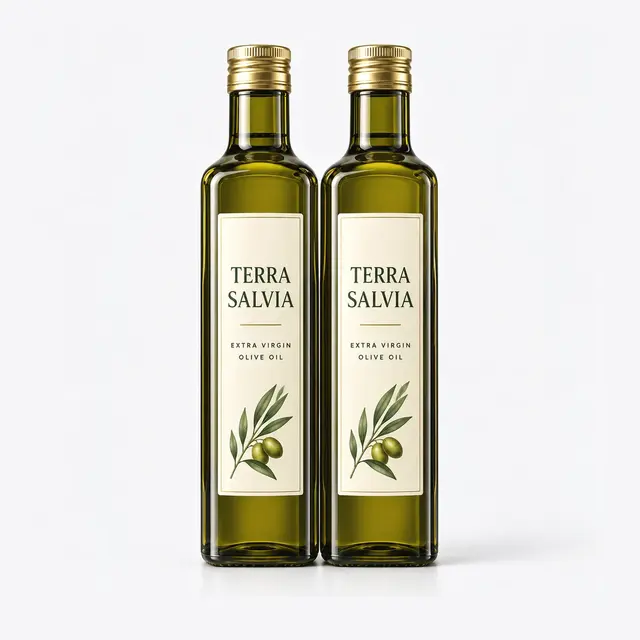
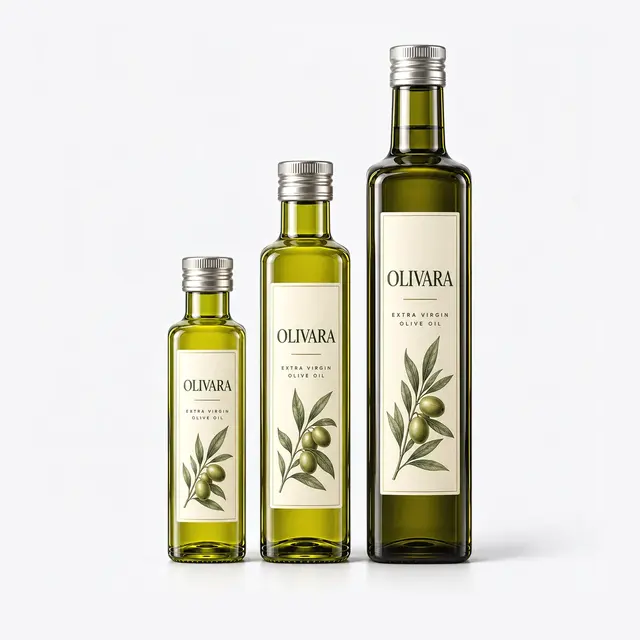
Series 1772 is a tall, round olive oil glass bottle blown in dark antique green glass, designed for producers and co-packers who need serious light protection for extra virgin olive oil without giving up the classic Mediterranean dorica silhouette. The bottle in the photo shows a slim cylindrical body, a defined shoulder, a long straight neck and a continuous-thread ROPP finish that accepts standard 31.5 mm aluminum olive oil caps with pourer inserts. It suits EVOO brands, private-label importers, estate mills and foodservice repackers who buy glass by the pallet or container and care about what happens to the oil between the filler and the consumer’s kitchen.
Why Dark Antique Green Glass Matters for Extra Virgin Olive Oil
Light is one of the three enemies of olive oil, alongside heat and oxygen. Ultraviolet and visible blue light accelerate photo-oxidation of the oil, breaking down polyphenols and developing the rancid, cardboard-like off-flavors that ruin a good extra virgin long before its printed best-before date. Dark antique green glass absorbs a large share of that damaging spectrum, which is why it has been the default color for quality EVOO across Spain, Italy, Greece and Tunisia for generations.
For an exporter or brand owner, the practical implication is simple: a dark green bottle buys you shelf-life margin. Oil that sits under fluorescent retail lighting for months, or travels through sunny distribution chains in the Middle East or southern Europe, keeps its sensory profile noticeably longer in antique green than in flint or lightly tinted glass. If your oil is certified extra virgin and priced accordingly, the bottle color is part of protecting that claim.
Round Dorica Geometry on the Filling Line
The round cross-section of Series 1772 is friendly to almost every filling technology used in the olive oil trade. Rotary fillers, linear gravity fillers and vacuum fillers all handle round bottles without the orientation equipment that square formats sometimes need at infeed. The cylindrical body runs smoothly through star wheels, timing screws and labelers, and change parts for round dorica-type bottles are widely stocked by line builders.
The tall, narrow proportions also keep the bottle stable at speed. A slim footprint means more bottles per meter of conveyor and per layer on the pallet, while the straight body wall gives pressure-sensitive and wrap-around labelers a consistent surface. If your co-packer runs multiple SKUs, a round dorica-style bottle is usually the format they can slot in with the least downtime.
Closure Options: 31.5 mm ROPP with Pourer Inserts
The neck finish visible in the photo is the olive oil industry standard: a 31.5 x 24 mm ROPP thread that takes roll-on pilfer-proof aluminum caps. For olive oil, these caps are almost always paired with a non-drip pourer insert, either pre-fitted in the cap liner or inserted after filling. The tamper-evident band breaks on first opening, which is a legal or retail requirement in many export markets.
Exact neck dimensions, thread profile and cap compatibility are confirmed on the technical drawing at quotation stage, and we always recommend running closure samples on your capping head before a full production run. Alternative finishes such as PP screw caps or cork-type closures can be discussed if your brand format requires them.
Capacities, Label Area and Decoration
Bottles in this shape family are commonly produced in the standard olive oil capacities of 250 ml, 500 ml, 750 ml and 1 liter; the exact capacity of Series 1772 and its brimful volume should be confirmed with the factory when you request a quotation. The tall body offers a generous vertical label area that suits front-and-back label layouts as well as full wrap designs.
Decoration options include pressure-sensitive labels, screen printing, acid-etch frosting and hot stamping. For private-label buyers, the dark green glass provides a deep, even background that makes gold, white and cream label inks stand out on shelf. Embossed brand marks in the shoulder or base area can be added with a custom mold when volumes justify it.
Quality Control Standards Behind Every Pallet
Every production lot passes through dimensional checks, visual inspection and performance testing before packing. Internal pressure resistance is verified with reference to ASTM C147, thermal shock endurance is tested according to ISO 7459, and resistance to internal pressure for containers is checked following ISO 7458 methodology. Annealing quality is monitored with polariscope inspection so the bottles survive hot filling, pasteurization where applicable, and long sea freight without stress cracking.
Glass is food-grade soda-lime, compliant with EU and FDA food-contact expectations, and heavy-metal migration is controlled within the limits your market requires. Certificates and third-party test reports can be shared with your quality team during the sampling stage.
How to Order: MOQ, Samples and Lead Time
Minimum order quantities for stock molds in this series are set to keep your landed cost competitive; the current MOQ for this bottle is explained in detail in our guide to glass bottle MOQ. Physical samples are available so you can test filling, capping and labeling before committing. Standard lead time runs from mold confirmation to ex-works in a matter of weeks, with sea freight arranged to your destination port.
Bottles are packed on export pallets with layer pads and shrink wrap, or in cartons if your filler requires them, and every shipment is photographed before container loading so you have a record of packing condition. If you are new to buying packaging from China, our overview of importing glass bottles from China covers Incoterms, inspection and documentation. To get a quotation on Series 1772 with your target capacity and annual volume, contact our sales team and we will reply with pricing, the technical drawing and sampling options.
Frequently Asked Questions
What is the minimum order quantity for Series 1772 olive oil bottles?
For a stock mold like Series 1772, the MOQ is typically one production run, which for this bottle size works out to roughly one 20-foot container load. Exact figures depend on the capacity you choose; smaller trial quantities can sometimes be arranged from warehouse stock. Ask our sales team for the current MOQ and any available stock lots.
Can I get samples before placing a bulk order?
Yes. We send physical samples of Series 1772 so you can test filling, capping torque, pourer fit and labeling on your own line. Samples are usually dispatched within a few days; you cover the courier cost, which is credited back against your first bulk order.
Which closures fit this bottle?
The neck finish shown is the standard 31.5 x 24 mm ROPP olive oil finish, compatible with roll-on pilfer-proof aluminum caps and non-drip pourer inserts. We can supply matching caps and pourers, or you can source them from your existing closure supplier. Exact thread dimensions are confirmed on the technical drawing before production.
Is the dark green glass food-grade and compliant for export markets?
Yes. The bottle is made from food-grade soda-lime glass. It meets EU food-contact requirements and FDA expectations for glass containers, and heavy-metal migration is controlled within regulatory limits. Test reports and declarations of compliance are available on request during sampling.
How long does production and delivery take?
From order confirmation and deposit, a stock-mold production run typically takes three to four weeks ex-works. Sea freight adds roughly two to five weeks depending on your destination port. We quote under the Incoterm you prefer, most commonly FOB, CIF or DAP.
Can I customize the bottle with my brand embossing or a different capacity?
Decoration such as screen printing, frosting and hot stamping is available at standard order volumes. Embossed logos or a modified capacity require a custom mold, which becomes economical at higher annual volumes, usually from several hundred thousand bottles per year. We will advise honestly whether a custom mold makes sense for your volumes.