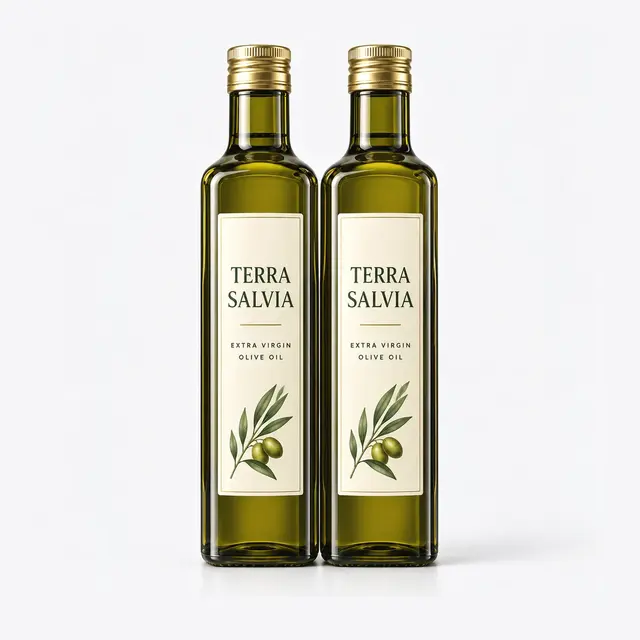
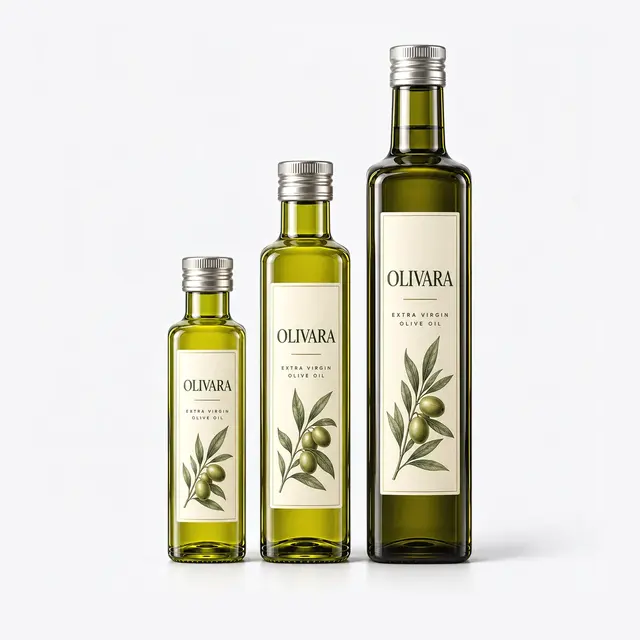
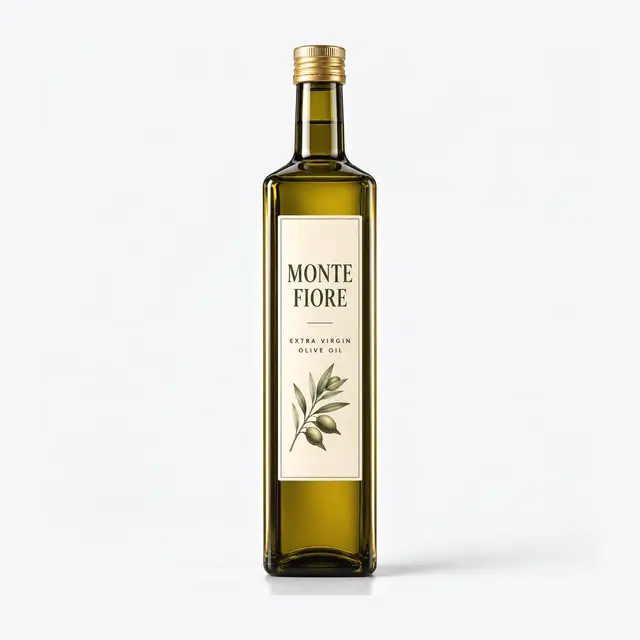
The Series 1984 is a matched pair of dark antique green marasca olive oil bottles in two complementary sizes, built for extra virgin olive oil brands that sell a small everyday format alongside a larger family or retail format. Both bottles share the same square marasca silhouette, the same deep green glass tone, and the same threaded neck finish designed for the standard 31.5 mm olive oil closure system, so a brand can line them up side by side on shelf as one coherent family. The smaller unit works naturally as a 250 to 500 ml trial, gift, or food-service size, while the taller unit reads visually as a 750 ml class retail bottle. Exact brimful capacity, weight, and dimensions are confirmed on the technical drawing at quotation stage.
For olive oil specifically, glass color is not decoration. Light, and especially the ultraviolet portion of it, is one of the fastest drivers of photo-oxidation in extra virgin olive oil, breaking down polyphenols and producing rancid off-flavors long before the printed best-before date. The dark antique green glass used in Series 1984 absorbs a large share of that damaging spectrum, which is why deep green and amber tones have dominated premium olive oil packaging across the Mediterranean for decades. When your oil competes on freshness, harvest date, and polyphenol content, the bottle is part of the product specification, not just the container.
Why Dark Antique Green Glass Protects Your Oil
Antique green glass sits in a sweet spot between protection and presentation. It blocks substantially more UV than flint or light green glass, yet still lets the customer see the golden-green hue of the oil inside, which remains an important buying signal for extra virgin grades. Retailers also benefit: stores with bright shelf lighting, and e-commerce brands shipping to sunny climates, put real light stress on bottled oil. A dark green marasca reduces that risk through the whole chain, from your filling hall to the consumer’s kitchen counter, without requiring full-sleeve labels or secondary cartons.
The two-size pairing shown here amplifies that benefit commercially. Many of our olive oil customers launch with the larger bottle as their core retail SKU and add the smaller one as a sampler, a hotel and restaurant amenity, or a promotional bundle. Because both sizes come from the same glass family and share the same neck finish, you keep one closure supplier, one capping chuck, and one visual identity across the range.
Marasca Square Shape: The Olive Oil Industry Standard
The square marasca profile is the workhorse of the olive oil trade for practical reasons. Its flat faces give front and back labels a clean, distortion-free panel, its corners pack efficiently in export cartons with almost no wasted air between bottles, and its stable base behaves well on conveyor rails and in shrink-wrapped multipacks. Compared with round bottles of the same capacity, square marascas typically fit more units per carton and per pallet layer, which lowers your landed cost per bottle on ocean freight.
The gently sloped shoulder and tall cylindrical neck visible in the photo are classic marasca proportions. The long neck gives pour control in the kitchen and provides ample thread engagement for the closure, while the squared body maximizes fill volume within a compact footprint. If you are currently buying round bottles and considering a switch, our team can share carton and pallet loading comparisons so you can quantify the logistics saving before committing.
Closure Compatibility: 31.5 mm ROPP and Pourer Systems
The threaded finish shown on Series 1984 is the industry-standard olive oil neck that accepts 31.5 mm ROPP aluminum caps, including versions with integrated non-drip pourer inserts and tamper-evident bands. This closure family dominates retail olive oil because it combines an airtight, oxygen-limiting seal with controlled pouring at the table. Exact finish dimensions and tolerances are confirmed with the factory drawing, and we can supply matched aluminum caps, plastic pourers, or plain screw closures from our closure partners so bottles and caps arrive as a tested set.
If your brand positions at the premium end, the same bottle can also be paired with cork-top T-bar closures on compatible finishes; tell us your preference at inquiry and we will confirm the correct neck specification. Either way, cap and bottle are leak-tested together before shipment.
Quality Control and Food-Grade Compliance
Every production run of Series 1984 bottles passes a documented inspection protocol. Internal pressure resistance is verified per ASTM C147, thermal shock endurance per ISO 7459, and vertical load strength per ISO 8113, so the bottles withstand hot-fill-adjacent processes, pasteurization-adjacent temperature swings, and high stacking in warehouses. Glass is soda-lime, food-contact safe, and produced in factories operating under food-grade quality management systems; migration and heavy-metal test reports are available with your shipment documents.
Annealing, wall-thickness distribution, and finish dimensions are checked on sampling from each cavity, because a marasca’s square body concentrates stress at the corners. Third-party inspection before loading can be arranged on request, and our guide to importing glass bottles from China explains how inspection fits into the overall order timeline.
Ordering, MOQ and Packing for Export
Series 1984 bottles are packed in export cartons with dividers, then palletized and shrink-wrapped for ocean freight; the photo below shows our standard shrink-wrap line handling a glass bottle consignment. MOQ depends on whether you order one size or the matched pair, and stock-program sizes often carry lower minimums than custom runs. Our explainer on glass bottle MOQ walks through how minimums are set and how mixed-size orders can be structured. For a quotation with exact capacity, weight, carton count, and current lead time, contact our sales team with your target volumes and destination port.
Frequently Asked Questions
What is the MOQ for the Series 1984 olive oil bottles?
MOQ depends on whether you order one size or the matched pair. Stock-program sizes usually start from a lower minimum that fits a 20-foot container, while custom runs require a full mold charge. Send us your target volumes and we will quote the exact minimum per size.
Can I get samples before placing a bulk order?
Yes. We provide physical samples of both sizes so you can test filling, capping, and label application on your line. Sample bottles are typically free; you only cover the courier cost, which is refunded against your first bulk order.
Which closures fit this bottle?
The threaded neck finish is designed for the standard 31.5 mm olive oil closure system, including ROPP aluminum caps with tamper-evident bands and non-drip pourer inserts. Exact finish dimensions are confirmed on the technical drawing, and we can supply matched caps and bottles as a tested set.
Is the dark green glass suitable for extra virgin olive oil?
Yes. Dark antique green glass absorbs a large share of the UV spectrum that drives photo-oxidation, which is why it is the traditional choice for EVOO across the Mediterranean. It protects freshness while still letting the color of the oil show through.
Are the bottles food-grade and compliant for export?
The bottles are soda-lime glass produced under food-grade quality management, with heavy-metal and migration test reports available for your market. Production runs are inspected against ASTM C147, ISO 7459, and ISO 7458 performance standards.
How long is the lead time and how are bottles packed?
Standard lead time is typically 25-35 days after order confirmation, depending on size and decoration. Bottles are packed in divider cartons, palletized, and shrink-wrapped for ocean freight, with loading photos provided before shipment.