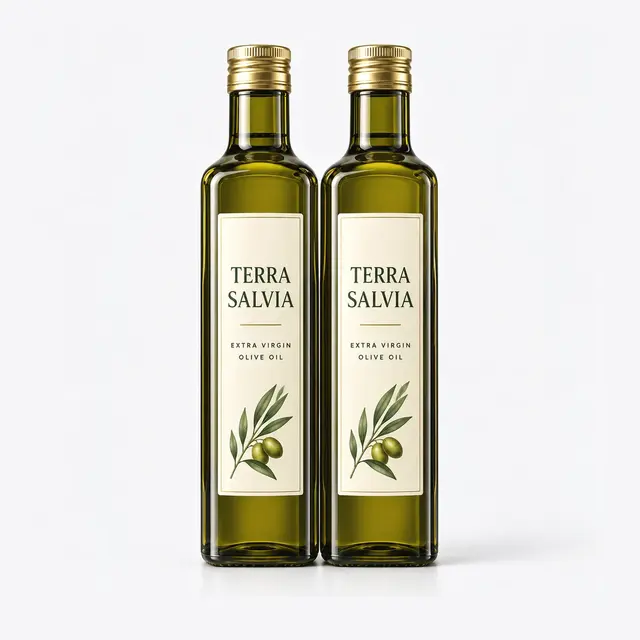
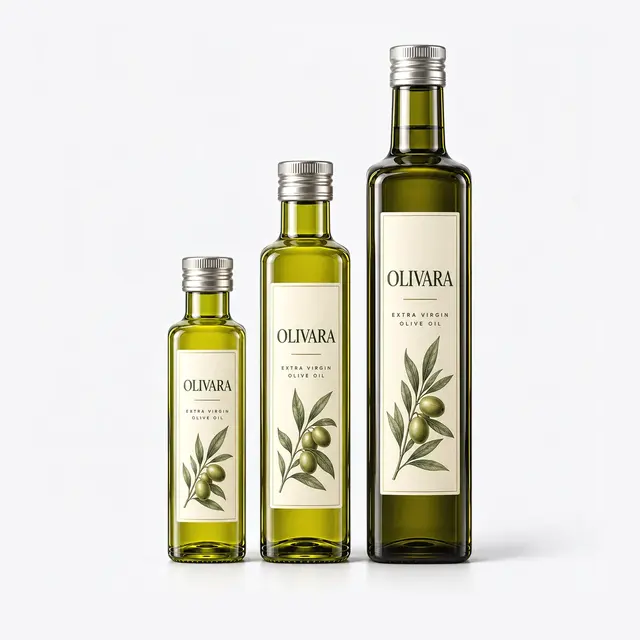
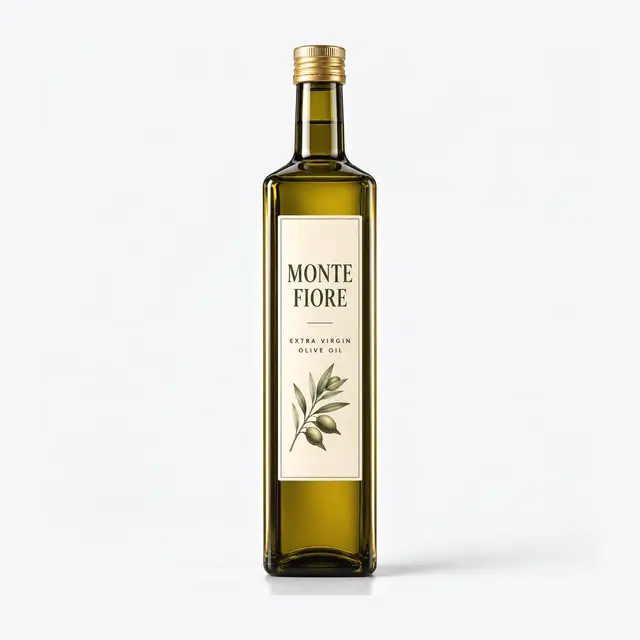
The Series 1953 is a slim, round dorica-style olive oil bottle in olive green glass with a threaded neck finish sized for the standard 31.5 mm olive oil closure. Its tall, narrow cylindrical body and modest height point to the small-format end of the olive oil range, the 250 ml to 500 ml class that brands use for everyday kitchen bottles, airline and hotel amenities, sampler sets, and food-service table cruets. This is the bottle for producers who run high-speed filling lines and want a shape that behaves predictably at every station. Exact capacity, weight, and dimensions are confirmed on the technical drawing at quotation.
Round bottles have quietly dominated automated olive oil filling for a reason: geometry. A cylinder has no corners, no flats, and no orientation problem. A dorica rolls into the star wheel the same way every time, centers itself under the filling nozzle without pucks or orienting devices, and accepts wraparound labels at speeds that square bottles cannot match. If your cost model is built on line efficiency rather than shelf differentiation, the Series 1953 shape family is the rational choice.
Built for High-Speed Filling Lines
Every design cue visible in the photo serves line performance. The continuous cylindrical body lets accumulation tables feed bottles without jamming at corners. The pronounced shoulder ring gives grippers and handling stars a consistent contact point. The straight, fairly long neck keeps the bottle stable under the filling lance and gives capping heads full thread engagement for consistent torque. And because there is no orientation requirement, changeover between products is fast and reject rates from misfeeds stay low.
For contract fillers and co-packers who handle multiple olive oil brands on shared equipment, a round small-format bottle like this one minimizes the mechanical adjustments between runs. Change parts for a cylindrical container are simpler and cheaper than those for shaped bottles, and spare star wheels and guide rails for common round diameters are often already on the shelf. Tell us your line speed and filler type at inquiry, and we will confirm compatibility details such as body diameter tolerance and neck finish gauge against your equipment specification.
The same geometry pays off downstream as well. Round bottles wrap-label at full line speed with automatic orientation against a seam or a registration mark, they tolerate minor label application drift without visible misalignment, and they load into case packers with simple lane guides rather than pocketed infeeds. For brands that plan seasonal flavored-oil runs alongside their core extra virgin SKU, that operational simplicity translates directly into more saleable bottles per shift and fewer hours lost to changeover.
Small Formats That Sell: Where This Size Wins
The slim proportions of Series 1953 suit the commercial roles where small olive oil bottles earn their margin. A 250 ml class bottle is the standard trial size that converts first-time buyers, the core of gift-box and sampler assortments, and the default table cruet for restaurants and hotels. In the 500 ml class, the same silhouette serves daily-use kitchen buyers who find 750 ml too slow to finish before the oil’s freshness fades. Because oxidation accelerates once a bottle is opened, smaller formats are increasingly promoted by premium brands as a freshness feature, not just a price point.
The olive green glass shown here offers moderate light protection for these faster-turnover formats, while keeping enough transparency for the oil’s color to read on shelf. For long-shelf-life retail programs in brightly lit stores, ask us about darker antique green options in the same shape family. Whichever tone you choose, the color is furnace-melted through the glass wall, not a surface coating, so it will not scratch, fade, or peel during filling, washing, or consumer use, and it remains fully recyclable in standard glass streams.
Closures and Pour Control
The threaded finish accepts the standard 31.5 mm olive oil closure ecosystem: ROPP aluminum caps with tamper-evident bands, non-drip pourer inserts for table service, and plastic screw caps for economy lines. For restaurant and hotel programs, pairing this bottle with a pourer-fitment cap turns it into a professional kitchen cruet that controls flow and reduces waste. We can source matched closures and supply bottles and caps as a leak-tested set; confirm the exact finish drawing with the factory before ordering caps from third parties.
Quality Standards Behind Every Pallet
Small bottles still carry the same engineering obligations as large ones. Series 1953 production is sampled and tested for internal pressure resistance per ASTM C147, thermal shock endurance per ISO 7459, and vertical load strength per ISO 8113, so bottles survive line handling, case packing, and warehouse stacking without failure. The glass is food-contact soda-lime from certified furnaces, with compliance documentation available for your destination market. Our import guide for glass bottles from China explains how testing and inspection slot into a typical order.
Packing, MOQ and How to Order
Bottles ship in divider cartons on shrink-wrapped pallets, as shown on our packing line below, with full-container and mixed-pallet options depending on volume. Small-format bottles pack densely, so container economics are excellent even at modest order values. Minimum order quantities vary by stock availability; the logic behind glass bottle minimums is laid out in our MOQ explainer. For pricing with confirmed capacity, carton counts, decoration options, and current lead time to your destination port, send us an inquiry with your annual volume estimate and target launch date.
Frequently Asked Questions
What is the minimum order for Series 1953 bottles?
MOQ depends on current stock and whether you need custom decoration. Stock glass typically starts at a container-friendly minimum, and we can combine sizes to reach it. Share your target quantity and destination and we will quote the exact figure.
Can I order samples to test on my filling line?
Yes, samples are available so you can verify running behavior, filling, capping torque, and label application before committing. Bottles are usually free of charge; courier cost is covered by the buyer and credited back on the first bulk order.
Will this round bottle run on my existing line without change parts?
Round dorica bottles are the most line-friendly shape and usually run without orienting devices or special pucks. Confirm your line’s diameter and height adjustment range against the bottle’s technical drawing, which we provide at quotation.
Which caps and pourers fit the neck finish?
The threaded finish is made for the standard 31.5 mm olive oil closure system, including ROPP aluminum caps, tamper-evident bands, and non-drip pourer inserts. We can supply matched closures and deliver bottles and caps as a leak-tested set.
Is olive green glass protective enough for extra virgin olive oil?
Olive green glass offers moderate UV protection and suits faster-turnover small formats. For premium EVOO with long shelf dwell under bright retail lighting, we recommend darker antique green options in the same shape family.
What quality standards do the bottles meet?
Each run is tested for internal pressure per ASTM C147, thermal shock per ISO 7459, and vertical load per ISO 8113. The glass is food-contact compliant soda-lime, and test reports are available with shipment documents.