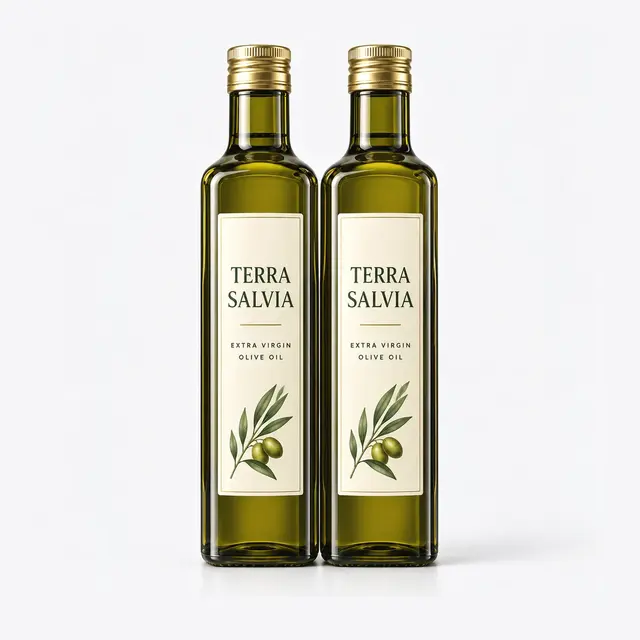
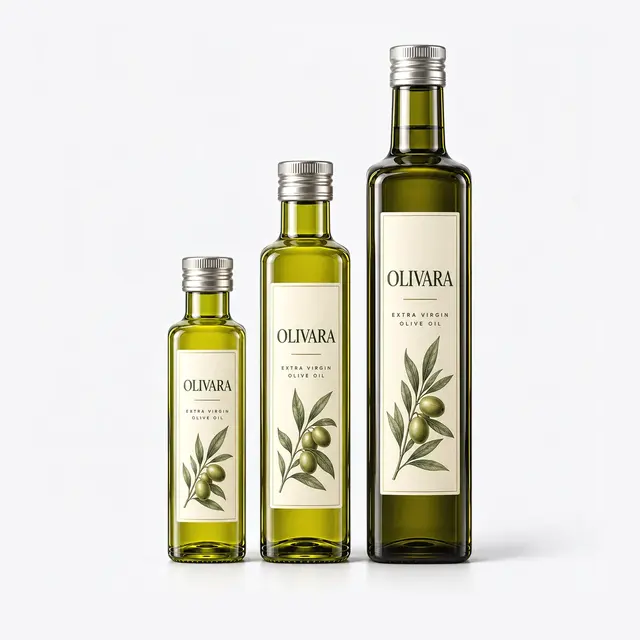
The Series 1813 is a tall, single-format marasca olive oil bottle in deep antique green glass, proportioned for the 750 ml class that has anchored olive oil retail for generations. Its square body, gently sloped shoulder, long cylindrical neck, and standard 31.5 mm threaded finish make it the archetypal extra virgin olive oil bottle: instantly recognized by consumers in every export market, and equally at home carrying an estate brand, a supermarket private label, or a distributor’s house brand. If your program needs one dependable flagship size that sells in volume across supermarkets, specialty shops, and duty-free, this is the format buyers reach for first. Exact capacity, weight, and dimensional tolerances are confirmed on the technical drawing at quotation.
There is a reason the 750 ml marasca dominates olive oil shelves from Madrid to Melbourne: it balances enough oil for a household month against a price point that still reads as an affordable quality purchase. For the brand owner, it is the size where label storytelling, glass color, and closure choice matter most, because the flagship bottle defines how every smaller size in the range will be judged.
The 750 ml Flagship: Why This Size Anchors Retail Ranges
Retail data across the major olive oil markets tells a consistent story: the 750 ml class carries the category’s image. It is the size food journalists photograph, the size competition winners are bottled in, and the size gift buyers choose when the purchase has to signal generosity. Even in markets where 500 ml outsells it in units, the 750 ml bottle usually leads in revenue and in brand-building value. Launching an olive oil brand without this size is possible, but you will meet retailer resistance, because buyers plan their shelf architecture around it.
For private-label programs, the economics are equally compelling. A 750 ml class bottle holds enough oil to justify premium shelf placement, yet packs efficiently in standard twelve-bottle or six-bottle cases, keeping freight cost per liter low. Our team can share carton and pallet configurations for this bottle at quotation so you can model the full landed cost against your target retail price.
The flagship role also shapes how the bottle is handled commercially. Buyers typically commit to larger annual volumes on this size than on any other, which unlocks better per-unit pricing and priority production slots. If you are building a multi-size range, most brands contract the 750 ml class as the volume backbone and add smaller formats around it, using the flagship’s established mold to keep supply stable through seasonal demand peaks such as the pre-Christmas shipping window.
Deep Antique Green: Protection That Reads as Premium
The dark antique green glass visible in the photo does two jobs at once. Functionally, it filters the UV wavelengths that oxidize extra virgin olive oil and degrade its aroma and polyphenols, protecting your product through long distribution chains and brightly lit retail display. Commercially, consumers have learned to read dark green glass as a quality cue: it signals serious, traditionally packed olive oil in a way that flint or light green cannot. The color is furnace-melted through the glass wall, so it will never scratch or fade, and it stays fully recyclable in standard glass streams.
That combination matters most in export programs where the bottle travels far from your quality control. An oil that leaves your mill in perfect condition can still arrive stale if the packaging lets light do its slow damage in transit and on shelf. Choosing the deep antique green option on the flagship size is effectively an insurance policy on your brand’s first impression in a new market, and it costs very little compared with the marketing budget behind the launch.
Label Real Estate on a Square Canvas
The marasca’s flat front and back panels give this flagship the cleanest label presentation in the industry. There is no curvature to distort your typography, no seam crossing the brand block, and enough panel height for the full regulatory story: origin, harvest date, acidity, certifications, and usage suggestions can sit alongside the brand design without crowding. The tall neck also accepts collar labels and tamper-evident capsules for premium finishing. We provide die-line dimensions with every quotation, and pre-production samples let your design team verify registration before the bulk run.
Closure Pairing for the Flagship Tier
The standard 31.5 mm threaded finish accepts the full olive oil closure ecosystem: ROPP aluminum caps with tamper-evident bands, non-drip pourer inserts, and premium capsule finishes. For a flagship bottle, most brands choose a quality ROPP with pourer, since the consumer’s pouring experience shapes repeat purchase as much as the oil itself. We source matched closures and deliver bottles and caps as a leak-tested set; confirm the exact finish drawing with the factory before ordering closures independently.
Quality Verification and Food-Grade Compliance
Series 1813 production is sampled against ASTM C147 for internal pressure resistance, ISO 7459 for thermal shock endurance, and ISO 8113 for vertical load strength, with wall-thickness mapping on the square corners where glass stress concentrates. The soda-lime glass is food-contact compliant, and migration and heavy-metal reports are available for your destination market. Our China import guide explains how these checks integrate with pre-shipment inspection.
Ordering: MOQ, Packing and Lead Time
Bottles ship in divider cartons on shrink-wrapped export pallets, as shown below, with full-container and mixed-pallet options. MOQ varies with stock status and decoration; the structure behind glass bottle minimums is explained in our MOQ guide. For a quotation with confirmed capacity, carton counts, decoration pricing, and current lead time to your port, contact our sales team with your annual volume and launch schedule.
Frequently Asked Questions
What is the MOQ for the Series 1813 bottle?
MOQ depends on whether the size is in a stock program or requires a dedicated run, and on any decoration you specify. Stock glass typically starts at a container-scale minimum. Share your annual volume and we will quote the exact minimum and case configuration.
Can I order samples before the bulk run?
Yes. We provide samples so you can test filling, capping, label application, and shelf presentation. Samples are generally free of charge; the buyer covers courier cost, which is credited back against the first bulk order.
Which closure do you recommend for a 750 ml flagship?
Most brands choose a 31.5 mm ROPP aluminum cap with tamper-evident band and a non-drip pourer insert, because the pouring experience strongly influences repeat purchase. We supply matched closures as a leak-tested set with your bottles.
Is the dark green glass suitable for premium extra virgin olive oil?
Yes. Deep antique green glass filters the UV wavelengths that drive oxidation in EVOO and is the traditional quality signal consumers expect on premium olive oil. The color is furnace-integrated, so it will not scratch or fade and remains fully recyclable.
Can the bottle carry custom decoration?
Yes. Beyond pressure-sensitive labels, we offer screen printing, frosting, and color coating, with pre-production samples for approval. Decoration minimums and pricing are quoted per process alongside the bottle quotation.
What quality standards and documents come with the shipment?
Production is tested against ASTM C147 internal pressure, ISO 7459 thermal shock, and ISO 8113 vertical load standards. The glass is food-contact compliant, and migration, heavy-metal, and inspection reports are available with your shipping documents.