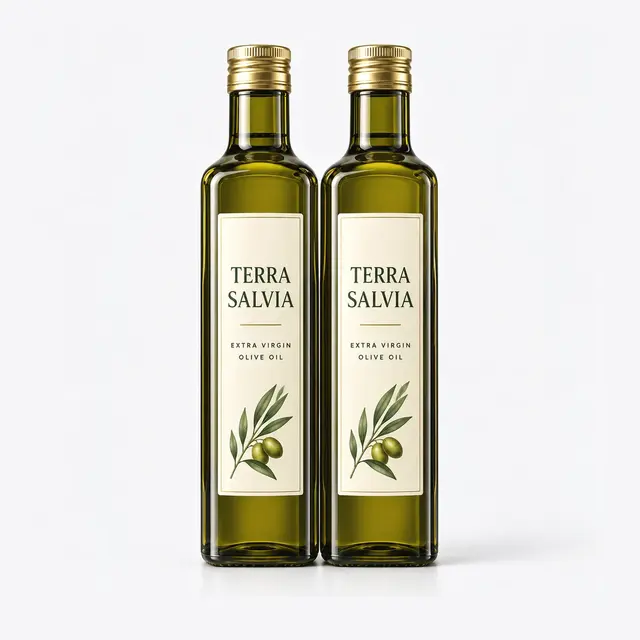
The Series 1782 is a tall, slender round olive oil bottle in warm amber-green glass with a smooth cork-style neck finish rather than a screw thread. Its elongated, wine-like silhouette and cork mouth place it deliberately outside the everyday ROPP-capped marasca mainstream: this is a bottle for limited editions, single-estate reserve oils, gourmet gift programs, and tasting-room exclusives where the packaging itself must tell the customer that what is inside is not a commodity. The amber-olive tone of the glass adds both visual warmth and meaningful light protection. Exact capacity, weight, cork finish dimensions, and tolerances are confirmed on the technical drawing at quotation, and cork or bar-top closures are sourced to match the confirmed neck specification.
Every mature olive oil market has a tier where oil stops being a cooking ingredient and becomes a gift, a collectible, or a restaurant’s tableside statement. That tier is won with different weapons than the supermarket shelf: unusual silhouettes, natural closures, numbered bottles, and glass colors you cannot find in the standard aisle. Series 1782 is engineered for precisely that tier.
Cork Finish: The Psychology of a Natural Closure
A cork closure changes the ritual of opening. The gentle resistance, the soft pop, the natural material in hand: these cues are borrowed from wine culture, and they transfer an entire set of associations, craftsmanship, patience, terroir, to your olive oil before the first drop is poured. For estate bottlings and harvest-date editions, that ritual justifies a price multiple that an aluminum screw cap, however excellent technically, rarely supports. Restaurants use the same psychology tableside, where a cork-finished bottle presented and opened in front of guests elevates a simple bread course into an experience worth mentioning.
Practicalities matter too. Cork-finish oil bottles are typically paired with natural cork stoppers, T-top bar-top closures with wooden or synthetic heads, or cork-and-pourer combinations for food-service reuse. Because the neck is smooth rather than threaded, the seal depends on precise bore dimensions and cork compression, which is why we confirm the finish drawing first and then source matched closures as a tested set. For longer shelf storage, a wax dip or capsule over the cork adds both tamper evidence and ceremony.
Amber-Green Glass: Warmth with Real Protection
The feuille-morte, amber-olive tone visible in the photo occupies an elegant middle ground. Like dark antique green, it absorbs a substantial share of the UV spectrum that oxidizes olive oil, so the bottle protects as well as it presents. Unlike deep green, its warm translucence shows the oil’s golden color in a honeyed light that photographs beautifully, a genuine advantage for e-commerce, social media, and gift-box windows where the product must sell itself through a lens before it is ever held.
The color is furnace-melted through the glass wall, not sprayed on, so it will not scratch in transit, fade under shop lighting, or interfere with recycling. For brands building a recognizable color signature across a premium range, this tone is distinctive enough to own, yet classic enough to read as authentically Mediterranean.
The Slender Silhouette in Gift and Gourmet Channels
Proportion is positioning. The tall, narrow body of Series 1782 reads as deliberate and refined, closer to a fine vinegar or dessert wine than to a kitchen staple, and it slips naturally into gift boxes, hamper programs, and corporate gifting where standard marasca bottles look utilitarian. The slim footprint also suits airline and high-end railway catering, boutique hotel amenities, and delicatessen shelf tiers where vertical space is generous but facing width is scarce. Paired with a sibling bottle in a contrasting oil or a balsamic vinegar, two of these slender bottles make a classic gourmet duo set with strong perceived value per unit of glass.
The shape also supports edition-based marketing. Numbered limited runs, single-grove harvests, and collaboration bottlings all benefit from a container that looks intentionally scarce. Because the silhouette differs so clearly from your core range, loyal customers recognize the special edition instantly without reading the label, which is exactly the kind of visual shorthand that drives repeat purchase of annual releases and keeps collectors coming back for each new vintage.
Filling and Labeling a Non-Standard Shape
Premium format does not mean production pain. The round body runs on standard rotary fillers and corking or T-top insertion equipment widely used in wine and spirits, and most contract bottlers handling premium oils already own compatible tooling. The tall cylindrical face accepts a wraparound label, a front-and-back pair, or a minimal neck-and-shoulder treatment; because the surface is curved, we recommend keeping critical text within the central third of the wrap to avoid edge distortion. We supply die-line drawings with the quotation and sample bottles for line trials before you commit.
Quality Standards Behind the Premium Presentation
Series 1782 is produced to the same verified regime as our mainstream bottles: internal pressure resistance per ASTM C147, thermal shock endurance per ISO 7459, and vertical load strength per ISO 8113, with bore and finish gauging on every cork-neck sample. The soda-lime glass is food-contact compliant with documentation available for export markets; our China import guide explains how inspection integrates with your order timeline.
MOQ, Packing and How to Order
Premium formats often carry different minimums than high-volume stock bottles, and cork-finish runs are scheduled to match closure sourcing. The structure behind these minimums is explained in our glass bottle MOQ guide. Bottles ship in divider cartons on shrink-wrapped export pallets, as shown below, with extra neck protection standard on cork-finish formats. For a quotation with confirmed capacity, matched closure options, and current lead time, contact our team with your edition size and launch date.
Frequently Asked Questions
What is the MOQ for this cork-finish premium bottle?
Premium formats carry different minimums than high-volume stock bottles, and cork-finish runs are scheduled alongside closure sourcing. Tell us your edition size and we will quote the exact MOQ, which is often friendlier for limited editions than buyers expect.
Which corks or closures fit this neck?
The smooth cork-style finish accepts natural cork stoppers, T-top bar-top closures with wood or synthetic heads, and cork-and-pourer combinations. We confirm the bore dimensions on the technical drawing first, then supply matched closures as a tested set.
Is cork sealing reliable for olive oil shelf life?
Yes, when the bore gauge and cork compression are correctly matched, which is why we supply bottle and closure as a validated set. For long storage or export, a wax dip or capsule over the cork adds tamper evidence and extra sealing security.
Does the amber-green glass protect the oil from light?
Yes. The feuille-morte amber tone absorbs a substantial share of the UV spectrum that oxidizes olive oil, while still showing the oil’s golden color attractively. The color is furnace-integrated, so it will not scratch or fade and stays recyclable.
Can this bottle run on my existing filling line?
The round body runs on standard rotary fillers, and corking or T-top insertion uses equipment common in wine and spirits bottling. Most contract bottlers for premium oils already own compatible tooling; sample bottles are available for line trials.
Can I order samples and what quality documents are provided?
Samples are available for line and closure testing; courier cost is covered by the buyer and credited on the first order. Production is tested to ASTM C147, ISO 7459, and ISO 7458, with food-contact compliance documents supplied for your market.