The usual bulk bottle for a 2 oz wellness or juice shot is a flint glass bottle of 60 ml nominal and 65 ml brimful, weighing about 90 g, closed with a 38 mm lug cap that carries a plastisol liner. Brands that use high-pressure processing (HPP) should take the 110 g heavyweight version with a liner compound rated for pressure cycling. Choose the neck finish to suit your filler and recipe, and buy bottle and cap as a tested pair, because most complaints in this category are leaks at the cap after cold-chain shipping.
Sizes and specifications for shot bottles
The 2 oz bottle is the format that premium grocery cold cases and juice bar grab-and-go coolers are laid out for. It is blown to 65 ml brimful to leave headspace, and it fits the 12-bottle and 24-bottle corrugated trays that US co-packers use. The 100 ml bottle is the standard in Europe and Asia and is gaining ground in the US for probiotic and kombucha-style shots, where a larger serving supports the shelf price.
These four sizes come from existing moulds, so a standard colour and finish needs no new tooling.
| Nominal / brimful | Height | Diameter | Neck finish | Glass weight | Usual cap | Typical use |
|---|---|---|---|---|---|---|
| 30 ml / 33 ml | 78 mm | 32 mm | 28 mm ROPP / PP | 45 g | 28 mm aluminum or PP screw | Concentrated drops, samples |
| 60 ml / 65 ml | 102 mm | 38 mm | 38 mm lug or 33 mm continuous thread | 90 g | 38 mm lug, plastisol liner | Ginger, turmeric and wheatgrass shots |
| 100 ml / 110 ml | 118 mm | 45 mm | 38 mm lug or 43 mm twist | 120 g | 38–43 mm twist-off | Probiotic and kombucha shots, EU market |
| 150 ml / 160 ml | 132 mm | 48 mm | 43 mm twist | 150 g | 43 mm twist-off | Meal-replacement mini, dual-serve |
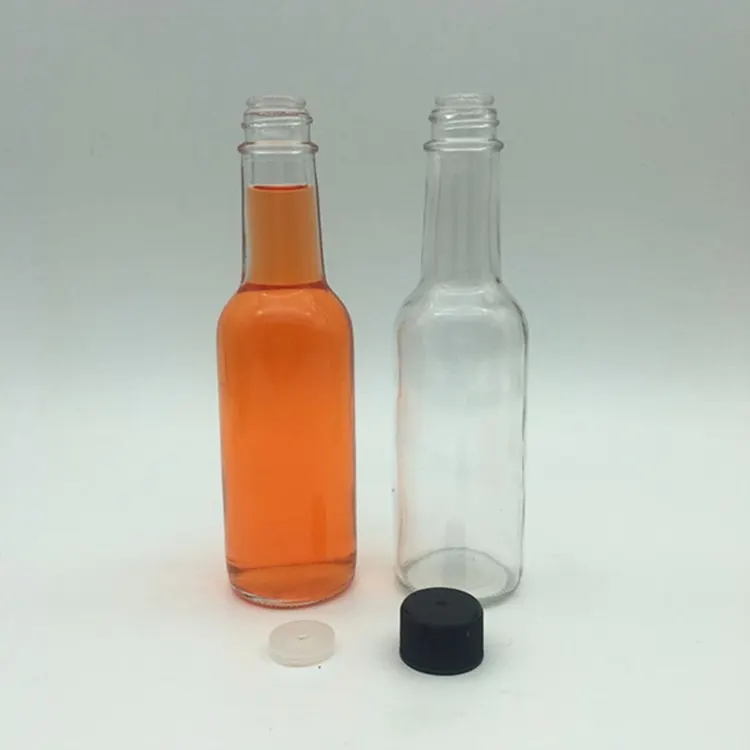
Glass weight deserves more attention than it usually gets at this size. The standard 60 ml bottle is made at 85–95 g and the heavyweight at 110 g. HPP is the main cold-pasteurization method for shots and runs at up to 87,000 psi for 90–180 seconds. The heavier bottle stands up to that better, and it also feels more substantial in the hand.
All of this applies to non-alcoholic functional drinks. Spirits miniatures share some glass moulds with wellness shots, but their closures, neck finishes, decoration and filling conditions differ. A juice shot filled at 2–8 °C and sent by refrigerated courier should not be specified like a 50 ml spirits flask. For that category, see the mini liquor bottle page.
Wide mouth or narrow mouth
The neck finish is decided by your filling line and by how the shot is drunk, and the two considerations pull in opposite directions.
| Wide mouth (38 mm or 43 mm) | Narrow mouth (28–33 mm continuous thread) | |
|---|---|---|
| Filling | Faster and more forgiving. Blends with pulp, chia or grated ginger flow cleanly, splash-back is lower, and fill accuracy is easier to hold at 80+ bottles per minute. | Pulp-heavy recipes can bridge in a 28 mm neck. Line speed typically falls 15–25% compared with a 38 mm finish on the same filler. |
| Drinking | Delivers a concentrated ginger shot too quickly for many drinkers. | Gives a controlled sip, which suits very spicy or bitter recipes. |
| Suits | Anything with visible particulate, or thicker than roughly 2,000 centipoise. | Finely filtered single-ingredient shots such as wheatgrass, celery or lemon-ginger. |
Drinking matters because roughly 60–70% of shots are consumed straight from the bottle. A wide mouth also shows off a brightly coloured product in photographs. If the choice is not obvious, we include both finishes in the sampling round, and your co-packer can run a line trial before you commit to a full order.
Caps that stay sealed through the cold chain
The typical failure looks like this. A pallet of filled shots leaves the co-packer at 4 °C, passes through two distribution centers on a refrigerated truck, waits on a dock for 3 hours, and reaches the retailer with 2–4% of the bottles weeping at the cap. The drink is still good, but the labels are stained and the case is rejected.
Cap choice prevents it. On 60 ml shots the default is a 38 mm lug cap lined with plastisol. As the product cools it pulls a slight vacuum, the plastisol flows a little, and the liner forms a fresh gasket on each bottle. A standard liner can take a permanent set after 87,000 psi and stop sealing by the third or fourth temperature cycle, which is why HPP brands need the pressure-rated compound.
Most markets require tamper evidence at retail. A lug cap with a breakaway band provides it on a 38 mm finish, and a PP cap with a TE band does the same on 28–33 mm continuous thread. Aluminum ROPP closures are increasingly requested for probiotic lines. They cost more than PP, run reliably on standard cappers, and open with a metallic pop that shoppers read as freshness.
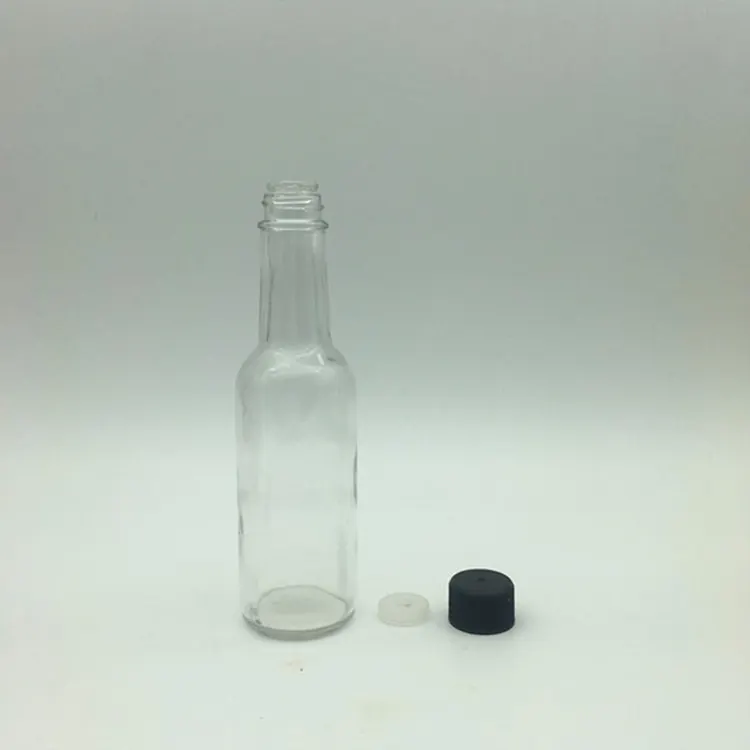
Whatever the cap, it should be validated on the bottle it will ship with. The tests to ask for are closure application torque at 8–14 inch-pounds, depending on the finish, and inverted leak tests at 4 °C and 25 °C for 72 hours on pre-production samples. A supplier who cannot show that data is leaving your cold chain to find the fault.
Caps normally travel separately from bottles unless you request otherwise, and a mismatch found at the co-packer is expensive. We arrange for caps to be fitted to sample bottles and checked for torque before the rest of an order is released, and we prefer to source bottle and closure together, which leaves one party answerable for thread tolerances. The bottles with caps page describes how those matched sets are put together.
Decorating and labelling a 60 ml bottle
The label area on a 60 ml shot bottle is about the size of a business card: roughly 55–65 mm of usable height and a wrap of around 115 mm. Rules in the US, EU, UK and most export markets nonetheless require a nutrition or supplement-facts panel, an ingredient list, an allergen statement, net contents and manufacturer details.
The answer many brands settle on is to print the branding on the glass. Applied ceramic labeling (ACL) is direct screen printing fired into the surface at around 600 °C. It survives HPP, ice buckets and the condensation that ruins paper, and it leaves the small label free for compliance text. Screen setup has to be spread across the run, so ACL suits established volumes better than a first trial.
Shrink sleeves and pressure-sensitive labels on clear BOPP film are the alternatives. A clear "no-label look" works well on flint glass but needs a very clean bottle, with no tolerance for seeds, blisters or a rough mould line, so the cosmetic grade should be agreed in advance. Design for the cold case in every case. Bottles are displayed at 2–8 °C with condensation on them, and an ink or adhesive that is not rated for wet conditions fails within the first week.
Glass compared with PET
PET is cheaper per bottle, so the argument for glass rests on positioning and performance. Premium grocery cold cases lean heavily towards glass. Buyers at those chains describe it as the sign that a shot is a food and not a supplement, and the same formula in a thin PET vial tends to be read as the latter.
The functional differences are these:
- Oxygen. Glass is impermeable and PET is not. Over a 60-day refrigerated shelf life, that permeability shows up in potency testing of probiotic or oxidation-sensitive wheatgrass shots.
- HPP. Glass goes through it without paneling or stress whitening.
- Acidity. Ginger-lemon recipes typically sit at pH 3.2–3.8, and glass stays inert against them for the whole shelf life.
- Recycling. Glass has established recycling streams in the US and EU, while small-format PET has some of the lowest real recycling rates of any pack.
PET is the sensible choice where breakage is a real risk, as in gym retail, airlines and other on-the-go channels, and for any brand whose distribution cannot carry the 3x freight weight of glass.
Inspection and documents to ask for
Small bottles have thin walls, so the defects that matter sit at the finish and the heel. Checks, which are hairline cracks, at the neck ring lead to cap-seal failures weeks later. A weak heel leads to bases breaking out on the filling line.
For shot bottles we look for the following controls at the plant:
- 100% camera inspection of finish dimensions, covering bore, thread profile and sealing-surface flatness to ±0.15 mm
- squeeze testing on a statistical sample every 30 minutes
- thermal-shock testing every shift at a 42 °C differential, which simulates a 4 °C fill into a room-temperature bottle
- AQL of 0.65 for critical defects and 1.5 for major ones, tighter than the common 1.0/2.5
The strict AQL is justified by the count. A single container can hold 420,000 pieces, so a loose sampling plan lets a large number of faulty bottles through.
Export buyers should also expect a certificate of analysis with each lot. It covers the glass composition (soda-lime flint, lead-free, cadmium-free), migration testing per EU 10/2011 and FDA 21 CFR 175–178 as applicable, cap torque windows and the inspection data. Co-packers increasingly want this file before they schedule a run, and retailers ask for it again in their quality audits.
Packing and freight
Shot bottles are small but dense. A 40-foot container takes roughly 420,000 pieces of the 60 ml bottle and weighs about 19–21 metric tons. The export case pack is 144 pieces in double-wall cartons, stacked at 5,040 pieces per pallet. Ask for photographs of the packing with every shipment.
Several bottle families can share one container, which helps a brand whose range goes beyond shots. Larger formats are covered on the bulk juice bottle page, which deals with the 8–16 oz range, and in the guide to juice bottle sizes. Brands that also sell spirits-style products can add bottles from the liquor bottle collection to the same load.
Matching the order to your production stage
Wellness shot brands tend to grow through three stages, and each one changes the brief.
- A juice bar or commissary kitchen fills 500–2,000 bottles per week by hand or on a single-head filler.
- A co-packer takes over at 10,000–30,000 bottles per run, usually prompted by a grocery chain pilot.
- Regional or national distribution reaches 50,000+ bottles per quarter on automated lines running 80–120 bottles per minute.
Glass weight tolerance, liner type, case pack and decoration method all shift as filling speed and freight volume rise. Early orders usually rely on stock moulds, stock flint glass and stock caps in standard cartons. Larger orders open up ACL printing, an embossed logo on an existing mould, custom cap colours and liner compounds, and a case pack set up for the co-packer's depalletizer. Share your forecast early, since it lets production capacity be planned around the reorder.
The order itself runs in a fixed sequence. Stock samples go out in both candidate neck finishes with fitted caps, and the co-packer runs a line trial. Pre-production samples carrying your decoration follow for approval. Production and ocean freight come last, with packing photos and QC reports sent before the vessel sails.
How quickly this moves depends mainly on how fast decisions are made on the brand's side. If you are still choosing a co-packer, settle its filling capability first and specify the bottle to the filler, never the other way round. A 20-minute technical call with the co-packer's line engineer heads off most of the costly misunderstandings.
Frequently asked questions
What is the minimum order for 60 ml shot bottles?
It is quoted per project. The figure depends on the mould, the decoration and the line the bottle is scheduled on.
Can the 2 oz bottle go through HPP?
Yes, in the heavyweight 110 g version, which is validated for the pressure and cycle times given above. It has to be paired with the pressure-rated plastisol liner.
Which neck finish suits a pulp-heavy ginger shot?
Take 38 mm or wider. A 38 mm lug finish fills cleanly with particulate, and its plastisol-lined cap copes with cold-chain temperature swings.
Are caps supplied with the bottles?
Yes, and we recommend buying them together. The caps are torque-matched to your bottles before shipment and the pair is leak-tested as described in the cap section.
How long does shipping to the US or Europe take?
Timing is confirmed per project, after the mould, decoration and production schedule are fixed.
Is glass or PET the better choice for a wellness shot brand?
Glass is stronger on cold-case positioning, oxygen barrier and HPP compatibility. PET is stronger where breakage or freight weight decides the matter. The right answer follows your mix of sales channels.