For most neck bands on glass bottles, clear PVC film at 45–50 microns is the working default: it shrinks at 70–90°C under a handheld heat gun and breaks predictably along a micro-perforation line. Move to PET/PETG when the band is printed or has to wrap a strong contour, and to PLA only when compostability is part of the brand claim. Whatever the film, size the band from the cap's outer diameter, not the bottle body, and choose the perforation pattern before asking for a quote.
Three decisions to settle before you ask for a quote
A shrink band is bought as a component, and three choices define it. Print, freight and everything else follow from them.
- Film. PVC, PET/PETG or PLA. The film fixes the shrink temperature, the shrink percentage, clarity, the print surface and the end-of-life route, and it limits which equipment can apply the band.
- Size. A layflat width and a cut length, both worked out from the closure and the height the band has to cover, then checked against a cap drawing or a physical cap.
- Tear style. How the band breaks or peels. This sets the opening feel and what a tamper check looks like on the shelf.
Bands bought alongside the glass suit hot sauce and condiment brands sealing 5oz woozy bottles, essential oil and tincture brands that need a visible tamper feature, supplement and skincare brands that prefer a printed security sleeve to a paper seal, and co-packers who want band and bottle sized against each other. They suit less well a bottle with deeply contoured shoulders, where a band alone will not grip and a full-body sleeve is needed, or a line with no heat source at all. Loose bands with not even a heat gun to apply them add labour quickly.
Five questions separate a supplier who is specifying from one who is selling from a catalogue:
- Which film do you recommend for my cap material and my market, and why?
- Will the band be sized to my cap drawing or to a catalogue nominal?
- What is the micro-perforation pitch on the break line?
- Can you provide a food-contact declaration and a heavy-metal test summary per lot?
- What reject rate should I expect after shrink on my actual bottle?
PVC, PET/PETG and PLA compared
The figures below are typical industry ranges for 45–50µm neck-band film. Confirm the film specification with the supplier for each project.
| Property | PVC | PET / PETG | PLA |
|---|---|---|---|
| Transverse shrink | 40–55% | 70–80% | 50–65% |
| Shrink temperature | Starts around 60–70°C, complete at 70–90°C | 85–100°C | 70–85°C |
| Tear behaviour | Clean break at the perforation with moderate finger force; the most predictable of the three | Needs more force; printed graphics hold through the break and the band resists casual re-closing | Brittle, especially below 10°C, where it can crack instead of tearing |
| End-of-life route | PVC stream; not accepted in most curbside programs, so check the local recycler | PET stream; widely recyclable where PET is collected | Industrial composting only; not home-compostable and not conventionally recycled |
| Market restrictions | Some EU retail and municipal programs discourage or restrict PVC packaging | Few direct restrictions | Acceptance depends on the destination's composting infrastructure |
| Typical use | Stock neck bands on woozy, essential oil and sauce bottles | Printed bands, dropper bulbs, trigger necks, full-body sleeves | Compostable brand programs where the claim is marketed explicitly |
PVC
PVC (polyvinyl chloride) finishes shrinking at a temperature low enough that a heat gun closes a band in seconds without scorching a plastic cap or warming the product. Neck-band film is normally 45–50 microns, within a 40–60µm range. Its 40–55% shrink covers most cap-to-neck transitions, clarity is excellent, and it is the lowest-cost film of the three. Roughly 70% of the stock bands on woozy and Boston round bottles are PVC, largely because it breaks so consistently at the perforation.
PET and PETG
Polyester film shrinks far more, which lets it follow a dropper cap with a bulb, a trigger sprayer neck or a whole bottle. It needs more heat, and that matters when the cap is polypropylene with a low heat-deflection point. For printed bands it is the better surface: rotogravure inks lay down cleanly and the gloss resists scuffing in distribution better than PVC does. It costs more than PVC, and the stiffer tear reads as a stronger tamper feature.
PLA
PLA (polylactic acid), typically 45µm, is the compostable choice and the most expensive of the three. It is also the weakest mechanically. Below about 10°C it can crack, so a cold chain can break the band before the customer does. It is worth specifying only when the brand owner explicitly markets compostability.
Destination market rules
Some markets discourage or restrict PVC in consumer packaging, and compostable film is accepted only where composting infrastructure exists. These rules vary by country and by packaging type, so we do not give a legal opinion on where a film may be sold. We ask the film supplier for a food-contact declaration and, where needed, EU 10/2011 migration documentation, and you confirm the permitted materials with your importer or regulator before the specification is locked.
Sizing the band from the cap
A band grips the cap and the neck ring beneath it. Two measurements therefore decide the size: the cap's outer diameter (OD), and the height from the top of the cap to just below the neck ring or shoulder transition where the band should stop. Body width tells you nothing. A 5oz woozy is about 50mm across the body and around 26mm across the cap, and a band cut for the body will never hold.
Take the OD at the widest point. Ribs, knurling and anti-slip teeth count, so a ribbed closure measures larger than a smooth one of the same nominal size. Measuring the smooth land between ribs gives a band that sits loose over the peaks.
Two formulas turn those measurements into an order:
- Layflat width = (cap OD × 3.1416 ÷ 2) + 3–5mm shrink allowance. A 28mm cap on a woozy bottle works out at roughly 47–49mm.
- Cut length = cap height + the overlap below the neck ring, typically 8–15mm for a tamper band that has to break when the cap turns.
The 3–5mm allowance is what lets flat film slide over the cap before it shrinks. With none, the band will not go on. With too much, it gaps at the neck and looks like a failed seal. A layflat that is 2mm out in either direction is enough to turn a snug band into a reject, and nobody sees it until production is running.
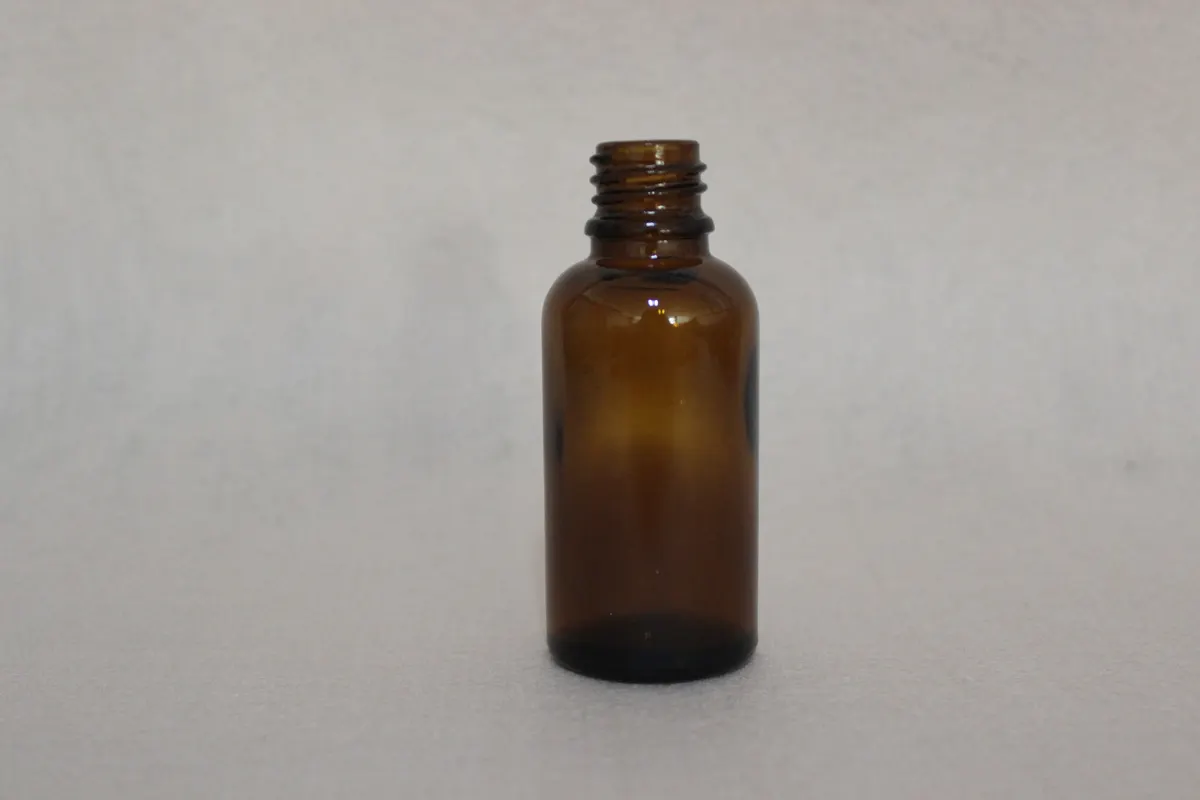
Typical band sizes for common bottle and cap pairings
These dimensions are typical starting points. Each project is confirmed against the cap drawing or a physical cap.
| Bottle and cap | Neck finish | Cap OD (mm) | Layflat (mm) | Cut length (mm) | Usual film |
|---|---|---|---|---|---|
| 5oz woozy, black PP cap | 24-414 | ~26 | 44–46 | 30–35 | PVC 45µm |
| 5oz woozy, ribbed cap | 28-400 | ~30 | 50–52 | 30–38 | PVC 45µm |
| 10–30ml essential oil, dropper cap | DIN 18 | ~21 | 36–38 | 25–30 | PVC 45µm |
| 1oz Boston round, dropper | 20-400 | ~23 | 39–41 | 28–32 | PVC 45µm |
| 150ml sauce bottle, PP cap | 28-410 | ~30 | 50–52 | 32–40 | PVC 45µm |
| 8oz sauce or dressing, PP cap | 38-400 | ~41 | 67–70 | 35–42 | PVC 50µm |
| Trigger sprayer neck | 28-410 sprayer | ~31 | 52–55 | 30–36 | PET 45µm |
A new cap means a new band size
Caps of the same nominal finish from different molders can differ by ±0.3mm in OD, which is enough to loosen a band that used to fit. Switching from a smooth PP cap to a ribbed or dropper cap changes both the OD and the height to cover. Treat any closure change as a re-sizing job, not a repeat order.
If the caps come from a third party, send 20 of them from the production lot so the OD can be measured across the batch. If the closure is still open, the guide to choosing glass bottle closures covers the finishes and cap styles that take a neck band cleanly.
Perforation styles and what counts as tamper evidence
The perforation decides where the band gives way, how it feels to open and how secure it looks. Five patterns cover the market.
| Style | How it opens | Where it fits |
|---|---|---|
| Full-perimeter perforation at the cap line | A ring of micro-perforations, pitch typically 0.5–1.0mm, sits at the bottom edge of the cap. Twisting the cap breaks the upper section away and leaves the skirt on the neck. | The classic OTC and supplement pattern and the first one auditors ask about on nutraceutical lines. A single die ring makes it the least costly perforated option. |
| Partial perforation | The cut runs only part of the way round, leaving a solid bridge that has to tear. | Brands shipping long distances that worry about bands splitting in transit or shelf handling. The die is more complex. |
| No perforation (film tear) | No cut line; the film is torn by hand, often from a scored edge. | Low-value, non-ingestible products where a visible band is a nice-to-have. Opening is imprecise and the band can also tear in the carton. |
| T-perforation (horizontal plus vertical) | Breaks on the first twist, then peels off in one motion along the vertical line, often marked with a printed “tear here” arrow. | Hot sauce and condiment bottles, where the band carries branding as well as security. |
| Pull-tab | A tab formed or welded into the film lets a fingernail strip the band without tools. | Products where opening experience matters. It adds a forming step and a little film, and it ends the complaint that a tear-strip band needs scissors. |
Keep the pitch fine
Micro-perforation at 0.5–1.0mm pitch tears cleanly for adults. Buyers occasionally ask for 2mm+ pitch “for strength”. The film then stretches instead of tearing, consumers cut it off with a knife, and the feature looks as if it failed. Complaints and returns cost far more than the coarser die saves.
US and other markets
For food and supplements sold in the US, the tamper-evident statement is the label copy (“sealed for your protection”), not the band. The physical feature has to be “distinctive by design”, and a perforated band shrunk over the closure qualifies. Documentation per lot should include a film food-contact declaration for resins compliant with FDA 21 CFR 177 and a heavy-metal test summary. EU buyers can ask for EU 10/2011 migration documentation.
Outside the US, the destination market decides what counts as acceptable tamper evidence and which pattern satisfies it. Confirm the required pattern with your importer or regulator instead of assuming the US one carries over. We match the pattern you confirm, and we do not call a band compliant for a market where it has not been validated against your product and filing.
Matching the film to your filling line
The film has to shrink under the heat your line actually delivers. Three inputs settle that:
- the application method: handheld heat gun, electric tunnel or steam tunnel;
- the cap material and its heat-deflection point;
- whether the product is filled hot (above about 60°C) or pasteurized after capping.
A heat gun or electric tunnel over a heat-stable cap points to PVC. A contour or a steam tunnel that calls for higher shrink points to PET. The cap check guards against the obvious conflict: PET needs 85–100°C, and some PP caps deform visibly at 95–100°C in the dry heat of a hot-air tunnel, so the band shrinks while the cap blisters. Leave these inputs out and the quote will be for a safe default film that may not shrink properly on your tunnel.
A new band and film lot should be shrink-tested on the bottle it will seal. When the fill runs hot, send filled production bottles for that test, because a hot product pre-warms the band and shifts the effective shrink curve.
Sequence around hot fill and pasteurization
Bands go on after filling, capping and cooling, never before. A band already shrunk onto the bottle will relax and wrinkle if it then passes through an 85°C hot fill or a 95°C pasteurization tunnel. The correct order is fill → cap → cool below 40°C → band → shrink, after which PVC bands hold up through normal warehouse life. Retort products above 100°C should skip the band and use a closure with a built-in tamper ring.
What drives band cost, and how much film to hold
Band pricing is quoted per project. The inputs are film thickness (a 50µm band uses roughly 10% more resin than 45µm), layflat width, the number of print colours and whether rotogravure plates have to be made, quantity, and freight. Resin costs move quarterly, so an old quote is not a reliable guide. At modest volumes a clear stock band with the branding left on the label is usually the sensible route.
Unit price falls with volume, but risk rises with it: film pre-shrinks in storage, cash sits in stock, and a closure change can strand what is left. Sizing each order to a 6–9 month consumption tranche captures most of the volume benefit without holding film that may not fit next year's cap.
Storage is where much of the saving is quietly lost. PVC bands stay dimensionally stable for about 12 months below 30°C and out of sunlight. Above 35°C they begin to pre-shrink in the carton. A pallet staged next to a steam tunnel pre-shrinks at its edges, and reject rates of 5–15% appear a month later with no obvious cause. Keep film in its sealed cartons, in the coolest part of the warehouse, away from the line heater.
Freight is rarely the issue. Bands ship pre-cut and loose in lined cartons, roughly 20,000–30,000 pieces per carton for small layflat sizes (36–46mm) and 10,000–15,000 for larger ones. A carton of 20,000 small bands weighs 8–12kg, so on a combined order the cartons fill void space in the glass container.
What to put in the band brief
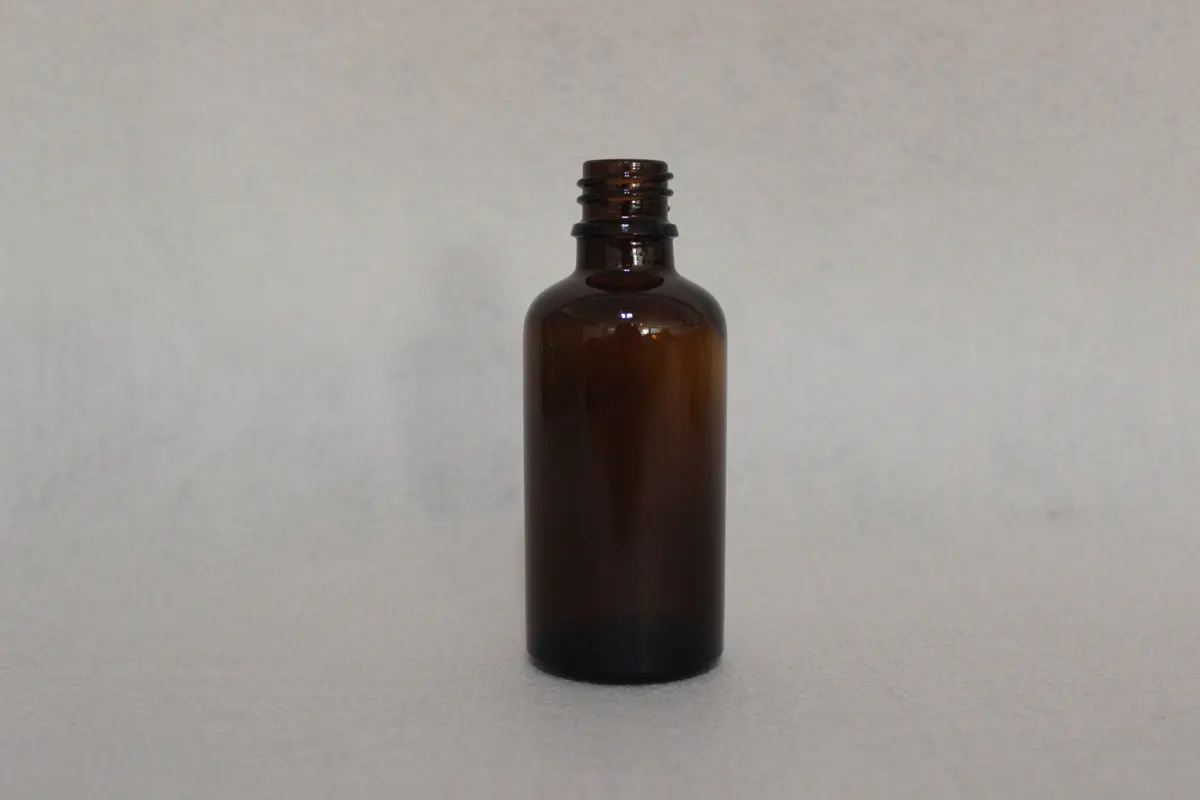
A photo of a bottle and a request for “bands” leads to rounds of sampling that a complete brief avoids. Send four things through the quote request form:
- Bottle and closure. The bottle model or drawing plus the cap specification or a physical cap, for example a 5oz woozy with a 24-414 black PP cap, or the DIN 18 dropper assembly used on 1oz dropper bottles.
- Film and print. Clear PVC stock, black, or printed PET with the artwork and number of colours.
- Perforation. Horizontal break line, vertical tear strip, T-pattern or pull-tab, together with the market (US OTC, supplement, food) and the pattern you have confirmed for it.
- Quantity and application. Pieces per size, and whether the band is applied by heat gun, electric tunnel or steam.
Bands are most often specified with hot sauce bottles and Boston round bottles, where the neck finishes in the sizing table apply directly.
Shrink band FAQ
Do essential oil bottles need a band if the dropper cap already seals?
For US retail, plan on one. The plug seal in a dropper assembly protects the oil, but it can be opened and reclosed without a trace, so it is not “distinctive by design”. Amazon, iHerb and most retail chains now require a visible tamper feature on ingestible and topical liquids, and a perforated PVC band over a DIN 18 dropper cap meets that. Finishes for this job are listed with the essential oil bottles.
How is a shrink band different from a full-body shrink sleeve?
A band covers the cap and neck only, with a 25–45mm cut length, and exists for tamper evidence. A sleeve covers the whole bottle (60–200mm) and works as a 360° printed label with a tamper feature. Sleeves need PET or high-shrink PVC and almost always steam application. On a standard shape such as a woozy bottle or a Boston round, a paper or BOPP label plus a neck band is usually the more economical way to reach the same print quality.
Can a QR code or batch code be printed on the band?
A QR code needs a flat print area of at least 12×12mm after shrink. On a narrow band that means printing on the skirt, not on the cap top.