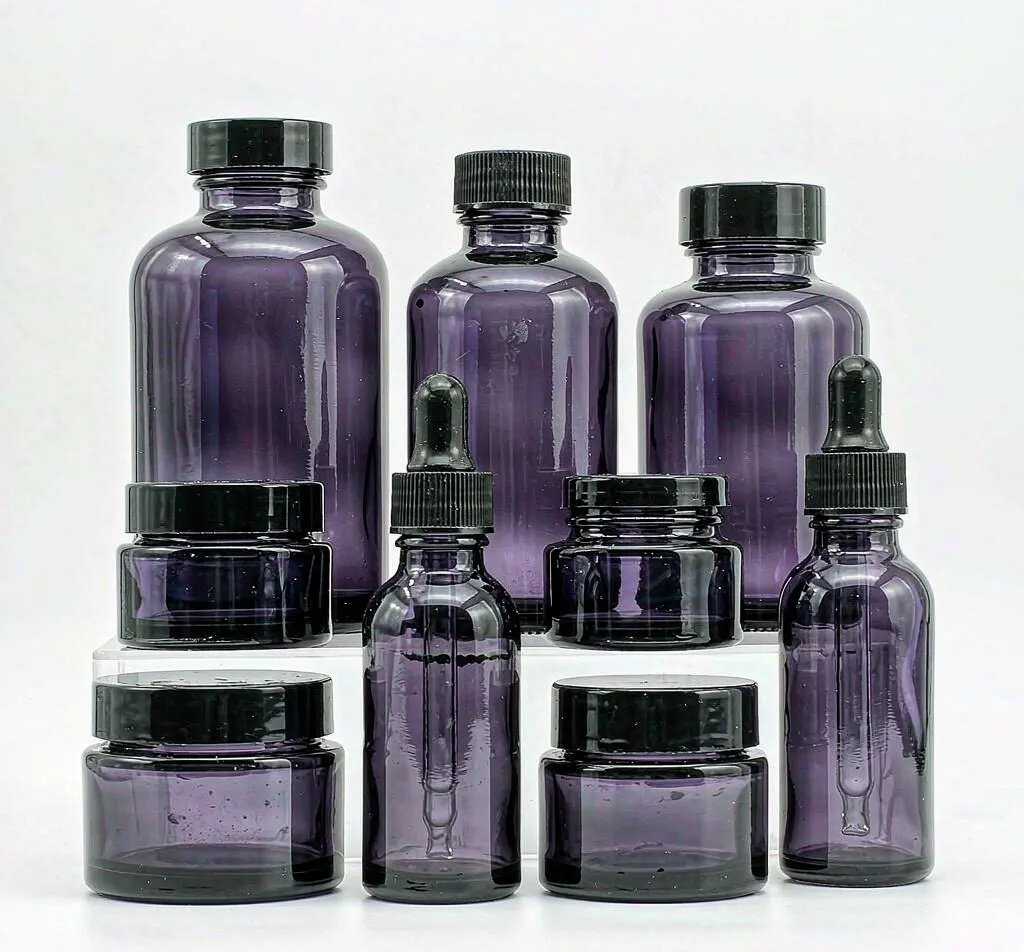
Violet glass is a light filter, not a darker tint. It blocks the broad middle and upper part of the visible spectrum, which drives most light-induced spoilage, and lets through only a narrow violet and near-ultraviolet band plus some infrared. Buy it in bulk when the fill is a photosensitive botanical, essential oil or natural cosmetic; where amber already gives enough protection, amber stays the more economical choice. Stock shapes run from 5 ml to 1000 ml on standard neck finishes, so existing caps, droppers and pumps fit.
Stock sizes, neck finishes and case packs
Violet bottles are made in the same basic shapes as other cosmetic, pharmaceutical and food glass, so most filling and capping lines take them without modification. Exact dimensions shift a little from mould to mould and between the glassworks producing the blank, but the threads are industry standard and closures stay interchangeable.
| Capacity | Shape | Neck finish | Usual closure | Case pack |
|---|---|---|---|---|
| 5 ml | Round Boston, thick base | 18 mm / 410 | Black urea cap | 720 pcs |
| 10 ml | Round Boston | 18 mm / 410 | Black urea cap | 480 pcs |
| 15 ml | Round Boston | 18 mm / 415 | White ribbed cap | 360 pcs |
| 15 ml | Modified rectangular | 18 mm / 415 | Aluminum cap | 360 pcs |
| 30 ml | Round Boston | 18 mm / 415 | Dropper assembly | 288 pcs |
| 30 ml | Wide shoulder | 20 mm / 410 | Screw cap | 240 pcs |
| 50 ml | Round Boston | 20 mm / 415 | Dropper assembly | 192 pcs |
| 50 ml | Flat shoulder | 24 mm / 410 | Screw cap | 168 pcs |
| 100 ml | Round Boston | 24 mm / 415 | Pump or screw cap | 120 pcs |
| 100 ml | Wide mouth jar | 53 mm / 400 | CT aluminum lid | 72 pcs |
| 200 ml | Round shoulder | 24 mm / 415 | Pump or disk cap | 72 pcs |
| 250 ml | Apothecary | 28 mm / 410 | CT aluminum lid | 48 pcs |
| 500 ml | Apothecary | 28 mm / 410 | CT aluminum lid | 24 pcs |
| 1000 ml | Apothecary | 38 mm / 400 | CT aluminum lid | 12 pcs |
Every finish in the table accepts standard continuous-thread or tamper-evident closures. That lets you buy caps, liners, droppers and pumps from more than one supplier instead of being tied to a single mould.
Settle the liner material early. PE, PP and induction-sealed composite liners each give the finished pack a different barrier and compatibility profile. The 5 ml to 30 ml sizes are in particular demand for high-value concentrates; for the narrower-neck sample and serum formats, see the glass vial range for bulk orders. Related bottle families and closures are grouped under cosmetic glass bottles.
How the light filter works
Each glass colour has a spectral transmission curve: the share of light that gets through, plotted against wavelength in nanometres, from roughly 300 nm in the ultraviolet to about 700 nm at the red end of the visible range and on into infrared. Clear glass passes almost all of the visible range. Violet glass does the opposite across most of it, leaving a window only at the violet and near-ultraviolet edge and another in the longer infrared.
This matters because many of the reactions that spoil botanical and natural formulas are photochemical. Light energy absorbed by a sensitive molecule can start oxidation, shift colour, strip aromatic compounds or break down fragile plant constituents. Fewer wavelengths entering the bottle means less energy available for those reactions.
The filtering is a property of the glass, not a coating or an additive in the product. Ordinary handling does not reduce it for as long as the bottle is intact.
Violet compared with other glass colours
The comparison below is descriptive on purpose. Laboratory percentages move with wall thickness and batch, so the useful question is how wide a slice of visible light each colour removes.
| Colour | Visible light blocked | Light passed | Typical use |
|---|---|---|---|
| Clear (flint) | Minimal | Nearly all visible light | Light-stable products, visual display |
| Amber | Blue to violet, much of UVA | Yellow, orange, red | Pharmaceuticals, beer, robust extracts |
| Cobalt blue | Most of the range outside blue | Blue band | Decorative, cosmetic, some spirits |
| Green | Partial, depends on shade | Green-yellow band | Wine, olive oil, food |
| Violet | Broad middle and upper visible range | Violet, near-UVA, part of the infrared | Photosensitive botanicals, essential oils, natural cosmetics |
No colour stops all light. What violet offers is a relative reduction in the most reactive wavelengths, and brands moving up from amber usually cite both that optical profile and the look of the bottle on shelf. For price-sensitive lines where amber protects well enough, amber cosmetic bottles are still the right specification.
Wall thickness
A thicker wall passes slightly less light at every wavelength than a thinner wall in the same colour, so a heavier version of a given shape protects marginally better. For that reason we state a nominal glass weight range on custom projects and suggest matching the wall to the expected storage time and light exposure. The effect is regular enough to plan around but small; it does not replace keeping filled stock out of direct sunlight.
What you can and cannot claim
Describe violet glass in physical and preservation terms only. It reduces light-induced change. It does not alter what is in the bottle, treat or cure any condition, or make a formula safer or more effective than its recipe allows. Product claims remain the brand's responsibility under the rules for its category.
Which products justify violet glass
The material earns its place where the contents react to visible light and the brand would rather not lean on synthetic stabilisers. Four product groups account for most bulk demand.
Essential oils and aromatic blends
The volatile compounds that give an oil its character are the ones light and air disturb most easily. Single oils, diluted roll-ons and finished blends are normally packed in 5 ml to 30 ml bottles with an orifice reducer or dropper. Filtering the light helps hold the scent profile and slows the oxidation that leaves a fresh oil smelling dull.
Herbal and botanical extracts
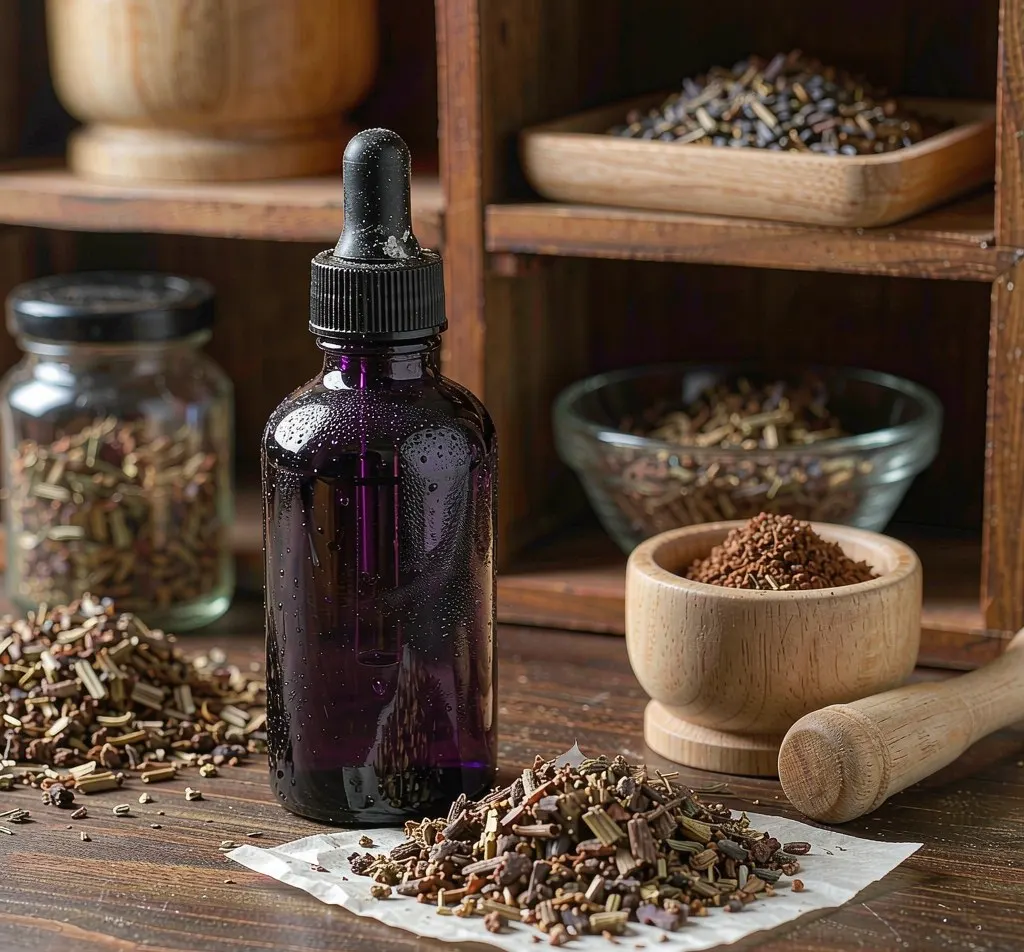
Tinctures, glycerites and plant extracts, whether based on alcohol, glycerin or oil, need to stay close to their freshly prepared state through storage and transit. The standard pack is a 15 ml to 100 ml bottle with a dropper cap, and the same moulds serve both the natural supplement and apothecary channels. Stock and bespoke shapes with matching droppers are covered on the tincture bottle page.
Natural skincare
Facial serums, oil cleansers and balms often depend on botanical actives that degrade in light. Serums and oils usually go into 15 ml to 50 ml Boston rounds or flat-shoulder bottles with a dropper or pump. Masks and balms use 30 ml to 100 ml wide-mouth jars.
Food, honey and supplements
Raw honey, specialty vinegars and small-batch condiments follow the same logic when colour and aroma are part of what the customer is buying. Honey kept in filtered glass is valued for holding its aroma and darkening more slowly. Supplement powders and capsules are increasingly packed in violet jars to support clean-label positioning; wide-mouth formats from 100 ml to 1000 ml with compatible lids are listed under glass supplement jars.
Customising the bottle, decoration and closure
Few bulk orders ship as plain bottles. Four areas of customisation come up most often, and one project can combine all of them.
- Shape. A stock mould suits launches and test runs. A bespoke mould lets you set the silhouette, base thickness, shoulder angle and label panel flatness, and with violet glass it also lets you tune wall thickness for the optical performance you want. Violet intensity can be adjusted within the range the batch allows.
- Surface decoration. Silk-screen printing puts durable multi-colour artwork directly on the glass and survives normal handling and washing of the empty bottle. Hot-stamp foil, usually gold or silver, adds a reflective logo or border that sits well against the dark body. Both are applied before capping, and a print proof is supplied so colour and registration can be approved before the full run.
- Caps. Options include screw caps in several colours, aluminum caps for an apothecary look, child-resistant caps where a market requires them, and decorative caps matched to a brand palette. Since the neck finish is standard, the cap can be changed later without touching the bottle mould.
- Dispensing heads. Glass droppers with rubber bulbs are the norm for oils and tinctures, and measured droppers help with consistent dosing. Lotion pumps and mist sprays serve larger skincare and toner formats. The head is chosen for the product's viscosity and the neck finish, and sample assemblies can be supplied so you can judge feel and output before committing to volume.
Planning a bulk order
Buyers generally weigh violet glass on optical performance, supply reliability and unit economics. Supply reliability means mould availability, decoration capacity and consistent colour from batch to batch. Unit economics should be judged on the landed cost of the complete pack, caps and inserts included, and not on the bottle alone.
Minimum quantities, pricing and timing are quoted per project. Quantities depend on bottle size and on whether decoration is needed; price follows volume, glass weight, decoration and freight terms; timing depends on the mould route, the decoration step and whether cap components are available. Violet glass needs a specialised batch and tighter colour control than clear or amber, which is reflected in the quote. We flag any cap shortage at the quotation stage.
Drawings for a bespoke mould are held in confidence, and an identical shape is not released to a competing brand in the same market segment without agreement.
Before ordering in bulk, run a fill-and-stability check on samples using your real product. Compatibility between the formula, the closure and the liner is best confirmed with the actual formulation, and the same trial shows how the dropper or pump dispenses. We can coordinate caps, droppers, pumps and liners with the bottles so the order arrives ready for filling instead of as loose components.
Frequently asked questions
Is the protection a coating that can wear off?
No. The colour is in the glass, so the filtering lasts as long as the bottle does. It is a preservation aid and leaves the composition of the contents unchanged.
When is amber or cobalt blue enough?
Amber removes much of the blue and violet range while passing yellow, orange and red, which is adequate for pharmaceuticals and robust extracts and makes it the cost-effective option for less sensitive formulas. Cobalt blue passes the blue band and little else. Violet is specified when the aim is the lowest possible visible light load on photosensitive oils and botanicals.
Does violet glass replace stabilisers or careful storage?
It supports the freshness window the formulator designed. It is not a substitute for good formulation, a suitable liner, or storage away from direct sunlight.
Which closures suit essential oils and tinctures?
Dropper or orifice-reducer closures on 5 ml to 100 ml bottles are the usual presentation. Check during sampling that the liner is compatible with the solvent base of the formula.
What is the minimum order quantity?
It is quoted per project, because it depends on the mould and the line it runs on.
How long does production take, and what about tooling?
Timing is confirmed per project once the mould, decoration and line schedule are known. A bespoke shape adds a tooling stage that a stock mould does not have.
Can samples be supplied before a bulk order?
Yes. Use them for the fill-and-stability trial described above before committing to a full production run.