Filed under amber glass bottles — start there for the stock moulds, then use the detail below to narrow the spec.
Amber glass is the standard pack for serums and oils that light can spoil, because the colour is melted into the glass and absorbs the 290–450 nm band that drives photo-oxidation. Clear flint lets more than 85% of that band through; a typical amber wall passes under 10%. The protection cannot scratch or wear off, so what remains for the buyer is to confirm the transmission of the actual bottle and to pair it with a closure that suits the formula.
Formulas that need light protection
Chemists rank cosmetic ingredients by photostability. The least stable group takes in nearly every essential oil and cold-pressed carrier oil, along with retinoids, L-ascorbic acid (vitamin C), alpha-arbutin, ferulic acid and benzoyl peroxide. Photons between 290 and 450 nm excite these molecules and set off free-radical chain reactions.
The customer sees the result as a serum that has darkened, an oil blend whose top notes have gone, a change in viscosity or smell, or simply an active that no longer performs. If a formula contains actives that break down above 300 nm, amber is the sensible default. The USP and EP pharmacopoeias treat amber glass as the reference "light-resistant container" for the same reason.
Light transmission of amber and clear flint
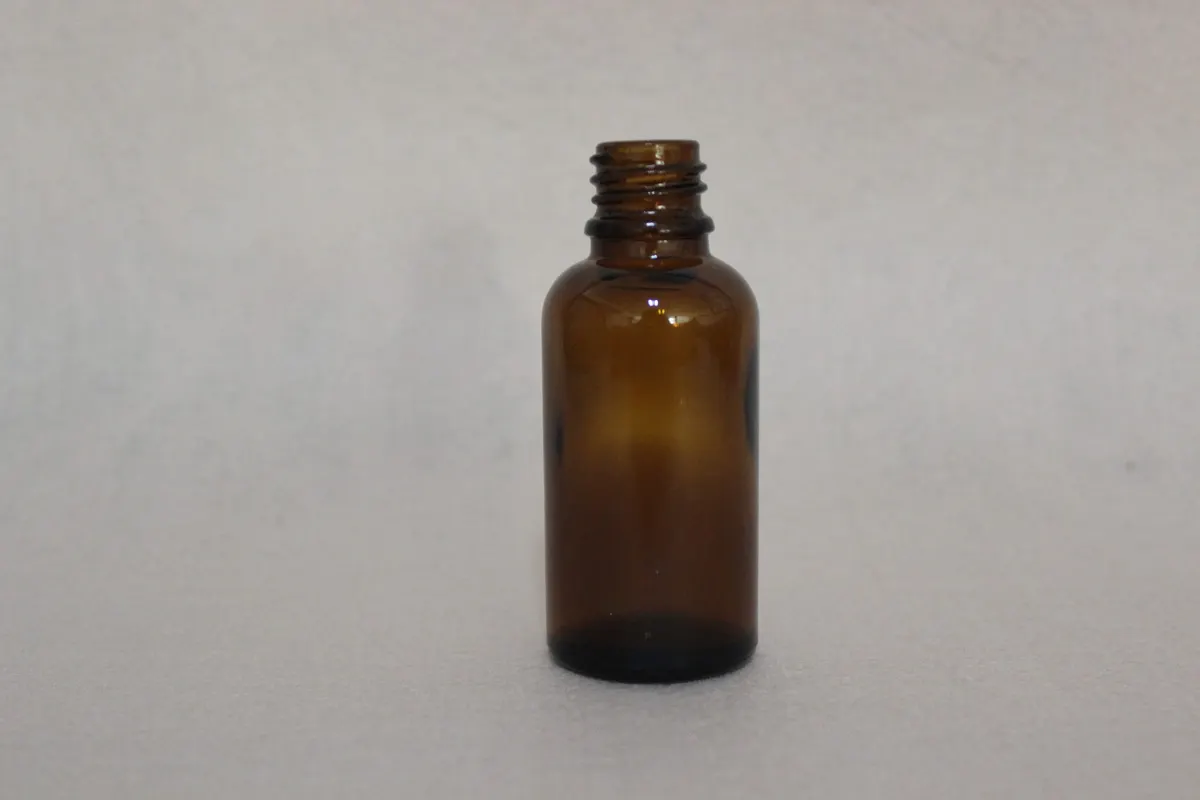
Amber glass takes its colour from iron and sulfur compounds in the melt. The figures below are spectrophotometer values for a 30 ml amber dropper bottle with a wall of about 2.5 mm, set against the same shape in clear flint.
| Band | Wavelength | Amber transmits | Clear flint transmits |
|---|---|---|---|
| UVB | 290–320 nm | < 1% | 75–85% |
| UVA II | 320–340 nm | < 3% | 80–88% |
| UVA I | 340–400 nm | < 8% | 85–90% |
| Blue visible | 400–450 nm | 10–20% | 88–92% |
| Green to red visible | 500–700 nm | 55–75% | ~90% |
Taken over the full UV range, amber stops roughly 90–99% of incoming radiation while still letting enough green-to-red light through for the fill level to be visible. Wall thickness changes these numbers: a thinner wall from a different mould transmits more UV, which is why a generic datasheet is not enough.
Common sizes and neck finishes
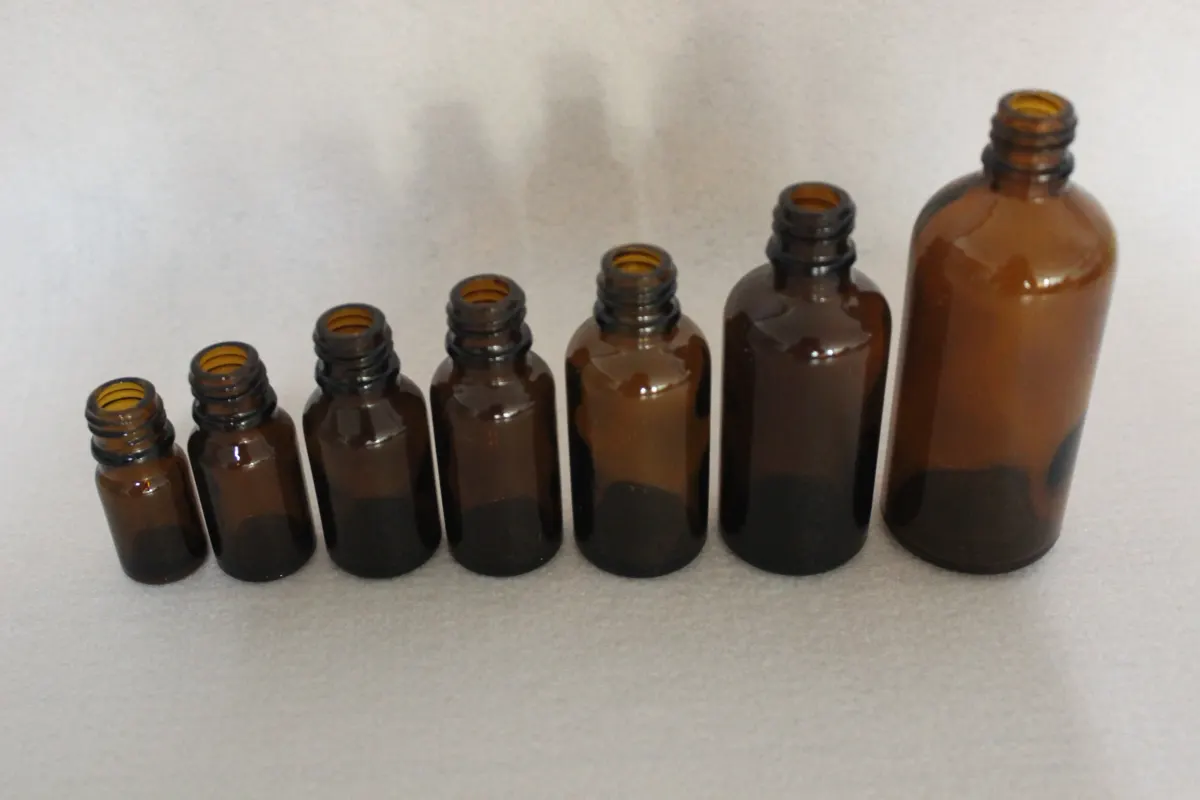
Six capacities account for most amber cosmetic bottle projects. The neck finish decides which droppers, pumps and sprayers will fit, so it should be fixed together with the capacity.
| Capacity | Neck finish | Approx. height | Usual contents |
|---|---|---|---|
| 5 ml | DIN18 | 48 mm | Travel minis and essential oil samples |
| 10 ml | DIN18 | 58 mm | Trial serums and roller blends |
| 15 ml | DIN18 / 18/410 | 66 mm | Concentrated actives and eye serums |
| 30 ml | 18/410, 20/410 | 78 mm | Beard oils and facial serums |
| 50 ml | 20/410, 24/410 | 92 mm | Cleansing oils and lotions |
| 100 ml | 24/410 | 118 mm | Refills, body oils and toners |
Droppers, pumps and sprayers for each formula type
The dispensing component sets the dose, the hygiene and how the product feels in use. Viscosity and the dose you want per application narrow the choice quickly.
| Closure | Suits | Neck finishes | Dose |
|---|---|---|---|
| Glass dropper with rubber bulb | Tinctures, essential oils and facial serums | DIN18, 18/410, 20/410 | 0.05 ml a drop; about 0.7–1.0 ml for a full pipette |
| Treatment pump | Cleansing oils, lotions and thicker emulsions | 20/410, 24/410 | 0.12–0.20 ml a stroke |
| Fine-mist sprayer | Hair essences, toners and facial mists | 18/410, 20/410, 24/410 | 0.10–0.14 ml a spray |
| Screw cap with reducer insert | Aromatherapy blends and essential oil refills | DIN18, 18/415 | Controlled pour, around 1 drop per tilt |
Two fit details cause most problems. The dip tube or pipette has to match the bottle height: 5 mm short and the last of the product cannot be reached, 5 mm long and the tube buckles and chokes the flow. The bulb material has to tolerate the formula, too. Natural rubber swells against essential oils, so butyl or food-grade silicone is the better choice for aromatherapy products.
Buying bottle and closure as a matched, leak-tested set removes the risk of sourcing the parts separately and finding they do not seal. The combinations we coordinate are listed under glass bottles with droppers.
Amber against coated glass, plastic and cobalt blue
Three alternatives come up when a brand wants light protection without amber.
- Clear glass with a sprayed UV coating. The coating is an extra process, can be scratched as bottles move through a filling line, and makes recyclability claims harder to state cleanly.
- Opaque plastic (PP or PET). It blocks light, but permeability and sustainability are concerns, and many clean-beauty brands rule plastic out by policy.
- Cobalt blue glass. Visually striking, but its protection is mainly in the UVB range; it lets through significantly more UVA than amber does.
Soda-lime glass coloured amber in the melt therefore remains the benchmark for photoprotection, in jars as well as bottles; balms and creams with the same sensitivity go into amber glass jars with lids.
Evidence to request before a volume order
Whoever supplies the glass, ask for the following before committing to a full run. These are the documents we collect when coordinating samples and inspection for a project.
- Spectral transmission report measured on the production glass itself.
- Batch colour consistency expressed as ΔE against a signed master sample. Shade drift is obvious as soon as bottles stand side by side on a cosmetics shelf.
- Neck finish gauging to confirm the chosen dropper or pump will seal without leaking.
- Annealing check by polariscope. Residual stress in the glass leads to spontaneous breakage in hot-filling or in transit.
- Drop and transit tests on the final packed configuration, which matters most for e-commerce shipments.
The wider range of shapes and finishes is on our cosmetic glass bottle collection. For a quotation, send the target capacity, neck finish, closure type and annual volume through the quote request form.
Frequently asked questions
Why do serum brands choose amber glass?
Active serums tend to contain ingredients such as vitamin C, retinol and botanical oils that UV and blue light oxidise within weeks. Amber slows that breakdown and lengthens usable shelf life, and it does so with no change to the formula.
How much light does an amber cosmetic bottle let through?
An amber soda-lime wall of 2–3 mm transmits less than 10% of light in the 290–450 nm range, against 80–90% for clear flint. UVA transmission stays below 8% and UVB is close to zero. USP <661> is the reference buyers cite for light-resistant containers.
Can amber cosmetic bottles be frosted or made in a custom shape?
Yes, both are possible.
What is the minimum order for amber cosmetic bottles?
Minimums are quoted per project, since they depend on the mould and the production line it runs on.
How are the bottles packed for export?
Either in export cartons with egg-crate dividers, or on pallets with layer pads and shrink wrap. Closures travel in separate packs so they do not scuff. Depending on the packing style, a 40HQ container takes 400,000–700,000 pieces of the 30 ml bottle.