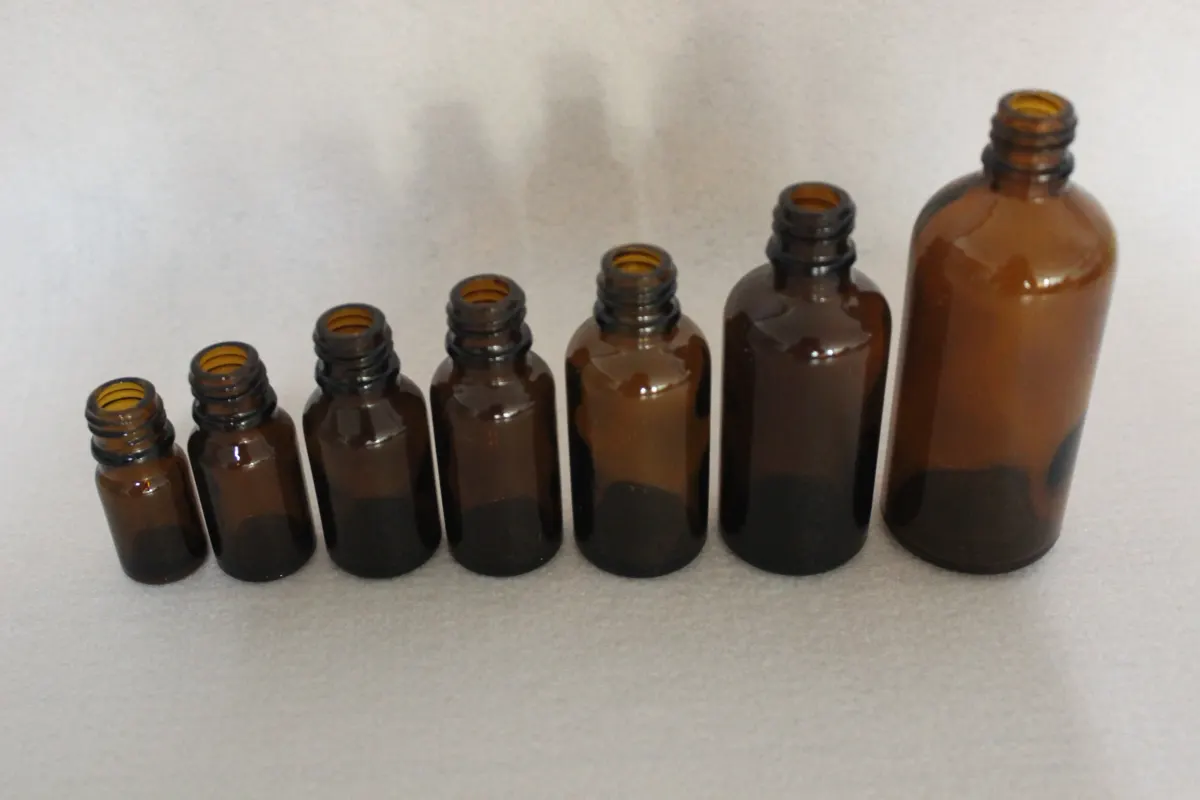
Part of our amber glass bottles wholesale range; the stock moulds are pictured at the end of this guide.
Amber glass protects light-sensitive products because the colour is melted into the wall and absorbs near-UV and blue light: on a 3–4 mm wall section it typically passes <5% of UV-A (315–400 nm) and <10% of blue light at 400–450 nm, where clear flint glass passes >85% and >90%. For a wholesale order, the decisions that follow are the capacity, the neck finish and the lid and liner that suit what goes inside. Coatings and sleeves can give similar shading, but neither is permanent.
How much light amber glass filters
Most light damage to foods, cosmetics and botanicals comes from UV-A and from high-energy visible blue light. Those wavelengths excite riboflavin, chlorophyll and essential-oil molecules and start free-radical chain reactions, which show up as flat flavour, bleached colour and oxidised actives. Amber glass absorbs across that band because iron, sulfur and carbon compounds are added to the soda-lime melt.
Typical transmission on 3–4 mm wall sections, the usual thickness for stock jars, looks like this:
| Wavelength band | Amber glass | Flint (clear) glass | What the filtering prevents |
|---|---|---|---|
| 290–315 nm (UV-B) | <1% | ~10–30% | Protein damage, vitamin loss |
| 315–400 nm (UV-A) | <5% | >85% | Oxidation of riboflavin and essential oils |
| 400–450 nm (blue) | <10% | >90% | Colour bleaching, flavour loss |
| 450–700 nm (visible) | 30–60% | >90% | Nothing; contents stay visible for inspection |
The practical result is that a turmeric blend, a balm or a scented candle holds its colour and strength longer under fluorescent shop lighting in amber than in clear glass. Enough light still passes in the visible range to check fill level and contents without opening the jar.
Jar sizes, neck finishes and matching lids
These are the configurations buyers ask us for most often. CT means continuous thread, a screw finish; lug and twist-off finishes close with a partial turn.
| Capacity | Common contents | Neck finish | Lid |
|---|---|---|---|
| 30–60 ml | Balms, salves, concentrates | 38–43 mm CT | PP or aluminum cap with liner |
| 120–150 ml | Face creams, spices | 58–63 mm CT or lug | Metal lug, plastisol-lined |
| 250–370 ml | Candles, nut butters, herbs | 70–82 mm twist-off | Plastisol twist-off |
| 500–720 ml | Preserves, bulk supplements | 82–100 mm twist-off | Plastisol twist-off |
The lid matters as much as the glass. Dry herbs, spices and supplements get the strongest oxygen and moisture barrier from a plastisol-lined metal lug or twist-off lid. Candles and creams are adequately sealed by a continuous-thread metal or PP cap with an EPE or induction liner. Liner chemistry should be matched to the contents at the sampling stage, before the order is placed.
For oxygen-sensitive dry goods, read the liner notes for airtight glass jars alongside this page. Herb and spice lines can be sized from the fill-weight tables for glass spice jars, and the wider glass jar collection shows the other closure options.
Amber glass compared with spray coating and shrink sleeves
A product that needs shading can get it three ways. They differ mainly in how long the protection lasts and what happens at recycling.
| Route | How long protection lasts | Effect on recycling | Where it fits |
|---|---|---|---|
| Amber glass, coloured in the melt | Permanent, through the full wall | None; goes into the normal amber cullet stream | Long-running food, supplement and candle SKUs |
| UV spray coating on flint | Scratches at shoulder and heel; fades with dishwashing | Coating has to burn off in the cullet | Special brand colours, short runs |
| Full-body shrink sleeve | Sound until the sleeve scuffs or shrinks unevenly | PET or PVC sleeve must be separated | Promotions, one jar shared by several SKUs |
Because amber colour cannot scratch, peel or wash off, it is the sensible default for repeat wholesale programmes. A coating earns its place only when the brand needs a specific colour that melt-coloured glass cannot reproduce.
Test standards to ask for
We check amber jars against the framework used for pharmaceutical primary packaging, and these are the reports worth requesting with a lot:
- Light transmission: measured by spectrophotometer on wall sections, giving a transmission curve.
- Annealing stress: read on a polariscope to ASTM C148.
- Thermal shock: tested to ASTM C149, with a 42°C differential as the minimum.
- Hydrolytic resistance of the inner surface: classified under ISO 720 / ISO 719.
- Capacity and brimful tolerance: checked using ISO 8106-style container metrology, with a dimensional AQL report.
Filed together, the transmission curve, annealing report and dimensional results give a QA team what it needs for a supplier qualification record.
Frequently asked questions
Can amber jars be hot-filled or pasteurized?
Yes. Amber soda-lime glass behaves thermally like flint. Jars annealed to ASTM C148 tolerances are routinely hot-filled at 85–90°C and run through tunnel pasteurizers, as long as the thermal shock differential stays under roughly 42°C.
What is the minimum order for amber jars with lids?
It is quoted per project. The figure depends on the mould and the line it runs on, and on whether the jar is decorated.
Do amber jars cost more than clear ones?
Pricing is quoted per project and moves with capacity, decoration, lid choice, quantity and freight terms. The colourant itself is a small fraction of batch cost, and amber can remove the need for a secondary UV sleeve, carton or foil wrap.
What should a quote request include?
Target capacity, neck finish, lid or closure preference, quantity and destination port. Send them through the quote form.