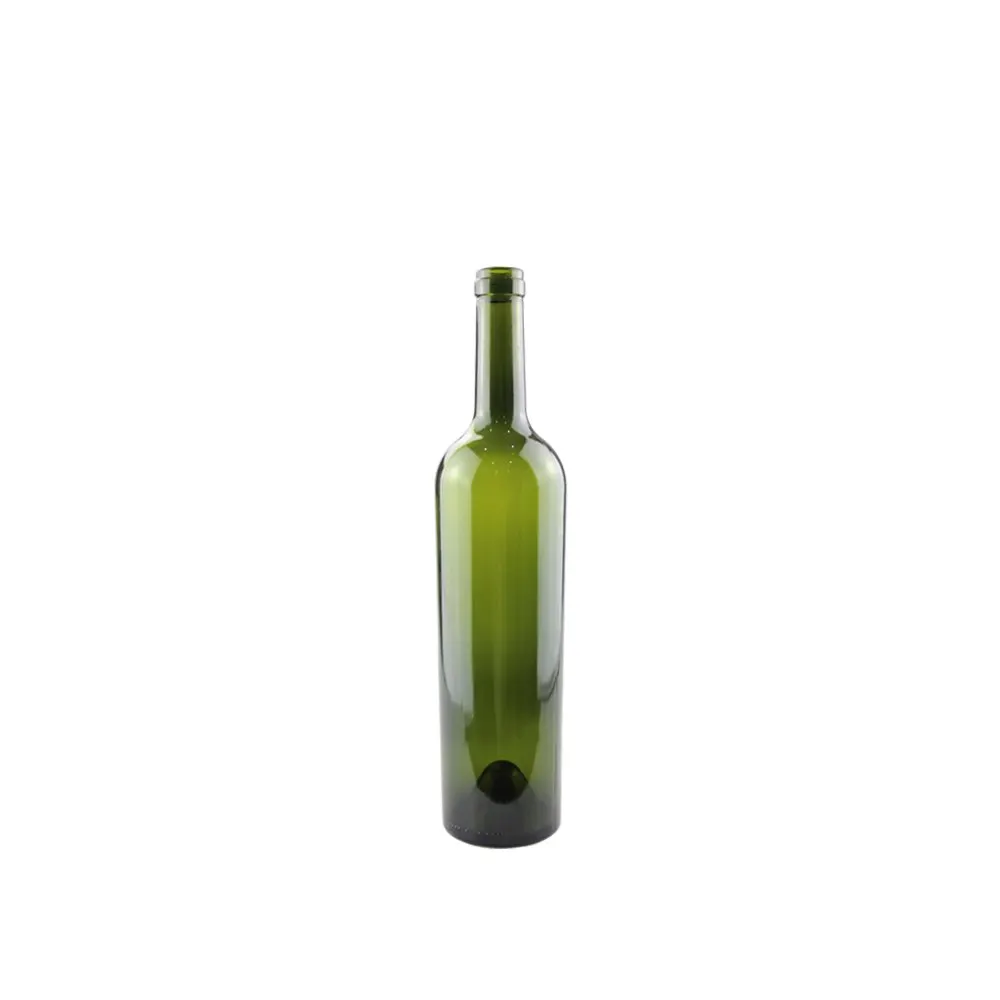
Filed under wine bottles wholesale; the moulds we quote for this are pictured at the foot of the page.
This page is written for the buyer who already has a bottle specification and now has to move the glass without breaking it, and who wants a defensible position if something does break. It deals with transport packaging only: cartons, dividers, molded pulp, foam, pallets, the ocean leg, and the evidence trail that turns a loss into a claim instead of an argument. It is a logistics and breakage-control page, not a bottle selection page. If the format itself is still open, including which capacity, shape family or closure the bottle takes, the entry point is the wine bottles category reference, and if the open item is the closure, the capsule and cork interface question sits on the wine bottle capsules page rather than here. How many bottles fit in a container, what a pallet carries and how the loading coefficient moves with bottle diameter is a separate calculation covered on the glass bottle CBM guide, and this page deliberately does not repeat those counts. Where a sparkling programme is involved and the container is a pressure vessel before it is a package, the bottle-side constraints are set out on the brut wine bottles page. No tooling figure, unit price, minimum order quantity, freight rate or transit time appears on this page, because each is a quotation item confirmed against a real route and a real specification.
What Changes When the Same Bottle Ships Empty or Filled
Two shipments of identical glass can need completely different packaging, and the difference is rarely the bottle. It is who packs it, at which point in the supply chain, and what has to arrive intact besides the glass. Separating the two cases is the first useful step, because they fail in different ways and they are judged by different people.
The first case is the factory shipment of empty glass. The bottles leave the plant with no label, no closure and usually no capsule, packed into a carton system whose whole job is to stop glass from touching glass and to prevent the neck from carrying load. The receiving party is a filling plant or a decoration line, and the pack is broken down on arrival, so it can be simple, and it should be designed so that it can be depalletised mechanically rather than opened by hand. The commercially damaging events here are chipping, cracking, shoulder scuffing and neck damage. A scuffed shoulder still fills, but a chipped finish will not seal, and a finish chip that is only discovered at the filling head stops a line rather than a single unit.
The second case is the shipment of a finished, filled bottle, either from a contract packer to a distributor or from a brand owner’s warehouse to a retail account. The unit that now moves carries a liquid, a label and a closure, and the packaging has to serve two clients at once. The glass has to survive, and the commercial presentation has to survive. A label that has lifted in condensation, a carton that has abraded against its neighbour in the pallet, and a crushed foil capsule are all failures in this case even where no glass has broken, because the unit is no longer sellable.
The practical consequence is that a pack validated on empty glass is not automatically valid on filled glass. A filled 750 ml wine bottle is heavier than the empty glass by roughly the mass of the wine itself, and that additional mass sits above the base, so the centre of gravity of the packed unit moves. The compression load carried by the bottom carton in a full pallet therefore rises, and the impact energy in a drop rises with it. Where a buyer intends to reuse a pack format across both scenarios, the compression and drop assumptions have to be re-checked rather than inherited from the empty-bottle case.
There is also a compliance layer that attaches to only one of the two cases. Empty glass is a packaging material, and any food-contact coating, decoration or closure that touches the wine falls under food-contact rules such as EU 1935/2004 in the European market or the FDA 21 CFR framework in the United States. A filled, labelled, alcohol-containing retail unit additionally has to satisfy the destination market’s labelling and nominal-quantity rules for prepacked goods. Those requirements change the label field and sometimes the carton artwork, which is one more reason to put the destination market into the packaging brief at the start instead of correcting it after the artwork is printed.
Carton, Divider and Pallet Rules That Come Before the Quote
The most common reason two packaging quotations cannot be compared is that they are not quoting the same pack. A carton specification has a set of fields, and unless all of them are written down, a cheaper number is usually a lighter pack rather than a better price. Fixing this list before the enquiry is asked is the single highest-value habit in this part of the project.
- Unit load definition. How many bottles per carton, and in what internal arrangement. A six-bottle carton in a three-by-two layout behaves differently from a six-bottle carton in a two-by-three layout, because the load path to the pallet changes.
- Board grade and construction. Single wall or double wall, and the flute direction. Corrugated board carries its compression load through the flutes, so the flutes must run vertically in the finished carton. A carton whose flutes run horizontally looks identical on a drawing and loses most of its stacking strength.
- Internal fit. The clearance between the bottle body and the cavity. Too tight and the operator forces the bottle in, which is itself a damage event. Too loose and the bottle moves through the whole journey and abrades the bottle beside it.
- Divider or insert geometry. The divider has to hold the bodies apart at the widest point and support the shoulder so that the neck does not become the load-bearing element. Where the insert does not reach the shoulder, the neck takes the load in a stack.
- Top pad and closure clearance. The internal height has to allow for the finished closure height including the capsule and any protruding stopper head. A closure changed late in the project can make a previously correct carton too short.
- Pallet footprint and overhang rule. The carton count per layer, the layer pattern, and the explicit rule on overhang. Corner overhang is the fastest way to lose compression strength in the bottom layer.
- Stack pattern. Column stacking gives the highest compression performance because the corners line up. Interlocked stacking is more stable in transit but breaks the vertical load path, so it demands a stronger board for the same stack height.
- Unitising method. Stretch wrap, shrink hood, straps, corner boards and a top cap, and whether the load is wrapped down onto the pallet or only around the cartons.
- Pallet specification. Wood, plywood or plastic, the entry height for the handling equipment at destination, and the treatment and marking requirements of the destination country for wood packaging.
- Moisture exposure. Whether the carton has to hold its compression strength after a humid ocean leg, which is a different test from a dry one.
Two of these fields are repeatedly the cause of a claim. The first is the closure clearance, because the packaging specification is often written while the closure is still being chosen, and a taller stopper head changes the carton height and therefore everything above it. The second is the fit tolerance, because it looks like a two-millimetre detail on a drawing and behaves like a root cause in the field. Both belong in the written specification, not in a verbal understanding with the packaging supplier.
Palletised, Slip-Sheet or Floor Loaded: A Risk Decision, Not Only a Volume Decision
Once the carton is fixed, the next choice is how the load sits in the container, and this is usually presented as a volume question when it is at least as much a risk question. The three common arrangements behave very differently at the point of unloading and at the point of damage.
A palletised load is the slowest to consume container height and the fastest to handle. The pallet itself occupies vertical space, which reduces the number of carton tiers, but the pallet can be pulled out with a forklift at destination and the unit load arrives as a unit. It is the natural choice when the receiving site is a modern warehouse or a filling plant with dock equipment, and it is also the arrangement that makes re-packing and inventory counting cheapest.
A slip-sheeted load sits between the two. It recovers most of the height lost to pallets, and it can still be moved as a unit where the receiving site has the right attachment on its handling equipment. It transfers the handling risk to the destination: if the receiver does not have the equipment or the practice, the unit is broken down manually, and manual breakdown is where a large share of real damage happens.
A floor-loaded container carries the most cartons and the least convenience. Every carton above the bottom layer adds to the compression load on the layer below, so the board grade has to be chosen for the actual stack height rather than for a comfortable pallet height. Unloading is manual and slow, it is the point in the journey with the most individual handling events, and each event is a separate opportunity to drop a carton.
Bottle orientation belongs in the same decision. Wine bottles travel upright, neck up, because a bottle lying on its side concentrates load on the neck and shoulder, and because on a filled shipment a horizontal pack brings the closure into prolonged contact with the wine and exposes the pack to leakage staining if a closure weeps. For empty glass some shippers will accept horizontal layers because there is no liquid to leak, but the neck still becomes a load path and the decision should be made explicitly rather than by default. Whichever arrangement is chosen, the number of bottles per container is a function of bottle diameter, height, carton thickness and pallet build, and that arithmetic belongs with the container loading questions set out on the glass bottle CBM guide rather than on this page.
Transport Packaging Options Compared
The table below is the working tool on this page. It compares the pack structures a wine programme normally chooses between, and it maps each one to the cushioning that goes with it, to how it behaves under stack and drop, to the transport modes it suits, to where it usually fails, and to the evidence a claim will require. Read the last column as a pre-shipment checklist rather than as an afterthought, because the photographs that decide a claim can only be taken before the container is sealed and at the moment it is opened.
| Pack structure | Cushioning material | Compression and drop behaviour | Transport modes it suits | Breakage risk point | Claim evidence required |
|---|---|---|---|---|---|
| Single-bottle gift box (rigid or folding boxboard with an inner cradle) | Molded pulp cradle, die-cut corrugated cradle, or a foam insert, plus a neck support where the closure is tall | Strong against a single drop onto a corner or a face; weak against stack load, so these boxes are never used as the bottom layer of a stack | Parcel and courier networks, air freight, hand-carry and e-commerce despatch | Drop onto the closure end, and lateral crushing in the middle of a mixed parcel stack | Photographs of the outer parcel before opening, then of the inner cradle and the damage location before the bottle is removed; the courier tracking record and a note of visible external damage at delivery |
| Two-bottle presentation pack (hinged or sleeve box with two cradles) | Molded pulp or corrugated twin cradle, sometimes with a divider between the two bodies | Better against stack load than a single box because the load spreads over two bottles; the failure mode is contact between the two bottles if the divider is missing | Parcel and courier networks, gift and promotional despatch, air freight | Glass-to-glass contact through the centre line of the pack; hinge crushing from the side | The same outer and inner photographs, plus a record of which of the two positions failed, since a repeated failure in one position points at the cradle rather than at handling |
| Six-bottle carton with dividers (corrugated shipper with an internal cell structure) | Corrugated cell dividers, molded pulp cells, or a die-cut insert, usually with a top pad | Carries stack load well when the flutes are vertical and the cells support the shoulder; a common and well-understood export pack for both empty and filled glass | Sea freight as a palletised unit load, road and rail within a region, air freight in break-bulk | Top pad missing, allowing the neck or closure of the upper layer to bear on the carton below; insufficient clearance at the closure | Carton identification and layer position photographed in the container, a stuffing record, and photographs of the carton as it was opened rather than after the bottles were unpacked |
| Twelve-bottle master shipper | Corrugated dividers or molded pulp, usually with a double-wall board and a full-height top pad | Designed for wholesale and distribution handling; the board grade is chosen for the stack height, not for a single carton | Sea freight, road freight and distribution centre handling | Bottom-layer compression in a high stack, and edge crushing during pallet wrapping | Pallet and layer photographs, the container seal number, and a note of stack position; for a compression failure, the retained carton is more useful than a photograph of it |
| Full palletised unit load (pallet, tiered cartons, corner boards, stretch wrap) | Cushioning inside each carton plus corner boards and a top cap on the load itself | The strongest arrangement for volume shipments and the one that best preserves compression; the weak points move to the pallet edges and the wrap tension | Sea freight, road freight, rail, and any route with powered handling at both ends | Corner overhang in the carton pattern, under-tensioned wrap allowing the load to shift, and pallet damage from forklift entry | Loading photographs of the finished unit load before the doors close, the seal number, and a damage report made with the carrier present at unloading where the route allows it |
| Floor-loaded bulk (cartons stacked directly in the container, no pallet) | Cushioning inside each carton only, often the simplest divider system that meets the drop requirement | Highest compression demand on the lowest cartons; not suitable for a tall stack in a weak board grade | Sea freight where the receiving site has no dock equipment and will unpack manually | Manual offloading drop events, and compression failure in the bottom layers after a humid voyage | A stuffing photograph showing the stack height and the board grade marking, plus delivery photographs taken before the first carton is moved |
Corrugated Board, Molded Pulp and Foam: What Each Material Actually Does
The three cushioning families are not interchangeable, and the choice is driven by what is being protected, which is not always the glass. In a filled, labelled shipment, the label and the capsule are part of the commercial value of the unit, and a material that protects the glass while scuffing the label has not done the job.
Corrugated board is the default for shippers and dividers. It is inexpensive, printable, widely recyclable, and it performs well in compression when the flutes run vertically and the stack height is respected. Its weakness is point loading: a flat sheet offers very little protection to a shoulder or a neck that receives a direct impact, which is why corrugated packs almost always depend on a cell structure or a die-cut insert to keep the glass off the board. Corrugated also loses compression strength as moisture content rises, so a specification validated in a dry warehouse is not automatically valid after a humid sea leg.
Molded pulp is made from recovered fibre and formed into a cradle or cell that follows the bottle. It conforms to the shoulder and the body, absorbs shock by deforming, and it is typically recyclable in the same stream as paper and board, which matters in markets where packaging fees are weighted by recyclability. Its practical limits are tooling, because a cradle is format-specific, and cube, because a formed cradle is bulkier than flat board. In sustained high humidity it can soften and lose some of its cushioning performance, and lower-grade pulp can shed fibre dust, which is worth checking where the bottles will go straight onto an unwashed filling line.
Expanded and formed foams, including the polyolefin and polyurethane families, give the highest shock performance per millimetre and are often chosen for heavy premium glass, where a drop has more energy to absorb and no deformation budget is available. They are also the most durable if the pack is intended to be reused for samples or for a returnable empty-bottle loop. The cost is twofold: material cost, and market acceptance. Several destination markets levy fees on packaging that is difficult to recycle, and some retail and travel retail accounts have their own restrictions on plastic cushioning. Where a foam is specified, the destination market’s packaging rules should be checked as part of the brief rather than discovered at the port.
Air pillows and loose fill belong to a different job. They fill void space so that a carton’s contents cannot move, and they are useful in a mail-order pack around a gift box. They are not a substitute for bottle-on-bottle separation inside a shipper, because they distribute rather than localise, and a bottle that can still shift will eventually find the wall of the carton. Where the pack design depends on void fill, the correct question is why the cavity does not fit the bottle in the first place.
One further point belongs here. Any material that touches the bottle, including a liner or a coated insert, is in the same food-contact chain as the glass itself, and the relevant frameworks, such as EU 1935/2004 in Europe or FDA 21 CFR in the United States, apply to the material and not only to the container. Where the pack touches the closure or the neck finish, this should be stated in the brief so the correct documentation can be assembled.
Temperature, Humidity and the Long Sea Leg
A container is a steel box with no climate control, and the conditions inside it are not the conditions on the quay. On a long route the load can pass through repeated day and night temperature cycles, and those cycles drive condensation. Moisture is the enemy of almost every part of a wine pack: board loses compression strength as it absorbs water, metal capsules can corrode and stain the neck, paper labels can cockle or lift, and the print on the carton can transfer. The mitigating measures are ordinary but they have to be chosen deliberately: a desiccant where the pack is sensitive, a container liner where the route is humid, coated or moisture-resistant board where the destination climate is severe, and avoiding the top layer of a stack in a container that will sit in the sun.
For a filled wine shipment the temperature question is not only a packaging question, it is a quality question. Heat raises the pressure inside the bottle and increases the volume of the liquid, which puts a load on the closure, and repeated cycling works on the seal. A shipment that arrives with stained cartons and slightly raised closures has not failed as packaging, it has failed as wine, and no cushioning choice prevents it. That is why route, season and transit duration are inputs to a packaging decision rather than separate commercial considerations.
The closure side of the same problem has its own rules. A natural cork is traditionally kept in contact with the wine, which is why bottles are stored horizontally, but shipments normally travel upright and that is accepted practice for normal transit durations. Where the voyage is unusually long, or the destination is hot and dry, the interface between the closure, the neck finish and any capsule deserves a specific look rather than an assumption. That analysis sits with the closure specification on the wine bottle capsules page, because the answer depends on which closure and which finish the bottle carries, not on the carton.
The Variables That Actually Move Breakage Rate
Breakage is usually discussed as if it were a property of glass, when in fact it is a property of the journey. The list below is short on purpose, and the individual variables are ordered roughly by how much they move the outcome on a real wine route.
- Glass-to-glass contact. Direct contact between two bottles transmits impact without any cushioning between them; every divider, cradle and cell exists to remove this path.
- Handling events. Each time a carton is picked up by hand rather than moved as a unit is a separate drop opportunity. Reducing the number of manual touches typically improves breakage more than upgrading the cushioning material.
- Board grade against actual stack height. A board chosen for a pallet height and used in a floor-loaded container under-performs, and a humid voyage reduces its margin further.
- Fit tolerance in the cavity. A loose fit turns into abrasion and impact against the carton wall; a tight fit turns the packing station into a source of neck and finish damage.
- Pallet pattern and overhang. Overhanging cartons lose corner support, which is where almost all compression strength is concentrated.
- Closure and capsule height. A taller closure changes the carton’s internal height and can quietly remove the clearance that the neck needed.
- Wrap and unitising. A load that shifts inside its wrap loads the cartons unevenly and puts lateral stress on the corner columns.
- Offloading conditions at destination. A palletised load that arrives at a site with no forklift is unloaded by hand at speed, which is the single most damaging hour of the journey.
Where a buyer wants the pack verified rather than estimated, the standard way is a defined transit test protocol. Protocols published by ISTA are widely used for this purpose, and a compression test on the packed carton is the usual companion. The important point is procedural: the test specification, the drop orientations and the acceptance criteria belong in the purchase documentation, and the resulting report belongs in the file, because it is also the evidence that a subsequent claim will lean on. What is not useful is a general assurance that a pack is strong; a tested pack is a specification, an assurance is a sentence.
Incoterms: Where Responsibility and Evidence Change Hands
The trade term decides where risk passes from the seller to the buyer, and therefore decides when the packaging has to be photographed. This is the practical link between Incoterms and breakage claims, and it is the reason the term belongs in the packaging conversation rather than only in the finance conversation.
Under EXW, the risk passes at the works, so the buyer owns the load from the moment it leaves the factory gate. Under FOB, risk passes when the goods are on board at the port of loading, and the ocean leg is the buyer’s risk. Under CIF, the seller arranges and pays carriage and insurance to the destination port, but the risk still passes at loading, which is a distinction buyers frequently miss: insurance is a contract, risk transfer is a moment. Under DDP, the seller carries the risk all the way to the named destination, which means the seller also owns the breakage and therefore has the strongest reason to over-specify the pack.
The evidence habit that follows from this is simple and it is worth more than any single packaging upgrade. Photograph and count at the moment of risk transfer, and photograph again at the moment of receipt before anything is moved. Keep the container seal number, the pallet or carton count, the layer position and the damage location visible in the same frame where possible. Where the destination allows it, arrange for a joint survey with the carrier’s representative at unloading, and record the ambient condition if it is abnormal. A claim supported by a stuffing report, a loading photograph and an arrival photograph is a different document from a claim supported by a description written two weeks later, and carriers and insurers behave accordingly.
What the Landed Cost of Packaging Is Made Of
Packaging is usually judged on its purchase price and then paid for on its freight, which is why the honest comparison is a landed cost per sellable bottle rather than a price per carton. The components are consistent even though the amounts vary by route and order.
The first component is material: board, inserts, cushioning, top pads, pallets and film. The second is conversion, meaning the labour to erect and pack, which rises sharply when the pack is assembled by hand rather than formed from a flat blank. The third is cube: a bulkier cushioning system reduces the number of bottles a container carries, and that difference is charged at freight rates for the whole voyage, per bottle, for the life of the programme. The fourth is market cost at destination, including duties, and the packaging levies and extended producer responsibility fees that several markets now apply on a per-material basis. The fifth is the cost of failure itself: replacement freight for a broken consignment, the administrative burden of a claim, the delay to a filling or shipping schedule, and the loss of a batch that arrives unsellable even though the glass is intact.
Against those five sits the cost of over-packaging, which is real and is often invisible because it is spread across every unit rather than concentrated in a claim. The right answer is a crossover point: packaging below it loses more to breakage and claims than it saves in material and cube, and packaging above it spends money on strength the route never uses. That crossover depends on the bottle weight, the carton count per pallet, the number of handling events, the route and the destination market, which is exactly why it is answered on enquiry against a real shipment rather than quoted as a general rule.
Where This Page Stops and Which Page to Read Next
This page owns one decision: how to pack and move wine bottles so that they arrive intact and so that a loss can be evidenced. Everything downstream of that decision has its own home. If the open question is how many bottles fit in a 20GP or 40HQ, how the pallet build changes with bottle diameter, or what the loading coefficient is for a given format, that calculation is on the glass bottle CBM guide. If the open question is the closure, the cork, the capsule or the neck finish interface, including how a tall stopper head changes the carton’s internal height, the specification detail is on the wine bottle capsules page. If the pack is for a sparkling wine programme, where the container is a pressure vessel and the glass weight, base form and closure hardware all differ from still wine, the bottle-side selection logic is set out on the brut wine bottles page. And if the format itself is still undecided, including which capacity and which shape family suits the channel, the right starting point is the wine bottles reference page, after which the packaging decisions on this page can be made against a fixed bottle.
Read together, those pages cover one chain: choose the bottle, specify the closure, calculate the load, and pack it so it survives the route. Each answer depends on the one before it, which is why a packaging brief assembled before the bottle is fixed tends to be reworked, and why a packaging brief assembled after it can usually be quoted in one pass.
Frequently Asked Questions About Wine Bottle Shipping
How should wine bottles be packed for shipping?
Start from the failure mode rather than from the material. Every successful pack removes glass-to-glass contact, stops the neck from carrying load, and constrains the bottle so it cannot move inside its cavity. In practice that means a shipper with a cell structure or a molded pulp cradle that reaches the shoulder, a top pad, and a board grade chosen for the real stack height rather than for a single carton. A parcel sent to an end customer usually needs a rigid gift box with an inner cradle, because that journey includes sorting equipment and repeated manual handling. A palletised export shipment usually needs a six or twelve bottle shipper with dividers and a unitised load. The two are different packs solving different journeys, and the choice should follow the route.
What is the best cushioning material for shipping wine bottles?
There is no single best material, only a best match. Corrugated board is the most economical and the most widely recyclable, and it performs well in compression once a cell structure keeps the glass away from the flat panels. Molded pulp follows the bottle shape closely, cushions by deforming, and recycles in the paper stream, at the cost of format-specific tooling and more cube. Expanded foams absorb the most shock per millimetre, which matters for heavy premium glass, and they are the usual choice where the pack has to be reused. The deciding factors are the weight of the bottle, the destination market’s rules on plastic packaging, and whether the receiving line will accept fibre dust from low-grade pulp.
Can wine bottles be shipped on their side?
For a filled shipment, upright is the normal practice. A bottle on its side puts the neck, shoulder and closure under a load path they were not designed to carry, and it keeps the closure in prolonged contact with the wine, which is a problem if a closure weeps and stains the pack. Upright travel for normal transit durations is accepted practice even for cork-sealed wine. For empty glass, a horizontal layer is sometimes used because there is no liquid to leak, but the neck is still a load-bearing element and the choice should be made explicitly rather than by default, with the divider geometry designed for it.
How is the breakage rate kept low on ocean shipments?
The biggest single lever is the number of manual handling events, not the cushioning material. A load that moves as a pallet through every stage arrives in better condition than a load that is picked up carton by carton at both ends, even when the second pack uses better cushioning. After that, the levers are the board grade against the real stack height, the fit tolerance in the cavity, the pallet pattern with no corner overhang, and a unitising method that keeps the load from shifting inside its wrap. Moisture is the quiet variable: board that has absorbed water from a humid voyage carries less load than the same board tested dry.
Do empty bottles need the same packaging as filled bottles?
No, and treating them as the same is a common source of either overspend or breakage. Empty glass can travel in a simpler carton system, because there is no liquid mass, no label to scuff and no closure to protect, and because the pack is broken down at the filling plant rather than presented to a consumer. A filled shipment carries more mass higher up the bottle, has fragile commercial surfaces, and often has to survive retail handling as well. A pack validated on empty glass should have its compression and drop assumptions re-checked before it is used for filled glass, particularly for the bottom cartons of a full pallet.
What photos should I take to support a damage claim?
Take them at the two moments that matter: when risk transfers and when the goods are received. Before the container doors close, photograph the finished unit loads, the carton markings, the stack height and the seal number. On arrival, photograph the external condition before opening anything, then open one carton and photograph the damage in place before removing the bottle. Keep the damaged carton itself, because a compression failure cannot be demonstrated from a photograph. A stuffing report, the loading photographs, the seal number and an arrival photograph together make a claim that a carrier or insurer can act on; a written description alone usually does not.
Does packaging change how many bottles fit in a container?
Yes, and sometimes more than a change of bottle format does. Pallets consume vertical space, a bulkier cushioning system increases the outer carton size, and a double-wall board is thicker than a single wall, so each of those choices reduces the number of units per container and therefore raises the freight cost per bottle for the whole voyage. The number itself is calculated from bottle diameter and height, carton thickness, pallet height and container internal dimensions, and that arithmetic belongs with the loading calculations rather than with the pack design discussion.
How do I specify a carton for a given bottle format?
Write down five things and the quotation becomes comparable. First, the bottle: capacity, body diameter, total height including the closure, and weight filled. Second, the pack: bottles per carton and the internal arrangement. Third, the protection: divider or insert type, top pad, and whether the closure needs clearance above it. Fourth, the load: pallet pattern, stack height, floor-loaded or palletised, and the destination handling equipment. Fifth, the journey: route, season, expected humidity and the receiving market’s packaging rules. With those five, a pack can be proposed against a defined test, and two suppliers can be compared on the same job instead of on two different ones.
Send Bottle Format, Transport Mode and Order Structure
A packaging recommendation is only meaningful once three inputs are on the table. The first is the bottle format: capacity, body diameter, total height including the closure, empty weight and filled weight, and whether the shipment is empty glass or a finished, labelled unit. The second is the transport mode: sea, air, road or parcel, the route and the season, the port or destination, and the handling equipment the receiving site actually has. The third is the order structure: how many bottles per carton, the pallet build you want, whether the load is palletised or floor loaded, and whether the pack will be reused for samples or for a returnable loop.
With those three, the pack can be narrowed to the structures that fit the journey, the risk points can be named before the first container rather than after it, and the questions put to the producing plant become specific: which board grade is proposed for the stack height, what the cavity tolerance is, where the divider supports the bottle, how the closure clearance was calculated, and which transit test protocol the design has been verified against. It also helps to state the destination market, because its packaging and recycling rules can rule out a cushioning material that would otherwise be the technical favourite. Where a figure is not yet fixed, mark it open rather than guessing; it is far cheaper to settle a carton specification against a known bottle and a known route than to correct a pack after a container has arrived with damaged glass.