A closer look at one step of our custom glass bottles service; the full route, from drawing to approved sample, is set out there.
A private-label glass program rests on four choices: which mold route you take, how the bottle is decorated, what exclusivity you can realistically secure, and whether goods move through your warehouse or go blind to your customers. A stock mold with custom decoration gives most distributors all the differentiation they need; a fully private mold only earns its place on a flagship SKU running 200K+ units/yr. The model suits packaging distributors, importers supplying regional retail chains and brand owners with 3+ proven SKUs; below roughly 50,000 units/year across the whole line the overhead does not amortize, and it is better to wait.
Stock, modified or private mold
Tooling is the first decision because it fixes how far the bottle itself can differ from what other buyers can obtain.
| Mold route | What sets the bottle apart | Where it fits |
|---|---|---|
| Stock mold with custom decoration | The surface only: print, color and closure | New lines, market tests and the majority of distributor programs |
| Modified stock mold (emboss or deboss insert swapped) | Your logo formed in the glass | Brands that want a permanent mark without paying for full tooling |
| Full private mold | A silhouette, capacity and glass weight nobody else has | Flagship SKUs at 200K+ units/yr |
The middle route deserves more attention than it gets. A logo embossed in the heel of a proven mold gives most of the shelf distinction of private tooling at a fraction of the tooling outlay.
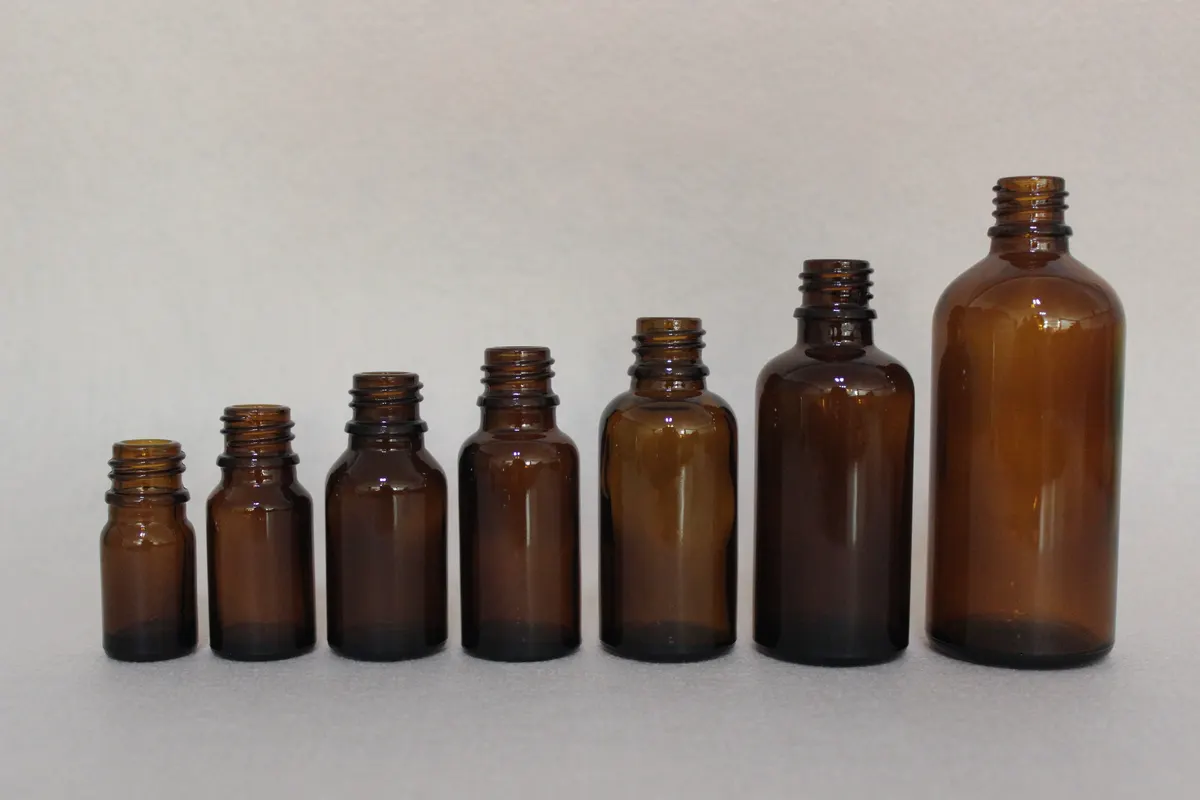
Cosmetics and personal care are the exception. Shape carries more weight there and retail buyers often insist on it, so distributors in that field tend to tool earlier. The cosmetic glass bottle collection and the amber cosmetic bottles show the stock platforms such programs usually begin with.
Decoration, artwork custody and SKU control
Decoration scales separately from tooling. Two points are specific to private label.
- Artwork custody. Screens, dies and decal films produced for your designs belong to you. The agreement should state that in plain words and set out how they are released if the relationship ends.
- Version control. A distributor carrying 10-30 SKUs needs each one identified on the glass, by a printed bottle code or laser-etched mold dots. Without that, a mispick in the warehouse reaches the brand's customer as a branding mistake.
We assign an exclusive code to each SKU and lock its decoration spec to that code, so a reorder is placed against the code and not rebuilt from an email thread.
Closures belong in the same brief. Where bottles are paired with droppers, pumps or lidded jars such as the 4 oz cosmetic jars with gold lids, ask for cap logos and custom collar colors to be specified alongside the glass decoration. The closure is the most visible small area on the pack.
Exclusivity a glass plant will agree to
Requests for "exclusive rights" are common and plants grant them narrowly. Four tiers exist, and each costs more in commitment than the last.
| Tier | What is protected | How it is obtained |
|---|---|---|
| Design exclusivity | Your private molds, artwork and decoration specs are not sold to anyone else | Standard professional practice; still put it in writing |
| Mold exclusivity | A mold you paid for runs only for you, with the right to demand its return or destruction when the contract ends | Standard with private tooling |
| Territorial exclusivity on a stock shape | The same stock bottle with your decoration combination is not supplied to another distributor in a named territory such as Germany, Texas or the GCC | Negotiable against a volume commitment, since the plant gives up a sales channel |
| Category exclusivity | The plant is shut out of a whole product category in a territory | Rare, and tied to seven-figure annual commitments; almost no program should pursue it |
A first-refusal and notice clause protects a distributor better than any of these. Under it, an inquiry from your territory that matches your branded specification is reported to you and routed through you. Plants accept it readily, it carries no commitment, and it catches the leak that actually occurs.
Do not spend negotiating effort on exclusivity for a generic stock shape such as a standard boston round or a plain dropper bottle. The same geometry exists at a dozen plants, so the clause cannot be enforced across the industry. Put that effort into the decoration combination and the notice clause. The 1 oz dropper bottles and the 50ml perfume bottles are typical platforms on which these terms are discussed.
Blind shipping and the three fulfillment models
Blind shipping means the goods leave the plant under your identity. Cartons show your company name and SKU codes, the packing list is on your letterhead, and the B/L consigns to your customer. The source is hidden from your customer only; origin declarations to customs stay accurate.
Distributors choose between three routes:
- Plant to your warehouse to customer. You keep the most control and carry 30-60 days of stock, and the second freight leg adds the highest overhead per unit.
- Plant to your customer's dock, blind. One freight leg and you never handle glass. It works when the customer orders at container scale; you invoice and coordinate.
- Hybrid pool. Fast movers go direct and blind, while slow movers and mixed-SKU orders are consolidated in your warehouse. Mature programs usually settle here within a year.
Documents on a blind shipment
The commercial invoice and packing list are issued on your letterhead: we fill them in, you approve, the forwarder files. The plant's name appears only where origin rules require it, on the export declaration and on the carrier's master B/L. That master B/L consigns to the forwarder you nominate, who then issues a house B/L showing you as shipper.
ISF is filed 24 hours before loading under your bond or your customer's. For EU destinations, pallets carry ISPM-15 stamps and, on request, a EUR.1 movement certificate is prepared so the customer can claim preferential duty. What the customer receives is the container photos, the seal number, your packing list and a delivery appointment.
One weak point remains. The forwarder sees both parties, so either use a forwarder under NDA or have documents sent to us and to the customer separately.
Inspection before a blind load
Blind orders are inspected before shipment to AQL 2.5, the same as goods bound for your own warehouse, and the report reaches you before the cargo moves.
How one distributor program is structured
A Midwest packaging distributor's program shows how the four choices combine. The line has 14 SKUs: eight essential-oil bottles (5-100ml, amber and cobalt), four cosmetic jars and two perfume formats. Annual volume is 380,000 units, sold on to 60+ brand customers.
- Molds: stock throughout. The range is set apart by two decoration platforms, one-color print for value brands and frost with foil for the upper tier, plus three proprietary closure colors.
- Exclusivity: the decoration combination is exclusive for the upper Midwest and backed by a first-refusal notice, in return for a 250,000-unit annual commitment.
- Fulfillment: about 70% ships blind to brand docks in 40HQ and 20GP splits; the other 30% passes through a Chicago warehouse for mixed-SKU orders.
The business sits in the decoration combination, not in the glass. The clause the distributor values most is 48-hour photo documentation of every load, which has closed three customer damage disputes with no site visit.
Agreements, releases and cash flow
Program pricing is quoted per project and depends on the mold route, the decoration, the quantities and the freight terms. Structurally, an annual agreement with quarterly releases is what secures production slots through the September-February peak, and it lets neighbouring categories join the same program: baby oil bottles, amber glass bottles and the wider ranges described on our about page.
Cash is the usual reason a profitable program stalls: stock sits in the warehouse while receivables are outstanding. Distributors who scale either agree net terms with their own customers after the first year or finance purchase orders against confirmed orders.
What to include in a program brief
- The SKU list with capacity, shape and annual volume per SKU; a spreadsheet is ideal.
- The level of differentiation wanted: decoration only, an embossed logo or a fully private shape.
- The territory and the scope of exclusivity you are looking for.
- The fulfillment model: your warehouse, blind to customers or a hybrid.
- The target sell price in your market, so the program arithmetic can be judged honestly.
To cost individual SKUs first, the quote request takes bottle, decoration and closure together.
Frequently asked questions
Can my customers find out which plant makes my bottles?
Not through the shipment. Cartons, labels and packing lists carry your identity, and container photos and documents pass through you. Customs declarations must state the true origin by law, but your customer does not see them.
What does a private mold cost in total, and how long until a first blind shipment?
Both are quoted per project. Cost moves with the mold itself, the decoration, the quantity and the freight terms; timing is confirmed once the decoration and line schedule are settled.
Can a new program begin with private tooling or territorial exclusivity?
Usually not. A stock mold with your screen print is the normal entry point, and private tooling and territorial exclusivity open up at 100K-500K annual units, depending on scope.
Who keeps the screens and decoration tooling if the relationship ends?
You do, and the agreement should say so. Screens, dies, films and molds made for your designs are transferred or destroyed on your instruction. Put this question to any supplier before signing, and treat hesitation as the answer.
Can stock be held and released on call?
Yes. A bonded-warehouse arrangement at the origin port can hold 30-90 days of your fast movers, released against weekly call-offs.
Can a decoration design change during a contract?
Between releases, yes; in the middle of a run, no. A furnace campaign is continuous, so a change waits for the next release. Most distributors group design refreshes into their Q1 and Q3 releases.