Buying glass spray bottles wholesale means buying a matched assembly: a bottle, a neck finish and a pump whose gasket and spring tolerate your formula. The glass itself is inert, so most field failures start in the pump. Fix the finish first (18/415, 20/410, 24/410 and 28/410 do not interchange), specify pump materials against the actual liquid, and leak-test the assembled pack inverted at 40 °C for 24 hours before mass production.
Sizes, finishes and pump output by capacity
These are typical planning values. Brimful capacity, wall tolerance (normally ±0.5 mm) and dip-tube length are set per assembly on the project drawing and confirmed on an approved sample.
| Capacity | Usual application | Finishes commonly used | Pump output |
|---|---|---|---|
| 5-15 ml | Fragrance sprays and samples | 13/415, FEA 13 crimp | 0.05-0.08 ml, fine mist |
| 20-30 ml | Facial mists, travel sizes | 18/415, 20/410 | 0.06-0.10 ml, fine mist |
| 50-100 ml | Hair, body and room sprays | 18/415, 20/410, 24/410 | 0.08-0.14 ml, fine mist |
| 250-500 ml | Home care, cleaning, salon back-bar | 28/410, 28/400 | 0.9-1.2 ml, trigger |
If you already own filling equipment or hold cap stock, start from that finish and let us find bottles that fit it.
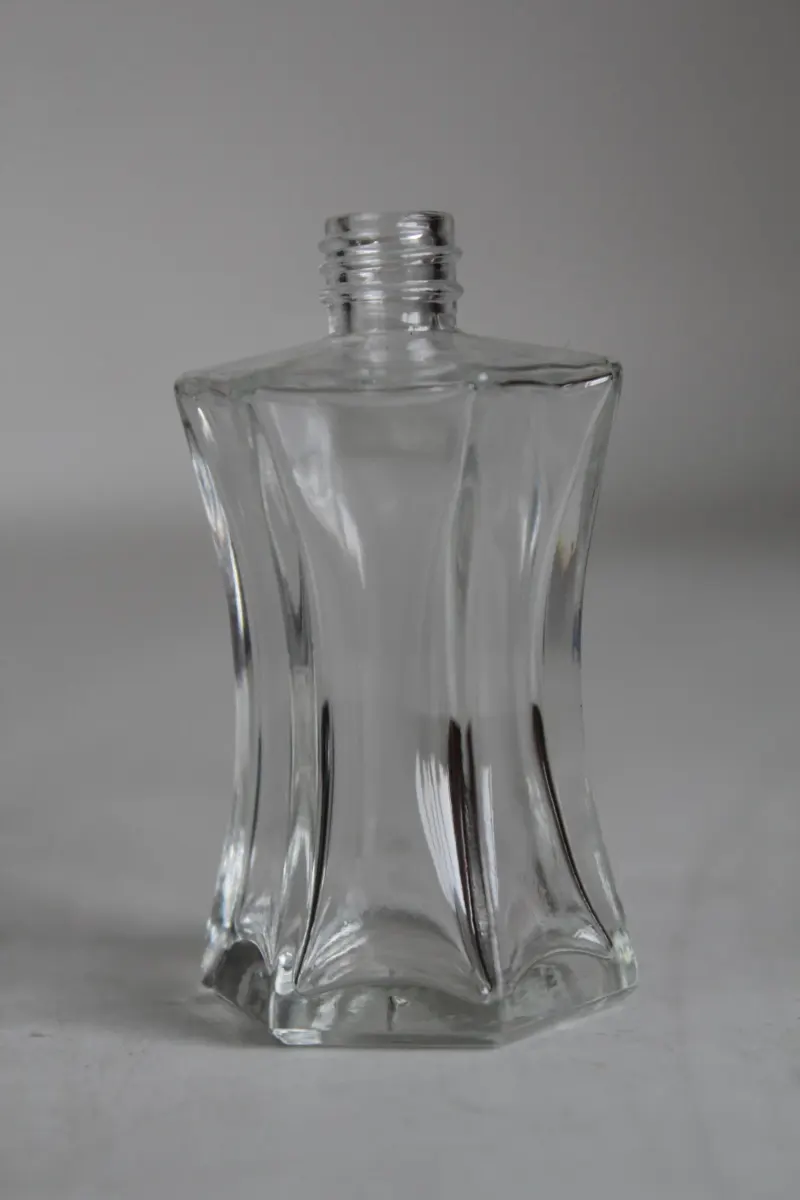
Choosing the pump type
The pump shapes what the user feels more than the glass does: how much comes out, the spray pattern, and whether it clogs. Four families cover most projects.
- Fine-mist pumps deliver 0.05-0.14 ml per actuation as a wide, soft cone of small droplets. They are standard for fragrance and facial mist. Better ones resist clogging and spray the same on the tenth press as on the first.
- Crimp pumps (FEA 13/15/18/20) have a collar crimped permanently onto the neck. Fine fragrance uses them for the clean look and the tamper evidence.
- Trigger sprayers on 28/410 or 28/400 necks give 0.9-1.2 ml per pull, with stream, spray and off nozzle positions. Spring and seal quality decide how long they last in cleaning and home-care use.
- Treatment or lotion pumps suit viscous oils and serums that should not be misted, with output up to 2 ml.
The dip tube is cut to the internal height of the bottle. A tube that is too long coils at the base; one that is too short leaves product behind. We specify bottle and pump as a single assembly and check actuation, output and tube fit on first articles.
Matching pump materials to the formula
Three kinds of formula account for most pump failures, and each damages a different component.
| Formula | What it does to the pump | What to specify |
|---|---|---|
| High alcohol (perfume, sanitizer) | Degrades some gasket elastomers; can stress-crack certain plastics | Alcohol-rated gaskets, checked with a 4-week immersion test |
| Essential oils (aromatherapy, natural cleaners) | Citrus and cinnamon oils act as strong solvents, swelling ordinary rubber gaskets and clouding some plastics | Oil-resistant gaskets, Viton-class or a specified PE |
| Acidic or alkaline (cleaners) | Corrodes unprotected springs | Stainless or coated springs; wetted-material list checked against your SDS |
Our verification runs in three steps. We compare the pump's wetted-material list (gaskets, spring, engine plastics) with your formula, soak a filled assembly in the real liquid, and then leak-test it stored upside down at 40 °C for 24 hours. Component datasheets alone miss problems that only appear once pump and bottle are together.
To start that check, send the alcohol percentage, essential-oil load, pH range and viscosity.
Glass colour and light protection
- Amber filters UV most strongly. Use it by default for essential oils, actives and anything that breaks down in light.
- Cobalt blue also protects well against UV and is popular with aromatherapy and wellness ranges for its look on shelf.
- Flint, meaning clear glass, displays the liquid. It fits stable formulas and products where the colour of the liquid carries the brand.
- Coated or frosted finishes are applied after forming and help with both UV control and differentiation. Check coating adhesion on a sample that has been filled and shipped.
If you are unsure, protect the formula with the glass and let decoration do the shelf work.
Cost drivers, packing and what to send for a quote
A spray pack has a larger component share than most glass projects, because the pump is an engineered part. Size and colour drive the cost of the glass; output quality and material specification drive the pump; printing or coating on small formats, packing, and freight with insurance and duties make up the remainder. We quote each project individually.
For export, bottles travel in divider cartons. Pumps and other components go in separate cartons so they are not actuated or damaged in transit. Pallets are shrink-wrapped and each container loading is photographed.
A workable quote needs four details: capacity for each SKU, formula basics (alcohol %, oil load, pH), pump type with target output, and preferred colour. Send them through the spray bottle quote request. For crimp-neck fragrance formats see our glass perfume bottle range; the wholesale glass bottle collections show other formats, and the guide to evaluating a glass bottle supplier explains what to ask before you commit.
Frequently asked questions
What is the MOQ for wholesale glass spray bottles?
It is quoted per project. The minimum depends on the mould, the line it runs on, the pump chosen and any decoration.
Which neck finish should I pick?
Work back from the pump and your filling line. Fine-mist formats of 20-100 ml usually take 18/415 or 20/410, larger mists take 24/410, and triggers on 250-500 ml bottles take 28/410 or 28/400.
Can pumps and caps come with the bottles?
Yes. We coordinate bottle and closure as one tested set: fine-mist, crimp, trigger or treatment pumps, matching caps or overcaps, and dip tubes cut to length. The set is verified on first articles and leak-tested ahead of mass release.