One of our guides on glass perfume bottles; start there for the overview.
Choose a square perfume bottle when the silhouette is part of the brand, when you need a flat face for long or multilingual copy, or when the range has to read as one family across several sizes. Choose round when the shape carries no meaning and budget is tight. Square is harder to mould: the corners run thin, the annealing window narrows and first-pass yield falls, although a generous corner radius and a slightly domed panel recover most of that loss.
Four constraints to check before fixing the profile
Most enquiries reach us with the shape already picked on looks, and the engineering questions come afterwards. Running the constraints first is the cheaper order.
The liquid
A clear, thin alcoholic fragrance hides nothing. Any variation in wall thickness shows as a wave running down a flat panel, because a flat face works like a window where a curved one would scatter the same flaw. Pigmented emulsions, heavy oils and gels are far more forgiving, as is glass behind an opaque coating. The closer the formula is to water in clarity and refractive index, the more panel flatness matters.
The sales channel
Each channel pays for something different:
- Department-store shelf: frontage and a silhouette recognised at a glance.
- E-commerce: a shape that photographs well head-on and survives parcel handling.
- Travel retail: a compact footprint that fits a standard carton.
- Subscription and sampling: low unit weight and a shape that nests in a mailer.
Square is neutral on the shelf and strong on the other three counts, which explains how often it appears in direct-to-consumer fragrance.
Labelling load
IFRA standards govern the fragrance concentrate. On the material side, the references commonly cited are EU 1935/2004 and, for goods going to the United States, FDA 21 CFR. For the shape, what matters is the amount of mandatory text: a long block needs an unbroken readable area, and a flat panel supplies one.
Range architecture
If three capacities must look identical side by side, the profile has to scale without changing character. Square and rectangular bodies grow by getting taller and still look like the same bottle. A round bottle stretched upward becomes a different silhouette.
Why square glass is harder to form
Bottles are blown. A gob of molten glass is cut, dropped into a blank mould and shaped into a parison (the hollow preform), then moved to the blow mould and inflated against its walls with compressed air. In a round body the glass stretches equally in every direction. In a square or rectangular body it does not.
A corner lies further from the centre axis than the panels beside it, yet the glass must arrive there in the same split second. Corners therefore come out thin and panel centres thick unless the parison is profiled and the corner radius is large enough for the glass to flow. This uneven distribution, called wall thickness run-out, is the main forming problem in square perfume bottles. It is the reason a mould shop asks for the corner radius before it will quote.
Annealing and residual stress
Annealing is the controlled cooling that relieves stress left by forming. A corner exposes more surface for its volume than a panel does, so it sheds heat faster. If the lehr profile is not tuned to the geometry, corner and panel cool at different speeds and a permanent stress gradient stays in the wall.
That stress lowers resistance to thermal shock during filling and shipping. It also makes the corner more likely to fail on impact, and the corner is exactly where a square bottle gets hit.
Yield and cost position
At equal capacity, a square mould usually delivers a lower first-pass yield than a round one, and the gap grows as the corner tightens. Square remains a sound choice. It simply follows a different cost curve, so two quotes at the same capacity will not land on the same point.
Design features that recover the loss
| Feature | What it does |
|---|---|
| Rounded corner | The strongest lever. Costs very little visually and removes most of the flow problem. |
| Body taper, shoulder to base | Helps the glass travel down the mould. |
| Soft panel (slight dome or controlled curve) | Masks optical distortion and minor mould wear. |
| Thick base (the punt, or bottom mass) | Steadies the bottle on the filling line and draws impact away from the corners. |
These are the ordinary working vocabulary of square bottle design, and none of them should be read as a compromise.
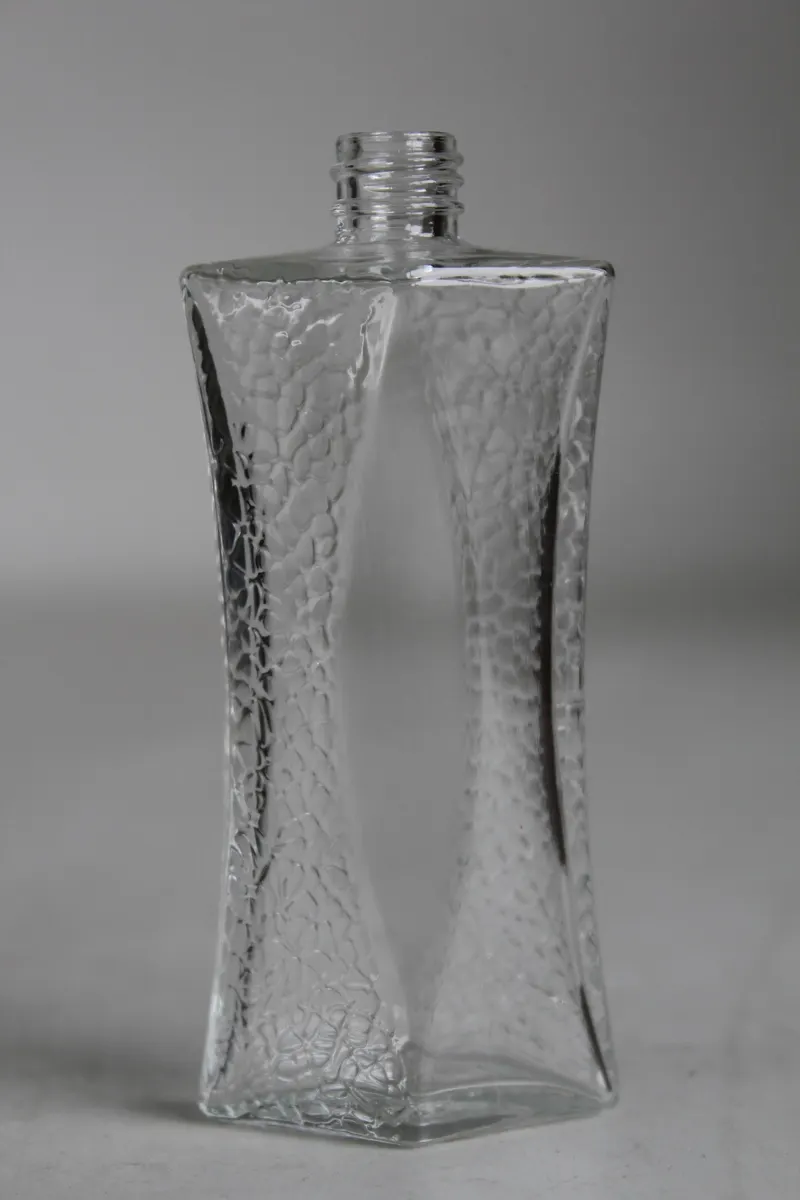
Square and round compared
We use this table with buyers who have not yet settled the profile. It describes behaviour, because the right choice depends on channel and positioning.
| Dimension | Square | Round | Which to pick | Confirm with the plant |
|---|---|---|---|---|
| Moulding | More difficult: thin corners, thick panel centres, annealing tuned to each geometry. | Easier: symmetric expansion and a wider annealing window. | Round on a tight budget with no brand meaning in the shape; square when the silhouette is the brand. | Corner radius the mould shop can hold, expected run-out, and whether the panel needs doming. |
| Shelf footprint | Fills its rectangular footprint, giving more facing per unit of shelf depth and no gaps in a display. | Leaves voids in a rectangular block and looks smaller than its capacity. | Square for dense shelf blocks, counter units and gift sets. | Shelf-ready carton or display dimensions, and any facing width set by the retailer. |
| Transit breakage | Corners take the impact; damage is a concentrated chip or crack. | Impact spreads round the curve; chips are rarer, though a full break can release more glass. | Square with inner dividers and corner cushions; round tolerates looser packing. | Cushioning, divider design, pallet stacking pattern, and whether a transit test to ISTA procedures is needed. |
| Label and print area | Takes full rectangular artwork without distortion and a longer text run. | Artwork distorts toward the edges; text runs are shorter or follow a curve. | Square for mandatory copy, several languages or a long ingredient list. | Flat panel width and height after decoration, and the smallest font the printer can hold. |
| Hand feel | Edges give a grip line and stop rolling; on big sizes a tight radius feels sharp. | Familiar and comfortable in the palm, but rolls on a slope. | Square for smaller sizes and unisex or masculine lines; round for large sizes and soft positioning. | Corner radius against hand size in the target market; need for a chamfer or soft edge. |
| Decoration coverage | Coating lies well on panels but thins or pools at sharp edges. | Coating is even all round but may show orange peel or shading on the curve. | Square for screen print and hot stamp; round competes well for spray coating and frosting. | Edge film thickness, edge masking, and whether decoration goes on before or after printing. |
| Pallet and container load | Rectangular cartons tile with no voids: more units per layer and per container. | Cartons still tile, but the bottle wastes volume inside them. | Square on high-volume ocean programmes where freight per unit counts. | Carton size, units per carton, pallet pattern, and load in 20GP and 40HQ terms. |
| Family logic | Lengthens with capacity, so 30 ml and 100 ml look related. | Widens with capacity, so the bigger size looks like another product. | Square for families and refill-plus-travel sets. | Whether a single mould family covers the planned sizes, and the tooling for each extra size. |
Positioning that suits a square bottle
A square or rectangular fragrance bottle says something specific: this brand is organised. When the story is spontaneity or softness, the shape contradicts the copy however good the artwork is.
Good fits
- Unisex, gender-neutral or masculine lines.
- Modern apothecary or clinical-clean looks, minimalist niche houses, architectural and design-led brands.
- Refillable programmes, since a plain square refill does not look cheap.
- Subscription and discovery sets that need a stable, stackable, low-waste format.
- Brands that must print legally required copy in several languages on one face.
Poor fits
- Classical femininity, floral romance or softness, where buyers expect a round or oval outline.
- Very large sizes held in the palm for a long time, unless the corner radius is opened up considerably.
- Short, wide, broad-shouldered formats, which read as a food jar.
- Concepts built on a continuous curve such as a sphere or teardrop, where a flat panel fights the form.
Capacity tiers and how each behaves in square form
Wholesale square programmes cluster around a few tiers, each tied to a use.
| Tier | Role | Square-specific notes |
|---|---|---|
| 10 to 15 ml | Travel, discovery, gift-with-purchase | Looks like a miniature of the main pack, not a sample. Run-out matters less on a small bottle, so tighter corners are affordable. |
| 30 ml | Entry full-size; the usual pocket format | The flat back panel carries copy a round 30 ml cannot. Comfortable in the hand even with a modest radius. |
| 50 ml | Volume driver in most ranges | The front panel is properly large, so the trade-off against round is clearest here. Weight distribution and base flatness start to matter for filling-line stability. |
| 75 to 100 ml | Statement size | Open up the corner radius, or the bottle feels sharp and run-out cost climbs. Many 100 ml designs use a chamfered corner to soften the edge and keep the flat face. |
Sets are where square has a structural edge. A refill, a travel spray and a full-size in one square language look like a single family and pack into one rectangular carton with no void fill. A rectangular landscape format also allows a two-bottle gift carton that looks planned.
The order of design decisions
After the profile is chosen, the remaining decisions follow a fixed sequence. Skipping one is what causes expensive rework.
- Shelf story. Decide whether the bottle or the label is the brand mark. A broad flat panel invites a fully printed or labelled face; a very narrow spine invites a minimal ink mark. This sets how much panel you need.
- Orientation. Square face-on, rectangular landscape, rectangular portrait, or a chamfered square that reads round from the corner. Orientation fixes the width-to-depth ratio and with it the carton size.
- Capacity and fill level. Nominal capacity and fill volume are different figures. Headspace, the gap above the liquid, depends on the pump or neck insert, thermal expansion and the target net content. A 50 ml square bottle is normally specified by nominal brimful capacity with a defined fill height, and that height must sit below the shoulder to give a clean meniscus line.
- Neck finish. The finish is the standardised top of the neck: usually a crimp finish for a pump or a screw finish for a cap. Pick it before the body, because it determines which closures fit without custom tooling.
- Shoulder and corner geometry. Shoulder height, corner radius, panel doming and base thickness are set together, since each one shifts glass within the same mould.
- Decoration route. Lacquer, matte or gloss coating, screen print, hot stamping, frosting and sandblasting each ask a different tolerance of the glass surface. A hot stamp on a domed panel needs a steeper radius than a screen print. Settle this before approving the mould drawing.
- Sampling. Check first samples for wall thickness distribution, brimful capacity, fill height, squareness, base flatness and top-load. Tooling amortisation is worth discussing only once these are signed off.
Usable print area on a flat panel
Few buyers put a figure on this, yet it often decides the profile. On a round bottle the artwork wraps, and the usable window is only the arc a printer can hold without distortion, which is a fraction of the circumference. On a rectangular bottle the entire flat rectangle is available.
Geometry helps too. For the same enclosed area, a square has a longer perimeter than a circle, and with flat panels that extra length becomes printable width. In practice it decides whether a legal block and a short story line fit on one face or have to be split across two faces or moved to a folded leaflet.
Print quality follows the same pattern. On a flat face the screen-printing squeegee presses evenly, the ink deposit is uniform, and solid colour blocks and fine type keep their edges. On a curve the pressure changes across the arc and the print looks thin or starved toward the shoulder. Hot-stamp foil breaks crisply on a flat face; a curve needs a shallower stamp and gives a softer edge.
Two limits apply. A panel domed for optical reasons presents the printer with a shallow curve that needs compensation. A very narrow panel turns the artwork into a tall column, and legibility drops even when total area is sufficient. So specify the largest rectangle that is both flat and printable, and agree it with the decorator from a moulded sample instead of reading it off the mould drawing.
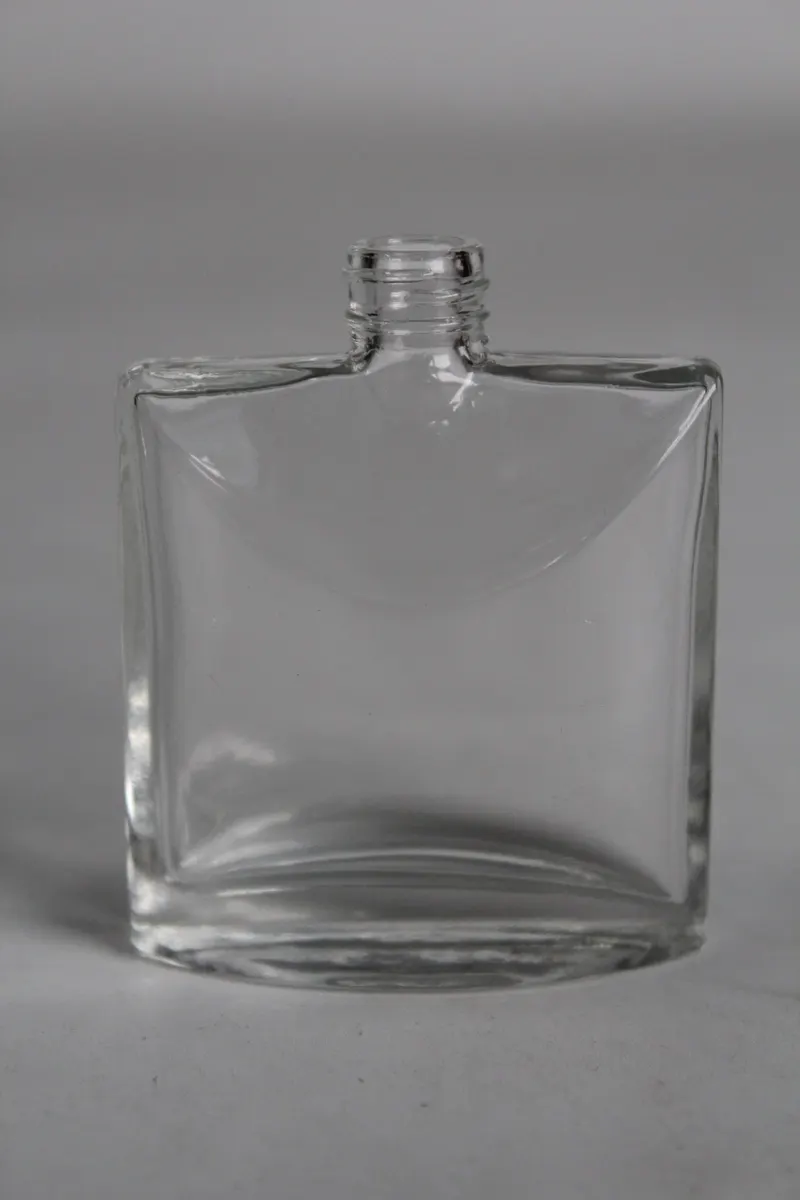
Filling, capping and decoration on a square body
Settle these production points before the mould is cut.
Cleaning
Internal corners are tighter than in a round bottle. Inverted air-jet cleaning and rinsing reach the panels easily but may leave a shadow zone in a tight corner. Specify the internal corner radius with the cleaning method in mind; the same goes for any internal coating or rinse.
Fill height
The shoulder transition on a square bottle is often shorter than on a round one, which narrows the tolerance band for fill height. Set and validate the filling line on the actual bottle, and check net content by weight, not by fill height alone.
Crimping and line handling
A crimp is the mechanical seal between the pump ferrule and the neck finish. Its quality depends on the finish dimension and the anvil setting, so body shape has no effect on the seal itself. Shape does affect handling: a square body indexes less smoothly through the star wheel of a rotary capper, and line speed and guide rails may need re-tuning when a range moves from round to square.
Orientation also becomes visible. Define the direction of the spray nozzle or dip tube relative to the flat panel, because the user notices it every time the bottle is used.
Coating at the edges
Film thickness is hardest to control at the corner, and a pale or streaky edge is the mark of a cheap finish. A fully coated square bottle is judged on its edges from every angle, which makes matte finishes less forgiving on square shapes than on round ones.
Shelf, stacking and packing for transit
Retailers buy facing width. A square unit turns its whole footprint into visible product, while a round unit of the same nominal capacity shows a narrower face and leaves crescent-shaped gaps in a row. The retailer fills those gaps with a competitor or hides them behind a shelf-edge strip. Per linear metre, a square block shows more product.
Empty square bottles also stack predictably, because a flat base on a flat shoulder is a stable contact. That helps when a distributor breaks down stock or a co-packer stores part pallets. In a loose layer round bottles shift and square ones lock. Square bottles still cannot travel loose in a container; they just tolerate a simpler divider pattern.
Damage patterns differ. The typical square failure is a chipped or cracked corner, the zone under most stress both in forming and on impact. The typical round failure is a body crack from point loading against a neighbour or a pallet edge. Square packs gain most from corner protection: a moulded pulp divider cradling each corner, or a corrugated cell holding each bottle clear of the next. Round packs gain most from a uniform layer pad and controlled pallet overhang.
Write two controls into the purchase specification:
- A drop and vibration procedure for the packed configuration, usually cited as an ISTA transit test series and applied to the shipping carton, not the bare bottle.
- A sampling plan for visual glass defects, normally ISO 2859-1 at an agreed AQL level.
Both are public standards. Ask the supplier to explain how each is applied on its own line; naming them is not enough.
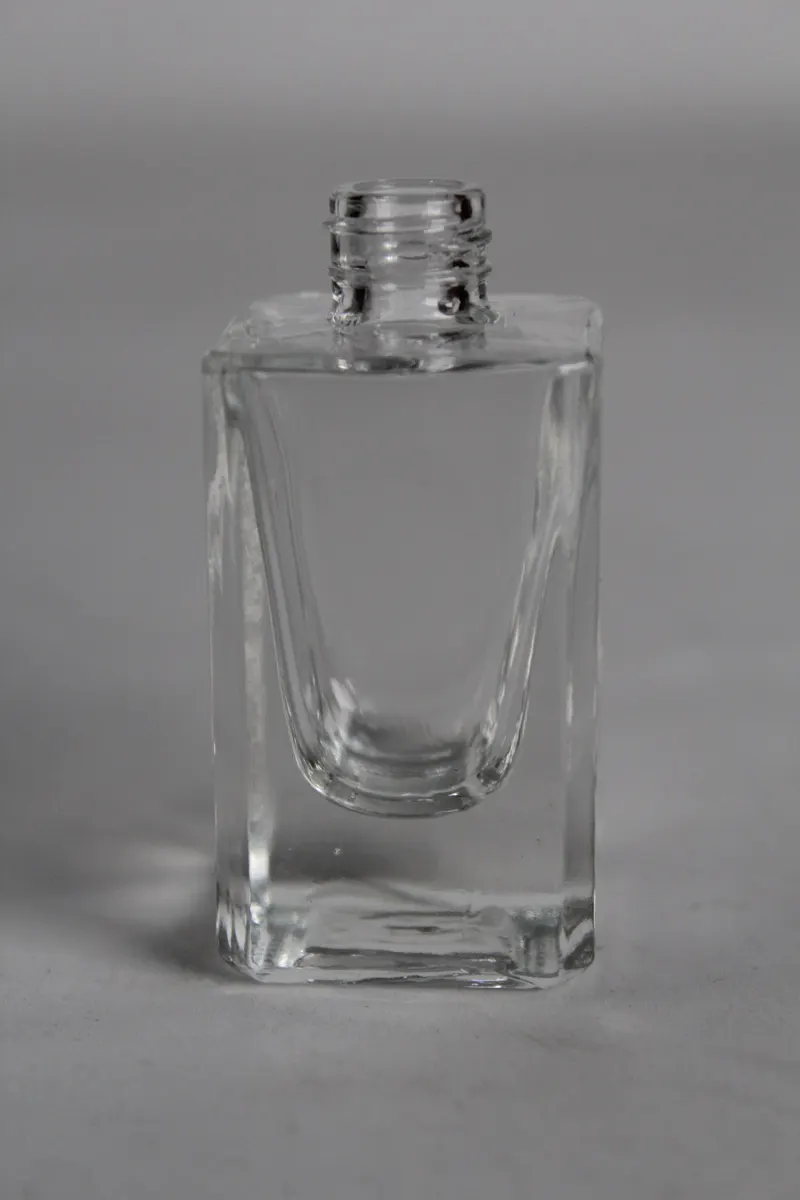
What to send for a square bottle specification
Three inputs sent together get a usable answer fastest:
- Shape preference: strictly square, rectangular landscape, rectangular portrait or chamfered square, and whether the silhouette or the label is the brand mark.
- Capacity and fill intent: nominal capacity, intended fill volume, and whether the format is full-size, travel or refill.
- Channel: retail shelf, e-commerce parcel, travel retail, or subscription and sampling, plus the destination market so the labelling load can be estimated.
From those we can return a proposed corner radius range, panel dimensions and printable rectangle, a capacity tier recommendation, a packing and carton concept, and the open questions to close before a mould drawing is issued. Existing artwork or a 3D concept sent at the same time usually shortens the loop.
Some questions sit on neighbouring pages. Surface finish, including lacquer, soft-touch matte, gloss, frosting and how a dark coating behaves on a flat panel, is covered under matte black perfume bottles. Pumps, crimps, collars, overcaps and closure-to-finish fit are under perfume bottle caps. Other shapes, multi-size orders, mixed profiles in one shipment and recurring programmes are on the main perfume bottle range page.
Frequently asked questions about square perfume bottles
Does a square perfume bottle cost more than a round one of equal capacity?
Generally yes. The difference comes from forming and yield, not glass weight: run-out narrows the annealing window, and that lowers first-pass yield. Pricing is quoted per project, and a fair comparison holds capacity, neck finish, decoration and packing constant, because a change in any of those shifts the figure more than the profile does.
Do square bottles break more in ocean freight?
Only when they are packed as if they were round. With corner-cradling dividers, a defined pallet pattern and a transit test on the packed carton, damage normally falls into the same range as a round programme. Loose packing with nothing but a layer pad is where square loses.
Can square and round bottles go in one order?
Yes, and mixed ranges are common. Treat the two profiles as separate filling and capping set-ups, and allow time for the changeover on a rotary capper. If both ship in one container, plan the carton sizes together so the pallet pattern leaves no void.
What corner radius should I specify?
No single number applies. A larger radius improves flow, widens the annealing window, raises yield and softens the feel, but the outline reads less strictly square. A very tight radius is an aesthetic choice with a yield penalty and should be priced as one. Ask the mould shop for the smallest radius it can hold at your capacity without material yield loss, and for the panel flatness that goes with it, since a tight corner usually forces a domed panel.
Can one mould make both a 30 ml and a 50 ml bottle?
No. Mould geometry sets capacity, so every size needs its own mould set. What the sizes can share is the drawing: corner radius, shoulder proportion and panel treatment. Fix those before the first mould is cut so the family stays consistent as sizes are added.
Will a 50 ml square bottle fit a standard retail carton?
It fits a rectangular carton sized from the bottle's real footprint plus decoration thickness and clearance for inserting and removing it. The outer carton, not the bottle, defines shelf facing and pallet pattern, so design the carton alongside the mould. Ask for the carton drawing and pallet load before approving the bottle drawing.