Part of our series on perfume bottles in bulk — read the overview first if the format is new to you.
A hanging car perfume bottle holds 5ml to 15ml, with 8ml and 10ml the sizes most programs run, and it is only as good as its closure: a porous wooden cap that diffuses the oil, sitting over an inner plug that keeps the oil in when the bottle ends up upside down. A supplier worth shortlisting can show how it controls the neck finish, the plug fit, the cap torque and the wood itself, and can back that with inversion and thermal-shock test records.
Sizes and shapes that suit a car cabin
The capacity range is set by where the bottle lives. Hung from a mirror mount, it has to stay light (a filled weight under ~40g), carry its mass low so it swings instead of tipping, and still hold enough oil to last. The 8ml and 10ml sizes meet all of those limits with the least glass, which is why they lead. Above 15ml is uncommon: the weight on the rear-view mirror becomes a safety concern, and the oil needs headroom to expand in the heat.
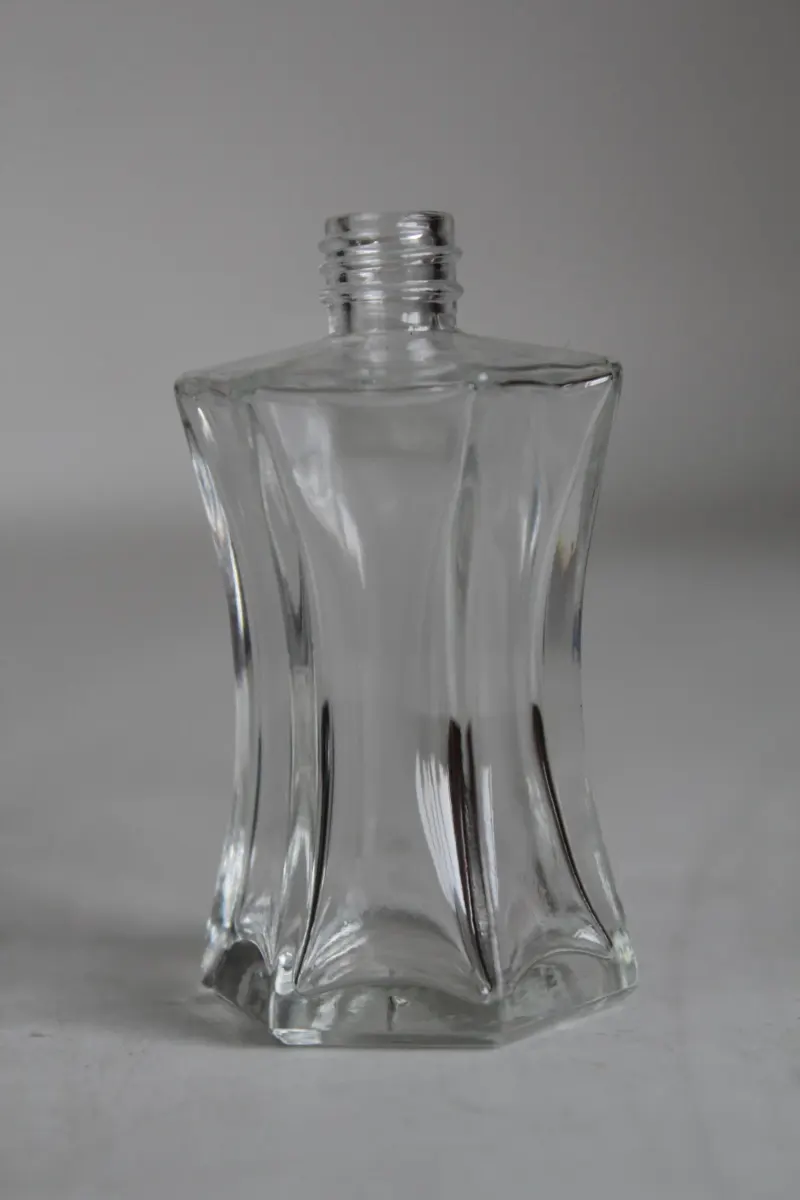
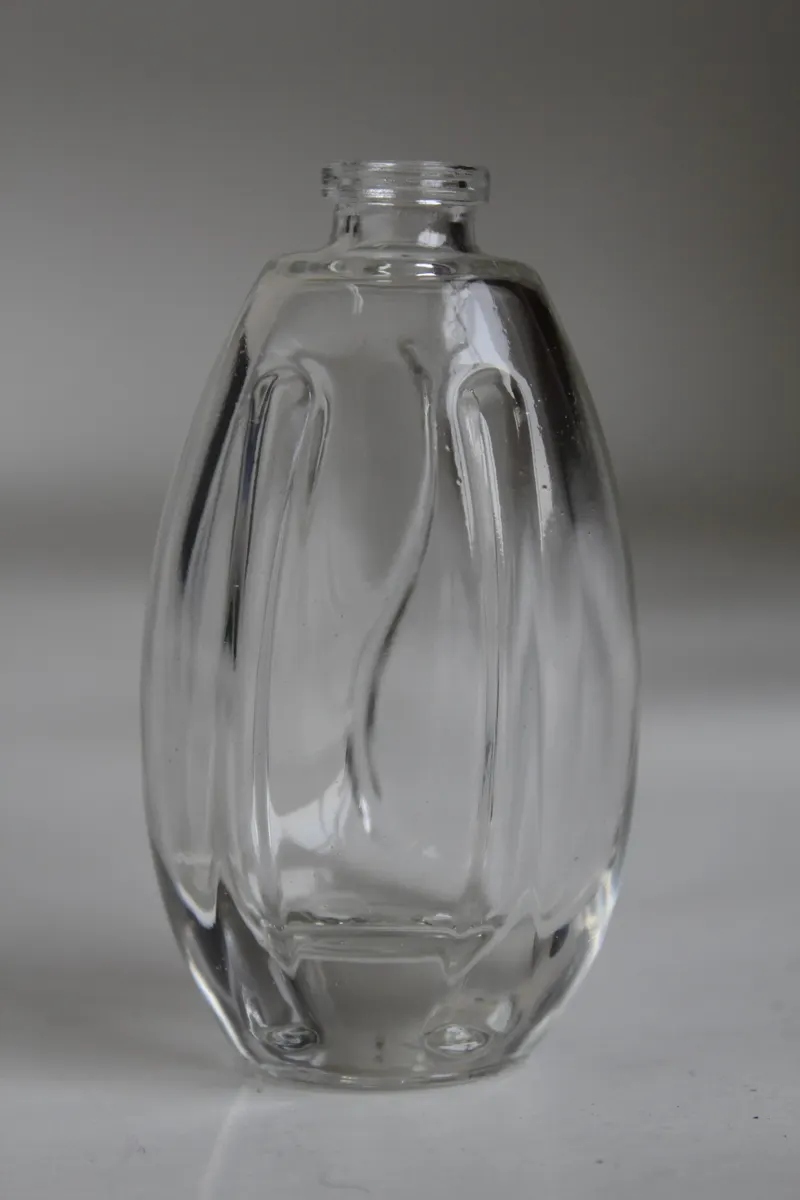
Four shape families cover most of the market. A round drum gives the best label panel. A square bottle is stable and reads as modern. Polygon or faceted bottles play with light and sit at the upper end of a range. Novelty shapes such as a fruit, drop or heart serve gift lines. Vent-clip products use a flat 5ml profile that clips onto the HVAC fins, while 12-15ml bottles serve hanging designs sold on a longer scent life.
Reference formats
| Format | Capacity | Neck inner diameter | Cap system |
|---|---|---|---|
| Round drum, hanging | 8 ml | 13 mm | Beech cap, plug seal, cord |
| Square, hanging | 10 ml | 15 mm | Beech cap, plug seal, cord |
| Faceted, hanging | 12 ml | 15 mm | Maple cap, silicone plug |
| Flat vent-clip | 5 ml | 11 mm | Wood cap with clip assembly |
If you need other diffuser formats alongside the car line, our reed diffuser bottle page covers the home-fragrance side.
Glass specification
Clear (flint) soda-lime glass is the default, because buyers of the finished product like to see the oil's colour and how much is left. Choose amber or a coated bottle when the blend is a natural fragrance that reacts to UV. A wall of 1.8-2.5mm is thick enough to be durable without loading the mirror hanger.
Heat matters more here than for a room diffuser. A cabin can cycle from -20°C to 70°C, so write anneal quality and thermal-shock performance (ASTM C149) into the specification instead of assuming them.
How the wooden cap diffuses fragrance
The cap is machined from beech, maple or rubberwood and threads onto the neck. Oil travels up the wood's lengthwise pores by capillary action and evaporates from the outside face. To start it, the user tips the bottle over for 3-5 seconds so the wood soaks, then hangs it upright; repeating that every 1-2 weeks brings the scent back up. How fast the oil leaves depends on the wood's porosity, the temperature and the volatility of the oil. Since the user controls intensity, the instruction card belongs in the pack specification.
Four cap variables need to be pinned down with the supplier:
- Species and porosity. Beech wicks at a moderate, controllable rate. A softwood that is too porous releases the fragrance far too quickly.
- Grain direction. The lengthwise grain must face the oil path. Caps cut across the grain wick poorly and tend to crack.
- Moisture content. Kiln-dried wood at 8–12% does not shrink after assembly.
- Bare wicking surfaces. Lacquer on the faces that carry the oil seals them, and a sealed cap does not diffuse.
What stops the bottle leaking
The bottle will be inverted in transit, in a glove box, and whenever a user over-soaks the cap. Sealing relies on three things together, and a quotation missing any one of them describes a leaker.
- An inner plug. A PE or silicone plug seats in the neck bore with an interference fit of 0.1–0.2mm before the cap goes on. This is the main barrier to the liquid, and without it a bottle leaks in summer however good the cap is.
- An accurate neck finish. The finish is machined or fire-polished to ±0.15mm. A rough finish makes the plug useless.
- A stated cap torque. Caps are applied at 6–10 in-lb and checked on every lot with a torque meter, with at least 1.5 turns of thread engaged.
The test to ask for is an 8-hour inversion at 50°C with no weepage at all, run on every lot, together with a 3-cycle thermal shock between 0°C and 60°C using a method adapted from ASTM C149. Parked cars routinely exceed 60°C inside, which is why the inversion test is not optional.
Checks to run on a supplier
These bottles are small-ware, formed on high-cavity IS machines, where finish quality separates a specialist plant from a generalist. When we assess a plant for this kind of project, we look for:
- Wooden-cap machining that is either done on site or bought from a single partner who issues moisture-content certificates.
- Inversion leak tests that are documented, with records kept by lot.
- The ability to assemble cord and bead. Many suppliers send assembly out and lose control of cap torque when they do.
- Drop-test results for the complete unit, filled and capped.
For the general questions that apply to any glass supplier, use our supplier evaluation checklist. The page on perfume bottle manufacturers covers other fragrance formats.
What to put in the brief
Send the target capacity, the cap style (wood species and any engraving), the quantity and the destination port through the quote form. Pricing is worked out per project and moves with the mould, the decoration, the quantity and the freight terms.
Frequently asked questions
What is the MOQ for custom car perfume bottles?
There is no single figure. The minimum is set per project, since it follows from the mould and from the line the bottle runs on.
Can a car perfume bottle be refilled?
Yes, and it is a selling point worth designing for. Ask for a neck with an inner diameter of 13mm+ so a standard dropper or small funnel fits, and a cap thread that holds up through 50+ open-close cycles. The refill oil is best sold separately in a 30-50ml dropper bottle. The diffuser bottle itself lasts indefinitely as long as the wooden cap is re-oiled and not left standing in liquid.