Filed under bulk wine bottles; the moulds we quote for this are pictured at the foot of the page.
Quick answer
What are the standard wine bottle sizes?
The standard wine bottle holds 750 ml. Below it sit the 187 ml split (piccolo), the 375 ml half bottle and 500 ml; above it, 1 L, the 1.5 L magnum and the 3 L double magnum. Shape varies at the same size: a Bordeaux bottle has straight sides and a high shoulder, a Burgundy bottle a wider body with sloping shoulders.
| Size | Name | Typical use |
|---|---|---|
| 187 ml | Split / piccolo | Airlines, trains, minibars, sparkling wine |
| 375 ml | Half / demi | Dessert wine, by-the-glass, trial |
| 500 ml | In-between size | Sweet wine |
| 750 ml | Standard | The global default |
| 1.5 L | Magnum | Celebrations and collectors |
| 3 L | Double magnum | Limited runs, mostly Champagne and prestige still wine |
Wine glass comes in seven standard capacities: 187 ml, 375 ml, 500 ml, 750 ml, 1 L, 1.5 L and 3 L, with 750 ml making up the large majority of world production. Capacity is only half the specification, though. A Burgundy and a Champagne bottle can both be nominally 750 ml and still differ in body diameter, glass weight, punt and neck finish, and those differences decide how many bottles fit on a pallet and in a container.
Standard capacities and where each is used
| Capacity | Trade name | Typical use | What to note when sourcing |
|---|---|---|---|
| 187 ml | Split, piccolo | Airlines, trains, hotel minibars, a growing share of sparkling wine | Made on lightweight IS machines; usually a screw-cap or crown finish |
| 375 ml | Half, demi | Dessert wine, restaurant by-the-glass lists, trial SKUs | Moulds exist with both Bordeaux and Burgundy shoulders |
| 500 ml | — | Sweet wine, Tokaji-style ranges, a smaller "weekday" bottle | An intermediate size the EU permits |
| 750 ml | Standard | Everything | The widest choice of shapes, weights and finishes |
| 1 L | — | Value table wine in Central Europe, some New World bulk brands | Allowed in several markets, not all |
| 1.5 L | Magnum | Celebration and collector bottlings | 900–1,200 g of glass, which needs careful annealing |
| 3 L | Double magnum (Bordeaux); jeroboam (Champagne, Burgundy) | Champagne and prestige still wine | Limited runs, special handling, longer lehr cycles |
The naming of the largest size trips buyers up: in Bordeaux a jeroboam means 5 L, so write the capacity in litres on the enquiry and leave the name out. Magnums are favoured for ageing because the wine exchanges oxygen more slowly per litre than it does in a standard bottle.
The half-bottle range is laid out on our 375 ml wine bottle page, and the standard size, with its shape and colour variants, sits in the wine glass bottle collection.
The four classic shapes
Shape tells the shopper which grape tradition a wine belongs to, and it tells the logistics team how wide the case will be. Four families cover nearly every project.
| Shape | Profile | Wines it signals | Sourcing consequence |
|---|---|---|---|
| Bordeaux | Cylindrical body, high abrupt shoulder, deep punt; 73–76 mm body | Cabernet, Merlot, Sauvignon Blanc | Packs densely and stacks predictably |
| Burgundy | Wider body, typically 88–92 mm, with gently sloping shoulders | Pinot Noir, Chardonnay | 10–15% fewer bottles per pallet and container |
| Alsace / Rhine flûte | Tall and slender, long neck, almost no shoulder | Riesling, Gewürztraminer | The most fragile standard shape on fast lines |
| Champagne / sparkling | Thick wall, deep punt, finish made for cork and cage | Sparkling wine | 900 g+ at 750 ml; a pressure vessel |
The Bordeaux shoulder began as a practical feature, holding back sediment while the wine was decanted. Its efficient packing is one reason the shape became the world default. The Bordeaux bottle range runs from a 400 g lightweight to a 650 g heavy version.
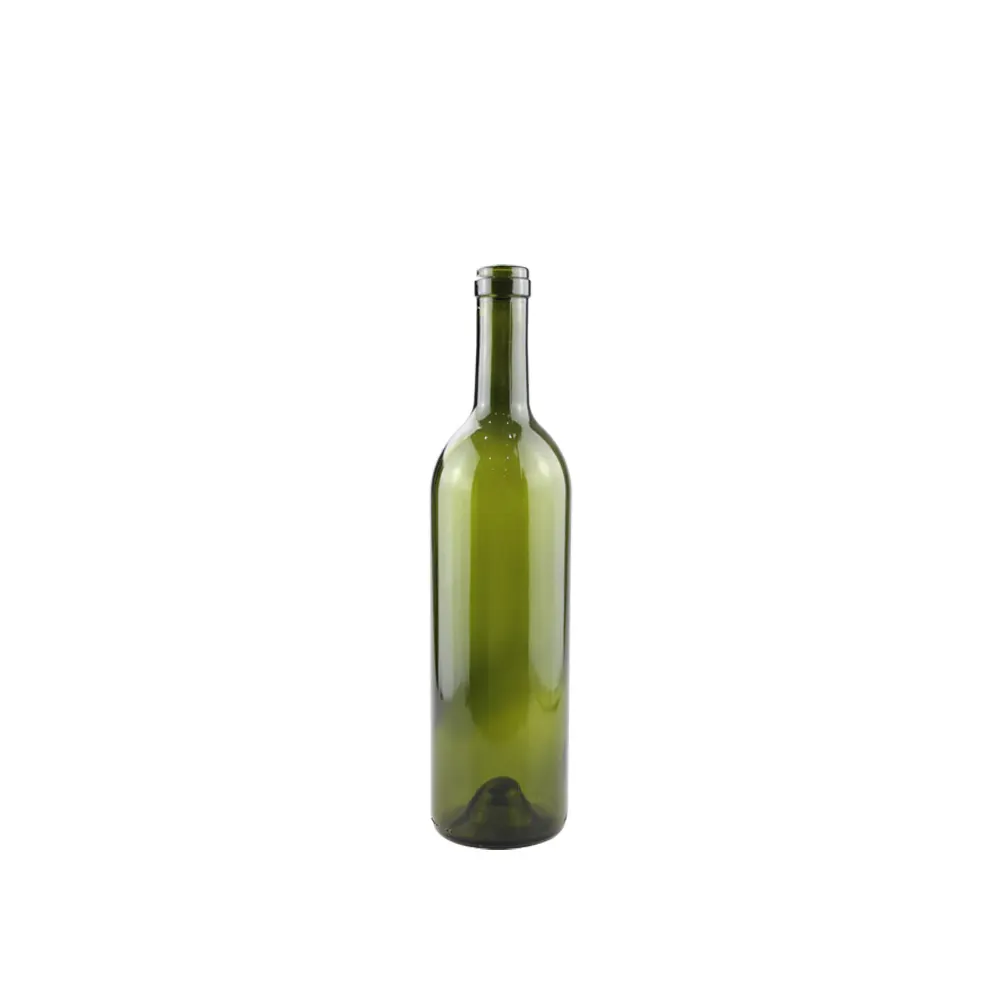
With Burgundy bottles, the freight penalty of the wider body is often noticed only after the design is approved, so run the pallet count before committing. For a flûte, state the column strength you need and check every conveyor transfer on the filling line, because the thin body is where breakage starts.
A sparkling bottle has to contain 6 bar of internal pressure plus a safety factor. Its walls, base and punt are all structural, and it is made and tested as a pressure container, which is why it weighs 900 g or more against 400–550 g for still wine. The larger sparkling formats are covered under Champagne bottle sizes.
Punt depth, colour and glass weight
Punt
The punt is the push-up in the base. It strengthens the base, collects sediment and steadies the bottle on the line. Shoppers also read a deep punt as a sign of quality, although it says nothing about the wine. Ordinary still-wine punts measure 20–40 mm and "premium deep" versions 45–65 mm. A 60 mm punt on a 750 ml bottle costs 40–60 g of extra glass and about an inch of case height, so put the depth in the RFQ as a number. On Champagne bottles the punt is structural and not open to negotiation.
Colour
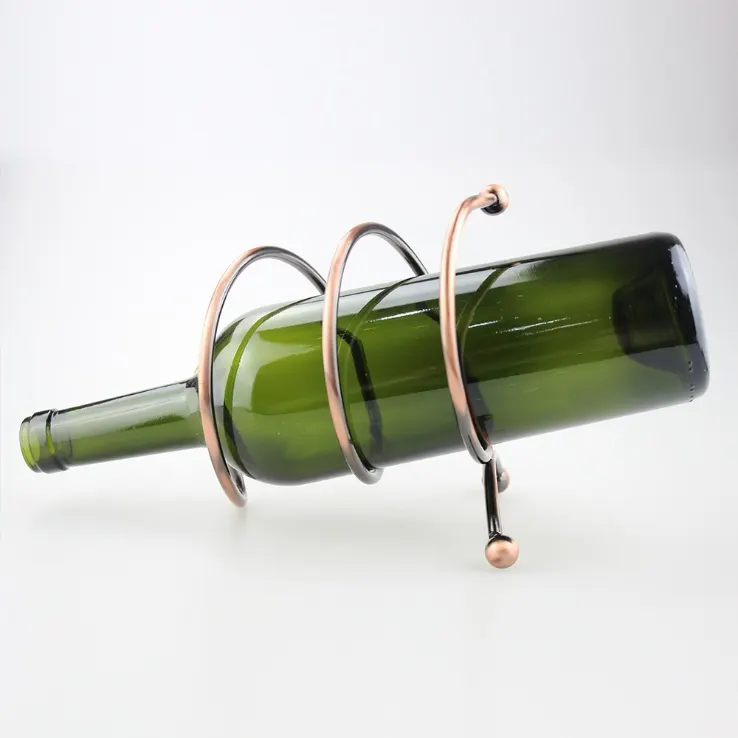
Antique green is the usual choice for reds. Flint, meaning clear glass, suits whites and rosés that sell on their colour, with dead-leaf and champagne green in between. Darker glass blocks more UV, which is worth weighing for unfiltered whites that travel a long way.
Weight
Ten years ago a standard 750 ml Bordeaux weighed 500–550 g. Current lightweight versions come in at 380–420 g, and some reach 350 g, without losing line performance as long as annealing and wall distribution are well controlled. Packaging levies in several European markets now penalise heavy glass in effect. The cost of going light is a finish that chips more readily under rough handling, so trial the lighter bottle on your own filling line and case packer before moving a whole range across.
Closures and neck finish by size
The finish is moulded into the glass and cannot be altered afterwards, whereas the closure itself can change up to bottling day. Choose cork finish or BVS finish for each size first.
- 187 ml: screwcaps and crown finishes have mostly replaced cork, since a cork this small is awkward to pull and worse to put back.
- 375 ml and above: natural cork, technical (agglomerated) cork and aluminium screwcap are all in use. The screwcap is the Stelvin class on a 30×60 mm BVS finish, and New World brands adopt it more each year.
- Magnum and 3 L: corks of the 49 mm class need a correspondingly larger finish, corking takes longer per bottle, and a failed cork costs far more.
Cases, pallets and container loads
For a standard 750 ml Bordeaux the usual arithmetic is 12 bottles per case and 56 cases on a EUR pallet, which gives 672 bottles. A 40HQ container loaded with palletised cases carries roughly 21,000–22,000.
- Burgundy shape: 10–15% fewer because of the wider body.
- Magnums: 6 per case and around 4,500–5,000 per container.
- Sparkling: at 900 g+ the load reaches the 26-tonne payload limit while pallet positions are still empty, so weight caps the shipment before volume does.
Two checks save trouble later. Compare the outer dimensions of the packed case with your warehouse racking before any tooling is cut, and request palletisation drawings together with the quotation, not once a deposit has been paid. Standard layouts are shown in our glass bottle packing specification.
Stock shapes with custom embossing
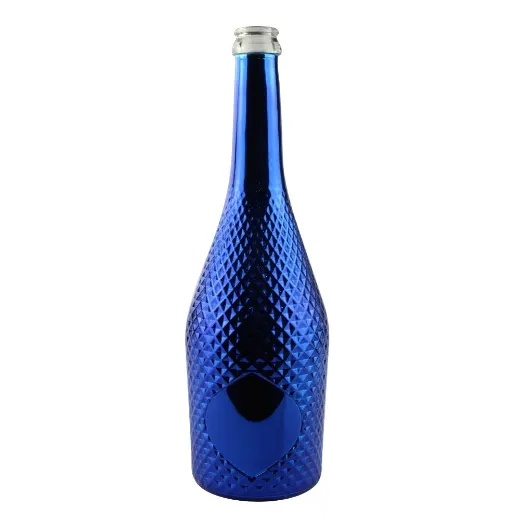
Brands that want a recognisable bottle without paying for a full private mould often take a stock shape and add an embossed crest at the heel. The same shape family is available in 375/750/1.5 L, so a range of sizes still looks like one brand.
Whichever route you take, ask for capacity to be verified cavity by cavity on the first production lot. A nominal 750 ml bottle has to fill within the legal tolerance of the destination market, and a brimful spread of more than 8 ml between cavities points to mould wear.
FAQ
Which wine bottle sizes count as standard?
The split at 187 ml, the half at 375 ml, then 500 ml, 750 ml, 1 L, the 1.5 L magnum and the 3 L double magnum.
How does a Bordeaux bottle differ from a Burgundy bottle?
Bordeaux is straight-sided with a sharp, high shoulder. Burgundy is broader, and its shoulders slope away gradually. For an exporter the practical difference is pallet efficiency, which is lower for Burgundy.
Is wine in a deep-punt bottle better?
No. Beyond base strength and sediment handling, punt depth is a decision about image and glass weight.
Are bottles under 400 g available?
Yes, in the lightweight 750 ml class described above. Expect more chipped finishes and handling damage if the line or the case packing is harsh, and test before you switch.