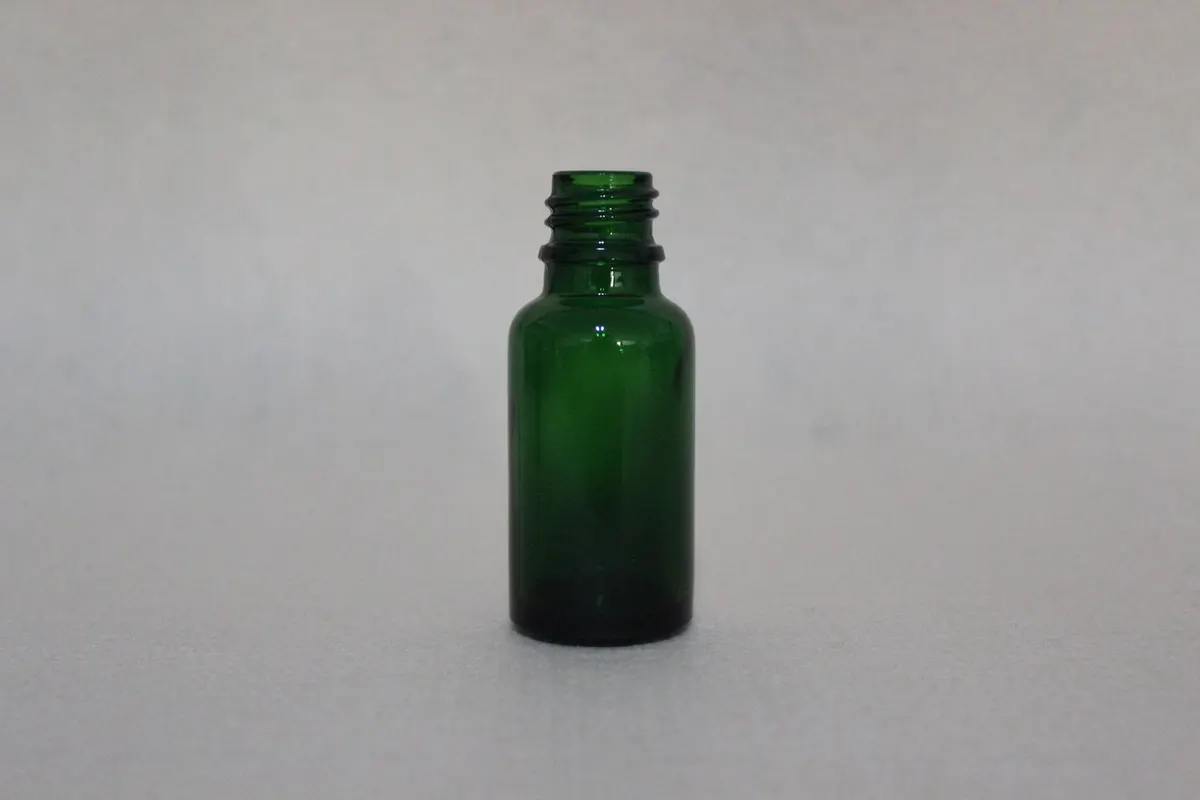
Part of our amber dropper bottles range; the stock moulds are pictured at the end of this guide.
Quick answer
What sizes do dropper bottles come in?
Six sizes cover almost all glass dropper bottles: 5, 10, 15, 30, 50 and 100 ml. The 18 mm screw neck is the most common finish from 10 to 50 ml, with 20 mm and 22 mm necks on wider bodies. Plan on about 20 drops per millilitre for a water-based liquid; oils give fewer drops and thin alcohol blends more. A 30 ml bottle holds slightly more than 1 US fluid ounce, which is about 29.5 ml.
| Size | Pipette length | Typical dose |
|---|---|---|
| 5 ml | About 45–50 mm | 2–4 drops, spot use |
| 10 ml | About 60–65 mm | 3–5 drops |
| 15 ml | About 70 mm | 3–6 drops, one facial application |
| 30 ml | About 85–90 mm | 4–8 drops |
| 50 ml | About 95–100 mm | 8–20 drops, body and massage |
| 100 ml | About 115–120 mm | 20–40 drops, professional or refill |
This page is for the buyer who has already decided that the pack is a dropper bottle and who now has to choose how large it should be, how long the pipette should be and how many drops a single dose will be. It resolves one chain and only one: capacity to finish, finish to pipette length, pipette and orifice to drop volume, drop volume to drops per millilitre, and drops per millilitre to the number of doses a batch of liquid will actually deliver. The mechanics of the glass-to-glass interface, including how a finish is cut, how the thread engages and how a gasket seals, belong to the site page that covers dropper bottles as an interface. Choosing and auditing a supplier belongs to the sourcing page for dropper bottle manufacturers. Where the question is capacity against closure options in the general round range rather than the pipette, the site reference on Boston round bottle sizes is the correct starting point, and where the driver is the brand scenario for a fragrance or aromatherapy oil rather than the dose, that belongs to the page on essential oil bottle sizes. This page quotes no minimum quantity, price or lead time, because those follow from a finished specification at enquiry.
Why a Dropper Bottle Size Chart Cannot Be Read as a Capacity List
Search results for dropper bottle sizes are dominated by tables that list millilitres and stop there, and those tables are the reason so many first production runs are the wrong size. A capacity figure tells the buyer how much liquid the body holds when it is completely filled. It does not tell the buyer how much the closure can reach, how much the user will actually receive in one application, or how many applications the container will deliver before it is empty. Those three numbers are what the purchaser of a serum, a tincture or a body oil is really paying for, and none of them is written on the bottle.
The confusion is reinforced by the language buyers use. Phrases such as one ounce and two ounce dropper bottles, or a thirty millilitre dropper bottle, are treated as equivalent descriptions of the same object. They are not. Thirty millilitres is a metric volume, one US fluid ounce is about twenty-nine and a half millilitres, and a bottle sold as one ounce may hold anywhere between twenty-eight and thirty-one millilitres depending on how the nominal capacity was rounded and whether the figure refers to brimful capacity or to the fill line. Two suppliers quoting the same ounce figure can be shipping containers that differ by more than a millilitre, which on a five-millilitre sample is a twenty percent difference in the customer’s experience of the product.
There is a further reason to distrust a capacity-only chart. Capacity and dose are only loosely connected. A twenty millilitre bottle and a thirty millilitre bottle with the same finish, the same orifice and the same pipette tip will deliver the same drop. The user receives the same amount per application from both; only the number of applications differs. Buyers who size a pack by asking how much liquid they want in it usually arrive at a defensible number. Buyers who size it by asking how much they want the user to receive per use often need a different bottle from the one they expected, and sometimes they need a different closure rather than a different bottle at all.
So the practical sequence is not capacity first. It is dose first, then doses, then capacity, then the finish that the chosen capacity is available in, then the pipette that the finish accepts, and finally the check that the pipette actually reaches the bottom of the body it is paired with. Everything below follows that order, because reversing it is the single most reliable way to buy a second sampling round.
The Conversion Chain From Capacity to Delivered Dose
The chain has five links, and each one constrains the next. Understanding where the chain is stiff and where it is flexible tells the buyer which decisions are worth a meeting and which are not.
Link one: nominal capacity to working volume. Nominal capacity is the volume of the body, and it is measured either brimful or to a fill line. Working volume is what can actually be filled, filled consistently and then drawn out again by the closure. Three deductions separate the two: the headspace required above the fill line, which exists so that the closure does not displace liquid when it is applied and so that thermal expansion during transport does not build pressure; the liquid that the closure cannot reach because of the geometry of the shoulder and the base; and the small volume that remains in the pipette and on the tip after a dose. For a smooth round bottle with a dropper, a planning assumption of roughly ninety-two to ninety-six percent conversion from nominal capacity to usable product is reasonable, with the exact figure confirmed against the actual assembly rather than assumed.
Link two: working volume to finish. This is the stiff joint in the chain. A capacity band is normally offered in one or two finishes and rarely in more. The finish is the threaded neck specification, given as an industry code such as a two-digit or three-digit number that describes the neck diameter and, in some systems, the thread geometry. The codes that dominate small glass dropper formats are the eighteen millimetre screw neck used widely across the ten to fifty millilitre range, and the wider twenty and twenty-two millimetre necks that appear as capacity grows and on formats intended for heavier fillings. A buyer who wants a particular capacity in a particular finish is not choosing freely; they are choosing from the intersection of two catalogues. That intersection is fixed by the mould, and it cannot be changed without a new mould.
Link three: finish to pipette length. Once the finish is fixed, the family of closures that fits it is fixed as well, and within that family the pipette comes in a small number of standard lengths. The correct pipette length is the one that lets the tip sit close to, but not against, the inside of the base, so that the last portion of the fill can still be drawn. Two failure modes bracket the correct length. A pipette that is too short leaves liquid in the bottom of the bottle that the user cannot reach, and the customer experience is a product that seems to run out early. A pipette that is too long touches the base, and the tip seals against the glass at the point of contact, which makes the final draws slow and inconsistent and in some assemblies damps the drop rate for the whole bottle because the tip is resting rather than hanging free.
Link four: pipette and orifice to drop volume. The drop is formed by the transfer of liquid out of the pipette tip, and its volume is set by the tip opening and by the properties of the liquid rather than by the bottle. A squeeze bulb of the same geometry will produce a larger drop from a higher-viscosity liquid and a smaller drop from a liquid with lower surface tension, which is why a drop count taken on water cannot be transferred to an oil, to an alcohol, or to a glycol-based blend. This is the most commonly assumed and least commonly verified link in the chain.
Link five: drop volume to doses. The last link is the commercial one. Drops per millilitre, divided into the working volume, gives the total number of drops the container can deliver. Divided by the drops per dose, that gives the number of doses. That number is what the customer is buying, and it is also the number that a marketing claim about a thirty-day supply has to survive.
Capacity, Finish, Pipette Length and Drops per Millilitre
The table below sets out the conversion chain for the six capacity bands that cover almost all glass dropper programmes. Finish figures and pipette lengths are typical ranges for the bands rather than fixed values, because a specific bottle and a specific closure are confirmed against a drawing before production. The drop counts use the conventional baseline of twenty drops to one millilitre for an aqueous liquid with a standard orifice; oils tend to run below that baseline and alcohol or glycol blends above it, and the direction of the shift is more reliable than any single number.
| Capacity band | Common neck finish | Matching pipette length | Drops per ml (20 drops to 1 ml baseline) | Typical single dose | Common selection error at this band |
|---|---|---|---|---|---|
| 5 ml | 18 mm screw neck, and narrower 13 mm necks on miniature formats | Short pipette, roughly 45 to 50 mm, trimmed to the body | About 20 for aqueous, 16 to 19 for oils, 21 to 25 for alcohol blends | Two to four drops, single spot application | Sizing it for a full face routine when it holds only a few applications; the band is for testing and for spot use, not for a supply cycle |
| 10 ml | 18 mm screw neck, 13 mm on slim formats | Roughly 60 to 65 mm | About 20 for aqueous, 16 to 19 for oils | Three to five drops | Assuming a ten millilitre bottle and a fifteen millilitre bottle take the same pipette, which they do not |
| 15 ml | 18 mm screw neck | Roughly 70 mm | About 20 for aqueous, 16 to 19 for oils | Three to six drops, a single facial application | Buying it as the default when the arithmetic points to thirty millilitres, producing a supply that runs out before the customer has formed the habit |
| 30 ml | 18 mm screw neck, with 20 mm and 22 mm necks on wider bodies | Roughly 85 to 90 mm | About 20 for aqueous, 16 to 19 for oils, 22 to 26 for thin alcohol tinctures | Four to eight drops | Treating it as interchangeable with a one ounce pack without deciding which ounce is meant, and without checking whether the pipette reaches the base |
| 50 ml | 20 mm and 22 mm necks, 18 mm on some tall slim bodies | Roughly 95 to 100 mm | About 20 for aqueous, 15 to 18 for oils | Eight to twenty drops, body and massage use | Keeping a narrow-neck orifice so the user has to squeeze repeatedly for a body-sized dose, which reads as a faulty bottle |
| 100 ml | 22 mm and wider necks, 20 mm on slim formats | Roughly 115 to 120 mm | About 20 for aqueous, 15 to 18 for oils | Twenty to forty drops, professional or refill use | Sizing by the travel liquid limit and then finding that a hundred millilitres of a facial oil is more product than the customer will use before it oxidises |
Matching Each Capacity Band to a Dosing Scenario
The band follows from the dose multiplied by the number of applications the pack is meant to supply, plus the headspace and residue allowance described earlier. That arithmetic produces four recognisable zones, and knowing which zone a product sits in removes most of the guesswork.
Spot and precision work. Five and ten millilitre formats suit products that are applied in one or two drops to a small area: a cuticle oil, a spot treatment, a lip treatment, a concentrated active, a fragrance sample. The case for the small band is not economy, because the per-millilitre cost is at its worst here. It is that the user needs precise control in a small area, and a large body with a long pipette makes that control harder to achieve. Ten millilitres is the larger end of this zone and is generally the smallest format that still carries a legible regulatory panel directly on the bottle; below that, artwork usually has to move to an outer card.
Facial and daily-use skincare. Fifteen and thirty millilitres cover the majority of serum, face oil and beard oil programmes. Thirty millilitres is the commercial default because it is close to one US fluid ounce, which makes it legible to a North American audience, and because a typical four to six drop facial dose delivers somewhere around thirty to forty applications from a properly filled bottle. Fifteen millilitres is the travel and trial format in the same family, and the two are usually offered together so that the customer can sample small and repurchase large. Both bands commonly share an eighteen millimetre neck, which is what allows the same dropper family to be used across the pair.
Body, hair and massage. Fifty millilitres and above are driven by dose size rather than by supply length. A body oil dose is measured in pipette fills rather than in drops, and a narrow orifice that is comfortable for a serum makes the same act laborious when it has to be repeated twenty times. The band that fits is the one whose orifice delivers a full pipette in a reasonable number of squeezes, which usually pushes the specification towards a wider neck and a larger tip opening. This is a case where the closure, not the bottle, is the specification that decides whether the pack feels right.
Tincture, herbal and professional use. Tinctures are dosed in droppers rather than in drops, most commonly one full pipette, and a full pipette is roughly one millilitre in most standard glass dropper assemblies. That single fact sets the whole specification: the dose is a volume, the volume is a pipette, and the number of pipettes the customer wants per bottle sets the capacity. A blend taken as one pipette three times a day is consuming three millilitres daily, so a hundred millilitre bottle is just over a month, and a thirty millilitre bottle is ten days. The arithmetic is simple, and it is the only reliable way to choose between the two bands.
The same logic governs the travel case. A hundred millilitres is the common threshold for liquids carried in hand baggage in many markets, which makes the hundred millilitre dropper bottle a functional travel format as well as a bulk one, and it is often the reason a programme carries it at all.
How Capacity Choice Changes Dose Error and Consumer Feel
Two quantities describe the accuracy of a dose, and conflating them is what makes a specification look acceptable on paper and disappointing in the hand.
Absolute error is the error in millilitres: the difference between the volume a dose should be and the volume it is. Relative error expresses the same difference as a proportion of the dose. A variation of a tenth of a millilitre is a small absolute error in both cases, but it is about two percent of a five millilitre pipette fill and about twenty percent of a half-millilitre drop-based dose. The practical consequence is that a pack dispensing a large volume is forgiving of imprecision and a pack dispensing a small volume is not. Two drops is a legible instruction on a serum; it is a difficult instruction on a product where a drop is the entire dose, and it becomes harder still as the user’s hands get less steady or the bottle gets oily.
Orifice and body size interact in a second way. A small orifice fitted to a large body forces repeated squeezing for every application. The user fatigues, the number of drops per measured squirt varies more as grip strength changes, and the perception of the product shifts from generous to mean. The opposite pairing, a large orifice on a small body, produces run-on drops that leave residue on the neck. That residue then migrates into the thread, the cap begins to gum, and the complaint that reaches the brand is about a leaking bottle rather than about an oversize tip.
Consumer feel is a third variable and it is not cosmetic. A dropper bottle is held in the hand, sometimes for the length of a massage. Body diameter against palm size, weight when full, and the surface finish of the glass all affect how the pack is perceived. A hundred millilitre round bottle is a functional object that sits in the palm; a fifteen millilitre bottle is held between finger and thumb. Both are correct for their own use and wrong for each other’s, and a programme that sells both needs the smaller one to read as a deliberate miniature of the larger rather than as a different product.
Finally, there is the settling question. Some liquids separate, and the pipette is the user’s mixing tool. A long pipette in a tall narrow body can be used to draw the settled layer up and re-suspend it, whereas a short pipette in a wide body may not reach the sediment at all. Where the product separates, pipette reach stops being an efficiency question and becomes a performance one, and the check that matters is whether the tip can reach the base of the filled body rather than whether it is nominally the right length for the capacity.
Common Misuses of a Dropper Size Chart
Six failures account for most of the sizing errors seen in first orders, and each of them is avoidable on paper.
Treating an ounce as thirty millilitres without saying which ounce. A US fluid ounce is about twenty-nine and a half millilitres, an imperial fluid ounce is about twenty-eight and a half, and an ounce by weight is a different quantity again. Where the market is the United States, the product label may be required to express net contents in a particular unit, and the metric conversion applied to that figure is what should drive the bottle order. Deciding the unit after the bottle is chosen is the wrong order.
Assuming drops per millilitre is a constant. The baseline of twenty drops to one millilitre is a working convention for aqueous liquids with a standard orifice, and it is useful for planning. It is not a property of the bottle. Viscosity, surface tension, temperature and tip geometry all move the number, and they move it by enough to change a supply-length claim. Where a label states how many days of use the pack provides, the drop count should be measured on the actual formula rather than taken from a table.
Assuming a longer pipette delivers a bigger dose. Pipette length exists to reach the base of the body. The dose is set by the tip opening and by how the user squeezes, so a longer pipette in the same assembly delivers the same drop. The trade is one of reach, not of dose, and confusing the two leads to a specification that is longer than the body requires and consequently flexes against the glass.
Assuming a dropper that fits one bottle fits the next. Compatibility follows the finish, not the capacity, and two bottles of the same capacity from different moulds can carry different finishes. A closure that fits the fifteen millilitre format in one family may not seat on the fifteen millilitre format in another. This is the reason a substitution made to shorten a lead time so often produces a leaking bottle that passed every factory check.
Sizing by label area rather than by dose. Artwork requirements, particularly for products that must carry a full ingredient panel, push buyers towards larger bodies. That is a legitimate constraint, but it should be resolved by moving copy to an outer pack or a folded label rather than by increasing the fill volume, because a larger bottle changes the dose, the supply length and the shipping weight all at once.
Choosing the capacity to fit a shipping case or a gift box, then discovering the dose is wrong. Container packing is a real constraint and it belongs in the specification, but it belongs after the dose arithmetic rather than before it. The outer pack can be redrawn far more cheaply than a mould can be recut.
When Sizing Ends and Procurement Begins
Sizing is finished when four numbers are fixed: the capacity band, the neck finish, the pipette length and the drops per dose for the actual formula. At that point the conversation changes, because the remaining questions are about availability and documentation rather than about arithmetic.
The first is whether the chosen combination exists as a stock item. A capacity and a finish that are individually common may not be common in combination, and the answer determines whether the programme can use an existing mould or needs one. That answer is confirmed against the finished specification rather than inferred from a catalogue.
The second is which documents the destination market will require. The names to know are FDA 21 CFR in the United States, EU 10/2011 and EU 1935/2004 in Europe, LFGB where the German market applies it, and IFRA for fragrance and flavour compositions. Those are named here as the frameworks a buyer’s own authority will refer to, not as any statement about certification status, and the components that usually generate the paperwork are the ones in contact with the fill.
The third is decoration, which interacts with sizing more than buyers expect. A small body may not carry a pressure-sensitive label with the required panel area, and a screen print laid out for a thirty millilitre body does not scale to a fifteen millilitre body without a redraw. Both the label size and the print area should be checked against the final capacity before artwork is approved.
There is also an inspection question. Where certificates of analysis, dimensional checks or an agreed inspection plan are required, the plan is usually discussed as an AQL arrangement between buyer and supplier before production, and a sized specification is what makes that plan meaningful, because it defines what is being measured. No minimum quantity, unit price or lead time is stated on this page, and none should be assumed from it. All three are confirmed once the specification is closed.
Adjacent Pages and Their Boundaries
Three neighbouring subjects are deliberately excluded here, and knowing where this page stops saves a buyer from reading the same material twice. The interface between the glass and the closure, including how a finish is cut, how a thread engages, how a gasket seats and how drop rate behaves across different sealing systems, is covered on the page for dropper bottles. Choosing a production partner, checking tooling ownership and reviewing the evidence a factory can supply is covered under dropper bottle manufacturers. When the driver is the general round bottle range rather than the pipette, so that capacity is being read against the whole family of closures available, the reference on boston round bottle sizes is the right page. And where the question is being asked from the brand side, in terms of the scent family, the retail channel and the impression the pack has to make rather than the dose it delivers, that belongs to essential oil bottle sizes.
Frequently Asked Questions About Dropper Bottle Sizes
Is a 30 ml dropper bottle the same as a 1 oz dropper bottle?
Close, but not the same, and the difference matters on the label. A US fluid ounce is about twenty-nine and a half millilitres, so thirty millilitres is slightly more than one ounce, while an imperial fluid ounce is about twenty-eight and a half millilitres. Whether a bottle sold as one ounce holds twenty-eight, thirty or thirty-one millilitres also depends on whether the capacity is brimful or to the fill line. Fix the unit and the fill convention before ordering, rather than converting afterwards.
How many drops are in 1 ml from a glass dropper bottle?
The working convention is twenty drops to one millilitre for an aqueous liquid with a standard orifice, and that figure is a planning baseline rather than a constant. Higher-viscosity liquids such as cosmetic oils form larger drops and typically deliver fewer per millilitre, while thin alcohol and glycol blends form smaller drops and deliver more. Because the number moves with the formula and the tip, a label claim about days of use should be based on a drop count measured on the actual liquid.
What is the right dropper bottle size for a facial serum?
Fifteen millilitres for a trial or travel format and thirty millilitres for the main pack covers most serums. A four to six drop dose delivers roughly thirty to forty applications from a properly filled thirty millilitre bottle, which is a meaningful supply cycle. The two bands usually share an eighteen millimetre neck, so one dropper family serves both and the customer keeps the same dispensing habit when moving up.
Does a longer pipette deliver a larger drop?
No. Pipette length exists to reach the contents at the base of the body, and the drop is formed by the tip opening and the squeeze rather than by the tube. A longer pipette in the same assembly delivers the same drop. What a longer pipette changes is reach: it allows the last portion of the fill to be drawn, and it allows a separated product to be re-suspended if the tip can reach the sediment.
What neck finish should a 30 ml dropper bottle have?
An eighteen millimetre screw neck is the most common choice across the ten to fifty millilitre range, with twenty and twenty-two millimetre necks appearing on wider bodies and on formats intended for heavier fills. The finish is cut into the mould, so it cannot be changed after tooling without a new mould, and it determines which droppers, gaskets and capping heads will work. Confirm the finish against the closure drawing before the bottle specification is closed.
Can the same pipette be used across 15 ml, 30 ml and 50 ml bottles?
Only if the three bodies share a finish and a comparable internal depth. Capacity alone does not make a pipette interchangeable, and the relevant question is whether the tip reaches close to the base without resting on it. Where the three formats sit in one body depth, a single pipette length may serve them; where they do not, each band needs its own length, and a pipette that is right for one will either fall short or press against the glass in another.
How many drops should a sample-size dropper bottle deliver?
Enough to let the customer form a judgement about the product, which usually means five to fifteen applications rather than five to fifteen drops. Convert that into volume using the dose and the measured drop count for the formula, add ten to fifteen percent for headspace and residue, then choose the nearest capacity band. A sample that runs out in two applications reads as a token, and one that lasts a month removes the reason to buy the full size.
What information is needed to size a dropper bottle programme?
Four inputs: the volume of a single dose in millilitres or drops, the number of applications the pack should supply, the number of days the product should last once opened where that matters, and the intended batch size. Adding the formula type, since it sets the drop count, and the market, since it sets the documentation, makes the sizing complete. The capacity, finish and pipette length then follow from the chain, and quantities, prices and lead times are confirmed against the resulting specification.
Send Your Dose, Days of Use and Batch Size
Converting a dropper from a capacity to a dose takes three inputs. Send the volume of a single application, expressed in drops or in millilitres. Send the number of applications or the number of days of use the pack should deliver, since that is the figure that actually sets the capacity band. Send the batch size, and state whether it is a quantity of bottles or a quantity of filled units, because the two produce different quotations.
With those three inputs, plus the type of liquid, since viscosity and surface tension move the drop count, and the destination market, since it determines which documentation will be requested, a capacity band, a neck finish and a pipette length can be proposed as a single consistent chain. The drop count itself is then verified on the actual formula rather than carried over from a general table, and any minimum quantity, unit price or lead time is confirmed against the finished specification. Nothing on this page should be read as a standing figure for any of those, because none of them can be fixed before the specification is.