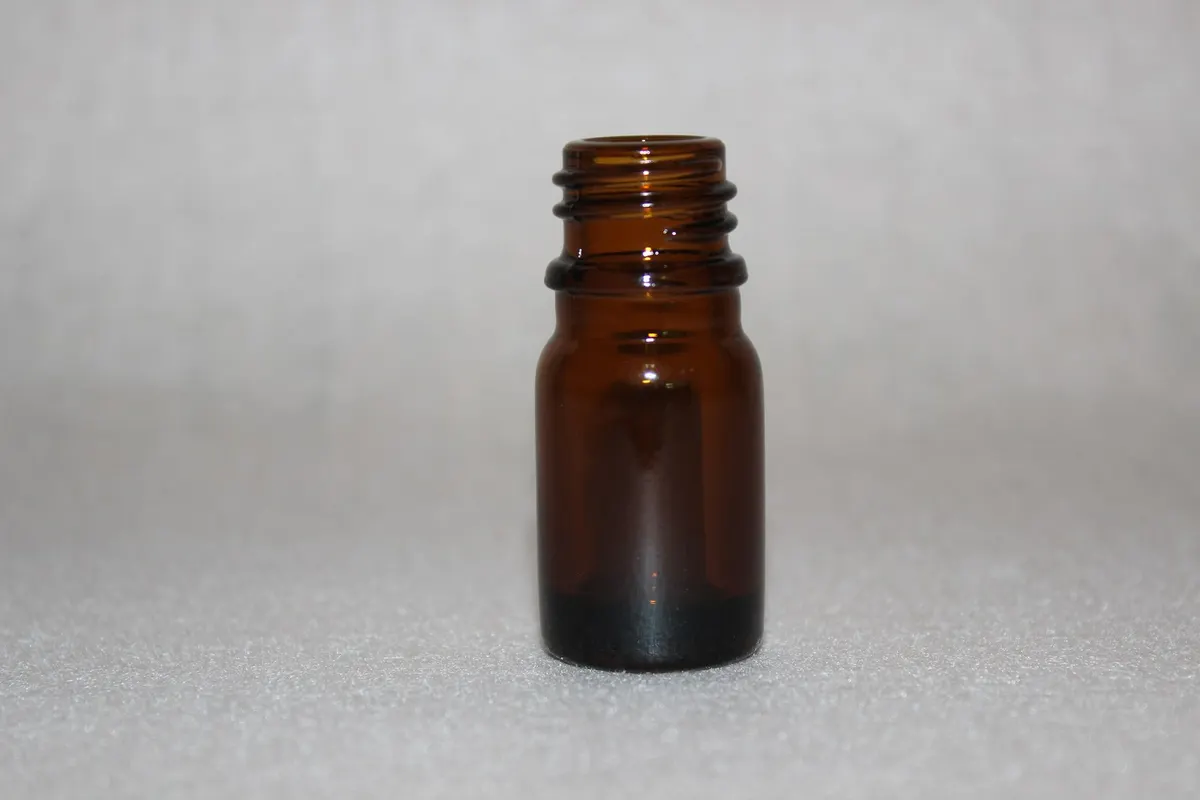
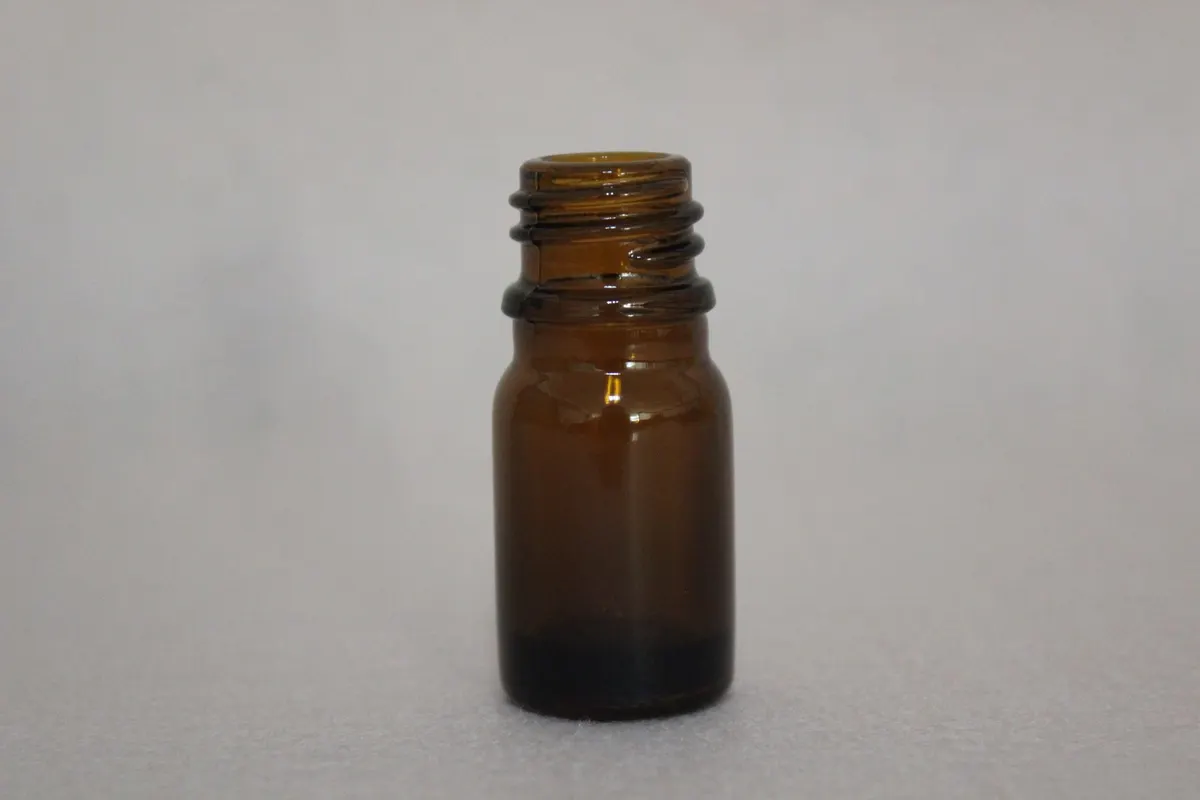
Part of our glass dropper bottles range; the stock moulds are pictured at the end of this guide.
This page is for the buyer who has already decided that dropper bottles are the right pack and now has to lock two engineering decisions: the neck finish the closure will sit on, and the flow rate the end user will actually feel. Everything below is about the interface between glass and dropper. If you are still deciding capacity, glass colour, decoration or whether the pack should be a dropper at all, that decision belongs to custom dropper bottles and to the capacity notes on the category pages. If you are choosing a supplier and need production evidence rather than dimensions, that belongs to dropper bottle manufacturers. This page does not repeat either of them, and it does not quote MOQ, price or lead time, because those come from an enquiry against a finished specification.
What the Term “Dropper Bottles” Actually Specifies
In a catalogue, “dropper bottles” describes a shape family. On a moulding floor, the same words decompose into three independent specifications: the finish, the body, and the dropper assembly. Only one of those three is expensive to change after tooling exists, and it is not the one buyers usually spend their first meeting on.
Capacity, glass colour and print are the visible variables. A buyer can change capacity between two production runs without retooling the neck, and colour is a raw glass or coating decision. The finish, by contrast, is cut into the mould permanently. Once a mould exists for an 18 mm screw neck, that mould will produce an 18 mm screw neck for its entire life. Every dropper, every gasket, every tamper-evident collar and every automatic capping head downstream of the mould has to match it.
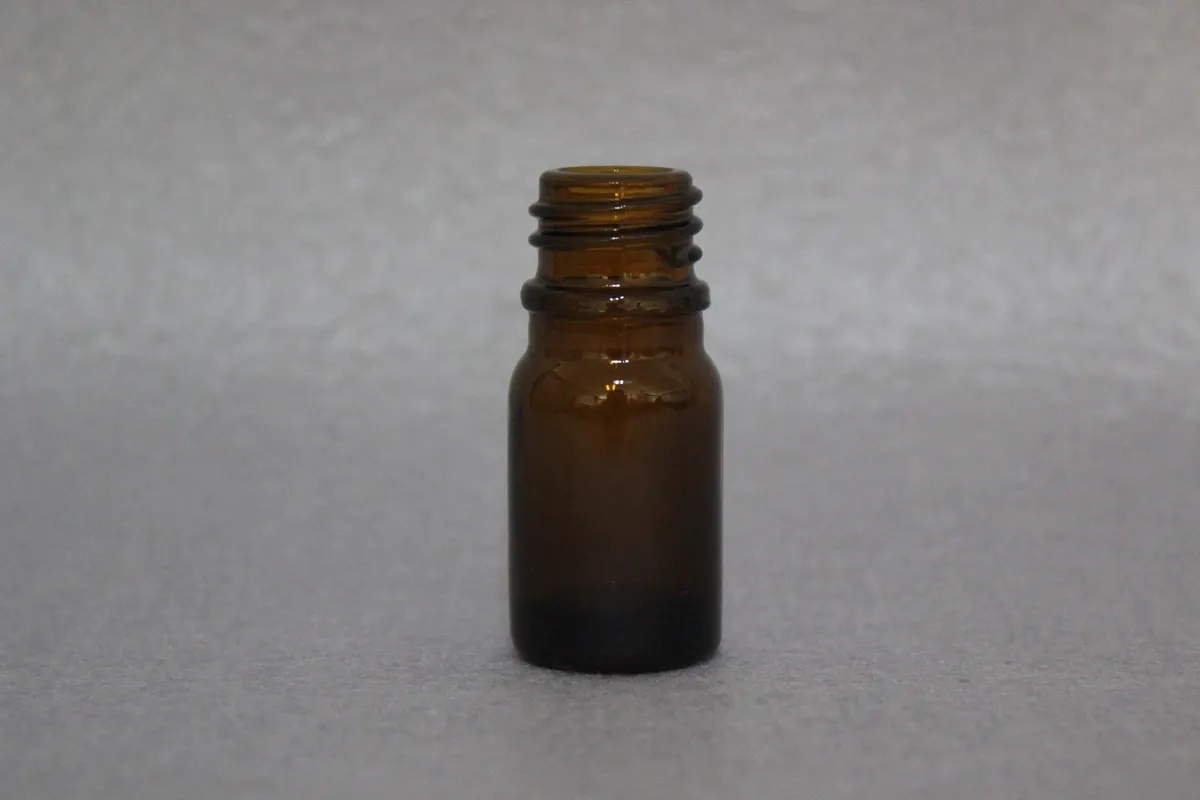
This is why two images that look identical on a supplier page can behave completely differently in the field. The neck diameter may differ by 0.4 mm, the thread turn count may differ by half a turn, and the sealing surface may sit at a different height. Both assemblies look correct in a photograph and both are “dropper bottles”. Only one of them will hold a low-viscosity tincture through a two-week sea freight and a final-mile parcel leg.
The practical consequence is simple. When you specify a dropper bottle, the first sentence in your specification should be the finish. Everything else, including the dropper itself, follows from it. Buyers who specify capacity first and finish last end up paying for sampling twice, and sometimes for an assembly that only seals when the dropper is tightened by hand to an uncomfortable degree.
Buyers also arrive at these bottles through different wording, and the wording usually shows which variable has already been decided. Someone who has chosen the light-sensitive option searches for amber dropper bottles. Someone who already knows the dose searches for 10ml dropper bottles. Someone comparing pack formats searches for bottles with droppers and weighs them against a roller applicator. All three describe the same neck interface, so the finish has to be settled whichever wording brought you here. Glass dropper bottles sold into fragrance, tincture and skincare programmes share this interface, which is what makes a single finish decision reusable across a whole product line.
Key Dimensions That Decide Whether a Dropper Fits
Before comparing options, agree on what each dimension means. Suppliers sometimes use the same words for different measurements, and a specification that is ambiguous by one dimension is ambiguous in a way that only shows up on a leak test.
- Finish diameter (often written as the T dimension). The outside diameter measured over the threads of the neck. This is the number behind a name such as 18 mm or 20 mm, and it is the first field in any finish table.
- Thread pitch and turn count. Pitch governs how far the collar travels per rotation. Turn count governs how much of the neck is threaded and therefore how much torque the closure can develop before it bottoms out. A closure designed for two turns placed on a single-turn neck will feel tight while barely compressing its gasket.
- Neck height (often written as the H dimension). Measured from the top of the finish down to the shoulder. The dropper collar has a skirt length; if the neck is taller than the skirt, the collar will not seat, and if the neck is shorter, the collar bottoms on the shoulder before the gasket loads.
- Sealing surface. The flat annular rim on top of the neck where the gasket or the moulded cone of the dropper contacts the glass. Sealing happens here, not on the threads. A perfect thread on a wavy sealing surface still leaks.
- Bore (often written as the I dimension). The inside diameter of the neck opening. It sets whether the pipette stem passes freely and how much air can return into the bottle as liquid leaves it.
- Internal depth and body concentricity. The pipette tip should stop a small distance above the inside bottom rather than resting on it, otherwise the tip blocks and the bottle stops dispensing before it is empty. Concentricity decides whether the stem hangs straight or leans against the glass wall.
- Collar outer diameter. The knurled outside of the dropper collar. It should sit flush with, or slightly inside, the bottle silhouette. A collar wider than the shoulder reads as a mismatched part even when it seals correctly.
- Sight ring and tamper-evident band position. On tamper-evident droppers the band and the recess on the neck must line up, or the collar will crack on first opening instead of tearing cleanly.
If you can supply only one measurement to a factory, supply the finish. If you can supply two, add the intended contents viscosity, because that is what converts a finish into a flow rate.
Tolerances and How They Are Verified
Moulded glass does not hold a nominal dimension; it holds a window around it. The useful question is not “what is the tolerance” but “what window does this mould normally produce, and how is it checked”. Ask for the answer in writing on the drawing, and ask which measuring method produced the number.
Four measurements carry most of the risk. The finish diameter controls whether the closure starts at all. The sealing surface flatness controls whether it holds. The bore controls the fill and dispense behaviour. The neck height controls whether the gasket reaches its designed compression. A supplier who can quote windows for these four, and who can say how each is measured, is describing a process rather than a promise.
Verification practice on a glass line typically includes go and no-go thread gauges for the finish, a plug gauge for the bore, callipers on a fixed number of points per shift, and a sealing check that applies the real closure rather than a gauge. Sealing checks are done with the closure at a defined torque, because a test at hand-tight torque tells you nothing about a capping machine set at 12 inch-pounds. Deeper checks include a vacuum test with the filled or water-filled unit immersed, a torque test with a calibrated torque meter to record both application and removal values, and a pull-off test on the collar to confirm it does not separate from the pipette under handling.
For transport, a drop test and a vibration sequence modelled on ISTA style procedures is the usual way to convert a bench result into a shipping result. For incoming inspection, sample sizes and acceptance numbers are normally taken from ISO 2859-1, with AQL levels written into the purchase order. Do not assume a default. State the AQL you will accept, state the defect classes, and state whether a critical defect such as a leaking unit is a zero-acceptance class. Glass factories work to whatever the order says, and an unspecified sampling plan reliably produces a disagreement at the port.
Finish Systems Compared: DIN18, 18/410, 20-400 and the Word “18 mm”
“18 mm dropper bottle” is a description, not a specification. Two necks described that way can be threaded differently enough that a closure will cross-thread on one of them. What buyers actually need is the finish system the mould was cut to.
DIN18 is the system most associated with essential oil and aromatherapy work, and it is the de facto default for the small neck sizes that carry glass pipette droppers. Its thread geometry is designed so that a collar with an internal cone compresses against the top rim of the neck. A DIN18 collar from one supplier normally fits a DIN18 neck from another, which is why the format spread across the category.
The GPI style designations work differently. A name such as 20-400 encodes two facts: 20 is the finish diameter in millimetres, and the three-digit suffix describes the thread profile rather than the diameter. The 400 series is the standard continuous thread, and the 410 and 415 variants describe progressively longer thread engagements. This is the trap in comparing quotations. A 20-400 closure is not a slightly larger DIN18 closure. It is a different interface. Placed on an 18 mm neck it will either refuse to start or engage one thread and leak at the sealing surface, and the failure will look like a bad gasket rather than a wrong finish.
The table below is the one to keep next to a quotation. It maps the finish family to the capacity range it usually carries, the dropper type it accepts, a nominal drop count, and the specific mismatch that most often goes unnoticed until the first claim.
| Finish specification | Typical bottle capacity | Accepted dropper type | Nominal drops per ml | Common mismatch |
|---|---|---|---|---|
| DIN18 (18 mm screw neck, DIN geometry) | 5 to 15 ml, occasionally 20 ml | Glass pipette dropper, DIN18 collar, internal cone seal, optional tamper-evident band | 20 with a 2.0 mm orifice on a water-thin liquid | Fitting a 20-400 collar because the two look similar in a photo; the collar starts on the thread and weeps at the rim |
| 18/410 (18 mm GPI, longer engagement) | 5 to 30 ml | Dropper with 410 thread collar, flat gasket or cone seal, often a plastic pipette | 20 with a 2.0 mm orifice; 25 to 40 with a 1.0 to 1.5 mm orifice | Using a 400 series collar with a short thread on a 410 neck, which stops before the gasket is compressed |
| 20-400 (20 mm GPI, single continuous thread) | 15 to 60 ml | Wide dropper collar, pipette dropper or a dropper with a larger bulb | 14 with a 2.5 mm orifice; 20 with a 2.0 mm orifice | Assuming a 20 mm neck takes the same pipette length as an 18 mm neck; the pipette is too short to reach the last millilitre |
| 18 mm nominal, unspecified thread | Any | Undefined until the thread is confirmed | Undefined | The whole specification. A quotation that says only “18 mm” cannot be validated, sampled or reordered reliably |
How Drop Rate Is Set: Orifice, Air Inlet and Viscosity
Drops per millilitre is not a property of the bottle. It is a property of the whole dispensing path, and the buyer is the only person who can define the last variable in it. Three factors set the number: the orifice diameter at the tip of the pipette or the dropper insert, the air path that lets air back into the bottle as liquid leaves, and the viscosity of the contents.
Orifice diameter is the dominant factor, and the relationship is close to linear. Halve the orifice and the drop volume roughly halves, which doubles the drop count per millilitre. This is why a dropper specified for a fragrance oil and a dropper specified for a thick serum will not produce the same count even when they look identical.
| Orifice diameter | Nominal drops per ml, water-thin liquid | Effect of a higher-viscosity liquid | Typical use case |
|---|---|---|---|
| 1.0 mm | about 40 | Fewer drops per ml, often 25 to 30 | Very small dose per drop, thin tinctures, low-viscosity fragrance |
| 1.5 mm | about 25 | Fewer drops per ml, often 18 to 22 | Essential oil blends, aromatherapy dosing |
| 2.0 mm | about 20 | Fewer drops per ml, often 14 to 17 | General purpose dropper, the most commonly quoted reference point |
| 2.5 mm | about 14 | Fewer drops per ml, often 10 to 12 | Larger dose per drop, body oils, thicker serums |
| 3.0 mm | about 10 | Fewer drops per ml, often 7 to 9 | High-viscosity contents where the user wants a fast pour-like flow |
Two corrections matter in practice. First, drop counts quoted by any supplier are nominal. They are measured on a defined liquid at a defined temperature, usually water at around 20 degrees Celsius, and real contents shift the number. Second, an under-sized air inlet makes the dropper feel unpredictable even when the orifice is correct, because the bottle has to pull air back through the tip between drops. The result is a first drop that is large, a stream of drops that slow down, and a user who concludes the bottle is defective. If your contents are non-Newtonian, such as a gel or an emulsion, treat any published drop count as a starting point for sampling and nothing more.
Measuring Points, Tolerances and the Failure Each One Predicts
The following table is the inspection sheet we would ask a buyer to agree before sampling. It lists the measuring points in the order they should be checked on an incoming lot, and it names the specific field failure that each one predicts. A measurement that does not predict a failure is a measurement that consumes inspector time without reducing risk.
| Measuring point | What to agree in writing | Inspection method | Field failure it predicts |
|---|---|---|---|
| Finish diameter over threads | A stated window around the nominal, not a single number | Go and no-go thread gauge plus callipers on a fixed sample | Closure that will not start, or that cross-threads on the capping line |
| Sealing surface flatness | Flatness across the full rim, referenced to the neck axis | Optical check or pressure-sensitive film under a loaded closure | Slow weeping around the rim after a temperature cycle in transit |
| Neck bore | Minimum diameter that still clears the pipette stem | Plug gauge, plus a fit check with the real dropper | Stem that binds, or an air path too small for a stable drip |
| Neck height and skirt engagement | Height window measured to the shoulder | Height gauge on the same sample used for the thread check | Collar that bottoms out before the gasket loads, or a visible gap |
| Applied and removal torque | A torque band, tested with the production closure and gasket | Calibrated torque meter, recorded per shift | Leaks from under-torque and cracked collars from over-torque |
| Pipette reach into the body | Tip clearance above the inside bottom | Assembly check on finished units, dry | Contents that cannot be drawn once the bottle is nearly empty |
| Assembly leak tightness | Pass or fail, no partial result | Vacuum immersion test on assembled units, or a pressure decay check | Transit leaks and stained cartons at the customer’s warehouse |
| Collar to pipette retention | Minimum pull-off force | Pull test on a sampled assembly | Pipette that separates and drops into the bottle during use |
Conditions for Running Dropper Bottles on a Filling Line
Most dropper bottle problems reported by buyers are not moulding defects. They are line problems that were never defined in the specification. Five conditions should be written down before the first production run, because each of them changes what the factory must supply.
Torque. State an application torque band and a removal torque expectation. A band is required rather than a target, because capping heads drift and the band tells the factory what it is allowed to drift through. The lower bound is set by the seal, the upper bound by the point at which the collar or the tamper-evident band cracks.
Cap orientation and spindle setup. Droppers with a tamper-evident band need a defined orientation so the band seats in the neck recess. Automatic capping machines that were set for a flat screw cap often need different spindle pressure for a tall dropper collar, and a machine that crushes the collar will produce leaks that look like a glass fault.
Fill level and headspace. The pipette displaces volume. A bottle filled to the visual shoulder line without accounting for the pipette can overflow when the dropper is inserted. Agree the fill level with the dropper in place, and record the headspace that results.
Content temperature at filling. Warm contents expand. If a bottle is capped at a filling temperature above the temperature it will experience in a warehouse, the internal pressure drop as it cools pulls air and possibly liquid past the gasket. This is one of the most common causes of a leak that cannot be reproduced in the factory, because the factory tests at room temperature.
Cleaning and drying before filling. Residual water in the neck thread and on the sealing rim changes friction and can hold lint. A dry, lint-free neck is the cheapest leak prevention available, and it costs nothing to put in writing.
If your contents are a solvent-based fragrance or a product with a high essential oil fraction, say so at the quotation stage. Solvent attack on the gasket material is a leading cause of a seal that passes at month one and fails at month six. Gasket material selection is part of the matching conversation, and it is driven by the contents, not by the bottle.
Failure Modes: Weeping, Over-Torque and Transit Leaks
Three failure modes account for most claims on glass dropper bottles. Each has a distinct signature, and each points back to a different line in the specification.
Weeping at the sealing rim. The unit is dry when packed, shows a thin film of product around the base of the collar after a few days, and leaves a ring on the shelf. The cause is almost always insufficient gasket compression, a sealing surface that is not flat, or a gasket material that has swollen or shrunk against the contents. Increasing torque sometimes hides it temporarily and then produces a cracked collar, which is a worse outcome. The correct response is to check the sealing surface and the gasket in that order.
Over-torque damage. The collar is cracked, or the tamper-evident band has torn before the customer opened it. This is a capping line condition rather than a glass condition. It is fixed by measuring the applied torque and setting the capping head, and it is prevented by writing the torque band into the specification so the factory knows the ceiling.
Transit leaks. Units arrive dry, stained or with product in the carton. Transit leaks are a system failure, not a single-unit failure: the seal may hold at one atmosphere on a bench and release when a parcel is handled at reduced pressure in an aircraft hold or when a pallet is stacked through a heat cycle. The fix combines three things. A gasket that matches the contents. An applied torque that stays inside the band. Packaging that stops the bottles from rotating against each other, since vibration-induced back-off is a real mechanism on long sea legs. This is the failure mode most worth testing before an order, because the cost of a claim is paid by the buyer who receives the container, not by the factory that shipped it.
Where This Page Stops: Related Pages and Their Boundaries
This page owns exactly two decisions: the finish, and the flow. It deliberately does not cover capacity selection, colour matching, decoration, or the sourcing and audit side of buying. Those decisions are handled elsewhere, and using the wrong page for them is how specifications end up incomplete.
If you are comparing essential oil roller bottles wholesale options against a dropper format, that comparison is a dispensing-format decision rather than a finish decision, and the roller page carries the applicator fit and roller ball materials that this page does not. If you need a private mould, a custom collar, or your own print and neck height, that is a tooling project, and glass dropper bottle manufacturers is the entry point for understanding how a custom neck is quoted. If your container decision sits at the level of the body rather than the closure, the capacity and shoulder geometry notes on Boston round bottles wholesale apply, since the Boston round body is the shape most dropper necks are cut into.
To summarise the boundary in one line: this page answers how wide the neck is, what thread it carries, and how many drops per millilitre the assembly will deliver. Capacity, colour, decoration and the choice of supplier are covered by the pages above. If your question is about evidence from a factory rather than a dimension on a drawing, start with the supplier pages instead of this one.
Frequently Asked Questions About Dropper Bottle Finishes and Flow
Is an 18 mm dropper bottle the same as a DIN18 bottle?
No. An 18 mm description only tells you the nominal neck diameter. DIN18 describes a specific thread geometry and sealing method on top of that diameter, and a neck described only as 18 mm may carry a different thread profile that a DIN18 collar will not seal against. Ask for the finish system, not the diameter.
Can I use a 20-400 dropper on an 18 mm neck?
No. The thread diameters differ, so the collar will either not start or will engage partially and leak at the rim. A 20-400 assembly must be matched to a 20 mm finish. If you have inherited a stock of 20-400 droppers and want to use them, the bottle neck has to be cut for that finish from the start.
How many drops per ml do glass dropper bottles deliver?
About 20 drops per ml is the commonly quoted reference for a 2.0 mm orifice on a water-thin liquid at room temperature. Orifice diameter changes the number roughly in proportion, so a 1.0 mm orifice delivers around 40 drops per ml and a 3.0 mm orifice around 10. Viscous contents deliver fewer drops than the nominal figure.
Why is my dropper bottle leaking in transit but not in the factory test?
Because a bench test and a shipping journey are different tests. Bench sealing is checked at constant temperature and pressure, while a shipping journey adds heat cycles, pressure changes and vibration that can back the collar off. The usual contributors are a gasket that is not matched to the contents, a torque value outside the agreed band, and packaging that lets bottles rotate against each other.
What is the difference between a cone seal and a flat gasket dropper?
A cone seal relies on a moulded cone inside the collar pressing into the top rim of the neck, which suits DIN18 style droppers and gives a reliable seal with fewer parts. A flat gasket relies on a separate washer compressing against the rim, which gives more freedom in gasket material selection when the contents are aggressive solvents. The choice is normally driven by the contents rather than by the bottle.
Does a longer pipette improve dispensing?
Only up to the point where the tip reaches close to the inside bottom. Beyond that, a pipette that touches the bottom blocks the tip and stops dispensing before the bottle is empty, and one that is too short leaves the last portion of contents unreachable. Ask for the tip clearance to be defined rather than assuming the longest available pipette is best.
Can I switch the dropper in a later order without changing the bottle?
Yes, provided the finish and the collar thread stay the same and the gasket material still suits the contents. Changing the orifice or the pipette length on the same collar is a low-risk change. Changing the collar thread family is not, because it moves the closure onto a different interface and invalidates the sealing test that was run on the first order.
Which AQL should I specify for dropper bottles?
The AQL is your commercial decision, not a default. The useful structure is to define defect classes yourself, treat any leaking unit as a critical defect with zero acceptance, and set a tighter level on finish and sealing-surface dimensions than on cosmetic faults. Sample sizes and acceptance numbers are then taken from ISO 2859-1 in the purchase order.
Send Your Finish, Contents and Volume for a Matching Recommendation
To get a dropper and gasket recommendation rather than a generic catalogue page, send three things. First, the finish: the finish system if you know it, or the neck diameter and a photo of the neck if you do not. Second, the contents type, including whether it is water-thin, oil-based, alcohol-based or an emulsion, because that drives the gasket material. Third, the batch volume you are planning, so the recommendation reflects a real production run rather than a sample.
With those three inputs, the matching conversation can cover the dropper collar type, the pipette length relative to the body, the orifice size that produces the drop count you want, the gasket material, and the torque band that keeps the assembly sealed through transport. Where a value depends on tooling or on the order, we will state a range and confirm it against an enquiry rather than quoting a number that a mould has to be changed to meet.