Part of our series on glass essential oil bottles — read the overview first if the format is new to you.
Most new essential oil ranges are built on 15 ml as the hero bottle, with 10 ml for roller blends and 5 ml for sampling; a 30 ml refill is usually added once repeat-purchase data comes in, and 50 ml and 100 ml serve carrier oils, hydrosols and refills. Each size does a different commercial job, so pick bands by product line, channel and fitment instead of by a list of millilitre values. Three bands chosen with care generally do better than six added piecemeal, because every band needs its own mould, closure, label and shipper.
What each capacity band is for
A 5 ml bottle and a 100 ml bottle are not one product in two sizes. The small one has no repurchase value by itself and exists to start a habit. The large one is bought by people who already have that habit and want a better cost per millilitre. The bands in between hold the margin, the shelf presence and the subscription revenue, and they are where label, closure and kit choices get tested.
Use the table as a shortlist for a first range discussion. The accessory column names the type of fitment only, because thread and neck designations are confirmed on the signed drawing. Read the use-cycle column as a planning assumption, not a forecast.
| Band | Product line and channel | Usual fitment | Use cycle and repurchase | Typical kit | Confirm before tooling |
|---|---|---|---|---|---|
| 5 ml | Single-note trials, discovery sets, samples for trade shows, influencers and practitioners | Short glass pipette dropper, or orifice reducer under a plain cap for one-drop dosing | One use to a few weeks. No real repurchase; its job is to prompt the first full-size order | Ten to twelve single notes in a tray or foam insert, one label per oil | Fill accuracy at this volume, pipette length against real bottle height, whether a child-resistant closure exists at this diameter |
| 10 ml | Roller blends, travel and handbag formats, sleep and wellness kits, therapist carry | Steel or glass rollerball in a screw collar; a dropper only where the blend is dosed by the drop | Four to eight weeks of daily use. Among the strongest repeat bands in the category | Three to six rollers in a zip case or folded card sleeve | Ball diameter and seat, cap height above the ball so the closure does not press on it, leakage at elevated transit temperature |
| 15 ml | Standard single-note retail size for marketplace and health-food listings | Standard dropper with glass pipette, or lined cap with reducer where drops are counted by hand | Two to four months of regular use. Carries the review count and the subscription base | Variety packs of six with matched labels, or one bottle in a printed carton | Pipette graduation marks, liner material against citrus terpenes, tamper-evident band height |
| 30 ml | Synergies and blends, small carrier volumes, practitioner dispensing | Longer pipette for the taller body; pump or disc top if the blend is poured | Three to six months. Often the refill step above a 15 ml core | Core and refill pair, 15 ml and 30 ml in one sleeve | Pipette reach to the base, headspace once the pipette is in, neck consistency across glass colours |
| 50 ml | Single carrier oils, massage and body blends, spa and professional supply | Pump or disc top for pour control; large dropper only for liquids thin enough to draw | Four to eight weeks with correct topical use. Margin is in the base oil, not the bottle | A 50 ml carrier paired with a set of small single notes | Flow of the actual fluid through the fitment, closure torque, label wrap on a curved body |
| 100 ml | Refills, hydrosols, large base oils, blender and ingredient supply | Disc top, pump, or wide orifice under a lined cap | Two to four months at volume. Bought by users whose habit is already fixed | Sold as a refill, or as the larger half of a two-bottle gift box | Wall strength and burst performance under the heavier fill, carton compression, freight per unit against the price advantage |
Why a narrow range usually wins
Every band brings a separate glass mould, closure, label size and, in most cases, its own shipper and case count. A sixth band therefore raises the minimum commitment on every component at once. A coherent range also has more presence on a shelf than a scattered one, and the tooling money a fourth band would absorb often does more good as a better closure on the bands already in the range.
Brands tend to decide capacity twice. At launch the range is kept deliberately narrow so that a first-time buyer understands it quickly. The second decision follows the first repeat-purchase figures, when it becomes clear that loyal buyers cluster in one band while trial buyers are stuck in another. A brand that anticipated that second step at launch does not need to re-tool.
Contents, channel and regulation narrow the choice
Contents and viscosity
A neat single-note oil, a diluted synergy, a carrier oil and a hydrosol all behave differently in an identical neck. Viscosity governs how quickly the liquid passes through the fitment and how much clings to the wall of a nearly empty bottle. A thin citrus oil behind a wide orifice runs, which makes both fill and label look careless. A thick jojoba or fractionated coconut base in a narrow dropper draws so slowly that users assume a fault.
Choose the fitment for the liquid first and the bottle for the brand second. Test draw time with the real fluid, not with water.
Sales channel
A discovery set on a marketplace is judged from a thumbnail in three seconds, so the bottles must look uniform across the band, and that uniformity is paid for in tooling. Practitioners and therapists buy larger volumes of the same oil; they look at cost per millilitre and at whether the closure opens one-handed while the other hand is busy. Refill and subscription buyers need a cap that survives many reuses without thread wear or a permanently compressed liner. These are three separate briefs for one oil, and each points to a different hero band.
Regulation and product claim
Which rules apply depends on what the product claims to be. Sold as a cosmetic, the oil falls under the destination market's cosmetic labelling rules for declared nominal quantity, ingredient naming and durability information. Used as a food flavouring, the contact materials must meet food-contact rules, with EU 1935/2004 and its national implementations, or the FDA 21 CFR provisions for food-contact substances, as the usual references. For certain single oils, the United States child-resistant packaging rules at 16 CFR 1700.20 can apply, assessed oil by oil and not brand by brand.
None of this replaces checking your own market position. All of it affects the closure, the cap torque, the label panel and often the band itself, so a brief that starts from the claim avoids a second round of tooling.
Six questions to settle in order
- Which oil is worth most per millilitre? It defines the smallest band, since nobody buys a large bottle of something precious. It also sets the pipette quality: a cheap dropper on the most expensive oil in the catalogue loses repeat buyers fast.
- How do customers refill? Monthly returns for a daily blend put the subscription in the refill band. Twice-yearly returns for a carrier oil make that band a question of weight and freight instead of retention.
- Which band gets the marketing spend? The one receiving the imagery, reviews and paid traffic needs the best closure, the best glass and the tightest weight consistency. The others can be specified simply to hold the range together.
- Drop, roller or spray? Each gives a different fill height, headspace and net-content risk. Decide before choosing the neck, because the dosing method fixes the fitment and the fitment fixes the mould.
- How much label area does the text need? Unsubstantiated wellness claims require space for mandatory warnings; fragrance claims do not. The smallest band runs out of room first and is the hardest to correct after tooling.
- How is the range kitted and shipped? Kits multiply component decisions. Three bands with six components each means eighteen items to hold, inspect and reconcile, and that reconciliation happens at packing unless kitting is ordered from the glass plant.
If your starting point is a cap or neck you already hold, work the other way round with the Boston round size lookup by closure. For glass colour and pack type by oil, see the overview of essential oil bottle options.
Fitments by band and how they fail
The fitment decides whether the pack works in the user's hand. Three families cover nearly every essential oil line.
Pipette droppers
A dropper has four parts: pipette, collar, bulb and cap shell. Pipette length must match the internal depth of the specific bottle, measured from the sealing surface of the neck to the inside of the base, minus a working clearance. Too long, and the tip hits the base, chips and sheds glass, which is a foreign-body defect. Too short, and oil is left that the user cannot reach, which reads as poor value. Both come from ordering a dropper by nominal capacity instead of by length.
Bulb compound matters with citrus-forward blends. Natural rubber and silicone swell and harden in contact with limonene-rich oils, while nitrile holds up better, so the compound should be written into the specification. Drop size, drops per millilitre and fill accuracy belong to the assembly, not the glass, and are covered with pipette and bulb detail in our guide to dropper bottle assemblies.
Rollerballs
Ball diameter sets the wetted area and the delivery per stroke. The collar sets how deep the ball sits. Cap height must clear the ball without loading it once the closure is torqued; a cap that presses on the ball pre-loads the contact, and the bottle leaks in transit well before it would leak on a shelf.
A 10 ml roller body is short, so collar and cap make up a large share of total height. A small collar change can be enough to break the fit between packed case count and the intended shipper. Ball, collar and leak-risk detail sit on the page about roller bottles for oil blends.
Orifice reducers, disc tops and pumps
The reducer is the cheapest fitment and the one most often chosen by default. It meters drops by geometry alone, which makes it the most sensitive to viscosity: two oils that flow differently will not give equal drop counts through one reducer. If the dosing instruction counts drops, validate the reducer with each fluid. Disc tops and pumps suit the pouring bands, and their limit is activation force, which matters when the user is elderly or has limited dexterity.
Kitting across bands
Kits are where a capacity choice turns into operating cost. Three structures dominate.
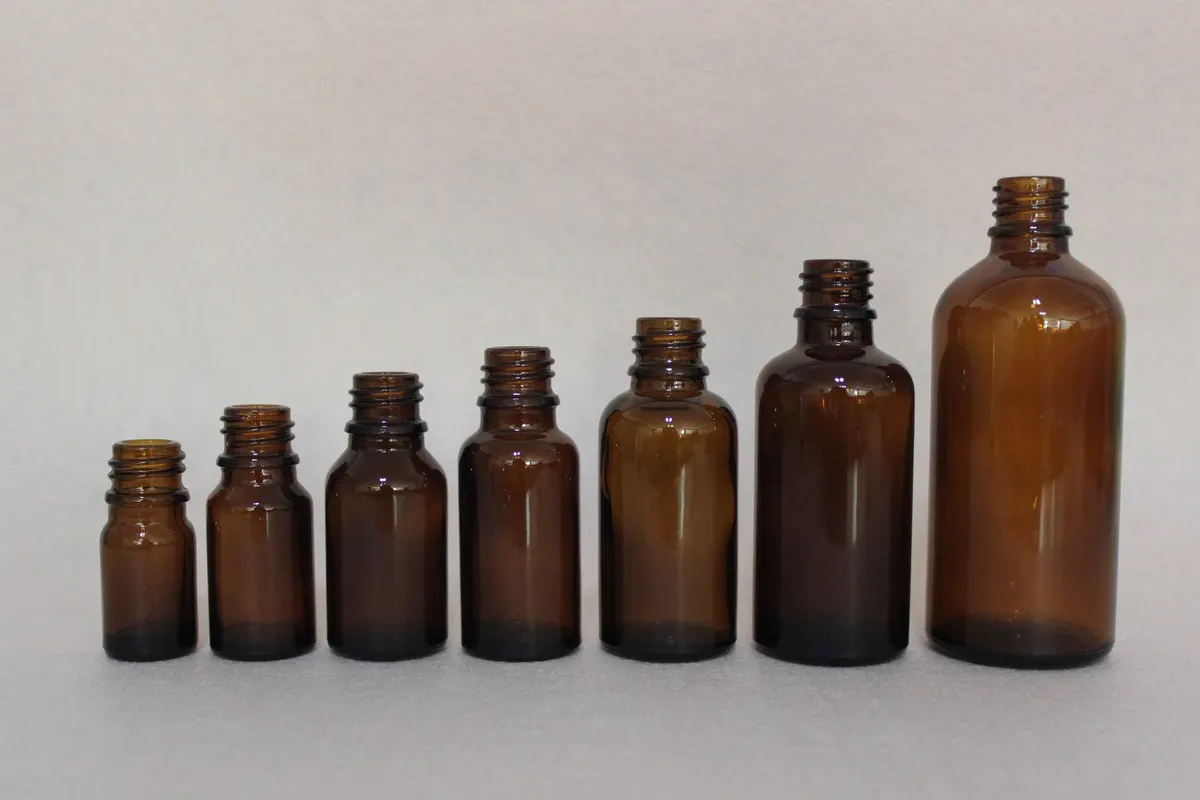
- Discovery set. Ten to twelve small bottles in a tray, each with a different oil. Glass cost is low and labour is high, since each unit has its own fill, label and cap position. The risk is consistency: bottles from two mould cavities can look slightly different under studio lighting, the same light used for product photography. For an entry-point set, specify one mould and one glass colour lot and list the match as a requirement.
- Travel or roller kit. A few identical assemblies in a case or sleeve. One repeated component and one repeated fill make it the cheapest kit to assemble. The cost is in the case and in the foam or card insert that holds rollers upright and keeps weight off the caps. That insert needs its own tooling and is often left out of the launch budget.
- Gift box. The structure most likely to mix bands, such as a fifteen millilitre core with a five millilitre single note. It looks generous and prices well but doubles the parts: two glass sizes, two closures, two pipette lengths, two label sizes, two insert cavities. The insert tends to arrive late because it is die-cut to the bottle outline. Design it after the drawing is approved and before artwork sign-off.
Two rules apply to all three. Decide where the kit is assembled: kitted at the glass plant, it has one inspection point and one carton; assembled in your warehouse, every component needs inbound inspection and the pack needs a second carton. Then choose the shipper ahead of the kit, since case count, inner partition and pallet build all follow from the kit footprint. A kit that does not sit cleanly in a standard shipper usually gives up a pallet position to padding.
Fill height, headspace and closure torque
Declared net content is where capacity becomes a legal matter. A moulded bottle holds more than its nominal figure, the fill line sits below the rim, and the closure takes up space in the neck. A dropper removes a further volume, because the pipette displaces liquid as soon as it goes in. In small bands that displacement is a meaningful share of the fill, so fill height has to be set with the assembly fitted. Give the plant the declared fill volume, the assembly to be inserted and the filling temperature, and ask for the fill line in writing.
Headspace comes next. Liquid expands in a sealed container during ocean transit or in an unventilated warehouse and pushes against the closure, so a bottle filled to the shoulder for looks may be over-filled for shipping. Wide-shouldered, large-diameter bands are forgiving. Narrow ones are not: a two millimetre shift in fill height shows through the glass and looks like a short fill in a thumbnail.
Torque is determined by liner material and neck geometry, not by feel. It must be high enough to hold pressure through the thermal cycle of transit and low enough for repeated opening without damaging the liner. Over-torquing can crack the neck at the shoulder of the thread, which appears later as a field leak and is very hard to trace.
The liner also has to suit the oil. Plain PE foam is adequate for many fragrance uses and marginal against aggressive terpenes, where a PTFE-faced or laminated liner is the safer choice. Confirm it against the actual formulation, and verify fill weight by sampling instead of relying on a volumetric setting on the line.
What to send with an enquiry
Three items let us answer specifically: the product line each band serves, the bands you are considering or have committed to, and the batch size per band for the first order. With the liquid type, dosing method and destination market added, the reply can cover fitment, liner and case pack in one pass. Label size or intended fill volume helps too, because it shows whether the band has enough usable label area and whether the declared net content is achievable with the fitment in place.
Say which requirements are still open. Band, fitment and child resistance interact, and the unresolved item is often the one that decides the closure; naming it early tends to save a second round of samples. Quantities, tooling and commercial terms are confirmed against the enquiry, since glass, closure and kitting route each set their own conditions.
Frequently asked questions about essential oil bottle sizes
Why is 15 ml the usual launch size?
The market reads fifteen millilitres as a proper bottle, it has room for the mandatory text, and it gathers the reviews that later sell everything else. A 30 ml refill can follow without re-tooling the hero and raises order value from buyers who already have the habit.
Is a 10 ml roller bottle the same glass as a 10 ml dropper bottle?
Usually not. The roller needs a collar that seats the ball at a set depth and a taller cap, which alters the neck and sometimes the body height. A dropper bottle can often take a roller fitment on its existing neck, but this must be confirmed on the drawing. If one body is to serve both formats, make that the brief at tooling, not a request at reorder.
Does a larger bottle cost the buyer less per millilitre?
Glass cost per millilitre falls as the band rises, but delivered cost falls more slowly: heavier glass adds freight, a larger carton needs more compression strength, and the fitment changes. Compare landed cost per millilitre including freight and carton. Between a 15 ml and a 100 ml unit, the freight gap is often bigger than the glass gap.
How many bands can one closure family cover?
Several, provided the neck finish is deliberately held constant across the moulds. One neck across 5 ml, 10 ml, 15 ml and 30 ml simplifies dropper and roller stock and cuts the number of parts in the warehouse. The price is a proportionally large closure on the smaller bottles, which shifts the visual balance. Settle this before the moulds, because a common neck added later means new tooling.
Do essential oil bottles need child-resistant closures?
That depends on the oil and the market. Under 16 CFR 1700.20 the United States requirement is assessed per oil, so one range can hold both regulated and unregulated items. Child-resistant versions exist for screw closures and dropper assemblies, but they add cap height, change the pack footprint and may reduce the fill volume available in the neck. Check each oil in each destination market before specifying.
Can all bands share one glass colour and one label design?
Yes, and a consistent range benefits from it, but the artwork has to be laid out again for each band instead of scaled. Shrunk to 5 ml, type on mandatory panels falls below the minimum size; enlarged to 100 ml, the design floats in the middle of a large face. Give each band its own type size and mandatory panel, and hold colour, typography and imagery constant.