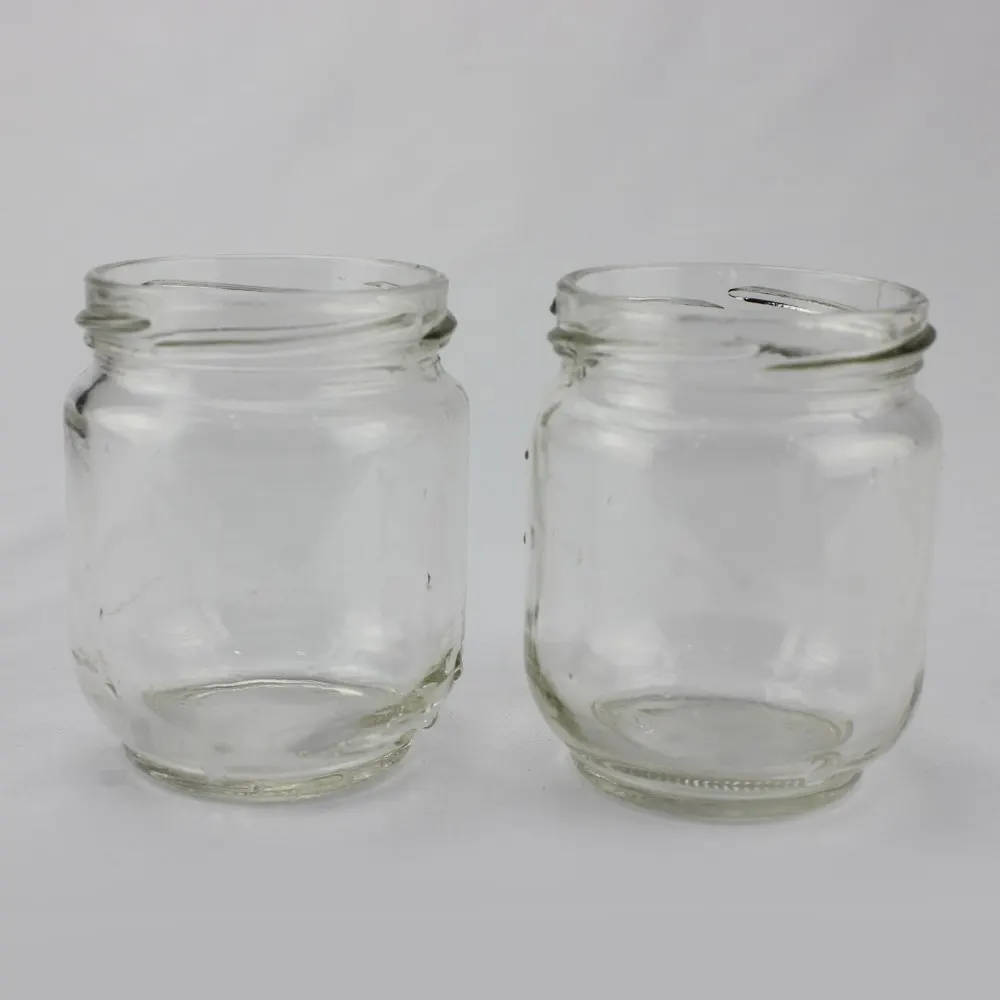
Filed under frosted glass bottles wholesale; the moulds we quote for this are pictured at the foot of the page.
Choose acid etching when a frosted jar will be washed, hot-filled or handled hard, because the texture is cut into the glass and has no layer that can lift. Choose a sprayed coating when you need a wide range of looks, tints or frequent changeovers and the jar will stay below the coating's temperature limit. Whichever you pick, write the process route, a haze band, a gloss limit and the exact treated area onto the drawing, since the word "frosted" alone does not bind a supplier to anything.
What a frosted finish changes
Frosted glass is ordinary clear or tinted glass that has had one more operation applied to some or all of its surface. That operation alters how light exits the wall. A clear jar transmits light, so the eye picks out crisp edges behind it. A frosted jar throws much of that light back and to the sides, and the contents appear as a soft block of colour.
Buyers who ask for frost usually want a matte look, a gentler view of the product and a surface that still looks good after being picked up on a shelf. The settings that deliver each one pull against the others. Etch deeper and the diffusion gets denser and whiter and the matte feel stronger, but printed artwork loses contrast. Etch lighter and the print stays legible and more product shows, yet fingerprints and scuffs appear sooner and the jar can look cheap beside a denser sample. A spray can cover more of that range in one pass, but it is a film on the glass with its own limits on abrasion, heat and washing.
This is why two quotes for the same "frosted jar" can produce surfaces that fail differently, one blotchy at the shoulder and the other peeling along the ring where it touched the next jar on the conveyor.
Acid etching and spray coating compared
Acid etching
Formed jars meet a hydrofluoric-acid-based mixture in one of three ways: dipped in a bath, coated with a paste through a screen or mask, or sprayed inside a closed chamber. The acid strips a thin skin of glass and leaves a mineral micro-texture. Nothing has been added, so nothing can flake or delaminate, and the finish normally stands up to dishwashing and repeated handling.
The weakness is drift. Concentration, temperature and dwell time all move over a shift, and unless the plant controls the line and tops up the acid on a set cycle, jars spread across a wider band of shades. A dip also etches every face the liquid touches, inside and out, which is awkward when the sealing land or threads must stay plain.
Spray coating
Here a lacquer, an inorganic sol or a water-based matte system is sprayed on and cured, generally in a tunnel. Because the film has its own chemistry, the plant can switch from white to grey to tinted frost within one shift by changing the formulation. In exchange, you are buying two materials, and the join between them is where trouble starts.
- Adhesion. A film that passes on a flat test panel may still fail on a jar's slightly conical shoulder, where the spray lays down a different thickness.
- Contact wear. Jars rub at the contact ring and the base, in the carton and on the line. Film that is too thin or too thick chips there first.
- Heat. Cured organic films have a ceiling. Hot filling, pasteurisation and retort can exceed it.
Blasting and selective etching
Two other routes turn up in quotations. Abrasive blasting gives a feel close to a light etch with no acid bath, though it is harder to repeat exactly at volume and its grain can look louder and more directional. Selective etching through a printed resist mask frosts only a pattern, logo or band, and is how a jar ends up with a frosted body and a clear neck from a single operation. Always ask which route a price covers and which faces it treats, otherwise two quotes may describe two different products.

Route by route
The table shows the risk you accept with each route. Start with the right-hand column, which lists what determines whether the route will repeat at your volume.
| Route | Appearance | Abrasion and washing | Batch consistency risk | Volume fit | Confirm with the plant |
|---|---|---|---|---|---|
| Immersion acid etch | Dense, even satin with strong whiteness; artwork contrast drops | The texture is glass; normally survives repeated washing and handling | Medium. Bath strength, temperature and dwell time need control and cyclic replenishment | High volume, one frost density, one or two shapes | Replenishment cycle, haze control in the bath, whether both faces are etched, how the neck transition is masked |
| Selective etch via screen or paste mask | Frost limited to a band, panel or pattern with clear windows | As immersion on etched areas; masked areas stay plain glass | Medium to high. Mask registration and paste thickness are two extra variables | Mid to high volume, where the design justifies mask tooling | Mask life and replacement, registration tolerance, edge definition, reuse of the mask on other shapes |
| Sprayed matte coating | Widest range, down to very low gloss; simple to tint | A film on glass, limited by adhesion, contact-ring chipping and heat | Medium. Formulation, spray path and cure profile each move the reading | Low to mid volume with frequent colour or look changes | Adhesion test method, cure window, maximum process temperature, behaviour where base and shoulder touch |
| Sprayed tinted frost | Frost matched to a colour; cosmetic look | As a matte coating, plus colour fastness to washing and light | High. Tint strength and frost density both have to stay in band | Mid volume with a fixed palette and rare changeovers | Master sample kept per batch, colour difference tolerance, test method and viewing conditions |
| Abrasive blasting | Fine, faintly directional grain; more tactile than optical | Durable mineral texture, close to a light etch | Medium to high. Nozzle path and media wear cause variation | Low to mid volume, short runs, prototypes | Run-to-run reproducibility, grain direction, dust control at filling |
| Full-surface etch, both faces | The inside diffuses too, so contents read deeper and softer | Durable, but an etched interior is harder to clean fully under a viscous product | Medium. Curved interiors are hard to measure | High volume for decorative or candle use, not food fill | Cleaning validation for the product, whether the inside is inspected, where on the interior curve it is measured |
Haze, gloss and depth on the drawing
Three numbers stand in for the adjective.
Haze is a percentage: the portion of transmitted light scattered more than 2.5 degrees away from its incoming direction. At low haze the jar looks lightly misted and the contents are plain to see. At high haze it approaches a satin diffuser. Since haze settles whether the shopper can still see the product, specify it as a band, not a single target.
Gloss is given in gloss units at a 60-degree angle of incidence. It is what most people mean by "matte", and it tells apart two samples that look alike under shop lighting. Set a maximum instead of a typical value. The complaint that arrives later is always that the second batch is shinier.
Depth is the amount of material taken away or put on. For an etch that means etch depth and surface roughness, and for a coating it means film thickness. These figures forecast behaviour more than looks. Depth and roughness govern feel and how readily scuffs show, and film thickness governs adhesion and heat tolerance.
Each number also needs a named measurement zone. One etch gives different readings on a flat wall, a shoulder curve and a base radius, and a haze figure without a zone will be disputed sooner or later.
Diffusion, visibility and tint
Frost scatters light. It does not stop it. A standard white frost still lets most incident light through, which softens the look of a pale oil or white cream but does nothing for a formula that oxidises. If the pack must protect against ultraviolet and visible light, specify an opaque pack, dark tinted glass or an external barrier, and treat the frost purely as decoration.
Tint sits between the two and widens the choice of looks:
- White frost has the strongest cosmetic feel and is the first to show handling marks.
- Grey frost looks cooler and hides fingerprints better.
- Colour-match frost, with the tint in the coating or in the glass, can follow a palette. It also adds drift, because tint and frost density must both be held from batch to batch.
Where tint accuracy matters, ask for a master sample retained from every batch and a written colour difference tolerance. A verbal assurance is not a control.
Where frost goes uneven
A jar is not a flat panel, and both main routes react to its shape in opposite ways. In a dip, acid reaches a convex shoulder before it wets an inside corner, and the four corners of a square jar hold a little more liquid than the walls. The corners come out denser and the broad faces lighter, a difference you only notice with three bottles lined up under directional light. Spray does the reverse. Edges and corners face the gun from two directions and collect more film, leaving a heavier, slightly glossier rim around a thinner field on a wide face.
Embossed and debossed details are the next cause. A raised logo sits at a different angle to the acid or the gun and takes too much or too little treatment, so it commonly ends up partly clear and a little shiny against the frost. Some brands like that and others reject it, so decide before sampling and record the decision. Mould seams behave similarly: invisible on clear glass, they show as a line under a coarse frost because texture emphasises geometry.
The neck is the remaining zone. Interior surfaces, the sealing land and the thread flanks are generally masked or left alone. Closures need consistent friction and a clean seal face, and an etched thread wears differently against a metal lug or plastic cap. A clear neck means a visible boundary, and good masking puts that boundary just below a shoulder ring, under a label band or beneath the closure skirt, where the cap hides it.
Closures, decoration and filling heat
Closure and neck finish
Metal lug caps, twist-offs, plastic screw caps and corks all depend on predictable friction and a clean sealing surface. An etched thread flank can shift the torque a capping head needs for a given seal. A coated thread adds a compressible layer that settles with time. The safe default is a plain sealing land and a defined stop line for the frost. If the brief insists on frost over the whole jar, run a closure trial on frosted necks ahead of bulk production.
Print and labels
Silk screen, hot stamping, digital print and adhesive labels each respond to a frosted ground differently from clear glass.
- Contrast falls as haze climbs. A two-colour design that reads on a light frost can vanish on a dense one, so print over coarse frost needs a heavier ink film or a clear window printed behind it.
- Hot stamping wants a flatter surface and more pressure, which raises the chance of cracking a thin decal on a curve.
- Print on sprayed coatings is the hardest to predict, because ink and coating are chemically related. Ask the supplier to name the ink system qualified on that exact coating.
- A light etch gives label adhesive a mechanical key. A heavy etch can hold dust and moisture in its valleys, a concern for paper labels applied after filling.
- Some routes allow decoration before frosting and some do not, and the order changes how well the print anchors.
Sample any label or print on the actual frosted surface at the actual etch depth before the order is confirmed.
Filling temperature
A jar for hot-filled or pasteurised food is a different specification from a candle jar that never meets heat. A coated route has a temperature ceiling, and it belongs on the drawing as a number. Etched routes tolerate far more, although a heavy interior etch under a viscous product gives the cleaning process more surface to validate. Put the temperatures and durations the surface must withstand on the enquiry and let them pick the route, with appearance second.
Frosted jars on the filling line
Clear jars only raise glass-on-glass and glass-on-metal contact. A sprayed film puts a softer layer exactly where jars are gripped, turned and pushed: beneath the capping head, in the star wheel, and on the accumulation table where they press together and slide. Wear tends to show at the base radius and shoulder ring. Those zones are easy to miss on a bench check and obvious in a retail photo shot at an angle.
Friction shifts too. A dense etch is marginally coarser than clear glass, which generally makes conveyor transfer more predictable while wearing rubber and plastic strips a little faster. Coatings may be noticeably slicker or grippier than glass, depending on formulation. After a switch from clear jars, re-check guide rail spacing, accumulation pressure and capping torque, using real frosted jars and not clear substitutes. It is an inexpensive check.
Pre-fill cleaning matters as well. Etched texture retains a thin water film, which slows tunnel drying and leaves spots unless the drying profile is changed. Coatings need to be compatible with the washer's chemistry and temperature, since a film that copes with hand washing can soften in an industrial washer. List everything on the line that touches the jar, from air knife to drying oven, so the supplier can confirm in writing what the surface tolerates.
Defects and their likely causes
| Defect | How it looks | Usual cause |
|---|---|---|
| Patchy etch, also called measles | Islands of denser frost on an even field | A bath losing concentration, uneven wetting before the dip, or jars racked too tightly |
| Orange peel | Subtle, slightly shiny mottling on sprayed jars | Film applied too thick or cured too fast |
| Edge build-up | A heavier, glossier rim at corners and shoulders | Spray accumulating on edges |
| Peeling and chipping | Film lifting at the base radius and contact ring | Adhesive failure, often revealed only after transit |
| Wash-induced change | Uneven clouding or a ring-shaped loss of density | A coating washed above its rated temperature, or an etch that was too shallow |
| Flavour or odour change in the product | Off notes in the filled contents | Uncured coating or residue trapped in the texture |
| Shade drift | A shipment sitting two shades from the retained master | Process variables moving between batches |
Peeling and chipping deserve attention because a single sample hides them. They become plain when a case is unpacked after a sea leg followed by a parcel leg. Taint is the costliest defect, since it damages the contents and not just the container. Shade drift is the quietest and the dearest to fix, because by the time it is spotted the jars are decorated, filled and labelled.
Acceptance rules and inspection
Most frosting disputes come down to a drawing that described a look and an inspection that described an impression. Before the first bulk shipment, tie acceptance to instruments and fixed viewing conditions. Haze percentage, 60-degree gloss units and a film or texture measurement cover diffusion, sheen and depth. Give each a measurement zone, a band and a number of pieces per lot.
Two mechanical tests catch what instruments miss. For coated jars, run a standard tape or cross-hatch adhesion test separately on shoulder, body and base radius, as the three behave differently. For every route, run a wash test that copies real use, either a set number of dishwasher cycles or a soak at a set temperature, then measure gloss again and look for clouding, blistering and lost adhesion.
Visual acceptance needs the same precision. State the light source and intensity, the viewing distance and angle, and whether jars are judged empty or filled, because each state conceals different faults. Keep a signed master sample for each route and batch, and say that bulk is compared with the master and never with a photograph. For full containers, a defined sampling scheme such as an AQL plan gives both sides shared terms for accept, reject and rework, and it carries more weight in the contract than raised after a complaint.
For jars crossing borders, this is also the point to ask about the regulatory hygiene of the coating or etch residue, for instance under FDA 21 CFR food-contact provisions or EU 10/2011 for plastics in contact with food. We name these as frameworks to raise with a supplier, not as a statement about any plant.
| Parameter | Question answered | Check | Wording for the drawing | Reject trigger |
|---|---|---|---|---|
| Haze band | How visible the product stays | Haze meter on a defined wall zone | Band, zone and sample count per lot | A reading outside the band in that zone |
| 60-degree gloss | How matte it looks in shop light | Gloss meter on the haze zone | A maximum, plus a lower limit agreed against the master | A visibly shinier field or patchy gloss |
| Process depth | Feel and scuff visibility | Etch depth or roughness; film thickness on coatings | A range and a defined method | Depth under range, giving a washed-out look |
| Coverage boundary | Where frost ends against neck and closure | Visual against the master with the closure on | A named boundary, ideally beneath the closing ring | Transition line showing with the closure fitted |
| Coating adhesion | Whether the film stays put | Tape or cross-hatch, zone by zone | Pass criteria per zone, shoulder and base apart | Lift at the base radius or contact ring |
| Wash resistance | Whether the look outlasts the consumer | Set cycles and temperature, then re-measure | Cycle count, temperature and post-test criteria | Clouding, blistering or gloss drift afterwards |
| Transit abrasion | Whether it survives the container and the last mile | Transit test in the agreed carton and divider, by a recognised method such as ISTA protocols | A test level agreed with buyer and channel | Rub marks or coating wear in the carton |
A supplier who pushes back on a written rule is not necessarily a poor one. A supplier who cannot name a measurement method is showing you how the third shipment will be argued.
Shape, end use and tooling are separate decisions
The surface is one decision. Form, use and tooling each carry their own costs and failure modes and are better settled on their own pages.
- If the container is not chosen, shapes, mouth openings and capacities are listed under mason jar formats.
- For wax products, wick, melt pool and heat exposure are covered under candle jar specifications. Candle jars rarely fill hot and never meet a dishwasher, so their frost can be specified more aggressively than on a food jar.
- For viscous food with a hot-fill or pasteurisation step, see the filling and sealing limits for honey jars.
- For dry retail contents under a shaker or grinder cap, the closure interface and label band are on the glass spice jar page.
- If no mould exists for the shape, drawing, tooling and sampling follow the custom glass jar process, where frost is a single line in a longer specification.
Quantity, unit cost, timing and any certification are confirmed in writing against a finished drawing, so none of them is stated here.
What to send with an enquiry
Three facts decide which routes are possible at all. End use fixes the heat and washing exposure. Volume shows whether a mask or a dedicated etch bath is worth setting up. The light requirement tells us whether frost is the right surface or the brief should move to an opaque pack.
Add the closure type, the filling temperature and any decoration already chosen, as each can alter the answer. Send a drawing or reference jar if one exists and mark the zones that must stay clear. A useful reply names the route, the measurable parameters and the tests that will settle acceptance.
Frequently asked questions
Is an acid etch more durable than a sprayed matte coating?
Under most handling and washing, yes, since there is no interface to delaminate. A coating's life depends on adhesion, film thickness and heat. Coatings still win on appearance range and changeover speed, and a well-qualified one performs acceptably on a jar that avoids heat and industrial washers. Judge the route against your filling temperature, your carton and what your sales channel expects.
Can frosted jars be dishwashed or hot-filled?
Etched jars generally can. Coated jars need an agreed temperature ceiling and cycle count before ordering. What decides it is peak temperature, dwell time, cleaning chemistry, and whether jars are handled wet and stacked hot. A coating may pass a domestic dishwasher and fail a hotter industrial washer with stronger detergent, or pass washing and cloud in pasteurisation. If the process is hotter than a coating allows, change to an etch or another pack, not to another supplier.
How do I specify a haze level?
Give a haze percentage range, the zone where it is measured and the sample count per lot. Commercial frosts are usually grouped into light, standard and dense bands, chosen by how much product the shopper should see. A jar etched inside reads differently again, so say so. Pair the haze band with a 60-degree gloss maximum, which catches a surface that has turned slightly shinier.
Will shoppers still see the product?
Yes, with less detail as haze rises. A light frost still shows fill level and texture. A dense frost shows mostly colour and silhouette. Candles benefit, because wax and wick blend into an even glow. Food can lose out if the product is meant to be the selling image.
Can the neck and threads stay clear on a frosted body?
Yes, and it is often the better option. If the frost ends just below the closing ring, the line vanishes once the jar is capped. If it ends mid-neck, it shows permanently. A screen or paste mask sets the boundary and adds a registration tolerance to the drawing. Ask for the position as a dimension from the mouth and check it with a real closure fitted.
Does frost affect labels and printing?
It lowers contrast, changes how adhesive grips and, on coatings, limits which inks will key. Test the real label or print on the real surface during sampling, with a wash or rub check if the pack is handled after purchase. Approval on clear glass proves nothing about a frosted jar.
Why do batches of frosted jars differ in shade?
On etched jars, bath concentration, temperature and dwell time drift, and racking density and acid reach into inner corners add to it. On coated jars, formulation strength, spray path and cure profile move, with colour strength as an independent variable on tinted frost. A deep-shouldered shape shows drift sooner than a straight-sided one. Effective controls are a signed master per batch, a colour difference tolerance for tints, instrument readings at defined zones and a set replenishment cycle for acid or formulation.