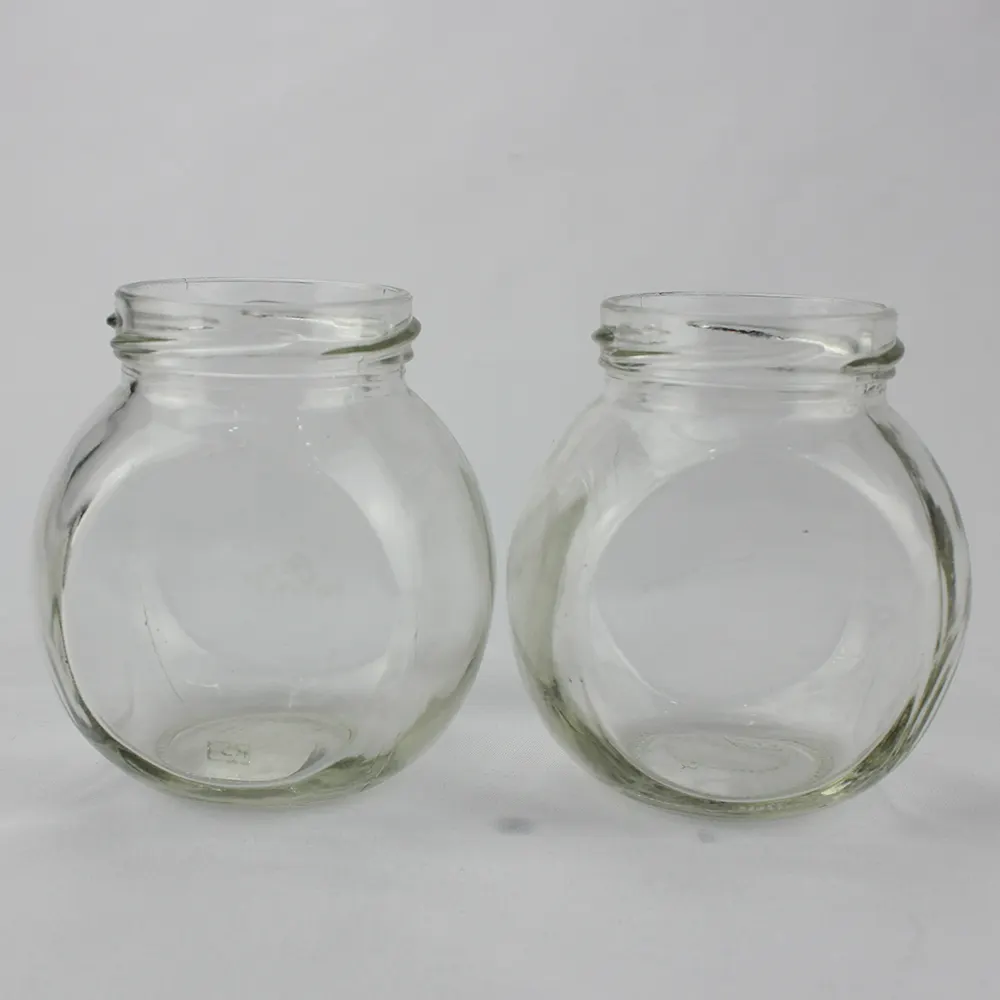
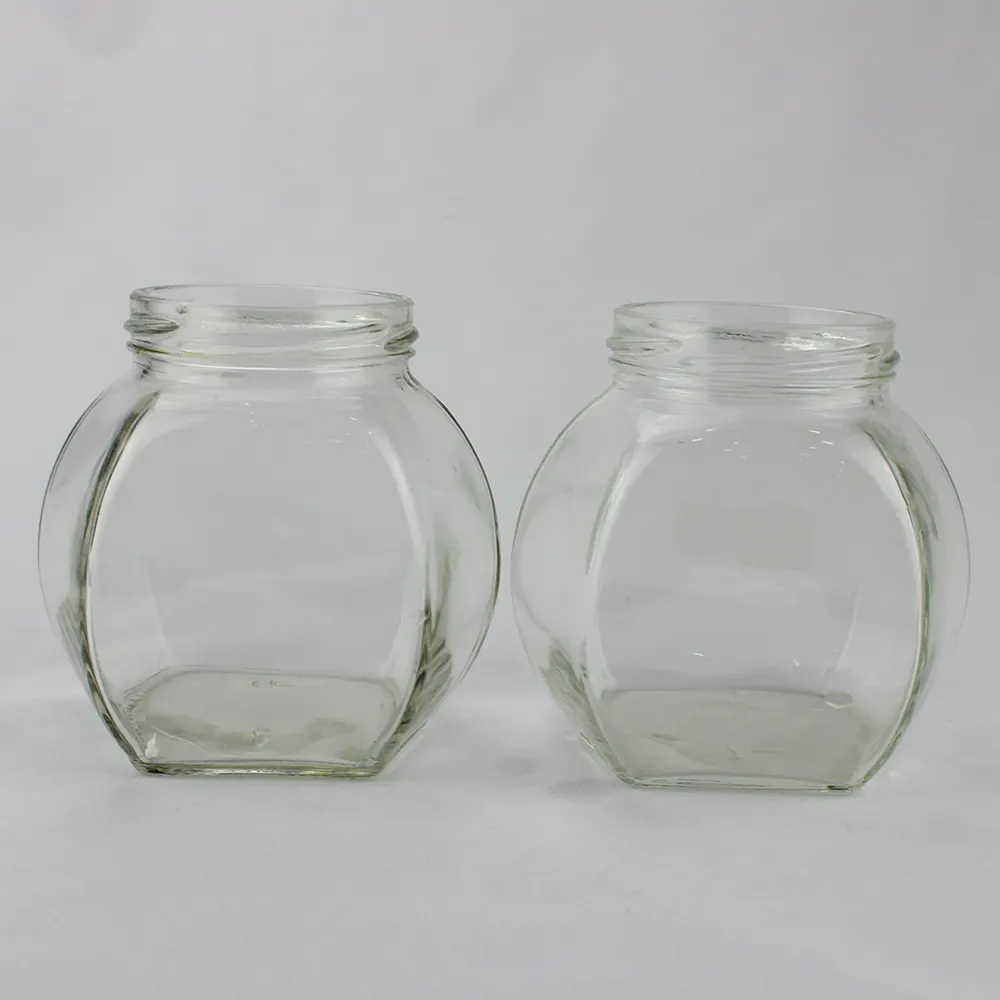
Part of our wholesale glass jars range; the stock moulds are pictured at the end of this guide.
Choosing a honey jar is about matching size and silhouette to your sales channel. This page compares the classic honey jar styles – hex, queenline, round, muth – across every capacity from sampler to bulk.
- 1.5-2oz hex jars: farmers-market samplers and gift sets
- 8-12oz queenline and classic round: the retail shelf standard
- 16-32oz wide-mouth rounds: family size and food-service
- 5lb bulk jars with lug lids: repacking and bakery supply
Related: see wholesale honey jar pricing
This page is a selection catalog for honey jar size and style: it helps honey brands and packers match capacity, mouth type, neck finish and jar silhouette to a specific sales channel. It is deliberately not the pallet-level procurement or harvest-calendar planning guide (that work lives on the bulk honey-jars page), and it is not a price sheet (the wholesale honey-jar page carries program pricing) — here the question is “which jar,” not “how many pallets” or “what does it cost per thousand.”
Honey is one of the most demanding products you can put in glass: it is hot-filled, it crystallizes, it is sold by weight across a dozen national conventions, and the lid has to hold a vacuum seal through all of it. Sourcing glass honey jars wholesale is therefore less about finding a pretty jar and more about matching three systems — the jar’s capacity-to-weight convention, the lug finish that matches your capping line, and a closure that keeps the seal from the filler to the customer’s kitchen. This guide covers the standard sizes and finishes, closure and sealing mechanics, food-contact compliance, wholesale economics, and the questions honey packers ask before the first pallet.
Key Takeaways
- Honey is sold by weight, filled by volume. A “1 lb” or “500 g” jar is really a brimful-capacity decision — honey’s density (~1.4 kg/L) means the glass must be sized for the declared weight plus headspace, and a mis-match is a common, avoidable returns cause.
- The lug finish picks your cap. Twist-off (TO) sizes 43/48/53/58/63/70/82/100 mm are not interchangeable; match the finish to your capper and your cap supplier’s range before you commit to a mold.
- Vacuum seal is the freshness signal. A plastisol-lined metal lug cap, applied on hot-fill, gives the audible “pop” consumers trust — and the tamper evidence retailers require.
- Hot-fill demands thermal discipline, not heroics. Filling at 80–90 °C into ambient glass requires thermal-shock-rated jars (verified per ISO 7459) and controlled cooling; the jar choice is “rated for it,” the technique is yours.
- Stock molds dominate for good reason.
- Style is a channel decision. Hex reads “farmers-market,” queenline reads “gift,” square stacks for export, and bear reads “kids” — the silhouette does merchandising work before the label does.
Standard Honey Jar Sizes and Specifications
Honey jars are specified by the weight of honey they declare, which varies by market — 8 oz and 1 lb in the US, 250 g / 500 g / 1 kg in metric markets. The table below maps typical declared weights to glass capacity and finishes across our running programs. Final brimful capacity and headspace are confirmed against your fill weight and density on the project drawing.
Brimful Capacity vs Declared Net Weight: The Conversion Most Buyers Get Wrong
The single most common specification error in a honey program is treating the jar’s label size and its real fill as the same number. They are not. Honey is almost always sold by weight (ounces or grams) but the glass is sized and tooled by volume (millilitres, or brimful capacity). The bridge between the two is density, and honey’s density is not a fixed point: it runs roughly 1.38–1.45 kg/L depending on moisture content and temperature, and it creeps upward as the jar cools and as trace crystallization begins. A jar stamped “1 lb” in a US catalog therefore needs enough internal volume for ~454 g of honey at your actual fill density, plus the headspace that keeps the meniscus off the lid and gives the vacuum seal somewhere to seat.
When the two systems are not reconciled on the drawing, the failure mode is predictable: the filler reaches the declared net weight before the jar is full (you short-fill and risk a weights-and-measures rejection), or the jar looks full at the declared weight but leaves no headspace (no vacuum, weak or absent “pop,” seal complaints). Either way the retailer or end buyer sends product back, and the root cause is a capacity spec that was copied from a competitor’s listing rather than measured. The fix is mechanical, not cosmetic:
- Ask the supplier for brimful capacity, not just “holds 500 g.” Brimful (sometimes written “overflow”) is the volume to the very top of the finish. Declared net weight is a fraction of that, and the gap is headspace.
- Convert against your own honey’s density. Required brimful volume ≈ (declared weight ÷ measured density) × (1 + headspace fraction). If you declare 500 g at 1.42 kg/L you need ~352 ml of honey volume; add ~8–12% headspace and you are shopping for a ~385–400 ml brimful jar, not a “370 ml” one.
- Fix fill temperature on the same drawing. Honey shrinks as it cools, so a hot-fill that looks short when hot can look correct when cold — or the reverse. Lock the fill temperature and the headspace together, and have the supplier confirm brimful on a first-article sample at that temperature.
- Watch the moisture variable. High-moisture honey is lighter per millilitre, so the same jar holds more grams; low-moisture honey is heavier, so the same jar holds fewer grams. If your moisture band is wide across harvests, size for the dense end.
The practical takeaway for a selection exercise: pick the row in the matrix by the weight you sell, then read the brimful millilitre column as the real engineering target, and confirm that number on a drawing before you order tooling or caps.
The Size-and-Style Selection Matrix (1.5 oz to 5 lb)
| Nominal Size | Mouth Type | Neck Finish | Closure | Glass Colour | Label Panel | Best For | Notes |
|---|---|---|---|---|---|---|---|
| 1.5 oz (≈45 ml) | Regular | TO 43 | Lug twist-off / CT / metal lid | Flint / amber | Small (wrap ≈90–130 mm) | Sampler, gift sachet | Hex mini most common; brimful 48–55 ml — confirmed per project |
| 2 oz (≈60 ml) | Regular | TO 48 | Lug / CT / metal / wooden lid | Flint / amber / green | Small (≈100–140 mm) | Sampler, gift set, hotel amenity | Hex or round; wooden lid for non-sealed gift use — confirmed per project |
| 4 oz (≈120 ml) | Regular / wide-mouth | TO 48 / TO 53 | Lug / CT | Flint / amber / green | Small–medium | Gift, sampler multipack | Queenline and mini round; brimful 125–140 ml — confirmed per project |
| 8 oz (≈227–250 ml) | Regular / wide-mouth | TO 53 / TO 58 | Lug twist-off | Flint / amber / green | Medium | Retail, portion pack | Classic round and queenline; brimful 240–270 ml — confirmed per project |
| 12 oz (≈355 ml) | Regular / wide-mouth | TO 58 / TO 63 | Lug twist-off | Flint / amber | Medium | Retail, gift | Queenline standard; brimful 365–400 ml — confirmed per project |
| 1 lb / 16 oz (≈370–425 ml) | Wide-mouth | TO 63 / TO 70 | Lug twist-off / metal lid | Flint / amber | Large | Retail, gift, food service | Round and hex queenline; brimful 390–450 ml — confirmed per project |
| 2 lb / 32 oz (≈720–850 ml) | Wide-mouth | TO 70 / TO 82 | Lug twist-off / metal lid | Flint / amber | Large–XL | Bulk repack, food service | Square and round; brimful 750–900 ml — confirmed per project |
| 5 lb / 80 oz (≈1.9–2.3 L) | Wide-mouth | TO 82 / TO 100 | Lug twist-off / metal lid | Flint | XL | Bulk repack, bakery, food service | Wide-mouth round; brimful 2.0–2.4 L — confirmed per project |
Values are typical ranges from current production programs, provided for planning. Honey density varies (roughly 1.38–1.45 kg/L by moisture and temperature), so declared weight, fill temperature and headspace are fixed together on the drawing — we mark any unpublished model data “to be confirmed per project” rather than leave a blank field. Neck-finish codes follow the continuous “TO” (twist-off) convention; the number is the finish diameter in millimetres, and it is the one dimension that must match your capper exactly.
Matching Jar Style to Sales Channel
The silhouette does merchandising work before the label is read, so “which shape” is a channel decision, not a decoration decision. The four shapes that dominate honey selection each default to a channel:
- Hex. The faceted hex jar reads “farmers-market,” “raw,” and “local” at a glance. It is the sampler and gift-set default in the 1.5–8 oz range, where the facets catch light on a shelf and signal “small-batch.” Hex is harder to label cleanly on a flat panel than a round, so it suits short runs and premium position more than high-speed private label.
- Round (classic and queenline). The workhorse retail jar. Queenline — the tapered “shoulder” shape — is the gift and premium-retail standard because the tapered body reads as “pour” and gives a generous front label panel. Plain rounds dominate 1 lb food-service and private-label retail where label real estate and capper commonality matter more than silhouette character.
- Square. The stacking, export and food-service shape. Square jars pallet and shelf denser than rounds, which is why they appear in 1 lb and 2 lb export and food-service programs where cube utilisation beats shelf romance. The flat faces are also the easiest to label and to print directly.
- Bear. The kids-and-gift shape. Bear jars outsell rounds in children’s honey and gift segments but carry their own tooling and breakage logistics (covered on the honey-bear guide). For a selection catalog, treat bear as a channel-specific exception, not part of the core sampler-to-bulk size run.
Sampler jars (1.5–2 oz) earn a special note because they punch above their volume. At a trade show or in a gift set they are the lowest-risk way to put product in a buyer’s hand: small glass weight means low freight and low breakage exposure, and a 1.5–2 oz hex or mini round is cheap enough to give away yet substantial enough to feel like real honey. The apiary co-op case study below leaned on exactly this — a small SKU that opens doors at expos without committing volume to a shape that may not survive the retail cut. If you are building a range from zero, start the sampler before you commit the 1 lb hero.
Closures and Sealing: The Lug Cap System
The twist-off lug cap is the honey industry standard for good reason: the cap’s lugs engage the jar’s thread profile, and a plastisol liner flows into the finish during capping to form a hermetic seal. On a hot-fill line (honey at 80–90 °C), the cooling contents pull a vacuum that seats the safety button — the consumer’s audible proof of integrity. For a selection exercise the decisions that actually change the jar you buy are these:
- Lug (twist-off) vs CT (continuous thread). Lug caps have interrupted lugs that snap onto a matching lug finish and are the vacuum-seal standard for hot-fill honey. CT caps have a continuous thread and suit ambient, non-vacuum fills (creamed honey, some gift packs) but do not deliver the same tamper-evident “pop.” Pick lug unless you have a specific ambient, non-vacuum reason not to — and if you do pick CT, say so early because it changes the finish family.
- Finish size is the master constraint. TO 43 through TO 100 are not interchangeable; the finish must match both the jar and your capping head. Changing finish later means changing chucks and cap inventory, so the finish is decided before the silhouette, not after.
- Liner choice is a honey-specific call. Honey is hygroscopic and it crystallizes, so the liner has to do more than look neat: a plastisol liner flows and welds the vacuum on hot-fill, while pulp or foam liners suit only non-vacuum, ambient packs. For long shelf life and to slow moisture-driven crystallization at the seal, the liner must resist vapour transmission — ask the cap supplier which liner grade they recommend for honey, and get it named on the declaration.
- Cap-to-jar convention by size. Small samplers (TO 43/48) take small lug or CT caps; the 8–12 oz retail band sits on TO 53/58/63; 1–2 lb on TO 63/70/82; 5 lb bulk on TO 82/100. The convention exists so one cap supplier can cover a size range — which is exactly the lever the co-op case study uses.
Every jar-and-cap combination we quote is verified as an assembly: finish gauges on first articles, cap torque windows, and seal integrity (inverted storage at 40 °C for 24 hours) before mass production release. When you are selecting, the question to the cap side is not “do you have lids” but “do you have the liner grade and the TO size for the finish this jar uses.”
Hot-Fill and Thermal Shock: The Engineering Detail
The only selection question that matters here is whether your honey needs hot-fill, because that decides the jar grade — not the thermal-shock engineering itself (that belongs on the process page). In short: most honey is filled at 80–90 °C to stay fluid and delay crystallization, and any jar used that way must be specified with thermal-shock resistance verified per ISO 7459 and annealing checked per ASTM C148. If your pack is ambient, creamed, or cold-filled, you can relax that grade and the capping family shifts toward CT and non-vacuum liners. So the decision tree for this page is two branches: hot-fill → thermal-shock-rated jar + lug vacuum cap; ambient/cold → standard jar + CT or non-vacuum cap. We provide practical line guidance (jar pre-warming, controlled cooling) with every hot-fill program because filling technique matters as much as the glass — but the jar you select is the rated one, and the technique is yours to run.
Food-Contact Compliance for Export Markets
Glass is the least problematic food-contact material — but “glass is inert” is not a compliance file, and the selection catalog is the wrong place to declare a market passed. For export honey programs the buyer confirms compliance against the destination; our role is to hand you the document set to do that. What to prepare, and what to ask:
- Glass migration reports. Ask for third-party heavy-metals migration test reports referencing EU Framework Regulation 1935/2004 and FDA 21 CFR food-contact expectations for glass. These are the documents your importer or retailer audit will ask for; request them quoted with the glass, not after.
- Cap and liner food-grade declarations. The lid is food-contact too. Get a food-grade declaration for the cap lacquer and the liner compound, named to the liner grade you selected above — this is where honey’s vapour-resistance requirement meets the compliance file.
- Production records. Annealing verification, capacity confirmation, and first-article inspection records support retailer and organic audits. Ask that they travel with the shipment paperwork, not sit at the factory.
- Name the market and the certification in the first inquiry. If your destination requires a specific mark (organic private label, a national retail standard, or a residue-free declaration), state it up front so the document set is quoted with the glass rather than discovered at the port.
We provide the reports and declarations on request; we do not declare your market “passed.” The buyer confirms the destination’s rule, and we supply the evidence to meet it. The questions to put to any supplier: “which migration standard do your glass reports reference,” “can you declare the cap lacquer and liner food-grade,” and “will the production records ship with the container.”
Wholesale Economics: What a Honey Jar Program Costs
Honey jars are workhorse glass — the economics reward consolidation. A realistic landed budget for a wholesale honey-jar program at container volume (structure only; per-thousand pricing lives on the wholesale honey-jar page):
- Glass jar (ex-works): 55–70% of landed cost — capacity and glass weight drive this line, so the size you pick in the matrix above is also the biggest cost lever.
- Lug caps: 8–15% — printed and specialty-colour caps at the top of the range; the liner grade from the closure section sits in here too.
- Packing and inland freight: 3–5% — divider cartons or bulk-layer packing by agreement; square jars usually win a point or two on cube.
- Sea freight, insurance, duties: 10–20% — a 20 ft container holds roughly 20,000–30,000 jars in the 212–425 ml range depending on style and how the sizes mix.
The selection takeaway: a bigger or heavier jar is not just more glass, it is a worse freight cube and a different cap cost, so the size decision from the matrix flows straight into this budget. Ask every supplier to quote glass, caps, packing and freight as separate lines — and to state container loading for your exact jar. A jar that pallets badly can cost more in freight than it saves ex-works.
Frequently Asked Questions
What is the MOQ for wholesale glass honey jars?
Minimum quantities are quoted per project, because they depend on the mould and the line it runs on.
Which twist-off finish should I choose for honey?
Match the finish to the jar size and your capping line: TO 53/58 for 212–314 ml, TO 63/70 for 370–500 g jars, TO 70/82 for 1 kg formats, TO 82/100 for 5 lb bulk. If you already own capping heads or cap inventory, tell us the finish first — we will match jar options to it rather than the other way around. The finish is the master constraint in the selection matrix, so decide it before the silhouette.
Can the jars handle hot-filling at 85–90 °C?
Yes — honey jars are specified for hot-fill with thermal-shock resistance verified per ISO 7459 methods and annealing checked per ASTM C148. We include practical line guidance (jar pre-warming, controlled cooling) with every hot-fill program, because filling technique matters as much as the glass. If your pack is ambient or creamed rather than hot-filled, you can select a standard jar and a CT or non-vacuum cap instead.
Do you supply the metal lug caps with the jars?
Yes, jars and caps are quoted as one tested assembly: plastisol-lined tinplate lug caps matched to the finish, with custom colors and litho printing available from moderate volumes. Seal integrity is verified (inverted storage at 40 °C for 24 hours) before mass release. Specify the liner grade for honey when you order, because the liner is what resists vapour and slows crystallization at the seal.
What food-contact documents can you provide for export?
On request: third-party migration test reports for the glass (heavy metals, per EU 1935/2004 and FDA 21 CFR expectations), food-grade declarations for cap lacquers and liners, and production records including annealing verification and first-article inspection. Name your market’s specific certification needs in the first inquiry so the document set is quoted with the glass. We supply the evidence; the buyer confirms the destination rule.
Can I mix jar sizes in one container?
Yes. Mixed loading is standard for size ranges — cartons are palletized by SKU with loading photos, and we plan the container layout so each size meets its adjusted minimum while the freight cost splits across the range. A three-size standard like 250 g / 340 g / 1 kg typically loads cleanly because the smaller jars fill the gaps around the larger ones.
How do I convert a declared honey weight into the glass capacity I need?
Start from the weight you sell, not the volume you imagine. Required brimful volume is roughly (declared weight ÷ your honey’s measured density) × (1 + headspace fraction), where honey density runs about 1.38–1.45 kg/L and headspace is typically 8–12%. So a 500 g declaration at 1.42 kg/L needs ~352 ml of honey volume plus headspace, pointing you to a ~390–450 ml brimful jar. Ask the supplier for brimful capacity on a first-article sample at your fill temperature, because honey shrinks as it cools and the two systems must be reconciled on the drawing to avoid short-fill or no-vacuum rejects.
Regular mouth or wide-mouth — which should I pick for honey?
For honey the mouth type tracks the size and the use. Samplers and 8–12 oz retail jars are usually regular mouth (TO 43–63) because the narrower finish suits the lug vacuum cap and looks right on a shelf. From 1 lb upward, wide-mouth (TO 63/70/82/100) wins: it is easier to fill with viscous honey, easier for the end user to dip or scrape, and standard on food-service and bulk repack. If your account is food service or bakery, default wide-mouth; if it is gift retail, regular mouth reads cleaner.
Which jar style fits retail shelf, gift sets, and food service best?
Hex for farmers-market samplers and gift sets in the 1.5–8 oz band; queenline round for premium retail and gift hero SKUs because the tapered body gives label room and reads as “pour”; plain round for 1 lb private-label retail and food service where capper commonality and label area beat silhouette; square for export and food service where cube utilisation and flat-label ease matter most; bear only for kids and gift channels. Match the shape to the channel first, then read the size matrix for the capacity and finish.
Start Your Honey Jar Order
Four details get you a usable quote in one round: declared weight per jar (250 g / 500 g / 1 kg / oz equivalents), preferred style (round, hex, queenline, square), finish or cap requirements (or your capping line’s chuck size), and fill temperature. Quotes are answered in one to two business days. If you are still choosing, send the channel list (retail / gift / food service / sampler) and we will propose a two- or three-SKU standard on one finish family, the way the co-op case study consolidated.
Request honey jar pricing with the details above.
- Compare program structure on glass bottles wholesale
- Verify production capability on glass bottle manufacturers
- Explore the broader jar range in our glass jar catalog
Related Packaging Guides
Considering the Bear Format?
Bear-shaped jars outsell round jars in kids’ honey and gift segments, but they bring their own sourcing challenges. Our guide to honey bear jars covers sizes, lids, labeling and breakage logistics.