One of our guides on perfume bottles in bulk; start there for the overview.
A glass atomizer bottle is the right pack for alcohol-based perfume and for water-based room mist, because its pump turns a metered dose into a fine, even cloud instead of a drop or a rolled line. The wholesale range runs from 5 ml to 100 ml in soda-lime glass, with a screw or crimp neck of 13 mm to 20 mm and a pump that delivers 0.08 ml to 0.14 ml per stroke. Pick the capacity by sales channel, the neck by whether the bottle must be refillable, and confirm the closed height before anything else is fixed.
Standard sizes, neck finishes and pump output
Six capacities cover almost every fragrance brief. The neck is sized so that a standard screw or crimp pump seats without an adaptor ring, and pump output can be tuned on request; room mists usually take a slightly higher dose and a broader spray than fine fragrance.
| Capacity | Screw neck | Crimp neck | Pump | Bottle height | Pieces per export carton |
|---|---|---|---|---|---|
| 5 ml | 13 mm | 15 mm | Mini spray, 0.08 ml/stroke | 48 mm | 1000 |
| 10 ml | 15 mm | 15 mm | Fine mist, 0.10 ml/stroke | 62 mm | 720 |
| 15 ml | 15 mm | 18 mm | Fine mist, 0.10 ml/stroke | 78 mm | 540 |
| 30 ml | 18 mm | 20 mm | Fine mist, 0.12 ml/stroke | 92 mm | 360 |
| 50 ml | 18 mm | 20 mm | Fine mist, 0.12 ml/stroke | 108 mm | 240 |
| 100 ml | 20 mm | 20 mm | Fine mist, 0.14 ml/stroke | 135 mm | 140 |
Dimensions are nominal. Expect plus or minus 0.3 millimeter between mould batches, and have the drawing checked against your signed sample before the production run starts.
The heights above are for the glass alone. If a filling line has fixed clearance, or a retail shelf has fixed depth, ask for the closed height: bottle, pump and collar together. An aluminum shell on a travel atomizer adds roughly 6 to 9 millimeters to that figure.
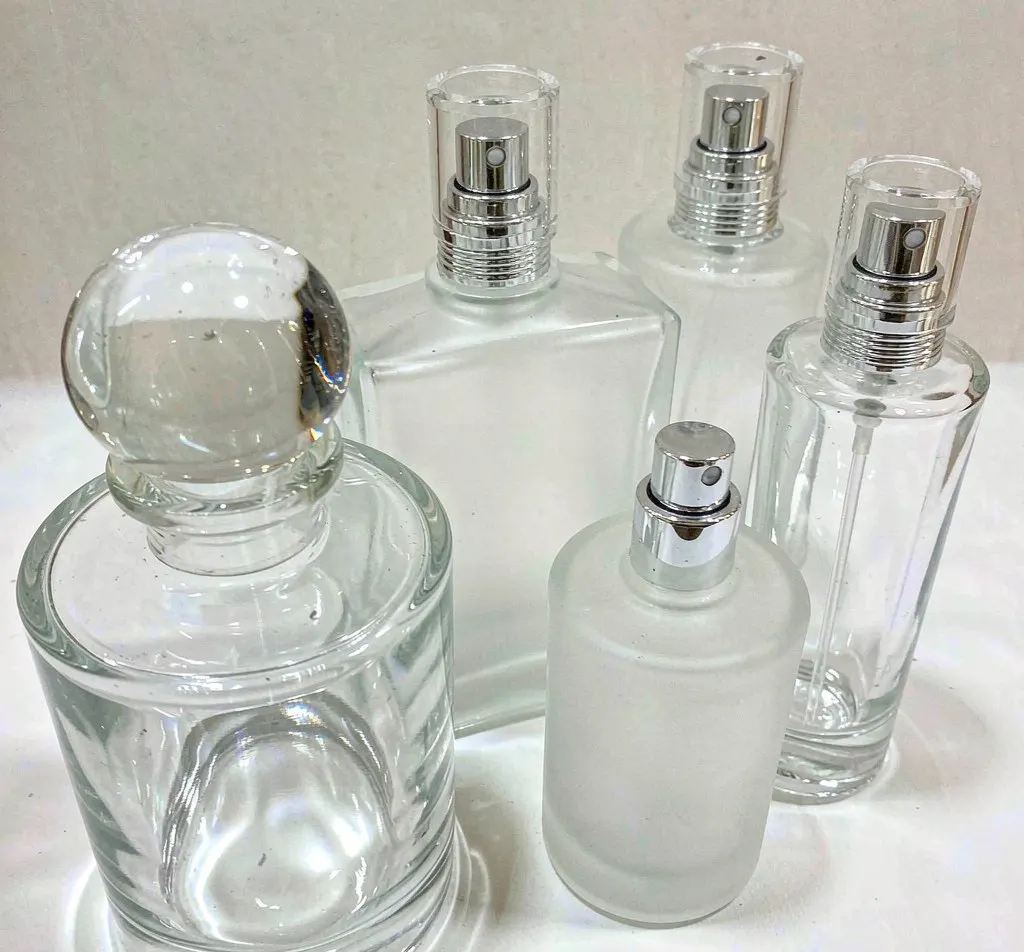
Screw-thread or crimp neck
The two neck types answer different briefs. A screw-thread pump can be unscrewed, so the owner can refill the bottle and reseal it many times; this is the format behind refill stations, refill pouches and the refillable travel spray. A crimp neck is closed permanently at filling, which gives a tamper-evident finish and suits the aluminum-shell travel atomizer that is sold as an accessory. Where a shell design also has to be refillable, it can be specified with a screw pump instead.
Check first that a spray is what the formula needs. An atomizer always sprays. A serum, an oil or a concentrated extract that is meant to be dabbed belongs in a dropper bottle, which releases drops through a glass pipette, or in a roll-on bottle with a steel or plastic ball, which draws an oily line on the skin. The three closures do not swap onto one neck, so this choice comes before the bottle is selected. Spraying also keeps the fragrance off the hands and preserves the sillage the perfumer intended.
Which capacity suits which channel
One bottle family can cover full-size retail, trial sizes and travel refills, which is why many brands specify the whole range together. Demand is being pushed from two sides: refillable perfume has become an ordinary retail expectation, and small formats keep growing as shoppers build a wardrobe of scents and brands rely on discovery sets to win first-time customers.
Retail eau de parfum and eau de toilette, 30 ml to 100 ml
At 30ml, 50ml and 100ml the bottle is the object the shopper judges on the shelf. For the two larger sizes, a heavy glass base makes the bottle feel settled in the hand, and a crimped aluminum collar with a weighted actuator gives a firm press. Clear or lightly tinted glass shows a coloured juice; deeper amber or cobalt signals protection from light.
The pump matters as much as the glass. It has to produce a soft plume. A jet wets the skin unevenly and makes an expensive fragrance feel cheap.
Discovery sets, 5 ml and 10 ml
Discovery sets hold sprays of 1.5ml to 10ml, and the 5ml and 10ml bottles are the usual choice: they give several wears, cost little to bundle, survive the post, and let the trial mimic the full-size ritual. Mini atomizers come in both screw and crimp versions, and the mini closure can be matched to the full-size one so the set looks like part of the same line.
Seal integrity is the weak point at this size. Sets travel by air and meet pressure and temperature changes on the way, so the seal on small vials needs particular scrutiny if the samples are not to weep in the box.
Travel and refillable atomizers
The same 5ml and 10ml sizes sit well under the 100ml carry-on liquid limit and fit a clutch or a wash bag. In the refillable version, the customer keeps one aluminum-shell atomizer for years and tops it up at home through a funnel or a decanting adapter. Three details make that work:
- a screw-thread pump that tolerates repeated opening and resealing;
- an anodized aluminum shell hard enough to resist abrasion in a pocket;
- a volume mark or a window, so the user can see when to refill.
Both men's and women's lines buy this format. For personal-care sprays that are not fragrance, the matching travel format is the glass pump bottle supplied in bulk.
Linen, bathroom and room mists
Home fragrance on a water or alcohol base mostly uses 30ml to 100ml, with a wider plume and a higher output per stroke so that one press scents more air. These brands often ask for a taller, slimmer bottle and for coloured or frosted glass that matches a decor range. If the collection also includes passive scenting, reed diffuser bottles are the non-pressurized counterpart, and the two formats can be decorated as a pair.
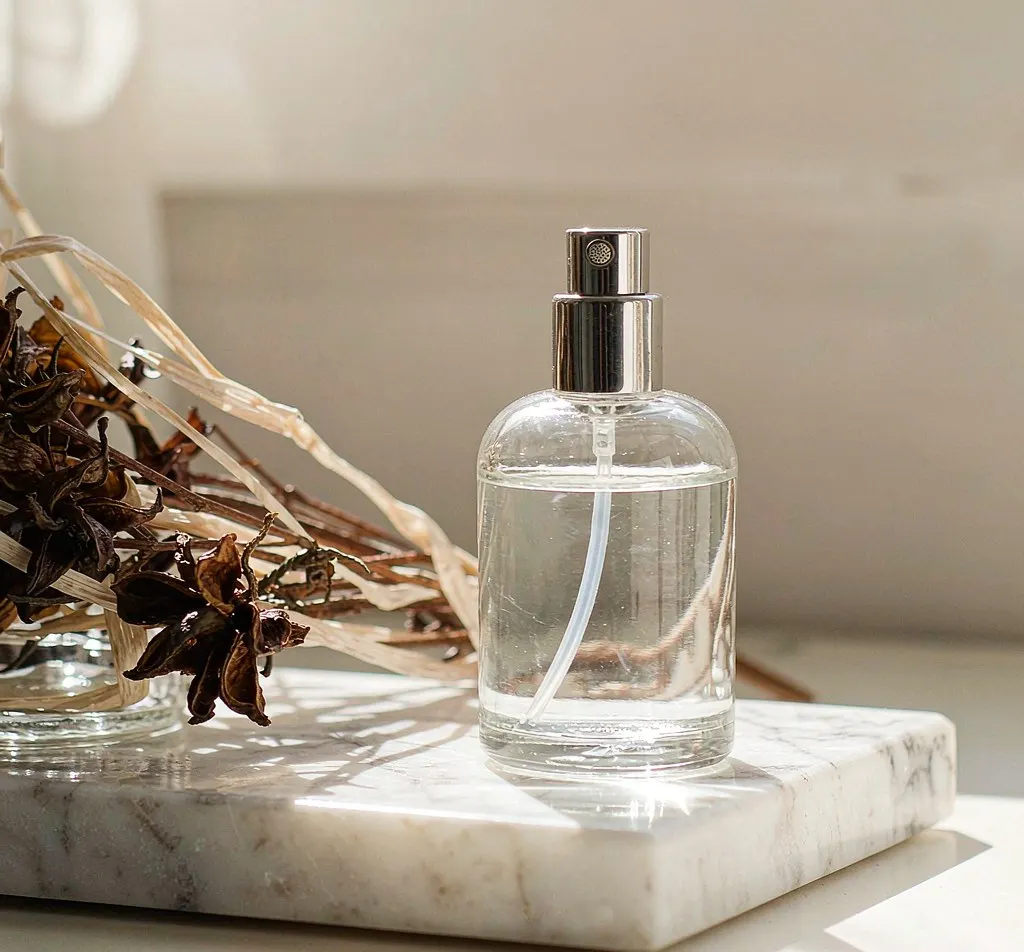
Decoration and custom shapes
Most of the difference between one perfume bottle and another is added after the glass is formed. The usual options are:
| Finish | How it is done | What it gives |
|---|---|---|
| Frosting (satin, matte) | Acid etching, or a sprayed frosted lacquer | A soft, tactile surface that also hides minor surface defects |
| Silk-screen printing | Logo and text in one or several colours, printed directly on the glass | Holds up to filling-line handling and washing far better than a stick-on label |
| Hot-stamp foil | Gold, silver or a custom metallic, applied after the silk screen | A reflective logo or border |
| Glass colour | Transparent or opaque colour, subject to a colour-run minimum | Brand colour in the glass itself |
| Pump and collar colour | Aluminum shells, collars and actuators anodized to any Pantone; ferrule colour-matched | A closure that belongs to the brand instead of a generic silver cap |
A fully owned silhouette is also possible. A custom mould can be developed from a 3D file or a sculpted prototype, with proprietary shoulder curves, a logo embossed on the base, or a pump architecture of its own. It carries a one-time mould fee and takes longer, and in return no competitor can buy the same bottle from stock.
For most launches a stock shape is the more sensible start. Custom colour, frosting, silk screen, hot stamp and a coloured aluminum shell together give a stock bottle most of the visual distinction of a bespoke one.
Glass, alcohol compatibility and spray testing
Soda-lime glass is the standard material for fragrance. It does not react with ethanol, the main solvent in perfume, it is stable with water-based formulas, it is economical at volume and it is fully recyclable. Tinted, it also blocks light and oxygen well enough to protect volatile top notes. For an unusual formula, a compatibility soak test can be run before approval, with any clouding, crazing or weight change reported.
The closure is where alcohol causes trouble. A gasket that swells, hardens or off-gasses in ethanol fails in the customer's hands and comes back as a return. The specification should therefore call for alcohol-resistant elastomers throughout the pump path, with a check that the closure passes no odour to the fragrance.
Three further checks are worth writing into the order:
- Spray. Sampled pieces from each production lot are checked by stroke count and droplet size, to confirm a fine conical mist and an actuation force that any user can press comfortably.
- Leaks. Filled samples go through temperature cycling and a simulated altitude change, then the crimp, collar and actuator are inspected for weeping. A lot that fails does not ship.
- Inspection record. Each shipment carries a record of appearance, capacity tolerance, pump function and carton quantity, so the receiving team has a standard to check against.
Packing, quotes and the pre-production sample
The carton counts in the size table are for the standard export carton. Bottles can instead be repacked into retail-ready inner boxes for an added handling fee, and decorated pieces travel with dividers and EPE sleeves to protect the finish during ocean freight.
Price is quoted per project in quantity tiers, with decoration listed line by line so the landed cost can be modelled. Silk screen is charged per colour per side, frosting per piece, hot-stamp foil by the area of the logo, and a custom anodized shell as a fixed amount per closure.
Order a decorated pre-production sample before the run. It is the one point at which a colour mismatch or a print registration fault can still be corrected before the goods are packed into a container. To start a brief, send capacity, neck type, decoration, quantity and destination through the cosmetic glass bottle collection, where the compatible closures are listed too.
Frequently asked questions
Which capacity should a discovery set use?
Usually 5ml or 10ml. The 5ml bottle also serves as a travel atomizer, so a single specification can supply both the sampling programme and the travel line.
Can the bottle and the pump be matched to a brand colour?
Yes. The glass can be coloured, subject to a colour-run minimum, and the metal parts of the closure are anodized to a Pantone reference. Frosting, silk screen and hot-stamp foil then carry the brand across the whole pack.
What are the minimum order and the price?
Both are quoted per project. The minimum depends on the mould and on the production line it runs on; the price depends on quantity and on the decoration lines listed above.
How long does production take, and are samples available?
Timing is confirmed per project once the mould, the decoration and the line schedule are known. Stock samples and a decorated pre-production sample can both be arranged before an order is placed.