Part of our frosted bottles range, where the stock moulds for this are listed and quoted per project.
A matte black glass bottle is a clear flint bottle sprayed with an opaque matte coating and heat-cured, and it lets through less than 0.5% of light across 290–450 nm, the band that breaks down retinol, vitamin C and citrus oils. The stock range runs from 15 to 100 ml on 18/415, 20/410 and 24/410 necks, taking droppers, fine-mist sprayers, lotion pumps and caps. What a buyer has to pin down is the coating itself: adhesion of at least 4B on the cross-cut test and proven resistance to the ethanol or essential oil in the formula.
Three ways a bottle ends up black
"Black glass" covers three different production routes, and mixing them up is the specification mistake we meet most often when a quotation request arrives. Each one behaves differently with alcohol-based perfume, with essential oils and under the rubbing of a filling line or a parcel in transit, and each has its own cost and durability profile.
| Route | How the colour is made |
|---|---|
| Body-tinted black glass | Iron, cobalt and carbon-based colourants are melted into the batch at the furnace |
| Black lacquer on flint | A clear bottle receives a black lacquer, UV-cured or thermally cured |
| Matte black spray coating | A matte coating is sprayed onto flint or lightly tinted glass and thermally cured |
Only the third gives the non-reflective, soft-touch surface buyers mean when they say "matte black". The same coating without its matting agent is glossy black, which reflects like paint.
Frosted glass is a different thing again. It is a surface etch or a satin spray that stays translucent, so the liquid remains visible and light still gets in. Where a soft, low-gloss look with partial light transmission is enough, frosted glass bottles are the more economical choice. The rest of our cosmetic glass bottle collection sets out the other primary-pack options.
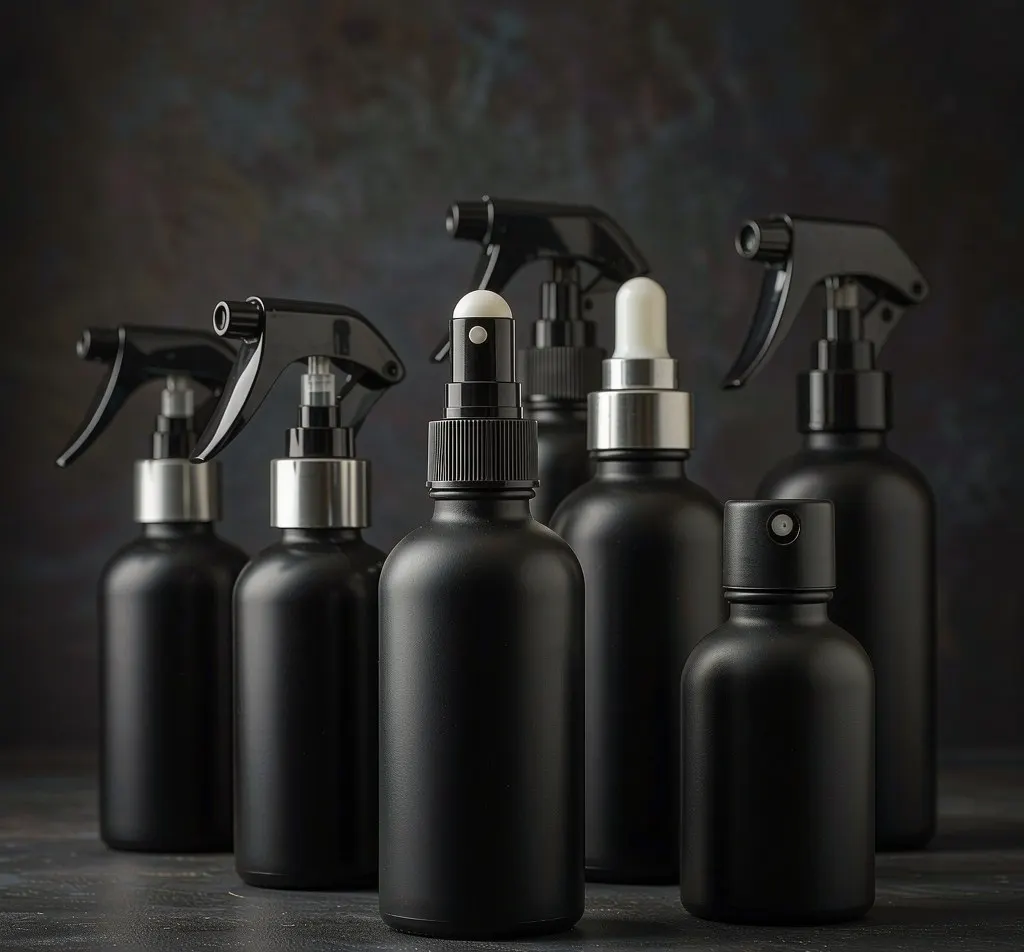
Standard sizes, necks and closures
Stock shapes are cylindrical, rectangular and Boston round, in the 15–100 ml band used for serum, essence, eau de parfum, beard oil and roll-on concentrates. Necks follow the SPI standard series, so closures can come from more than one supplier. Weights below are for the empty glass.
| Capacity (ml) | Shape | Neck finish | Empty weight (g) | Closures that fit |
|---|---|---|---|---|
| 15 | Round / Boston | 18/415 | 38–42 | Dropper, spray, cap |
| 20 | Cylindrical | 20/410 | 45–50 | Spray, cap |
| 30 | Round / Boston | 18/415 | 58–64 | Dropper, spray, pump |
| 30 | Rectangular | 20/410 | 62–68 | Dropper, spray |
| 50 | Round / Boston | 24/410 | 95–105 | Pump, spray, cap |
| 60 | Cylindrical | 24/410 | 110–120 | Pump, spray |
| 100 | Round / Boston | 24/410 | 165–185 | Pump, cap |
The 18/415 neck does most of the work for droppers and fine-mist sprayers, and using it on both 15 ml and 30 ml keeps one closure in stock for two sizes. For shipping by parcel, rectangular and cylindrical bodies hold up best because their flat faces spread point loads; we suggest them as the default unless the brand needs a round silhouette. Dropper-ready 15/30 ml bodies with reduced-neck options for tamper-evident droppers are in the serum glass bottle range.
Match the neck to the filling line
Essential oils and carrier oils such as jojoba, argan and squalane flow freely through 18/415 and 20/410 necks at room temperature. Thick balm phases and suspensions carrying clay or mica need 24/410 with a pump or a wide orifice, or the product bridges at the fill head.
As a guide to fill rate, an 18/415 neck supports 20–40 bottles/minute on a standard gravity filler, and 24/410 supports 30–60/minute on a piston filler. Choose the neck for the line as well as for the closure.
How much light the coating blocks
A formula that is stable at T0 can lose 20–40% of its labelled actives within eight weeks of shelf and window exposure when the bottle passes visible and near-UV light. Retinol, ascorbic acid, some peptides, citrus and conifer essential oils and many synthetic aroma chemicals all degrade in the 290–450 nm band.
Measured on a UV-Vis spectrophotometer with an integrating sphere at 10 nm resolution, a properly cured matte black coating on flint shows spectral transmittance of <0.5% across that whole range, covering UVA, UVB and the violet edge of visible light. It remains under roughly 0.5% out to 500 nm.
| Glass | Light transmission |
|---|---|
| Matte black on flint | <0.5% across 290–450 nm, staying low to 500 nm |
| Amber | Typically 50–70% at 450 nm; under 5% only below ~350 nm |
| Cobalt blue | Similar to amber in the visible blue window |
Amber and cobalt protect in the UV bands but still pass light at 400–500 nm, where some pigments and essential-oil constituents continue to react. For a bergamot-led fragrance or a vitamin C serum, matte black is therefore the strongest off-the-shelf glass protection short of a metal pack or a fully wrapped label. Where a lighter look matters more, amber cosmetic bottles handle UVB-heavy actives and cobalt blue glass bottles cover the UV-A band, though neither blocks the full window.
Coating specification and the tests behind it
The matte finish is a two-component polyurethane or UV-hybrid coating, atomized on a robotic HVLP line. The matte effect comes from the ratio of pigment to matting agent, typically 6–9% silica matting agent by weight, and not from abrading the surface. That is why it stays even over curved shoulders, where frosted etching would thin out.
Film thickness
Target dry-film thickness is 18–25 μm, read with a magnetic induction gauge on a control coupon for each batch. Under 15 μm the finish looks grey and the glass shows through at the shoulder. Over 28 μm the base radius becomes more likely to micro-crack under filling-line vibration.
Adhesion
Adhesion decides whether the bottle is usable or comes back as returns. The test is the cross-cut per ASTM D3359 Method B and ISO 2409: a 6×6 grid at 1 mm spacing, pulled with 3M 600 tape. The acceptance gate is ≥4B, which allows flaking at the grid intersections on no more than 5% of the squares. The production standard is 5B, with zero flaking. Ask for the photograph of the cross-cut in the inspection report; a pass/fail line tells you too little.
Solvent and oil resistance
Alcohol-based perfumes and many toners contain 70–95% ethanol, which dissolves a poorly cured coating. The qualification is 50 double rubs under a 500 g load with a cloth soaked in 95% ethanol, followed by a repeat cross-cut. A pass means no blistering, no softening and no black on the cloth. Alcohol systems up to 95% ABV also get a 28-day immersion.
Ethanol alone is not proof for oils. Terpene-rich essential oils containing limonene or pinene can attack a coating that passed the rub test, so oil-phase products go through a 28-day static immersion at 40 °C using the real formula when the brand can supply it.
Temperature, impact and scuffing
Finished bottles are cycled from −20 °C to +60 °C in 48-hour cycles and must show no crazing at heel or neck. They are dropped from 1.2 m onto concrete at filled weight, in line with the carton's transit rating. Pencil hardness is held at ≥2H per ASTM D3363, enough to resist scuffing from clip strips and shelf handling.
Material safety
The coating formulation contains no heavy-metal pigments: no lead, cadmium or hexavalent chromium. It complies with EU 94/62/EC and US Prop 65 limits, which matters to brands selling in both the EU and California. The flint glass underneath is inert to acids, alcohols and most oil phases at room temperature, with extractable alkali kept to <0.5 µg/cm² under the standard hydrolytic test.
Closures and their compatibility with the coating
Most failures in the field begin at the closure. Each closure family should be qualified on the coated bottle, so that the cap shoulder does not scrape the coating when torque is applied and the liner suits the formula. Coating and closure are best specified as one system.
| Closure | Neck | Key data | Typical products |
|---|---|---|---|
| Glass dropper | 18/415 | Silicone bulb rated for 0.5–1.0 ml draw; borosilicate pipette with fire-polished tip | Serums, beard and face oils in 15/30 ml |
| Fine-mist sprayer | 18/415, 20/410 | 0.12–0.18 ml per stroke; mean droplet diameter 30–50 µm by laser diffraction | Eau de toilette, setting mist, hair and face mists |
| Lotion pump | 24/410 | 0.25–0.30 ml per stroke; lock-down collar for transit | Moisturiser, pumped toner, hand and body care in 50, 60 and 100 ml |
| Aluminium overcap | 18/415, 20/410 | Anodised matte black or gunmetal; sits flush with the shoulder | Fragrance |
A few details are worth writing into the brief. The dropper collar is polypropylene in matte black or an aluminium look, and the pipette should stop 1–2 mm above the inside base so the last of the serum can be drawn without sucking air. The bulb is food-grade silicone, not latex, which avoids an allergen declaration. A tamper-evident dropper ring is available for products placed under EU cosmetic regulation 1223/2009.
On sprayers, the collar is matte PP or anodised aluminium and the dip tube is cut to the bottle height so the pump primes in under four strokes. On pumps for alcohol or essential-oil formulas, specify a faced liner such as PE and avoid bare EPE, which absorbs solvent and swells. The flush overcap removes the visible seam a standard PP cap leaves.
Decide closure decoration with the bottle. Options are silk-screen printing in up to 3 Pantone-matched spot colours, hot-foil stamping in gold or silver, and laser engraving on aluminium caps. Print should meet the same cross-cut and ethanol-rub standard as the coating, so a logo does not flake where a weak coating would.
Where matte black is used
Beyond light protection, the finish removes reflections and hides variation in fill level, leaving the closure and the print as the only bright parts of the pack. Four categories use it most.
- Men's skincare and grooming. Briefs ask for low reflectivity, a monochrome look and weight in the hand. A 30 ml Boston round with an aluminium overcap and one hot-foil logo is typical. Beard and face oils take the 15/30 ml dropper, with a 20/410 neck when the oil is viscous enough to need a wider draw.
- Niche fragrance. Usually a 50 ml or 100 ml round with a 24/410 fine-mist sprayer and an anodised collar. Under retail spotlights the matte surface shows no glare, so the bottle reads as a solid form. Limited editions can run two-tone, with a matte black body and matte gunmetal shoulder, which holds print contrast without a label.
- Essential oils and concentrates. The 15/30 ml dropper, or a 10–15 ml roll-on with a steel ball. The barrier protects the terpene fraction from photodegradation and conceals the gradual darkening some oils show over a six-month shelf. Tamper-evident droppers are advisable, and child-resistant closures in markets that require them for certain concentrations.
- Serums and treatments. Vitamin C, retinol, peptide and antioxidant concentrates are the formulas most sensitive at 400–450 nm, where amber falls short. The default is a 15/30 ml dropper, paired with an induction-sealed liner for oxygen-sensitive actives.
Custom colour, documents and freight terms
A brand-specific black, whether warm charcoal, blue-black or true neutral, is matched against a Pantone reference or a physical master. Development is charged once, and the matched formula is kept on file so reorders use it again. For most projects, though, a standard shape set apart by closure, print and coating colour gives a distinct pack without new tooling.
Name the quality documents in the purchase order so nobody treats them as optional:
- coating cross-cut result, with the ≥4B gate stated;
- ethanol-rub or immersion result;
- spectrophotometer transmittance curve;
- hydrolytic-test extractables;
- carton-level AQL 2.5 inspection report per ISO 2859-1.
Consistency between orders depends on fixing the coating formula and the source of the substrate glass when the contract is signed. Several sizes, for example 15/30/50 ml, can travel in one shipment to cut freight per bottle. Goods can move on FOB, CIF or DDP terms, the last being useful for LCL freight to the EU or US when you want a landed cost. Quantities, pricing and timing are quoted per project and follow coating complexity, decoration, volume and freight terms.
Ten questions for a matte black supplier
These can go straight into an RFQ. Score each from 0–2, and treat a zero on adhesion, transmittance or heavy-metal compliance as disqualifying.
- Adhesion: is a cross-cut grade to ASTM D3359 / ISO 2409 quoted, with a ≥4B gate and a photograph per batch?
- Solvent resistance: is there a documented ethanol-rub or immersion test for alcohol and essential-oil formulas?
- Light blocking: can a transmittance curve showing <0.5% at 290–450 nm be produced?
- Compliance: are coatings free of Pb, Cd and CrVI and within EU 94/62/EC and Prop 65?
- Necks: are finishes standard 18/415, 20/410 and 24/410, so closures can be multi-sourced?
- Closures: are they qualified on the coated bottle, or only sold alongside it?
- Pilot: is a pilot run made before full production?
- Inspection: do cross-cut, rub, transmittance and AQL reports come as standard?
- Reorders: are the coating formula and glass source fixed?
- Freight: can shipments go FOB, CIF or DDP to suit your freight plan?
Answers should arrive with documents attached. We use the same list when we assess a plant for a matte black project.
Frequently asked questions
Does the coating hold up to perfume or hand sanitizer?
It does when it has been fully cured and tested. Look for the ethanol-rub result in the inspection report, and for essential-oil blends send the real formula for immersion testing, because a coating can pass ethanol and still be attacked by terpenes.
Should I choose matte black, glossy black or frosted?
Take matte when you need full light blocking and a soft, non-reflective feel. Glossy black blocks light in the same way but has a high shine. Frosted costs less and looks soft, yet it remains translucent.
What are the minimum order and lead time?
Both are quoted per project. They depend on the bottle shape and its mould, the coating colour, the closure and decoration, and the production schedule at the time of order.
Is the bottle safe for cosmetics sold internationally?
The coating contains no lead, cadmium or hexavalent chromium and meets the EU and Prop 65 limits cited above, and the glass is inert to the usual cosmetic phases. Tell us the destination markets at quotation stage so the right liner, closure and supporting documents are specified from the outset.