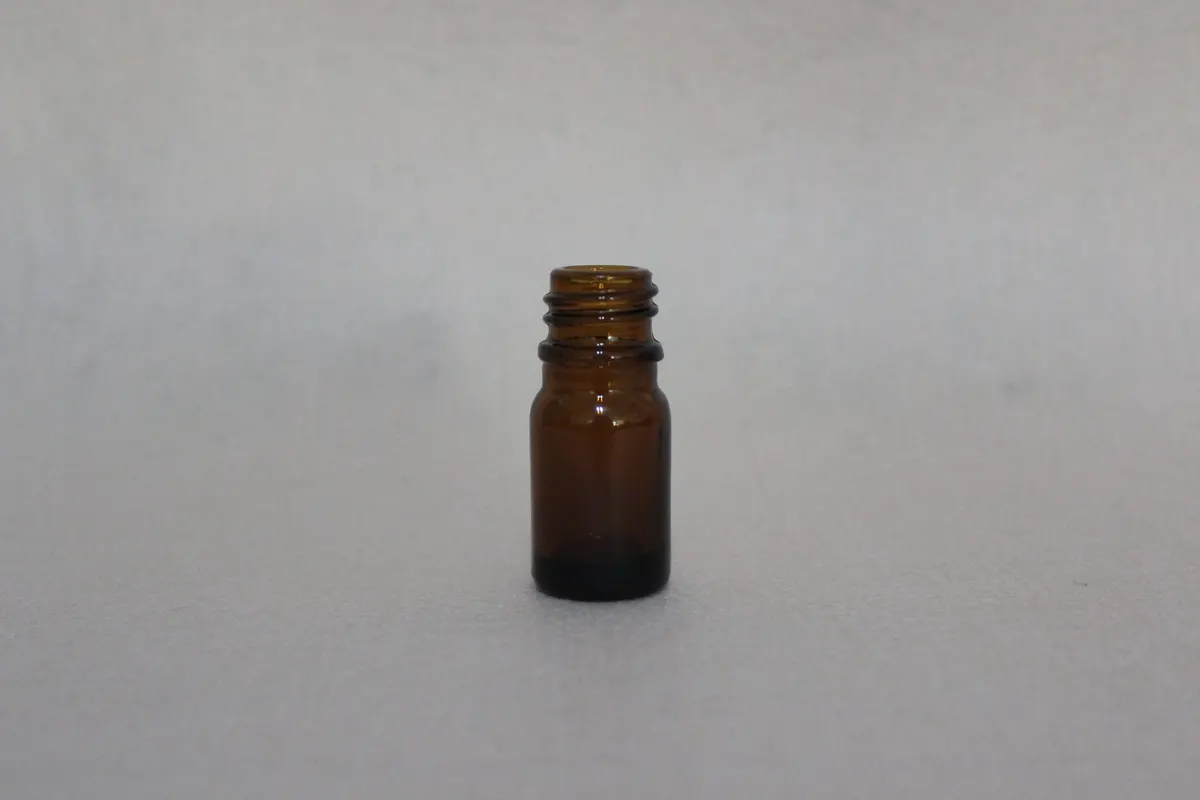
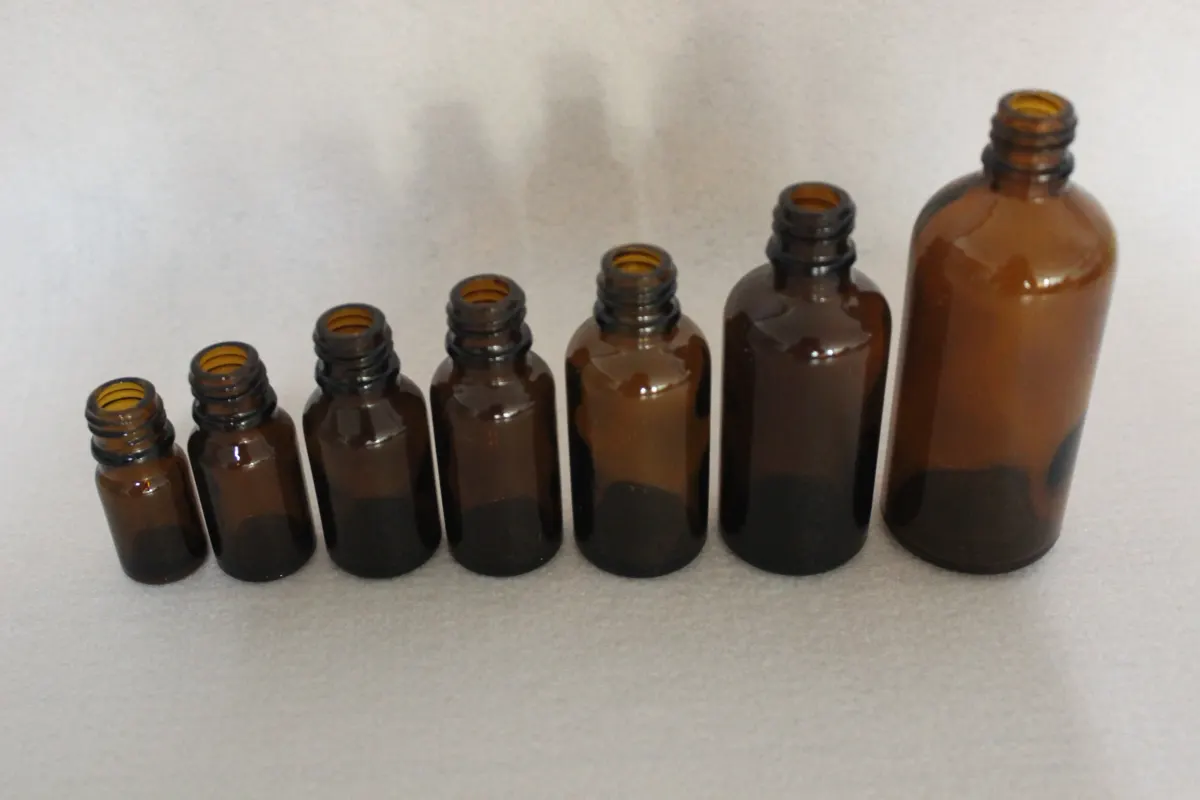
Filed under dropper bottles wholesale; the moulds we quote for this are pictured at the foot of the page.
A measured dropper bottle is a glass bottle whose pipette carries a printed or etched volume scale, so that an instruction such as 0.5 ml can be followed instead of guessed. The usual specification is a 30 ml bottle on the 18 mm DIN18 neck with a pipette marked in 0.25 ml steps up to 1.0 ml, accurate to ±0.05 ml at the marks. Pipette and bulb materials are chosen by how much oil the formula contains.
Scale layout and how accurate it is
On a pipette for a 30 ml bottle the standard scale runs from 0.25 to 1.0 ml in 0.25 ml divisions. That matches the four doses brands tend to print on a carton: 0.25 / 0.5 / 0.75 / 1.0 ml. Divisions of 0.1 ml can be made, but they are hard to read on a barrel this narrow. A single line at 0.5 ml is the opposite choice and suits a minimalist look.
Scales are calibrated for a full-stroke draw, because the volume a pipette takes up changes with how hard the bulb is squeezed and how deep the tip sits in the liquid. Write the usage instruction to match. Even with correct glassware, expect about ±10% variation in a consumer's hands, which is still close enough for skincare dosing.
Printed or etched graduations
| Screen-printed | Etched | |
|---|---|---|
| How it is made | Ceramic or UV-cure ink, fired or cured onto the barrel | Acid or laser marking cut into the glass |
| Appearance | Sharp; white and black are standard, gold for upmarket lines | Slightly more subtle |
| Durability | Good ceramic print stays legible after 30-day immersion in oil at 40 °C | Permanent |
| Best for | Brands that want the scale in a brand colour | Formulas with aggressive solvents; scales meant to outlast the label |
If you choose print, write the oil soak test into the QC plan, since ink durability is the open question with that method. Etching costs more than printing; the difference is quoted per project.
Glass or PP pipette
Decide the barrel material from the formula. Glass is inert to what cosmetic formulas contain: concentrated essential oils, retinoid solutions, fragrance compounds and pure vitamin C (L-ascorbic acid at 15–20%). It is the default for facial oils and for anything above ~20% oil content. Tips are straight or bent (ball), and the bent tip releases the last drops more cleanly.
PP (polypropylene) does not shatter and works well with water-based serums, hyaluronic acid and glycerin systems. Its weakness is essential oil. Citrus and terpene-heavy formulas turn PP cloudy and make it swell over a period of months. A simple rule: when water heads the INCI list, PP is acceptable, and when oils head it, specify glass.
Nitrile or silicone bulb
The bulb meets the formula on every draw and is the first component to fail. Natural rubber, still sold at the cheap end of the market, swells, turns tacky and sheds particles in oil-rich products within weeks. Two materials are worth specifying.
- Nitrile (NBR) resists oils and esters well and has a firm feel. It is the everyday choice for facial oils and oil-serum hybrids, and it copes with bathroom temperatures.
- Silicone is inert across a wider chemistry, including aggressive botanical extracts. It squeezes more softly, stays flexible in the cold, and comes with cleaner documentation for markets that are strict about cosmetic packaging. It is the safer call for formulas high in essential oils.
Name the material in the RFQ. A request for a "rubber bulb" is likely to be answered with natural rubber. The rest of the assembly is a closure cap in PP or with an aluminum shell and a wiper plug, and we coordinate complete dropper sets whose fit has been validated.
Bottle sizes, neck finish and glass colour
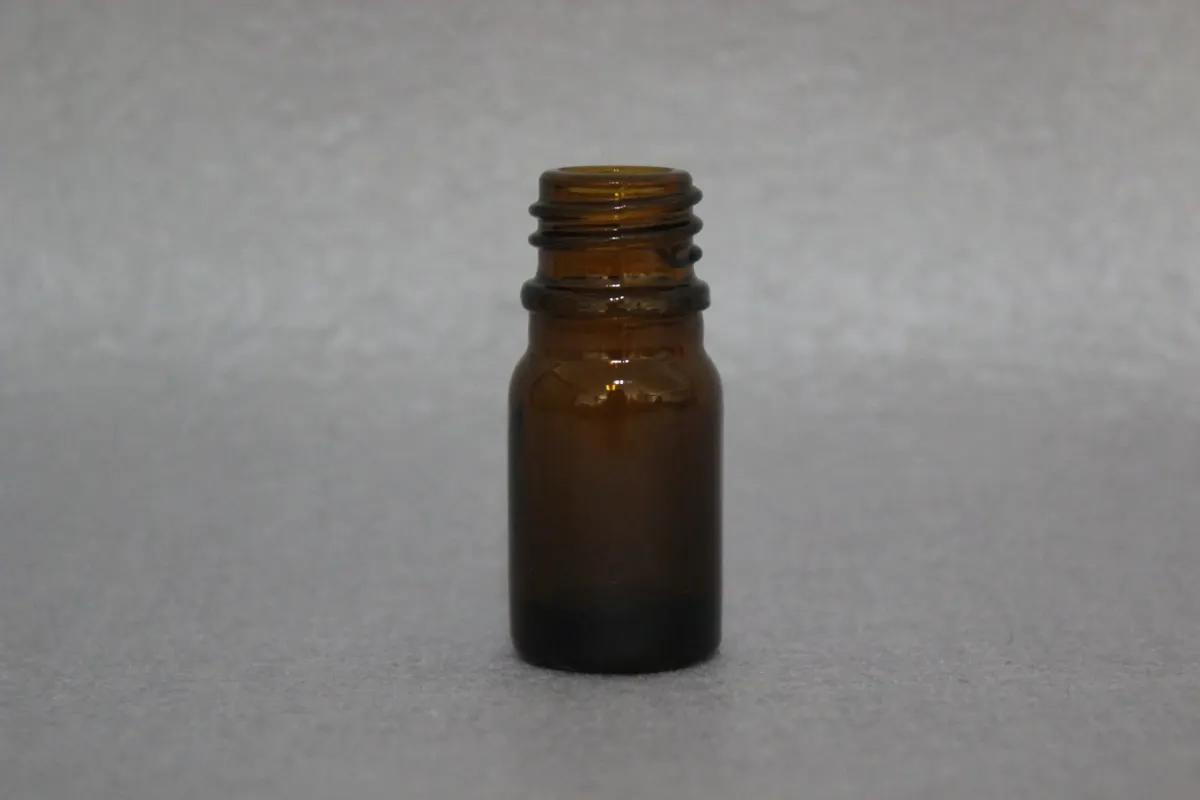
Four capacities cover the category, all on the 18 mm DIN18 finish. Because that neck is shared, closures, pipettes and bulbs interchange between sizes and between suppliers, so keeping it in the specification keeps sourcing options open. The same geometry runs through the dropper glass bottle range.
- 10 ml for eye serums, boosters and discovery sizes
- 15 ml for targeted treatments
- 30 ml for the main serum, roughly a month of use at 1 ml/day; see the 1 oz dropper bottle specification
- 50 ml for facial oils and products that cross over into body oil
Colour follows light sensitivity. Amber protects retinoids, vitamin C and botanical actives that break down under UV. Flint (clear) glass fits light-stable formulas whose own colour helps sell them. Frosted and coated finishes are there for differentiation, and cobalt and green serve brand coding more than protection.
Compatibility testing before mass production
A measured dropper puts four materials around the formula: the glass bottle, a glass or PP pipette, an elastomer bulb and the closure liner. Good practice is a 12-week accelerated study before the bulk order is placed, with filled units held at 40 °C/75% RH and at ambient. Inspect them at 2, 4, 8 and 12 weeks for:
- bulb swelling or hardening, where a durometer change beyond 5 points is a fail
- legibility of the printed graduations
- retention of closure torque
- changes in the formula itself, such as haze, colour shift or particulates
Run the study on actual production components, not near equivalents. We arrange the component set with material declarations for your lab. A brand that leaves this step out tends to discover the problem later, as retail returns.
Incoming QC and decoration
Graduation accuracy is the one test a measured dropper adds to an ordinary dropper-bottle plan. It is checked by weight on an AQL sample from each lot: draw to the 1.0 ml mark, weigh on a 0.001 g balance, and convert using the density of the formula. The usual tests remain, namely closure torque, dip-tube length against bottle height, and a leak test at −0.5 bar for goods travelling by air.
Decoration normally goes on the bottle and leaves the pipette alone. Options include one- or two-color screen print, hot-stamped bands and a full frosted coating, all handled as custom dropper bottle work. Neighbouring skincare formats are listed under serum glass bottles.
Assembled or separate, and the dip-tube length
Droppers can ship as loose components for your line to fit at capping, or pre-assembled in partitioned trays with the pipette inserted and the closure torqued to a set value. Pre-assembly adds cost per unit but removes a fiddly manual job, since sliding a graduated pipette into a bottle without scratching the print is slower than it looks. It suits smaller runs and lines with no dedicated assembly labour.
In both cases, state the dip-tube length for each bottle size on the PO. The tip should sit 2–3 mm above the base, so a 15 ml and a 30 ml bottle need different pipette lengths even though they share the DIN18 neck. Missing this is the most frequent mistake in a first dropper RFQ.
FAQ
How accurate is a graduated pipette?
Within ±0.05 ml at the marked lines for both printed and etched scales, measured on a full-stroke draw. In everyday use the dose varies by about ±10%.
Should the scale be printed or etched?
Print if you want brand colours and the lower-cost route. Etch if the formula is aggressive or the scale must never wear off.
Which pipette suits a facial oil rich in essential oils?
Glass. Polypropylene belongs with water-based serums, where resistance to breakage and cost count for more.
Which bulb lasts in a high-oil formula?
Nitrile for most facial oils, silicone for strong botanical and essential-oil blends. Do not accept a bulb described only as rubber.
What size is standard for a facial serum?
30 ml on DIN18. It is the capacity with the widest choice of stock tooling and closures.