Oval glass bottles are a practical choice from 30 ml to 500 ml, in flint or amber soda-lime glass, with continuous-thread necks from 18/410 to 28/410. Against a round bottle of equal volume the oval gives roughly 18 percent to 30 percent more flat label area and takes less shelf depth, but it carries 6 percent to 10 percent more glass and needs corner radii of at least 4.0 mm to hold up in drop tests. The details that decide whether a project runs smoothly are the neck tolerance, the annealing and the wall distribution, so those belong on the drawing before any mould is approved.
Standard capacities, dimensions and weights
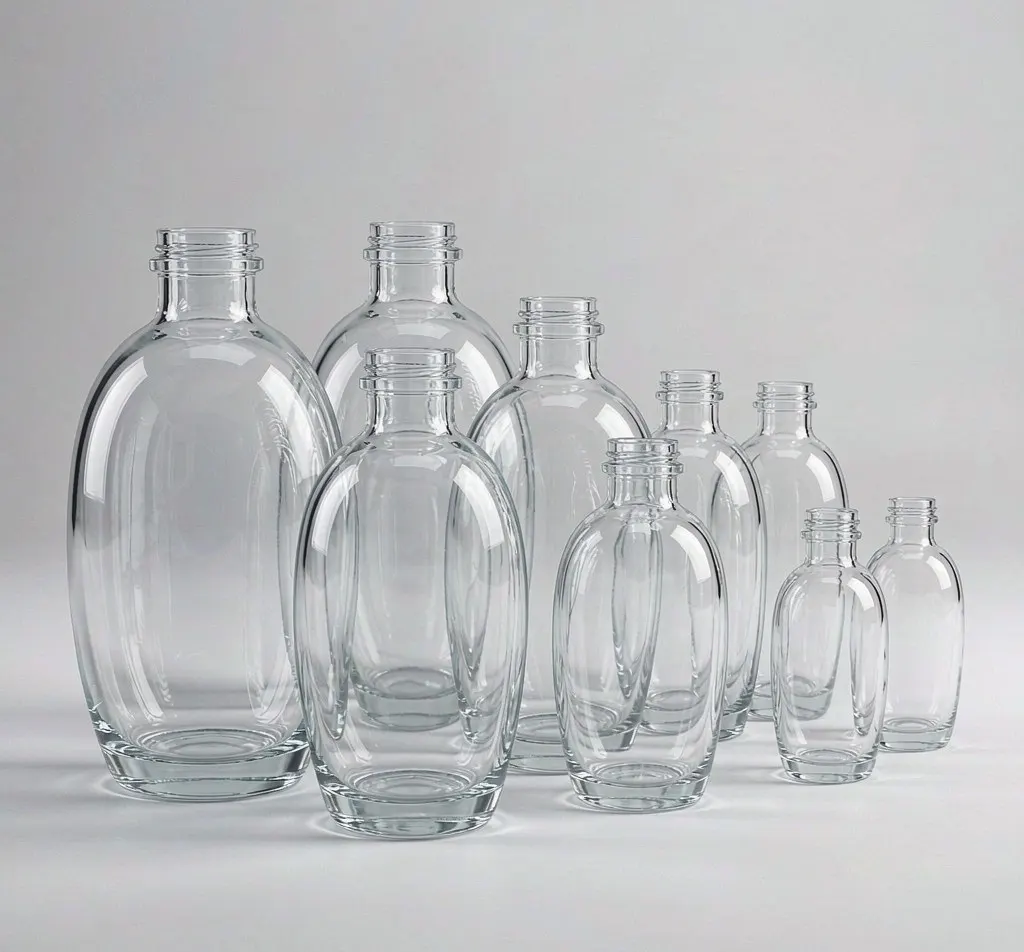
An oval bottle is defined by its cross section: the long (major) axis is 15 percent to 45 percent longer than the short (minor) axis, depending on the mould. Cosmetic projects mostly specify 30 ml, 50 ml, 100 ml and 120 ml; food and beverage projects sit at 200 ml, 250 ml, 330 ml and 500 ml. The table gives the usual envelope and finished weight for six of those sizes.
| Capacity | Height | Major axis | Minor axis | Finished weight |
|---|---|---|---|---|
| 30 ml | 75 mm | 40 mm | 28 mm | 55 g to 70 g |
| 50 ml | 92 mm | 45 mm | 32 mm | 80 g to 95 g |
| 100 ml | 110 mm | 55 mm | 38 mm | 135 g to 165 g |
| 200 ml | 140 mm | 65 mm | 45 mm | 190 g to 230 g |
| 330 ml | 165 mm | 72 mm | 50 mm | 280 g to 330 g |
| 500 ml | 190 mm | 82 mm | 58 mm | 360 g to 420 g |
Dimensions are taken cold, at 20 degrees Celsius. Glass grows by about 9 parts per million per degree Celsius, so a bottle filled at 85 degrees Celsius is around 0.06 percent larger on the line than at ambient. That is small, but it matters when pucks are cut to fit. Weights should be reported on the certificate of analysis from a calibrated scale with ±3 g repeatability.
The range has natural limits at both ends. Under 30 ml the minor axis drops below 25 mm and the bottle becomes awkward to hold, which removes the grip benefit. Over 500 ml the flat panels bow inward under the vacuum that forms as a hot-filled product cools, and the ribs needed to stop that spoil the plain label face the shape was chosen for.
Wall thickness is not uniform around an oval. The walls on the major axis run 0.2 mm to 0.4 mm thicker than those on the minor axis, because blow pressure is less effective on the longer radius.
Neck finishes and closure fit
Six continuous-thread finishes cover almost every oval bottle: 18/410, 20/410, 22/415, 24/410, 24/415 and 28/410. The number before the slash is the outside diameter of the neck in millimetres; the number after it identifies the thread style and pitch class. A 24/410 finish, for example, is 24.0 mm across with a single-start 410-series thread at 3.0 mm pitch and 1.5 mm to 2.0 mm thread depth, and it seals on a 24 mm wad or liner.
- 18/410 fits droppers and pumps on 30 ml to 50 ml serums.
- 24/410 is the usual match for 100 ml to 200 ml bottles with screw caps or pumps.
- 28/410 carries most 250 ml to 500 ml food and beverage closures, snap caps and trigger adapters included, and is the neck to choose for hot-fill closures.
Nominal size is only half the specification. A wrong or loosely toleranced neck is the most frequent reason a new bottle stops a filling line, so we write the tolerance on the drawing: neck outside diameter within ±0.3 mm and thread major diameter within ±0.2 mm, with the closure supplier working to the same band. A properly matched pair should hold a vacuum of minus 40 kPa for 24 hours without weeping. A 0.4 mm error on neck diameter is enough to pull the seal pass rate on a hot-fill line from 99.2 percent down to 91 percent.
Flint and amber glass
Oval bottles are produced in two colours. Flint is near-colourless and transmits more than 88 percent of light at 550 nm, so it shows the product. Amber blocks ultraviolet, cutting transmission below 400 nm to under 10 percent, and is the choice for light-sensitive fills such as some essential-oil blends and food concentrates that oxidise easily. Our page on clear flint glass bottles goes further into choosing between the two.
Both are soda-lime silica glass: 70 percent to 74 percent silica, 12 percent to 15 percent sodium oxide and 9 percent to 12 percent calcium oxide, with small additions of alumina and magnesia for durability. That composition reaches hydrolytic resistance class type 3 or better. For skincare, an extractables screen should show lead under 0.5 mg per kg and cadmium under 0.1 mg per kg, in line with EU and US packaging thresholds. For food contact, ask for a certificate of compliance and confirmation that the plant works under a hazard analysis programme.
Colour also affects scheduling. Amber and tinted glass are melted in blocks so they do not contaminate the flint melt, and the 4 to 6 hours of output around a colour change are discarded or downgraded.
What the oval shape gains and what it costs
Label area
Only the front of a round bottle is read at eye level, and that front is curved. The oval offers a nearly flat face, which is where the extra 18 percent to 30 percent of usable label area comes from. A 30 ml serum that has to carry a logotype, a capacity claim, a batch code and a mandatory ingredient list can often do it on a front panel alone, avoiding a wrap-around label and its registration problems at speed.
The same flat face helps the labeller. On round glass the curve tends to lift a 1.5 mm to 2.0 mm bubble at the label seam, with a baseline reject rate of about 1.8 percent. On an oval run through the same labelling head, where a flat platen meets a flat panel, rejects fall below 0.4 percent.
Grip and line handling
An adult palm spans 70 mm to 90 mm, so the minor axis of an oval sits comfortably between thumb and forefinger while the other hand turns the cap, and the bottle does not roll. On a rotary monoblock filler with the common 60 mm to 120 mm star-wheel pitch, the shape also sits more steadily in its puck, which reduces tipping once the line passes 6,000 units per hour.
Shelf depth
Retail planograms assign depth in fixed steps, often 100 mm to 150 mm. A 38 mm minor axis uses less of that depth than a 50 mm round, so more facings fit. In a 900 mm bay with 5 shelf tiers, moving from round to oval can add 6 to 10 facings without changing the SKU count.
Glass weight and impact strength
The non-circular section needs more glass, and the parison (the hollow pre-form that is blown into the final bottle) has to be distributed unevenly on purpose. A 100 ml flint oval typically finishes at 135 g to 165 g, where a round of that capacity lands at 120 g to 145 g. The 10 g to 20 g gap adds up to 2.0 kg to 4.0 kg of glass per 1,000 units and about 3 percent to 5 percent more furnace energy at the melt stage.
Impact is the other weak point. A 100 ml oval filled to 95 percent and dropped on its flat front from 1.2 m onto a concrete-like surface survives the first drop about 70 percent of the time, because the corners act as stress risers. Specifying corner radii of 4.0 mm or more and a nominal body wall of 2.4 mm to 3.0 mm lifts that to 82 percent to 85 percent. Both figures should appear on the drawing you approve.
Oval compared with round and square bottles
The three profiles differ on four measurable points. For reference, a 100 ml round is about 44 mm in diameter and 120 mm tall.
| Attribute | Round | Oval | Square |
|---|---|---|---|
| Glass weight at equal volume | Lowest; walls can be thinned to 1.8 mm to 2.2 mm | 6 percent to 10 percent above round | 12 percent to 18 percent above round; corners thickened to 3.0 mm to 3.5 mm |
| Label reject rate | 1.5 percent to 2.0 percent on wrap labels, 0.8 percent on spot labels | Near 0.4 percent on the flat front | Flat faces, as with oval |
| Shelf facings per bay | Baseline | 6 percent to 10 percent more | Up to 12 percent more |
| Drop survival from 1.2 m | 80 percent to 85 percent | 75 percent to 82 percent with radii of 4 mm or more | 65 percent to 72 percent |
Round glass is the most efficient because a circle encloses a given area with the least perimeter, so the parison spreads evenly. Square bottles tessellate with almost no wasted space, but that advantage disappears on curved shelf rails, and shoppers find sharp corners less pleasant to hold. This is why square formats are common in laboratory and pharmaceutical secondary packaging and rarer in cosmetics, while the oval holds the middle and upper cosmetic tiers.
If the brand wants a more rigid, architectural outline with the same flat label panel, French square bottles are the alternative, accepting more glass and a somewhat lower drop figure. Where possible, run samples of all three profiles on the same filler and compare reject rates before paying for a mould.
Line compatibility often settles the question. Round bottles run on nearly any puck or neck-handling system; a shaped bottle may need change parts. Count that downstream change as part of what the shape costs.
Decoration on the flat face
The flat front makes the oval easy to decorate. Four processes are in regular use, and they differ mainly in durability.
- Spray coating lays down a UV-cured or heat-cured lacquer 12 microns to 25 microns thick, over the whole bottle or through a mask. It lasts 50 to 100 household dishwasher cycles at 50 degrees Celsius before wear shows. High-alcohol formulas can soften the base coat, so add a clear over-lacquer for those.
- Silk screen printing pushes ceramic or UV ink through a 90-thread to 120-thread mesh and builds a layer of 8 microns to 15 microns. Ceramic ink is fused at 600 degrees Celsius and stands up better to dishwashers and solvents. UV ink offers a wider colour range and cures in 3 seconds to 5 seconds per pass under a 300-watt per centimeter lamp.
- Hot stamping transfers metallic foil through a silicone die at 120 degrees Celsius to 160 degrees Celsius and 2.5 bar to 4.0 bar, giving the gold or silver accents seen on prestige cosmetics. Keep foil on the shoulder or upper front: on the minor axis, where the palm rests, it dulls within 20 to 40 uses.
- Frosting is an acid etch in a hydrofluoric-acid-based bath that takes off 2 microns to 5 microns of glass and leaves a satin surface with 60 percent to 80 percent haze. It lowers light transmission a little, which suits light-sensitive products.
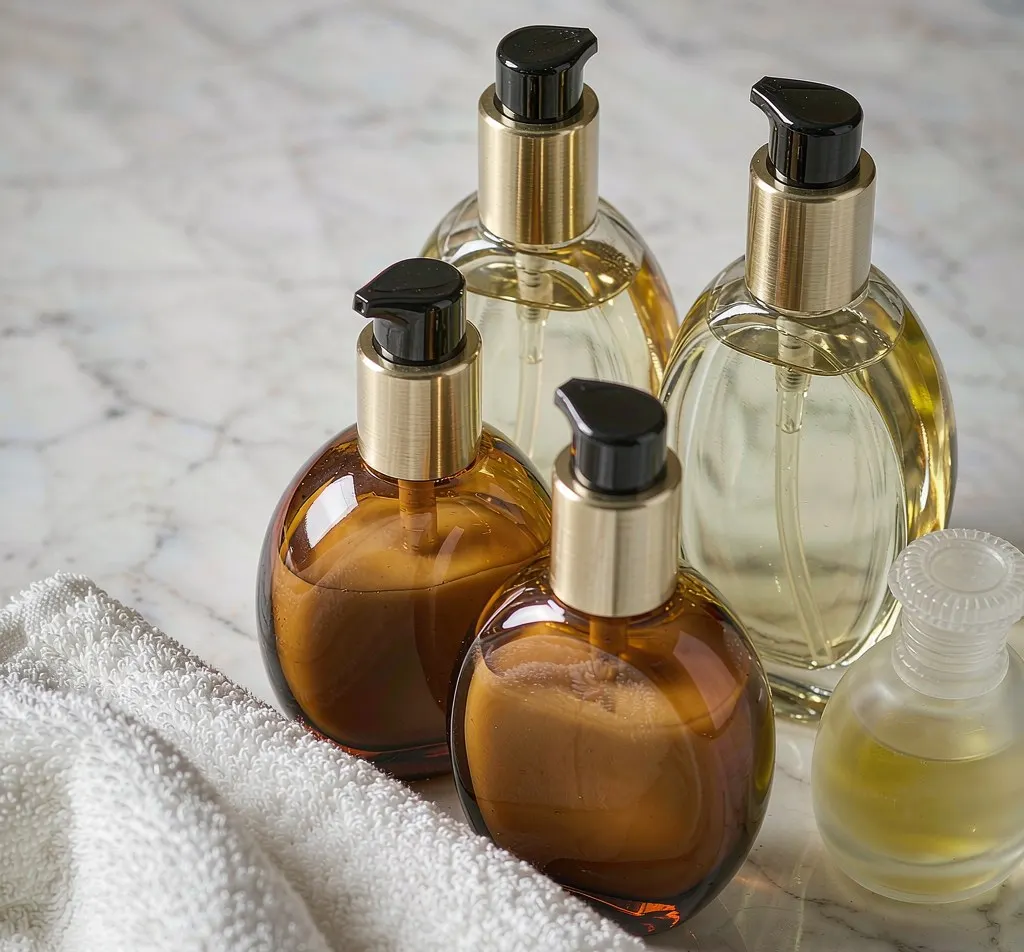
Decoration needs its own release tests. Ask for a cross-hatch tape-adhesion test with no more than 5 percent ink removal, a rub test of 50 double rubs under a 1 kg load with a named solvent, and a 14-day compatibility soak in which the decorated bottle holds your actual formula at 40 degrees Celsius with no ink migration or softening. Get the soak report before approving decoration on a product with a 12-month shelf life. Embossing, tooling and colour matching are covered on our custom glass bottle page.
How oval bottles are formed and annealed
Oval bottles are made on an individual section (IS) machine, usually with 6, 8 or 10 sections, running two or three gobs at a time according to bottle weight and cavity pitch. Each gob of molten glass is sheared at 1,150 degrees Celsius to 1,200 degrees Celsius and dropped into a blank mould, where an asymmetric plunger shapes the parison to suit the two different axes.
A servo-controlled blow-head then applies 250 kPa to 400 kPa of air, holding pressure on the major-axis side for about 8 percent less time than on the minor-axis side so the walls even out. The final blow runs at 600 kPa to 900 kPa for 1.2 seconds to 1.8 seconds, and the bottle leaves the mould at roughly 600 degrees Celsius.
Annealing is the stage first-time buyers most often leave unspecified, and it decides whether the bottle survives hot filling. Bottles enter the lehr, a temperature-controlled tunnel, at 580 degrees Celsius to 620 degrees Celsius and cool along a set curve to 100 degrees Celsius over 25 minutes to 45 minutes, depending on wall thickness. Around the strain point, near 520 degrees Celsius, cooling must stay below 30 degrees Celsius per minute or stress is frozen into the glass. A badly annealed oval shows strain colours under polarised light and cracks when product goes in at 85 degrees Celsius.
Tolerances and tests to write into the specification
These are the figures we look for on the drawing and the lot certificate when we review a plant's offer.
- Wall thickness: ±0.5 mm on the body and ±0.3 mm on shoulder and neck, measured by non-contact laser gauge (0.01 mm resolution) at 12 points, with any bottle under the 1.8 mm minimum rejected. A ±0.3 mm body tolerance is possible for pharmaceutical-adjacent food work, at the price of more forming scrap.
- Dimensions: height within ±0.8 mm and both axes within ±0.6 mm, checked on coordinate measuring equipment.
- Finish defects: vision inspection of every bottle with a 5 megapixel camera, rejecting neck chips larger than 0.5 mm.
- Annealing strain: polariscope inspection of 5 bottles per 10,000-unit lot, with retardation no higher than 40 nanometers per millimeter of thickness.
- Thermal shock: 10 bottles per lot moved from 95 degrees Celsius into 20 degrees Celsius water with zero fractures.
- Pressure: a pressure-decay test to 600 kPa on 1 per 500 units.
- Contamination: a black-light scan of the finish for glass fragments and foreign particles, with nothing above 0.3 mm accepted.
- Hot-fill vacuum: for still products such as oils and vinegars, retention of minus 30 kPa for 48 hours.
Briefing and ordering in six steps
- Write the specification. State capacity, the exact neck designation, glass colour, target weight, decoration method and fill temperature. Say so if the product is filled above 70 degrees Celsius, because mould cooling and the annealing curve change. Add an annual volume so the mould strategy can be planned.
- Qualify the plant. Ask about furnace type, IS machine section count, lehr length and whether spraying and silk screen are done in-house; subcontracted decoration adds a hand-off and a quality variable. Request a recent certificate of analysis from a comparable run. If the range also includes flat formats, our flask bottle application page shows how shapes can share a container.
- Prove the sample and the mould. Appearance is not enough. Measure the neck with calipers against the ±0.3 mm tolerance and confirm the closure seals at torque. Skipping this is how a 10,000-piece lot ends up as scrap.
- Agree the inspection plan. Decide between the plant's in-line checks, a third-party pre-shipment inspection, or both. At AQL 2.5 a 10,000-piece lot is sampled at 200 pieces and passes with up to 10 major defects; AQL 1.5 is the better setting for cosmetic-grade runs.
- Settle logistics and documents. Glass bottles normally ship under HS code 7010.90. Missing food-contact paperwork is the most common reason for a customs hold at destination, so for food and beverage fills check the bottle against the hot-fill and regulatory notes for food glass packaging. For planning, a 40-foot high-cube container takes roughly 38,000 to 45,000 units of the 100 ml size on standard 12-by-12 dividers, at about 6.0 metric tons to 7.5 metric tons gross.
- Release production and plan reorders. On a running programme, a quarterly review keeps volumes and any decoration or colour changes in step with the plant's campaign schedule.
Through all six steps, keep one engineering contact rather than dealing only with a sales desk. Questions about neck tolerance, annealing curve and wall distribution are answered by a process engineer, and those answers are what prevent expensive mistakes.
Frequently asked questions
What is the minimum order quantity for oval glass bottles?
It is quoted per project. The figure depends on whether an existing mould can be used, the decoration, and the line the bottle runs on.
How long does production take?
Timing is also quoted per project, once the mould, the decoration and the plant's colour schedule are confirmed.
Can oval glass bottles be hot-filled with food products?
Yes, if the bottle is correctly annealed and specified for vacuum retention. Use a 28/410 neck and keep the nominal wall at 2.4 mm to 3.0 mm so the panels resist being drawn inward as the product cools from 85 degrees Celsius.
Are oval bottles more expensive than round ones?
They use more glass, about 6 percent to 10 percent at equal volume, and the unit quote reflects weight, colour, decoration and quantity. Set that against fewer label rejects and more facings per bay before deciding.
Which decoration suits an oval bottle best?
All four common methods work on the flat front: silk screen, hot stamping foil, spray coating and acid frosting. The choice depends on how much handling, washing and solvent contact the finish has to survive.