Part of our series on perfume bottles wholesale — read the overview first if the format is new to you.
For a refill-at-home fragrance line, specify a screw-neck glass bottle: FEA 15 or FEA 18 are the usual finishes on 50 ml and 100 ml vessels, with at least 1.5 turns of thread engagement, an application torque window of 8–14 in·lb and a closure validated for a minimum of 50 open-close cycles. Crimp necks cannot be opened by the consumer, so they only belong in a refill program as a replaceable cartridge or in a brand take-back model. The glass itself rarely limits the life of the system; the collar, liner, valve and seals do, and those are what the brief has to quantify.
Neck construction comes before everything else
Every refill format is built on either a threaded or a crimped neck, and once tooling is cut the choice is practically fixed. It should follow the promise the brand makes to the customer.
Threaded (screw-neck) finishes
Here the spray pump screws onto a continuous-thread finish, usually FEA 13, FEA 15, FEA 18 or FEA 20 in European sizing, which corresponds to neck inner diameters of roughly 13 mm to 20 mm. The owner, or a refill counter in a shop, takes the pump off, tops up the bottle and screws it back on. No tools, crimping equipment or retailer infrastructure are needed, and the refill itself can be a plain capped bottle with a spout or dropper, which keeps the refill filling line simple.
What needs managing is torque. On FEA 15 glass threads the application window is typically 8–14 in·lb, and the thread has to be proven to survive it: thin decorative threads can chip when a collar is driven past 18 in·lb. Thread engagement below 1.5 full turns makes cross-threading likely whenever someone refits the pump at an angle.
Crimped (Féa crimp) finishes
The classic prestige build fixes the pump to the neck with a metal collar closed by a pneumatic crimper. Taking that collar off destroys it, so a standard crimp bottle is not something a consumer can refill. Crimping still has two roles in a refill strategy:
- Take-back refilling. The brand collects vessels, removes the collar, refills and re-crimps on its own line. Removal tools exist, but each cycle loses 3–8% of units, which restricts the model to brands working at scale.
- Cartridge hybrids. A crimped inner cartridge sits inside a decorative outer vessel and the customer swaps the whole cartridge. The crimp never leaves factory control.
When the promise is refilling at home, a threaded neck is the right engineering answer roughly 85% of the time. Return-and-refill concepts and heirloom vessels with replaceable contents are better served by a crimp-based cartridge, which keeps the feel buyers expect from prestige fragrance. Our glass perfume bottle range includes both neck types.
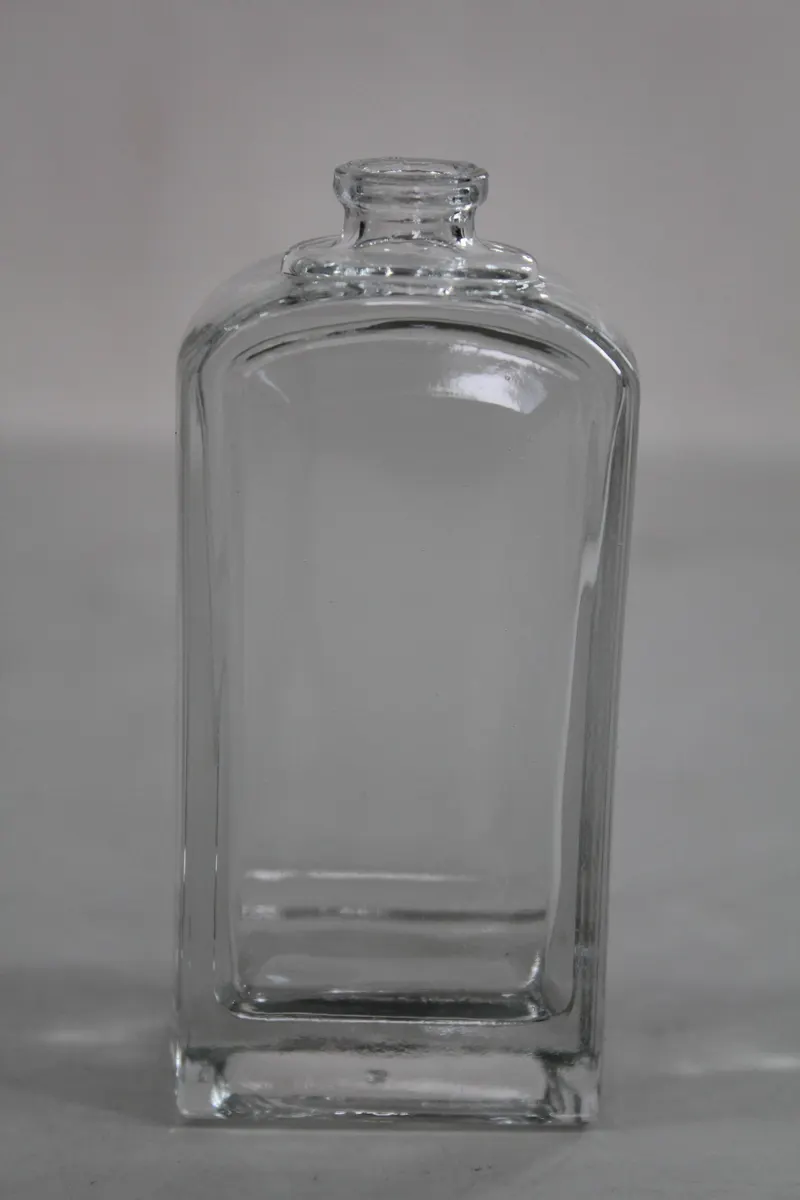
The four refill formats side by side
| Format | Usual capacity | How it is refilled | Durability | Where it fits |
|---|---|---|---|---|
| Screw-neck vessel with refill bottle | Vessel 30 ml / 50 ml / 100 ml; refill 50–200 ml | Owner removes the pump and pours through a spout or funnel | 50–200 open-close cycles | Mass-prestige home refill, refill SKUs sold online |
| Cartridge or pod | 8–30 ml cartridge in a durable shell | Owner swaps a keyed cartridge (15–35 N to remove) | Shell indefinite; cartridge single-use | Niche and luxury lines, subscriptions on a 45–60 day rhythm |
| Crimp-neck take-back | 50 ml / 100 ml | Brand collects, de-crimps, refills and re-crimps | 3–8% yield loss each cycle | Prestige flagships with retail take-back in place |
| Bottom-fill travel atomizer | 5 ml / 8 ml | Base valve pressed onto the donor pump stem (1.8–2.8 mm) | 100+ fills with a good valve | Travel, sampling, gifting, first step into the program |
Programs that work usually run two of these together: a threaded or cartridge hero at 50 ml or 100 ml, and a 5–8 ml bottom-fill unit as the easy way in. The 50 ml size tends to balance best, because the vessel is big enough to deserve durable construction while a 100–150 ml refill pouch or bottle still reads as a real double fill; our page on 50 ml perfume bottles in wholesale quantities covers that size.
Cartridge systems and the interface between shell and pod
Standard cartridge sizes are 8 ml, 10 ml, 15 ml and 30 ml. Niche brands are settling on 10 ml: at 3–4 sprays a day and pump dosages of 70–100 µl per actuation (roughly 0.12–0.15 ml per spray), it lasts 45–60 days, which lines up neatly with a monthly reorder.
Most of the engineering sits where the cartridge meets the vessel. Four points belong in the drawing:
- A hard stop. Axial play under 0.3 mm once seated. A cartridge that floats will rattle, and customers hear a rattle as cheapness.
- One-way insertion. Where spray direction matters, which it nearly always does for logo alignment, an asymmetric rib or D-shaped boss stops the cartridge going in 180° out.
- Removal by hand. Aim for 15–35 N. Under 10 N the cartridge drops out when the vessel is turned over; over 45 N people reach for pliers and break something.
- A self-sufficient seal. Before it is installed the cartridge will travel in handbags, glove boxes and gym bags, so its own closure must be leak-tight. The test is 4 weeks in a 45°C / 75% RH chamber with weight loss no greater than 0.5%.
The outer vessel then acts as a mechanical shell. Its internal finish no longer has to be cosmetically perfect, but the wall must take the insertion force without flexing and the opening gets wiped at every swap. If the cartridge bears on glass, ask for soda-lime with at least 3.5 mm of wall at the shoulder. A PP or ABS liner in the cavity allows thinner, lighter glass.
Bottom-fill travel atomizers
The hero vessel carries the brand story, but the 5 ml and 8 ml pocket sprays account for the unit volume. The user pushes the atomizer's base down onto the pump stem of a full-size bottle and the liquid transfers without a funnel or any decanting.
Inside the base is a spring-loaded check valve that fits over the donor stem, whose outer diameter is normally about 2.0–2.5 mm. Pressing down opens the donor pump and the valve together, and the pump's own pressure moves the liquid; a 5 ml unit takes 20–40 pumps to fill. Three things go wrong often enough to specify against:
- Stem fit. The valve bore should accept stems from 1.8 mm to 2.8 mm so it works on different donor pumps. A tight bore gets forced and the seal splits; a loose one leaks and draws air.
- Back pressure. The valve should hold at least 0.5 bar internally. Cabin altitude at 35,000 feet produces a differential of roughly 0.2–0.25 bar, and a valve that vents into hand luggage generates returns.
- Fill cycles. A good valve is rated for 100+ fills. Cheap ones give out at 20–30 when the spring weakens. The supplier's cycle test report is the quickest way to tell a serious vendor from a trader.
Glass-bodied atomizers are perceived as better made than aluminium-shell versions and can carry the same lacquering, metallization and hot stamping as the main line. The mini and travel-size perfume bottles we source run from 3–10 ml.
Durability and seal targets to put in numbers
A soda-lime vessel will outlast the brand. What wears is the closure, so a claim of endless refilling has to be turned into test values for the collar, liner and seals.
Collars and threads
Fifty open-close cycles is the floor for a credible screw-neck system, and ambitious programs aim for 100–200. Wear follows a known sequence. Thread galling shows first on anodized aluminium collars, typically at 60–90 cycles on soft 5000-series alloy. Then the PE or PP liner takes a compression set and the sealing force falls below what is needed to stop leaks. Three measures address this:
- Collars in 6061 or 6063 aluminium with 15–25 µm anodizing in place of the 8 µm decorative grade, which roughly doubles thread life.
- A captive liner in TPE or food-grade silicone at 50–60 Shore A, bonded into the collar. Loose discs disappear at the first refill.
- A ribbed grip wider than 32 mm, which keeps the torque most adults apply by hand under 12 in·lb and so protects the glass thread.
Seals at each interface
"Leak-proof" is not a specification. Each joint needs its own figure:
- Pump to bottle: no leak after 24 hours inverted at 40°C under 0.3 bar internal pressure.
- Cartridge closure: less than 0.5% weight loss after 4 weeks at 45°C / 75% RH.
- Travel valve: no weep over 72 hours at 0.5 bar.
Fragrance at 15–25% oil in 70–90% ethanol is an aggressive solvent. Nitrile swells in it and natural rubber breaks down, so liners and valve seals should be TPE, EPDM or platinum-cured silicone. Test with the actual formula: seals that hold water can fail in fragrance within a fortnight.
Refill uptake and sustainability claims
A refill program replaces the sale of vessel plus fragrance with a durable object and a consumable. Where the brand runs active CRM and refilling is clean and easy, 30–40% of vessel buyers take two or more refills within 24 months, and customer lifetime value rises by 30–45%. Where refilling means spills, cross-threaded collars or leaking travel units, the attach rate drops below 10% and the refill SKU turns into slow stock with a 24-month shelf life to manage. That gap is the commercial reason for the tolerances above.
Price position matters as much as hardware. Refills compete with discounted grey-market full bottles, and a refill that costs more than a marked-down 50 ml on a marketplace will not sell. Supplying refills as a pouch or plain capped bottle, with no spray of their own, keeps the atomizer experience tied to the vessel.
Retailers now audit refill claims and regulators are starting to. These figures can be defended:
- One glass vessel refilled 4 times cuts packaging weight per use by about 60–70% compared with four separate bottles.
- Flexible laminate pouches lower packaging carbon per fill by 50–70% against glass refills, but they come with recyclability caveats that should be disclosed. A lightweight glass refill bottle, 30–40% lighter than the hero vessel, is the easier position to defend.
- The word "refillable" should rest on the cycle rating. A collar proven to 50 cycles supports "refill again and again"; a decorative 8 µm collar that galls at cycle 15 exposes the brand to a greenwashing charge.
What to write into the supplier brief
Settle the refill itself first. The pouch, cartridge or refill bottle dictates the spout, funnel or valve geometry the vessel has to accept, so that interface should be frozen before the vessel artwork. Then list:
- Neck finish. The exact designation, for example FEA 15 screw, DIN 18 or crimp 15 mm, with thread engagement ≥1.5 turns and a torque window of 8–14 in·lb. If refitting the pump takes more than about 14 in·lb or careful alignment, a share of customers will cross-thread it and blame the bottle.
- Glass. Soda-lime, verified annealing, a 3.5 mm minimum wall at stress points on cartridge systems, and an internal pressure rating where the cartridge interface loads the glass.
- Cycle rating. At least 50 open-close cycles on the closure and 100+ fills on a travel valve, each with a test report.
- Seal materials. TPE, EPDM or platinum silicone only, compatibility-tested on your formula with ≤0.5% weight loss over the 4-week 45°C/75% RH soak.
- Pump. Dosage of 70–100 µl per actuation, output tolerance ±10%, and stem diameter given to a tenth of a millimetre so travel valves fit.
- Decoration. Lacquer, metallization and hot stamping must cope with spills at refill: cross-hatch adhesion to ASTM D3359 grade 4B or better, and an alcohol rub of 50 double rubs with 99% IPA. Threads and sealing lands are masked during coating, because 30 µm of overspray on a thread changes torque measurably.
- Cartridge interface. Axial play ≤0.3 mm, removal force 15–35 N, and keying where spray direction matters.
- Single accountability. Vessel, pump, collar and cartridge specified and supplied through one responsible party, so that a leak complaint does not turn into three vendors blaming each other.
FAQ
Can a crimp-neck bottle be sold as refillable at home?
No. A consumer cannot open a crimped collar without wrecking it. Crimp construction suits cartridge systems and factory take-back only; promising home refill on a crimped vessel leads to refunds.
How many refill cycles should we ask suppliers to prove?
Fifty open-close cycles as a minimum on a threaded closure, 100–200 for a more demanding program, and 100+ fills on bottom-fill valves. Ask for the written test report every time, since collar and valve cycle data is the best single predictor of a program reaching a 30%+ attach rate.
Is a pouch or a glass refill bottle the better sustainability choice?
A pouch saves more carbon per fill but laminates are rarely recyclable, which weakens the claim under retailer scrutiny. Lightweight glass makes for the more defensible story overall. In both cases the headline claim should rest on reuse of the vessel.
What minimum order quantities apply to refillable bottles?
They are quoted per project. The mould, the decoration, the number of components in the set and the production line the bottle runs on all affect the figure.
Which collar details shorten the life of a refill closure?
Thin 8 µm decorative anodizing and loose PE discs. Both are acceptable on a single-use bottle and both fail under 50-cycle refill duty.