One of our guides on essential oil bottles wholesale; start there for the overview.
A wholesale 10ml essential oil bottle should be specified as three matched parts: an amber glass body with a DIN 18 neck, a press-fit orifice reducer sized to the oil's viscosity, and a tamper-evident cap. Leaks in transit, oil that pours when it should drip and bands that fail to break are almost always closure faults, so the reducer and cap deserve as much attention as the glass.
DIN 18 neck finish and what fits it
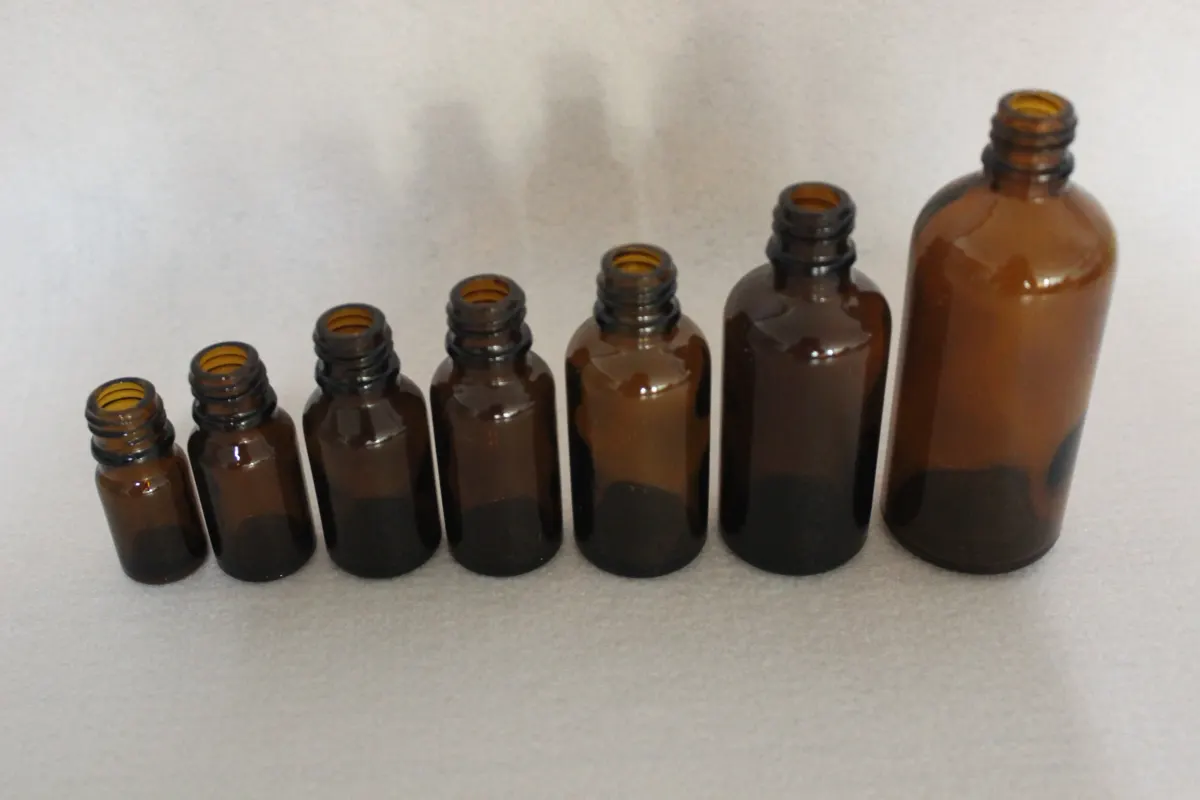
The 10ml bottle is built around the DIN 18 finish, also written GL18. It is an 18mm thread with the European pharmaceutical profile, and it is the common standard across essential oil bottles from 5 to 100ml.
Any closure made to the DIN system fits it: orifice reducers, tamper-evident caps, dropper assemblies, spray pumps and roll-on housings. A brand can therefore start with reducer caps and add a dropper or spray version later on the same glass. Dropper programmes are covered in our dropper glass bottle guide, roll-on formats on the essential oil roller bottle page, and spray closures on the essential oil spray bottle page.
DIN 18 is not the American 18-400 or 18-415 finish. The thread angles are different, and forcing one onto the other strips the closure.
Choosing the orifice reducer by oil viscosity
The reducer is an LDPE plug pressed into the neck. Its orifice restricts flow so the oil leaves one drop at a time, and the right diameter depends on how thick the oil is.
| Orifice | Oil type | Examples |
|---|---|---|
| ~0.6mm | Thin, mobile oils that would pour through a wider hole | Citrus, eucalyptus |
| ~1.0mm | General-purpose middle range | Lavender, tea tree, peppermint |
| ~1.5mm | Viscous oils that stall in a small orifice | Sandalwood, vetiver, myrrh |
Fit matters as much as diameter. The plug's press-fit land has to match the bore tolerance of the bottle: a mismatch of 0.1mm is enough to let oil seep around the plug, or to crack the neck when the plug is inserted. The reducer also has to suit the insert geometry of the cap that closes over it.
Kit configurations for the 10ml bottle
Because of that fit requirement, we recommend buying bottle, reducer and cap as one kit with the fit already verified. Sourcing the parts separately is how a brand ends up holding 20,000 reducers that weep. Each kit is packed in a divider case.
| Kit | Glass | Dispensing part | Cap | Typical use |
|---|---|---|---|---|
| EO-10A-OR | 10ml amber, DIN 18 | 1.0mm orifice reducer | Black PP with TE band | General aromatherapy |
| EO-10A-OR06 | 10ml amber, DIN 18 | 0.6mm reducer | Black PP with TE band | Citrus and other thin oils |
| EO-10A-OR15 | 10ml amber, DIN 18 | 1.5mm reducer | Black PP with TE band | Sandalwood, vetiver |
| EO-10C-OR | 10ml cobalt, DIN 18 | 1.0mm reducer | Black PP with TE band | Lines built on a brand colour |
| EO-10A-CR | 10ml amber, DIN 18 | 1.0mm reducer | Child-resistant with TE | Regulated markets |
| EO-10A-DP | 10ml amber, DIN 18 | Dropper assembly with nitrile bulb | PP TE dropper cap | Blends and serums |
The reducer suits pure oils sold by the drop. The dropper suits blends, serums and anything dosed by measure. Both use the same finish, so the choice is about dosing, not about the glass.
Amber, cobalt or flint glass
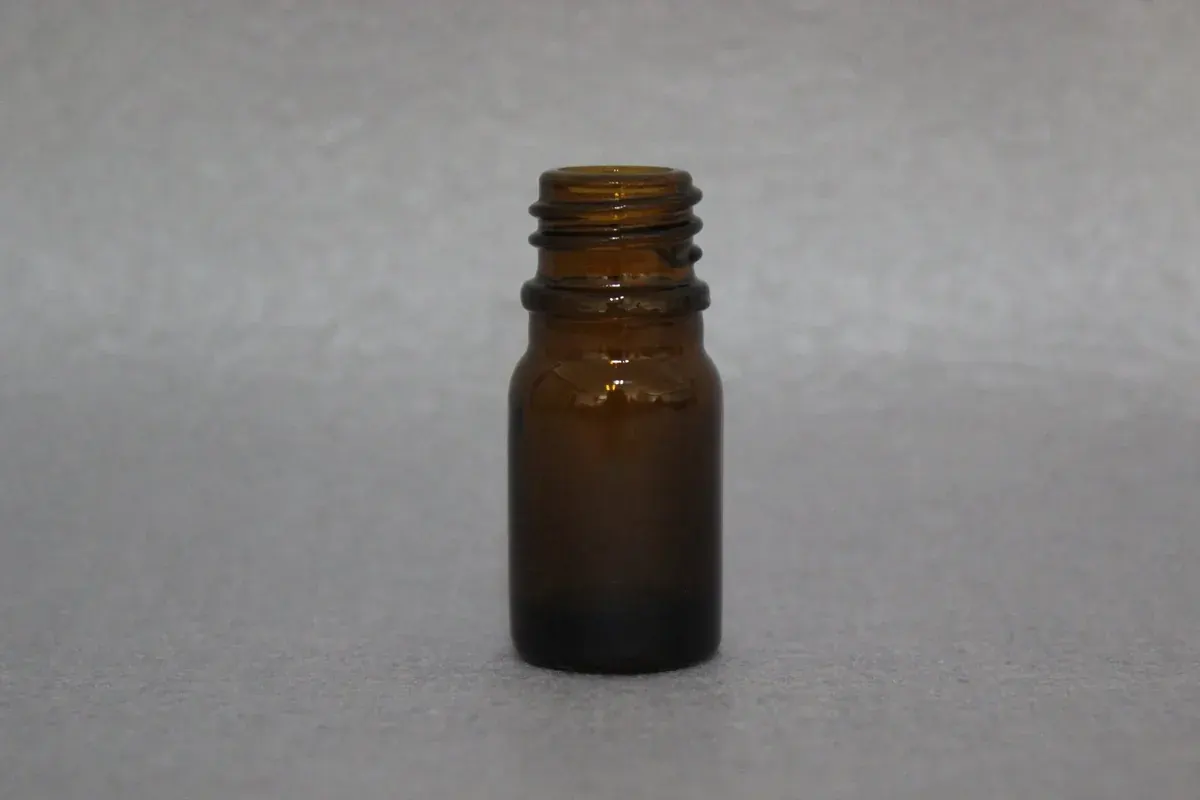
Light protection is a safety requirement for essential oils. Under UV, monoterpenes break down into oxidation products that sensitise skin.
- Amber blocks essentially all light below ~470nm and is the pharmacopeial default for light-sensitive contents. The colour comes from iron and sulfur in the melt, so it cannot scratch off.
- Cobalt blue lets through more near-UV than amber. Buyers choose it to stand out on shelf, where shoppers read it as an aromatherapy colour. For stock held longer than three months, add an opaque carton or a full-body label.
- Flint (clear) is only suitable for display products that turn over quickly.
Whatever the colour, specify glass coloured in the melt. Amber sprayed onto flint glass scratches in transit and then fails the UV test it was applied to pass.
QC checks to request before shipment
Four checks catch 95% of the failures seen in this category:
- Finish gauging per cavity, covering the thread and the reducer land. Thread engagement depth, land diameter and flatness of the cap-seal surface are what make DIN parts interchangeable, so the gauge report belongs in every lot file.
- Reducer insertion force. Too low leaves a leak path; too high causes stress cracks in the neck.
- Inverted leak test on filled golden samples at 40°C for 72 hours.
- TE band break torque inside the 8-18 in-lb window, so the band breaks for the consumer and not inside the case.
Dose and drop rate are then verified gravimetrically on 30-unit samples from each lot.
Frequently asked questions
Are the caps tamper-evident, and is a child-resistant version available?
The standard DIN 18 cap has a breakaway band that separates the first time it is opened, and most markets in practice expect this for retail aromatherapy. Push-and-turn child-resistant caps exist for the same finish and are mandatory for certain oils in some jurisdictions.
What is the minimum order for 10ml amber bottles with caps and reducers?
Minimums and pricing are quoted per project. They depend on the mould, the closure kit, any decoration and the quantity. Send the capacity, neck finish, closure type, quantity and destination port through the quote form.
Can a dropper replace the reducer on a 10ml bottle?
Yes. A DIN 18 dropper assembly threads onto the same neck with no change to the bottle. Keep the reducer for single oils dispensed by the drop and move to the dropper when the product is a blend or needs a measured dose.