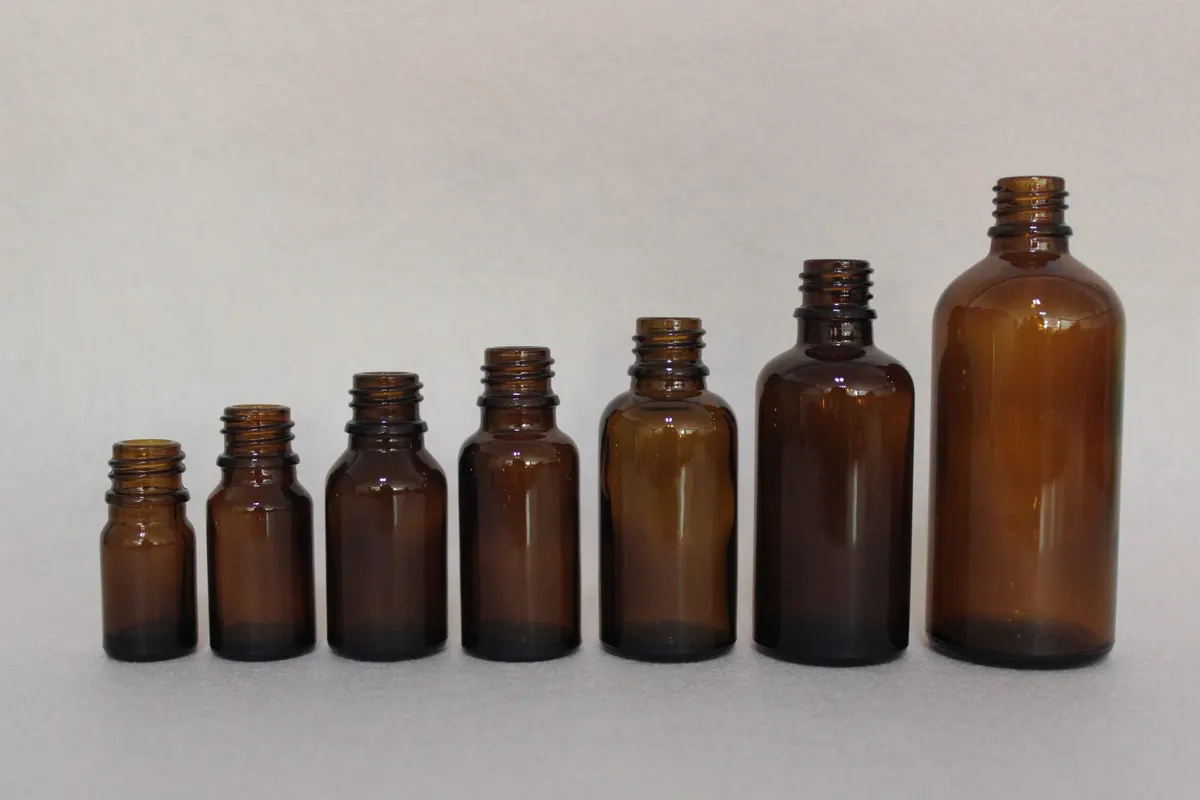
Filed under amber dropper bottles; the moulds we quote for this are pictured at the foot of the page.
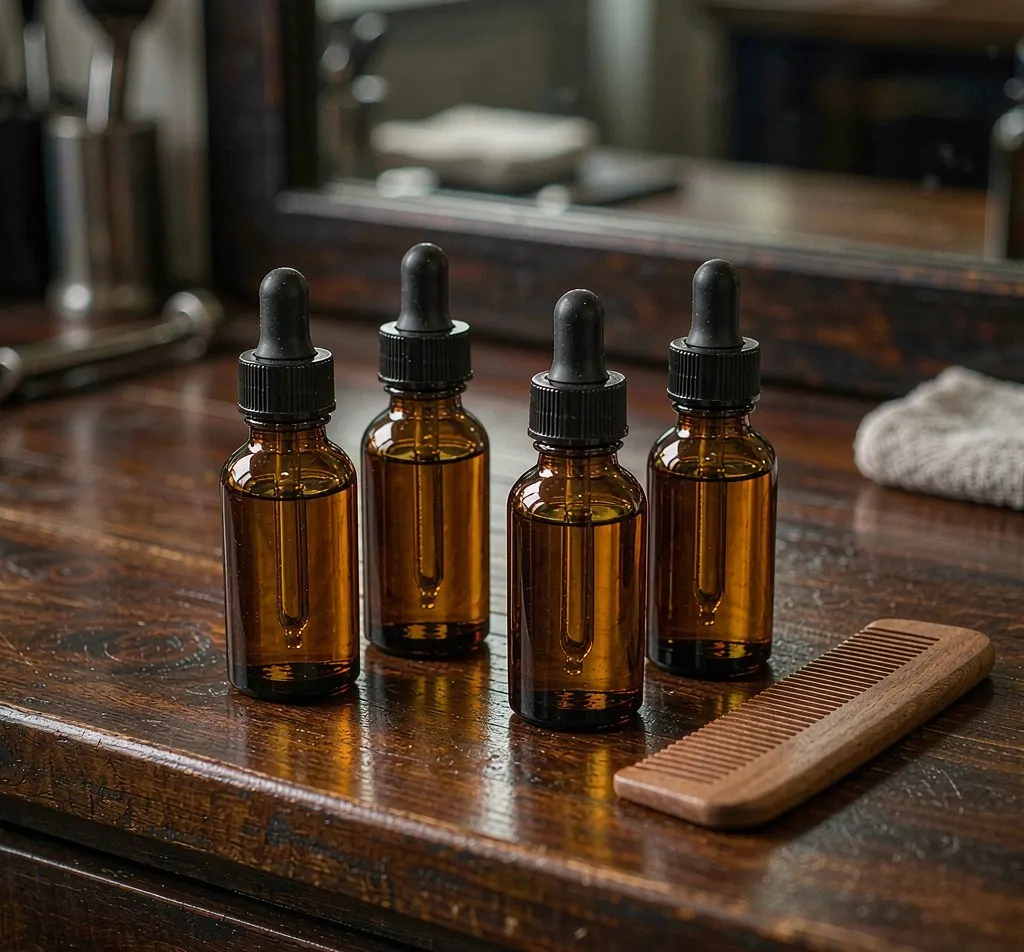
The default beard oil pack is a 30 ml (1 fl oz) amber glass bottle with an 18/415 neck and a glass-pipette dropper. Amber is chosen because it protects the essential oils from UV, 18/415 because any closure made to that GPI thread will fit, and the dropper because it meters a few drops at a time. Most of the work in a bulk order goes into the parts buyers tend to treat as defaults: the bulb material, the liner, the capping torque and the decoration.
Size and neck finish
Beard oil has settled on 30 ml as its main size. Dropper tooling, retail peg spacing and customer expectation all line up with it, so a brand launching one hero product should start there. The other sizes have narrower jobs: 10 ml for trial and subscription minis, 15 ml as an in-between, and 50 ml as a professional size for barbers.
The neck matters more than the capacity. In 18/415, the first number is the nominal thread diameter, 18 mm, and 415 is the Glass Packaging Institute (GPI) code that fixes thread pitch, thread height and the geometry of the sealing land. A bottle made to that finish accepts any 18/415 dropper cap, pump or screw cap built to GPI spec, so you are not tied to one closure vendor.
Interchangeability depends on tolerance. A neck held to 0.10 mm on diameter and 0.05 mm on thread form lets a collar from a second source seat without cross-threading. If you want a non-standard neck, or a thicker wall for a heavier feel, raise it at the start through a custom dropper bottle project, so mould and collar are designed together as a single system.
Dropper bottles for tinctures use the same neck platform. Collars and bulbs qualified for a beard oil can therefore carry over to our wholesale tincture bottle range without being validated again.
Why the bottle should be glass
A beard oil is mostly cold-pressed carrier oil: typically 40% to 60% jojoba, 20% to 35% argan, and lighter oils such as grapeseed or sweet almond for the rest. On top sit 1% to 4% volatile essential oils (cedarwood, sandalwood, black pepper, bergamot) and a little tocopherol, or vitamin E, as an antioxidant. All of it reacts with oxygen and UV, and it has to last a shelf life of 12 to 24 months.
Plastic lets oxygen in. A 1.0 mm wall of virgin PET passes roughly 0.30 cc of oxygen per 100 in² per 24 hours at 23°C and 50% relative humidity, and HDPE about 4.0 cc. Glass passes effectively none at any wall thickness. Over a long shelf life that difference decides whether the oil still smells of cedarwood or has turned rancid.
Plastic also gives something back. PET and HDPE contain residual oligomers and process aids such as slip agents, antistatic compounds and UV stabilisers, which can move into an oil at rates between 0.2 and 1.8 mg/dm² over a year. In a clear oil this appears as a faint haze and as a shift in the fragrance, which is a real risk for a brand built on a particular scent.
Three further points favour glass:
- Metering. A true dropper assembly needs a rigid glass neck. An 18/415 dropper delivers 0.7 ml to 1.0 ml per squeeze repeatably, and a squeezable plastic bottle cannot meter that tightly.
- Weight in the hand. An empty 30 ml bottle with a 3.0 mm wall weighs between 78 g and 95 g depending on shape, against a 14 g plastic tube.
- Recycling. Flint and amber soda-lime glass can be recycled indefinitely, and post-consumer recycled (PCR) content of 15% to 40% can be requested without cosmetic defects.
Plastic still has a place for the occasional travel-size promotion. For the main line, specify glass from the outset.
Amber, matte black or clear
Colour is both a branding choice and a protection choice. The right answer depends on how light-sensitive the formula is and where the bottle will sit.
| Finish | How it is made | UV protection | What it asks of you |
|---|---|---|---|
| Amber | Coloured in the melt | Typical readings: 0.4% transmission at 365 nm, 3.1% at 400 nm, 8.7% at 450 nm | Nothing extra; the technical default |
| Matte black | Full-wrap spray, 18–25 microns, over glass | Comes from the substrate, so the base must be amber | Specify “matte black on amber” and coating tests |
| Clear (flint) | Uncoloured glass | Essentially none: 88%, 90% and 91% transmission at the same wavelengths | More antioxidant, an opaque carton, stricter storage |
Amber
Pharmaceutical amber, meaning US Pharmacopeia Type III amber, transmits less than 10% of incident light below 450 nm and less than 1% below 380 nm. That matters for bergamot, which contains the photosensitiser bergapten, and for any citrus top note. For an oil that may sit on a sunlit shelf or in a glovebox, amber is the one finish that protects the actives with no coating added.
Amber is not one fixed colour. It shifts between furnace batches within a L*a*b* tolerance of Δ2.0, and tinting the melt alone will not hit a Pantone reference. The shade is controlled through iron and sulfur content, at 0.30–0.45% Fe₂O₃ equivalent, and confirmed with a spectrophotometer reading before the run.
Matte black
Matte black bottles are almost always sprayed, not made from black glass. The coating is usually a UV-cured polyester-urethane base coat under a matte top coat. Sprayed over amber, the glass supplies the UV block while the coating supplies the look and a further barrier to visible light, reaching 99.2% visible and 99.6% UV opacity at spec.
Because grooming bottles are handled, dropped and wiped, the coating has to be tested. Ask for a 1.5 N scratch test (Erichsen cross-cut plus tape pull) with a 4B–5B cross-cut rating, and a 2-hour immersion in isopropyl alcohol (IPA) with no lifting or softening. A soft-touch version uses a silicone-modified top coat that lowers the coefficient of friction from 0.42 to 0.28, so the bottle grips instead of sliding.
Colour control is simpler than with amber, since the spray is a surface film. Matching Pantone Black 6 C at Δ1.0 is routine. The coating also hides mould parting lines better than clear glass does.
Clear
A clear bottle shows off the oil and leaves the formula to defend itself. Plan on 0.5%–1.0% mixed tocopherols, compared with 0.2% in amber, plus an opaque carton. Pallets should be stored below 200 lux and below 25°C, or the peroxide value of the oil climbs.
Smoked and gradient tints do not solve this. They are decorative and still transmit 40%–70% of UV. If the label makes a UV-protection claim, either the glass or the base under the spray has to be amber, and we check that point at artwork approval.
Boston Round, cylinder or flat square
Three shapes cover nearly all 30 ml beard oil bottles on an 18/415 neck. They behave differently on the filling line, in the carton and on the shelf, so the choice is as much about logistics as about design.
| Shape | Typical dimensions | Glass weight | Strength | Drawback |
|---|---|---|---|---|
| Boston Round | 37 mm diameter × 92 mm tall, 12 mm radius shoulder | 82–88 g | Easy to label; runs through rotary fillers without orientation jams | The most common shape, so the hardest to stand out in |
| Straight-wall cylinder | 35 mm × 95 mm | 80–86 g | Roughly 8% more label area on a similar height; label lies flat for photography | Still a round bottle |
| Flat square | About 40 mm × 28 mm × 88 mm | 90–96 g | A 38 mm × 70 mm print face on each side; 20% more units per shelf inch | Custom cartons, infeed control and a costlier mould |
The Boston Round is rotationally symmetric, which is why it fills and labels so easily, with either a single wrap label or separate front and back labels. The cylinder swaps the curved shoulder for a near-vertical wall from base to neck, which improves grip as well as print area.
The flat square, a rectangular bottle with a flat shoulder, is for brands that treat the bottle itself as a logo. Its corners carry more glass, no off-the-shelf mailer fits it, and on a rotary filler it needs a timing screw or a paced infeed to stay oriented. The four-corner draft also raises the mould cost.
Capacity being equal, glass weight differs by up to 14 g between shapes, and that feeds directly into freight. Settle the shape with the freight figure in front of you. If a roll-on product such as a post-shave roller is planned, the neck and mould differ, but our roller bottles for essential oils come in the same amber and matte black finishes, so a 10 ml roller and a beard oil can share one look on a display.
The dropper assembly, part by part
A dropper has four components, and each one is a specification choice.
- Collar. Anodised aluminium, PP, or ABS over a metal shell. Aluminium collars weigh 4.5–6.0 g and PP collars 2.8–3.5 g. A matte black look normally means ABS or aluminium with a sprayed or anodised finish.
- Bulb. The elastic teat you squeeze, in natural rubber, nitrile (NBR), thermoplastic elastomer (TPE) or silicone. Natural rubber rebounds best but breaks down against citrus and peppermint oils within 6 months, so nitrile or TPE is the safer choice for beard oil.
- Pipette. Glass is standard, because it does not react with the oil. The usual bore is 2.0 mm inside diameter, with the tip cut at 45° to a 1.5 mm orifice. PP or LDPE pipettes exist for budget lines, but they fog in clear oil and can pick up a faint taste, so keep them for formulas without essential oils.
- Liner. A 1.5 mm EPE (expanded polyethylene) or LDPE wad, or a pressure-sensitive foam liner, compressed against the glass land at the specified torque. This is the leak barrier.
Pipette length is worked out from the bottle: it should end 3–5 mm above the base. In a 30 ml Boston Round that gives 58–62 mm.
Draw volume and drop size
Bulb size and pipette bore together set how much oil each squeeze lifts. With a 2.0 mm bore, a 12 mm bulb draws 0.7–0.8 ml and a 16 mm bulb draws 0.9–1.0 ml. For beard oil a 14 mm bulb is the usual recommendation, giving a controlled 0.8 ml and drops of 0.03–0.05 ml each.
The orifice decides whether the oil leaves as a drop or a stream. At 1.5 mm it forms a drop. A 2.5 mm orifice suits serums that need a bead, and brands that inherit a serum dropper for an oil get complaints about over-application. A facial serum in the same family should have its own assembly from the serum bottle range.
Capping torque
The working band for an 18/415 dropper is 15–25 in-lb, centred on 20. Below 15 in-lb the leak rate in inversion testing rises above 3%; above 25 in-lb the collar can crack at the thread root. Hand capping drifts between 8 and 20 in-lb from one operator to the next, so use a torque-limiting capper set to 20 in-lb ±2 and do not rely on feel.
Tests that catch leaks before they ship
A leaking dropper is the costliest fault in this category. One bottle leaking in a mailer soils the carton, the insert and the units next to it. These are the checks to write into the specification.
| Check | Method | Pass level |
|---|---|---|
| Draw volume | Dispense one full squeeze and weigh it on a 0.1 mg balance, across 500 samples | 0.7–1.0 ml, coefficient of variation under 6% |
| Drop size | Count 20 drops and divide | 0.03–0.05 ml per drop |
| Inversion leak | Fill to 90% with dyed jojoba, cap at 20 in-lb, invert, hold at 45°C for 48 hours; sampled at AQL 2.5, normal inspection level II | No oil at the collar |
| Bulb rebound | Release after a squeeze | Recovers 95% of displaced volume within 1.2 seconds |
| Bulb fatigue | 200 full squeeze cycles | No cracking; permanent set no higher than 15% |
| Neck land | Gauge flatness; verify thread to GPI 18/415 | Flat to 0.08 mm |
Two of these deserve a comment. A neck land more than 0.12 mm out of flat is the leading cause of intermittent leaks, the kind that pass a first test and then fail in the field, so neck gauging should cover every bottle on automated lines. On bulb life, nitrile and TPE still pass after 24 months of shelf ageing, while natural rubber fails by month 8 when citrus oils are present.
Child-resistant collars
A small bottle of fragrant oil can look like something to drink to a toddler, and several US states and the wider CPSC environment push for child-resistant closures on such products. The option is a PP push-and-turn collar to 16 CFR 1700.20, which is tested with a 200-child panel (under 15% openings) and a 100-senior panel (over 90% openings). It adds 1.5–2.0 mm of height, so the carton has to be slightly deeper. It is a sensible default for subscription and family-market brands and optional for barber sizes.
Decoration and secondary packaging
Agree the decoration method before artwork is approved, because each has limits that affect the design.
- Screen printing. The standard for logos in one to three colours. UV-cured ink is laid at 18–25 microns, with a minimum line of 0.18 mm and registration of ±0.25 mm. It withstands the IPA wipe test and 50 cycles in a tumble lab at 0.5 N. Fine serif type under 6 pt fills in, so use at least 7 pt and a sans-serif mark.
- Hot stamp foil. A 12–20 micron metallic foil pressed on at 140–180°C and 2.0–3.5 bar, for gold or silver logos. Foil does not hold on a soft-touch matte black surface because the coating compresses. On matte black, stamp before the top coat or print a gloss clear zone first.
- Sprayed black with one screen logo. The most common founder-brand look, and forgiving of tooling marks.
- Ink colour matching. Decorating inks are matched to Pantone within Δ2.0 in L*a*b*. A master drawdown is kept so that a repeat run 9 months later matches the first.
- Lot coding. A lot code and a 2D datamatrix can be printed or engraved on the shoulder or base during the main decoration pass. A 0.5 mm module size scans at a distance of 50 mm.
Beard oil is often bought as a gift, so the carton deserves attention once the bottle is settled. A typical specification is a 300–350 gsm folding carton with 1.2 mm E-flute, die-cut to the bottle shape, with a 28–40 pt insert tray that holds the bottle and stops the dropper rattling. A fuller unboxing adds a 70×70×30 mm kraft or black EVA insert and a 140 mm thank-you card.
Where the line also includes a balm and a wash, specify bottle, carton and foil together so the products read as one range. The cosmetic glass bottle collection is where we coordinate such programmes under one artwork and quality file.
What drives price, minimums and timing
Price, minimum quantity and lead time are quoted per project. The drivers are the mould (stock or custom, and the shape), the decoration (spray, screen, foil and the number of passes), the dropper components, the quantity and the freight terms. Payment terms are agreed before the order is placed.
Glass is dense, so ocean freight is usually charged on actual weight, not volume. A 30 ml bottle at 85 g of glass plus 15 g of decoration and carton comes to roughly 100 g per unit, or about 500 kg for a 5,000-unit lot. The costs worth managing are the glass and the decoration, not the sea freight.
Before shipment, each order should close with an AQL 2.5 inspection against the approved sample, recorded in a 30-photo report and a certificate of analysis (COA) covering glass colour, neck gauge and, for decorated bottles, adhesion and registration. Specify bottle, dropper and carton as one qualified system early. Sourcing each piece separately tends to reveal the mismatch only at filling.
Frequently asked questions
What size bottle is standard for beard oil?
30 ml, also labelled 1 fl oz, on an 18/415 dropper neck. Smaller 10 ml and 15 ml bottles serve trial and subscription use, and 50 ml is a barber size.
Can a matte black bottle still protect against UV?
Yes, if the spray goes over amber glass and not over flint. Write “matte black on amber” into the specification, since the protection comes from the glass underneath.
Which dropper should I specify?
A nitrile or TPE bulb of 14 mm on a glass pipette with a 2.0 mm bore and a 1.5 mm tip. That supports a use instruction of 3–5 drops. Avoid natural rubber bulbs and serum-size orifices.
What is the minimum order for custom decorated beard oil bottles?
It is set per project, because it depends on the mould and on the line the job runs on. Decoration method and quantity per design also shape the answer.
How long does production take?
Timing is confirmed per project once the mould, the decoration and the line schedule are known. Send the bottle shape, finish, decoration method and quantity with the enquiry so the schedule can be worked out against a real specification.
Will a reorder match the first lot?
It should, provided the references are kept. The repeat run is qualified against the original approved sample and the retained COA, using the master ink drawdown and a spectrophotometer reading. Expect amber glass to vary within the Δ2.0 batch tolerance and print registration to hold at ±0.25 mm.