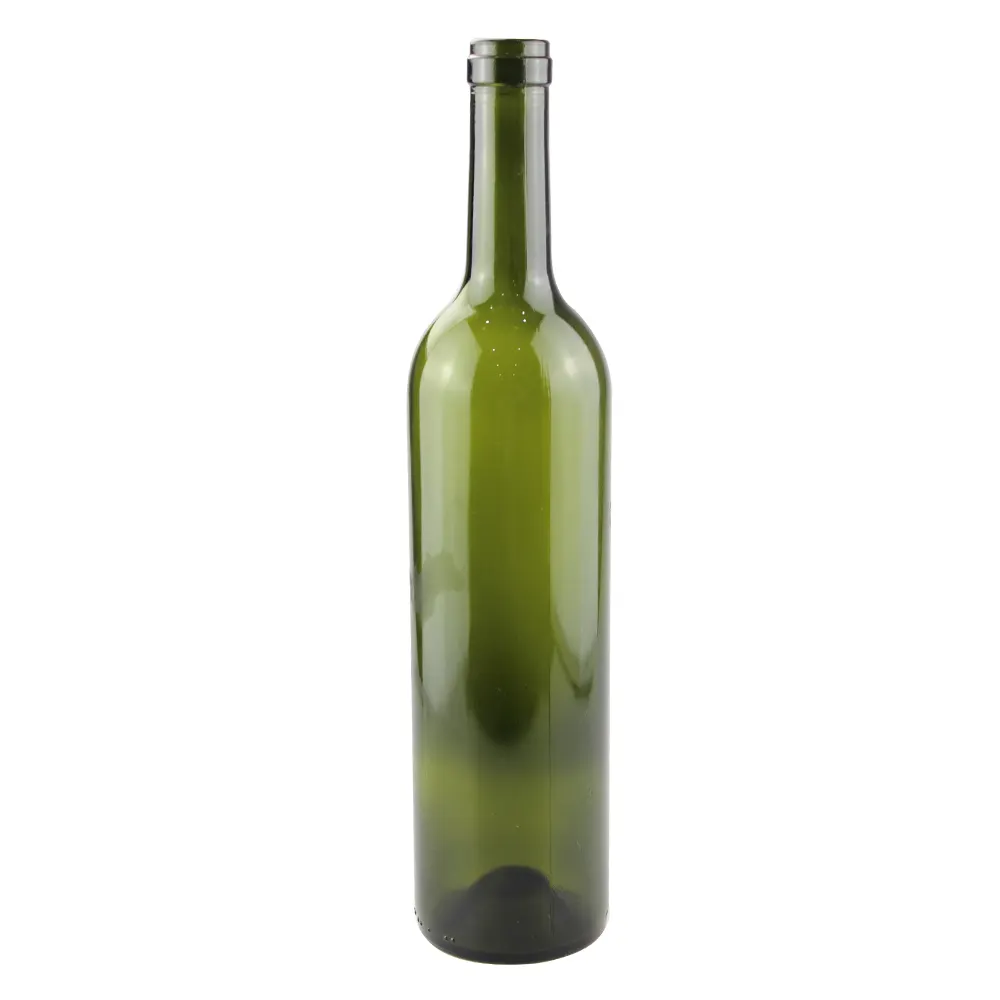
Part of our vodka bottles wholesale range; the stock moulds are pictured at the end of this guide.
Pick the gin closure by sales channel and filling line, then make the neck finish match it. A bar-top stopper in an 18.5 mm bore is the usual choice for premium gin, ROPP aluminium in 28 mm or 31.5 mm is the choice where tamper evidence is regulated, and a pre-threaded screw cap on a GPI 28-400 or 33-400 finish suits craft runs on shared lines. Most closure complaints start on the glass side, so the finish dimensions deserve as much attention as the stopper.
Closure, finish and capping equipment
Each closure family needs its own neck finish and its own capping equipment. The figures below are typical planning values; the project drawing and the closure supplier's gauges are what finally count.
| Closure | Neck finish | Dimensions to control | Capping equipment | Typical use in gin |
|---|---|---|---|---|
| Bar-top (T-top) | Cork finish, 18.5 mm bore | Bore 18.5 ± 0.3 mm, roundness, land finish | Plunger corker | Premium and super-premium |
| Straight natural cork with capsule | Cork finish, 18.5 mm bore | Bore 18.5 ± 0.2 mm, flatness of the top land | Wine-style corker and capsule spinner | Heritage and ultra-premium |
| ROPP aluminium | ROPP 28 mm or 31.5 mm | Thread profile to the shell supplier's drawing | Roll-on capper head | Duty-free, regulated tamper evidence |
| Continuous-thread screw cap | GPI 28-400 or 33-400 | T and E dimensions, thread continuity | Standard spindle capper | Craft, co-packer and RTD programs |
What each closure does well and where it falls short
Bar-top stoppers
A bar-top is a cork shank with a decorative head. The shank may be natural, micro-agglomerated or synthetic cork, and the head is wood, polymer or metal and carries the branding. Standard shanks measure 19.0–19.5 mm, so they compress into the 18.5 mm bore. Buyers of premium gin expect the pull-and-pop opening, and the stopper reseals well between pours.
The seal depends entirely on the bore. If the bore is wavy or out of round, aroma escapes slowly and nobody notices until the product has changed. Bore diameter, roundness and surface finish, plus a smooth top land free of chips, are the points to control on the glass.
ROPP aluminium
ROPP stands for roll-on pilfer-proof. The shell reaches the line blank, and the capper rolls the thread and the breakaway band into it against the bottle's ROPP finish. The result is a thread formed to that individual bottle, a very reliable seal and a tamper band that leaves no doubt. It is the standard for duty-free and travel retail.
Two things count against it. Some regions read ROPP as mid-market, and the filling line must have a roll-on capper head.
Pre-threaded screw caps
Continuous-thread caps on a GPI 400 finish are torqued on like any food closure. They work on co-packing lines that have no roll-on head, tooling is simpler, and caps are easy to source. Tamper evidence comes from a breakaway band, which is weaker than the ROPP band, or from an added shrink capsule. Consistent fit relies on gauge control of both the cap and the glass thread.
Straight natural cork under a capsule
Some heritage and ultra-premium releases use a wine-style straight cork of 24 mm diameter, covered with a tin or polylaminate capsule. Of the four options it runs slowest on the line and needs the most cork-taint screening. Brands accept that for the traditional look.
Liners and cork quality for 40–47% ABV
Gin is hard on a seal. Ethanol vapour works through a marginal closure, and the wrong liner absorbs botanical esters, an effect known as flavour scalping. A bar-top seals by compression and has no liner. ROPP shells and screw caps need one, and it should be chosen for the recipe.
- Most London dry styles: PE foam faced with aluminium or tin-saran.
- Navy-strength (57%+) and high-ester botanical gins: Saranex or PTFE-faced liners, which resist scalping and ethanol attack better.
- Cork shanks: natural cork screened for TCA, or a food-grade synthetic shank. Cork taint removes the citrus top notes from a botanical gin just as it spoils wine.
Checks on the glass and on the filled bottle
When a closure leaks, the cause is usually found in the glass: a tapered bore, a chipped finish, or threads damaged in transit. We therefore ask for the finish to be gauged batch by batch against the closure maker's drawing. Annealing to ASTM C148 matters as well, because residual stress left in the neck can crack the finish under capping load.
On filled bottles, three tests catch most failures:
- Torque or compression on the line. Application and removal torque for ROPP and screw caps should fall inside the windows given by the closure supplier.
- Leak testing. Inverted storage or pressure-decay testing shows up bore defects and liner problems.
- Accelerated shelf testing. Bottles are cycled in storage at raised temperature, typically 40 °C, and weighed to track loss. This reveals slow evaporation that the first two tests miss.
As a benchmark, a 700 ml gin that loses more than 1–2 ml per year through the seal has a closure specification problem. Losses of that kind are what turn 700 ml fills into complaints about 695 ml bottles, and in hot markets they lead to customs disputes as well. We can arrange all three tests when a project involves matching a closure to a bottle.
Stock, modified or custom closures
| Route | Stage it suits |
|---|---|
| Stock bottle with stock closure | Launch and line validation |
| Modified stock: printed shells, engraved heads, capsules | Differentiating the brand at the closure |
| Full custom: proprietary finish and custom closure tooling | Icon programs and patented pour systems |
Closure cost rises with the head material and the printing. For that reason a stock bottle under a decorated closure is often the most economical way to signal a higher tier. Bottle-side economics are on the wholesale gin bottle page, and capacities are covered in the guide to gin bottle sizes.
Details to send with a closure enquiry
- The closure family you are considering: bar-top, ROPP, screw cap or natural cork
- Bottle capacity, and the finish drawing if one exists
- ABV and botanical profile
- The capping equipment on your filling line
- Annual volume and destination markets
With these we can match a bottle finish to the closure and coordinate samples; the enquiry form takes all five points.
Frequently asked questions
Is a bar-top always the right closure for premium gin?
It is the category default, but not a rule. Closure choice follows channel and price point. A premium gin sold mainly through duty-free, or in a market that regulates tamper evidence, is better served by ROPP.
Should a craft distillery use ROPP or a screw cap?
If the gin is filled on a shared co-packing line and sold domestically, a GPI screw cap is simpler because it needs only a standard spindle capper. If the product is going to export duty-free or needs regulated tamper evidence, ROPP is the stronger option, provided the line has a roll-on head.
What does a closure cost at wholesale volumes?
Closures and bottles are quoted per project. The price depends on the mould, the decoration, the quantity and the freight terms.